


Healthcare providers, hospitals, and health systems face rising administrative burden, margin pressure, and staffing shortages.
Revenue cycle complexity, prior authorizations, and patient access workflows are increasing operational load across physician groups and care teams. Internal capacity is constrained while expectations for speed and patient experience continue to rise.
Healthcare BPO and outsourcing models address this gap by providing specialized expertise, scalable support, and standardized processes without expanding headcount. This improves operational efficiency, accelerates workflows, and strengthens revenue cycle performance.
This blog covers what to outsource, key benefits, risks, compliance requirements, and how to choose the right partner.
Why are Healthcare Organizations Outsourcing More in 2026?
Labor shortages, payer complexity, and revenue pressure are accelerating outsourcing adoption across healthcare operations.
Healthcare organizations are not outsourcing for cost alone; this is a response to structural inefficiencies:
- Persistent staffing shortages: A shortage of skilled billing, coding, and administrative talent (as highlighted by AAMC and AMA) is slowing operations and increasing hiring costs.
- Rising payer complexity: Prior authorization, evolving reimbursement rules, and documentation requirements are increasing administrative workload and delaying care.
- Pressure to improve cash flow: Higher denial rates and slower reimbursements are forcing organizations to optimize revenue cycle performance and reduce leakage.
- Shift toward flexible operating models: Healthcare organizations are moving away from fixed headcount toward scalable support that adjusts with patient volume and workload.
- Increased reliance on digital workflows and analytics: Modern healthcare operations require data-driven execution, automation, and reporting.
Outsourcing is now a strategic lever to stabilize operations, improve financial performance, and scale without adding internal complexity.
What are the Most Common Healthcare Outsourcing Services?
Healthcare outsourcing spans revenue cycle, patient access, and back-office functions, which enables providers to offload high-volume, process-driven work.
Medical Billing and Collections
This is the most commonly outsourced layer of the revenue cycle, where accuracy and speed directly affect cash flow.
It includes charge entry, payment posting, accounts receivable follow-up, and patient billing. The real value isn’t task execution, it’s reducing A/R days, improving collections, and maintaining consistency across the entire billing workflow.
Medical Coding
Coding sits at the intersection of clinical documentation and reimbursement; small errors here create downstream denials.
Outsourced teams handle specialty coding using ICD-10-CM, CPT, and HCPCS, along with audits, documentation review, and compliance checks.
Strong coding support doesn’t just ensure accuracy; it actively prevents revenue leakage.
Revenue Cycle Management (RCM)
Many organizations move beyond task-level outsourcing and externalize the full revenue cycle.
- Eligibility verification and pre-registration
- Claims processing and submission
- Denial management and rework
- Payment reconciliation
Prior Authorization and Referral Management
This is one of the fastest-growing outsourcing areas due to increasing payer requirements.
Authorization workflows involve constant follow-ups, documentation handling, and payer coordination.
Offloading this function reduces delays in care delivery while improving approval rates for procedures and treatments.
Claims Processing and Denials Management
Denials are no longer exceptions; they are a systemic issue.
Outsourcing here focuses on:
- Claim scrubbing and submission accuracy
- Appeals and resubmissions
- Root-cause analysis and payer trend tracking
The objective is not just recovery, but denial prevention through pattern recognition and process correction.
Patient Scheduling and Contact Center Support
Patient access is often the first breakdown point in healthcare operations.
External teams manage appointment scheduling, reminders, and inbound queries across contact center channels. This improves access, reduces no-shows, and ensures front-desk efficiency without overloading internal staff.
Medical Transcription and Documentation Support
Documentation remains critical but time-consuming for clinical teams.
Outsourced support handles transcription, formatting, and EHR documentation. It ensures physician notes are structured, accurate, and ready for downstream processes like coding and billing.
Healthcare Data Entry and Records Management
Data quality directly impacts operational visibility and compliance.
These services include data abstraction, document indexing, and patient record management across EHR/EMR systems. Clean, structured data enables better reporting, analytics, and decision-making.
IT, Cloud, and Infrastructure Support
As healthcare becomes more digital, IT support is increasingly outsourced.
This includes help desk, system monitoring, access management, and cloud support. It helps secure, compliant operations under HIPAA while maintaining uptime and performance across systems.
What are the Key Benefits of Healthcare Outsourcing Services?
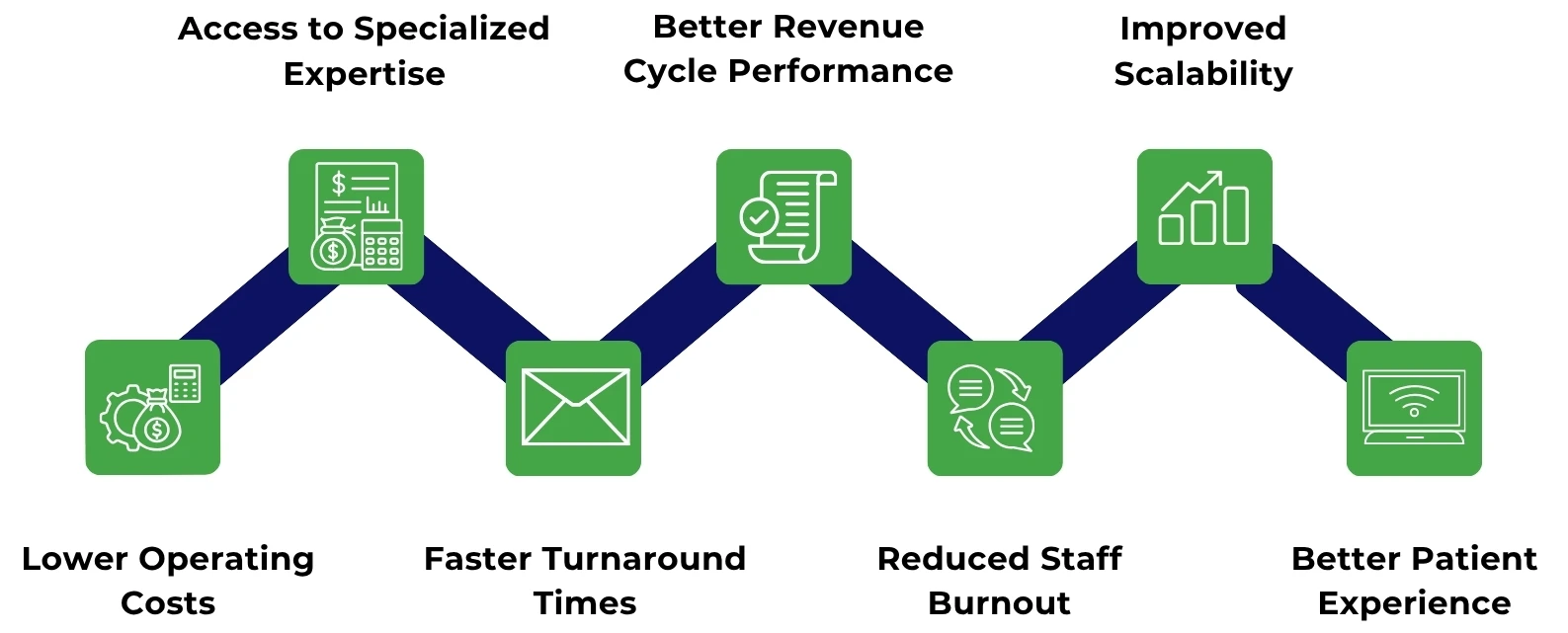
Healthcare outsourcing improves cost efficiency, scalability, and revenue performance while enhancing patient experience and operational control.
Lower Operating Costs
Outsourcing converts fixed staffing and infrastructure costs into variable, usage-based spend.
- No hiring, onboarding, or idle capacity costs
- Lower labor costs through optimized delivery models
- Predictable pricing tied to output, not headcount
This directly improves cost efficiency and overall outsourcing ROI.
Access to Specialized Expertise
Instead of building capability, organizations plug into it.
Experienced billers, certified coders, and RCM specialists bring built-in knowledge of payer rules, compliance requirements, and workflow nuances.
Faster Turnaround Times
Speed is not just about effort; it’s about process design.
Outsourced teams operate with defined SLAs, continuous processing cycles, and workflow automation, reducing turnaround time across billing, authorizations, and support functions.
Result: fewer bottlenecks, higher operational throughput.
Better Revenue Cycle Performance
This is where outsourcing delivers the most measurable impact.
Cleaner inputs lead to stronger financial outputs:
- Fewer claim rejections at submission
- Lower denial rates over time
- Faster reimbursements
- Improved collections and cash flow
The focus shifts from managing tasks to optimizing the entire revenue cycle.
Reduced Staff Burnout
Administrative workload is a primary driver of physician and staff burnout.
Instead of redistributing work internally, outsourcing removes it entirely and frees clinical and administrative teams to focus on patient care and decision-making, not repetitive processing.
Improved Scalability
Growth without operational strain is the real advantage.
Outsourcing allows organizations to:
- Handle volume spikes without hiring delays
- Expand to new locations without duplicating back-office teams
- Adjust capacity without long-term cost commitments
This creates true operational flexibility.
Better Patient Experience
Operational inefficiencies are often visible to patients first.
Delays in scheduling, unclear billing, and slow follow-ups impact satisfaction. Outsourcing improves responsiveness, communication clarity, and care coordination, leading to a smoother patient journey.
What are the Risks and Challenges of Healthcare Outsourcing?
Outsourcing introduces compliance, quality, and operational risks that require strong governance, clear SLAs, and the right vendor fit.
Outsourcing success is not guaranteed; it depends on how well risks are managed across compliance, workflows, and performance visibility.
What are the Challenges of IT Service Desk Outsourcing?
Outsourcing can introduce control, communication, and security risks if not managed with the right partner and governance model.
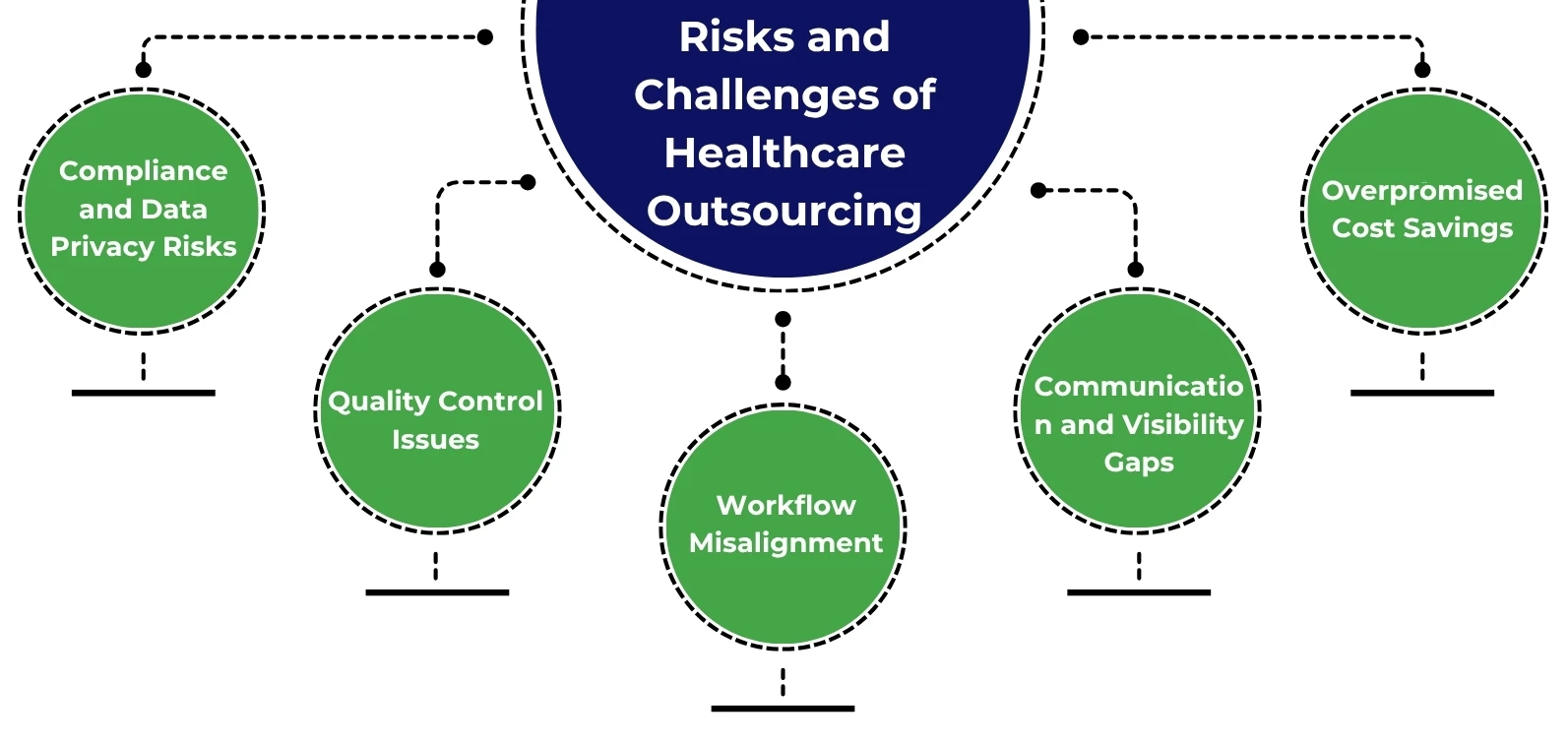
Compliance and Data Privacy Risks
Healthcare outsourcing involves handling sensitive patient data, making compliance non-negotiable.
- Exposure of protected health information (PHI)
- Weak access control and audit trail gaps
- Missing or poorly defined business associate agreements under HHS
- Subcontractor risks without proper oversight
Failure here leads to data breaches, regulatory penalties, and reputational damage under HIPAA.
Quality Control Issues
Outsourcing can introduce variability if processes are not tightly managed.
Inconsistent training, unclear workflows, and a lack of QA audits often lead to:
- Higher error rates
- Coding inaccuracies
- Claims rework and delays
Sustained service quality requires structured performance monitoring and continuous quality assurance.
Workflow Misalignment
Not all vendors understand specialty-specific operations.
Differences in payer mix, clinical workflows, and EHR integration can create friction. Without proper process mapping, even accurate work can fail to align with internal systems and expectations.
Communication and Visibility Gaps
Lack of transparency is one of the most common failure points.
- Delayed escalations
- Limited KPI visibility
- Inconsistent reporting cadence
Strong SLA management, real-time dashboards, and defined escalation paths are critical to maintaining control over outsourced operations.
Overpromised Cost Savings
Low-cost outsourcing often shifts costs instead of reducing them.
Hidden inefficiencies show up as:
- Increased rework
- Higher denial rates
- Poor patient interactions
The focus should be on the total cost of ownership and long-term outsourcing ROI, not just upfront pricing.
Is Outsourcing Better Than Building an In-House Team?
Outsourcing is better for scale and efficiency, while in-house teams offer control; most organizations benefit from a hybrid model.
In-House May Be Better When
Control and specialization outweigh scalability.
If workflows are tightly linked to clinical decision-making or require constant leadership oversight, keeping them internal makes sense. This is especially true for specialty practices where processes are nuanced and internal capacity is manageable.
In-house teams offer:
- Direct oversight and faster internal alignment
- Greater control over sensitive or complex operations
- Stronger integration with internal systems and teams
Outsourcing May Be Better When
Operational pressure exceeds internal capacity.
When hiring is slow, backlogs are increasing, or denial rates are rising, outsourcing provides immediate relief. It is most effective for high-volume, rules-based work where efficiency and turnaround time matter more than internal control.
Common triggers include:
- Staffing shortages and rising labor costs
- Revenue leakage from denials and delays
- Administrative burden impacting care delivery
- Operational bottlenecks across workflows
Hybrid Models Often Work Best
Most organizations are moving toward a hybrid model, which combines in-house control with outsourced execution.
Strategic functions stay internal, while repetitive, transactional, or overflow work is outsourced. This creates a shared services structure with clear accountability on both sides.
The advantage is balance:
- Control where it matters
- Scalability where it’s needed
- Flexibility without operational disruption
This co-sourcing approach aligns internal teams and external partners as a single operating unit.
How Do You Choose the Right Healthcare Outsourcing Partner?
Choose a healthcare outsourcing partner based on compliance, expertise, performance metrics, and long-term operational fit, not just cost.
Verify HIPAA Readiness
Start with compliance, as this is non-negotiable.
A qualified partner should demonstrate full HIPAA compliance aligned with HHS standards.
Look for:
- Signed business associate agreements (BAAs)
- Encryption and role-based access controls
- Defined incident response protocols
- Audit readiness and traceability
Check Healthcare-Specific Expertise
Generic outsourcing vendors often fail in healthcare environments.
Evaluate:
- Specialty billing and coding capabilities
- Familiarity with payer rules and denial patterns
- Certifications and domain expertise
- Understanding of provider workflows
Depth in healthcare operations reduces errors and improves execution speed.
Ask About Technology Compatibility
Operational fit depends heavily on system alignment.
The partner should already work with major platforms like EHR/EMR systems (e.g., Epic, Cerner, athenahealth) and integrate seamlessly with your practice management tools.
Key factors:
- Interoperability with existing systems
- Secure file transfer protocols
- Reporting and data visibility
Review SLAs and KPIs
Performance must be measurable from day one.
Define clear SLAs tied to:
- Turnaround time
- Accuracy rates
- Clean claim rate and denial rate
- A/R days and collections performance
Strong KPI tracking ensures accountability and continuous improvement.
Understand Staffing and Training
Execution quality depends on the people behind the process.
Go beyond headcount; understand:
- Who is assigned to your account
- Training structure and onboarding process
- Account management and escalation protocols
- Workforce continuity and backup planning
This determines consistency and long-term reliability.
Request References and Proof of Outcomes
Claims without proof are risk signals.
Ask for:
- Case studies with measurable outcomes
- Client references in similar specialties
- Performance benchmarks and reporting samples
A strong vendor should demonstrate ROI, not just promise it.
Clarify Pricing Structure
Cost models vary, and misalignment here creates long-term issues.
Common structures include:
- FTE-based pricing
- Transaction-based pricing
- Percentage of collections
- Hybrid models
Focus on the total cost of ownership and value delivered, not just base pricing.
What Questions Should You Ask Before Signing a Healthcare Outsourcing Contract?
Ask targeted questions on scope, compliance, performance, and accountability to reduce risk and ensure the right vendor fit.
- What functions do you manage end-to-end?
- How do you protect PHI?
- What systems do you support?
- What KPIs do you report on?
- Do you use subcontractors?
- What is your escalation path?
- What does onboarding include?
- How do you handle underperformance?
Who Benefits Most from Healthcare Outsourcing Services?
Organizations with high administrative loads, growth pressures, or staffing gaps achieve the highest ROI from healthcare outsourcing.
- Independent practices: Limited internal staff; benefit from cost control and operational support
- Specialty clinics: Complex workflows and payer rules require specialized expertise
- Ambulatory surgery centers (ASCs): High case volume demands efficient scheduling, billing, and authorizations
- Hospitals: Large-scale operations benefit from process standardization and cost optimization
- Health systems: Multi-location complexity requires scalable, centralized support models
- Management Services Organizations (MSOs): Need consistent processes across multiple practices and providers
- Healthcare payers: Outsource claims processing, member support, and administrative workflows
- Dental groups: High-volume billing and insurance verification benefit from streamlined RCM support
What are the Signs Your Organization Should Consider Outsourcing?
Rising inefficiencies, staffing gaps, and revenue leakage signal it’s time to consider healthcare outsourcing.
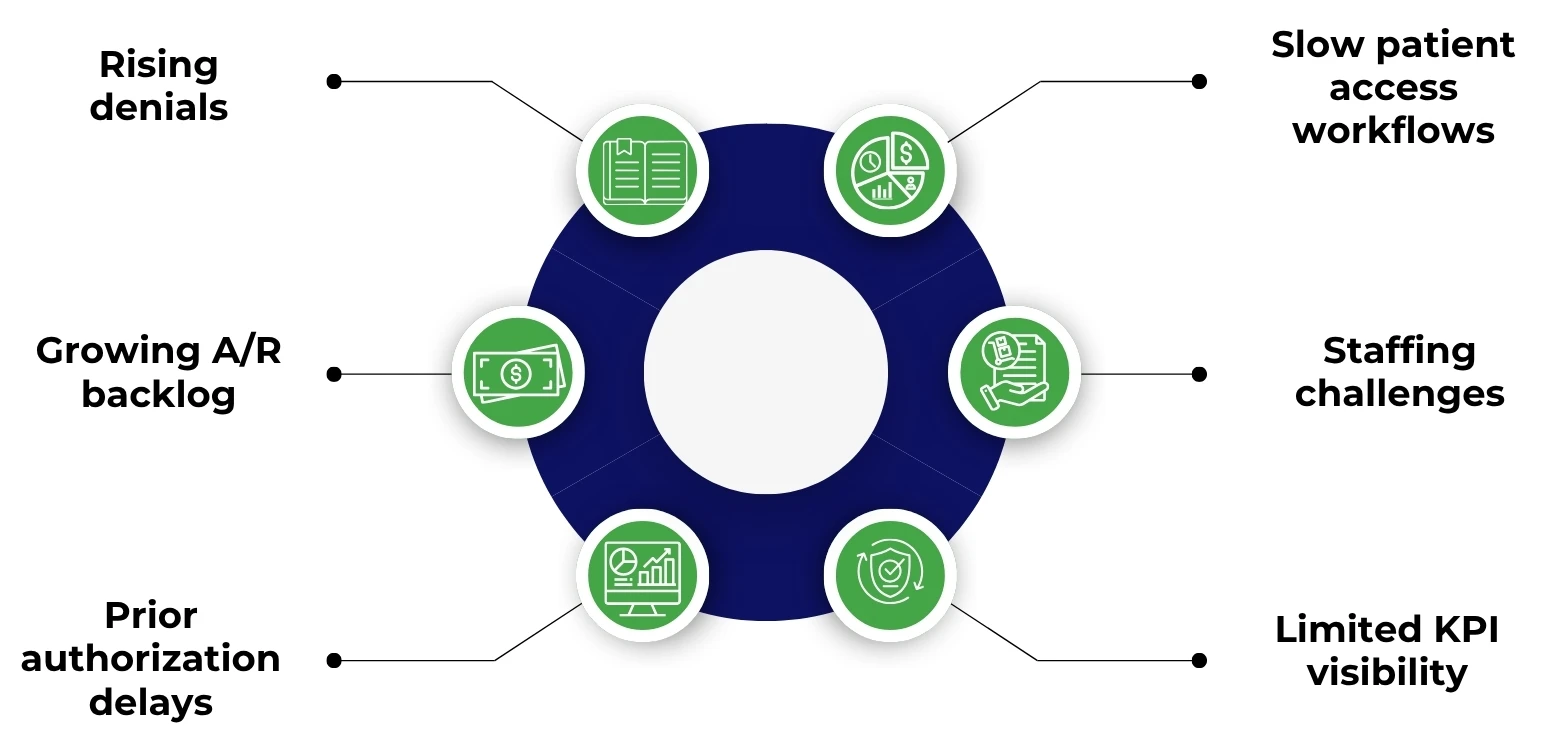
- Rising denials: Increasing denial rates, impacting cash flow and revenue cycle performance
- Growing A/R backlog: Delayed follow-ups leading to aging receivables and missed collections
- Prior authorization delays: Bottlenecks, slowing approvals and delaying patient care
- Slow patient access workflows: Scheduling backlog and intake delays affecting patient experience
- Staffing challenges: High turnover or difficulty hiring skilled administrative talent
- Limited KPI visibility: Lack of insight into performance metrics and operational gaps
Frequently Asked Questions (FAQs)
Conclusion
Healthcare outsourcing delivers the most value when organizations choose the right functions, define measurable outcomes, and partner with experienced vendors.
Outsourcing has evolved into a strategic lever for healthcare transformation, enabling organizations to improve efficiency, strengthen operational resilience, and support patient-centered operations.
When aligned with clear KPIs and a strong vendor partnership, outsourcing becomes an extension of healthcare operations, driving consistency, scalability, and long-term performance.