


Supply chain outsourcing reduces cost, improves resilience, and accelerates execution across logistics, procurement, and fulfillment.
As supply chains grow more complex, companies are moving beyond cost-cutting to optimize the total cost of ownership (TCO) across supply chain management (SCM). Outsourcing provides access to established logistics networks, scalable fulfillment operations, and structured service level agreements (SLAs).
It also strengthens resilience by introducing flexibility in capacity, geographies, and operations, while allowing internal teams to focus on strategic priorities instead of execution-heavy processes.
This guide outlines what to outsource, how to evaluate provider models, key pricing structures, risks to manage, and a clear framework for selecting the right partner.
What are Supply Chain Outsourcing Services?
Supply chain outsourcing services involve delegating logistics, procurement, and production operations to specialized external partners.
It means contracting third-party providers to manage specific or end-to-end operations across logistics, procurement, and production. This includes outsourced logistics, outsourced procurement, contract manufacturing, and managed transportation, often delivered through integrated or shared services models.
Common Outsourcing Models
Outsourcing can be tactical, focused on specific functions like warehousing or freight, or structured as end-to-end managed services covering the full supply chain.
Delivery models vary by geography and cost strategy:
- Onshore for control and proximity
- Nearshore for the balance of cost and coordination
- Offshore for scale and cost efficiency
Providers range from 3PLs handling execution to 4PL/LLP (Lead Logistics Providers) managing entire networks, alongside BPO and contract logistics partners offering specialized capabilities like shared warehousing.
Who Should Consider Outsourcing?
Outsourcing is most effective for businesses facing scale, complexity, or variability in operations. This includes fast-growing SMBs, eCommerce and DTC brands, manufacturers, and companies operating in omnichannel retail or global trade environments.
It is particularly relevant for:
- Businesses managing import/export complexity
- Companies balancing make-to-stock vs make-to-order models
- Organizations scaling across regions or handling seasonal demand shifts
What are the Types of Supply Chain Outsourcing Services?
Businesses can outsource logistics, fulfillment, procurement, manufacturing, planning, and trade operations to improve efficiency and scalability.
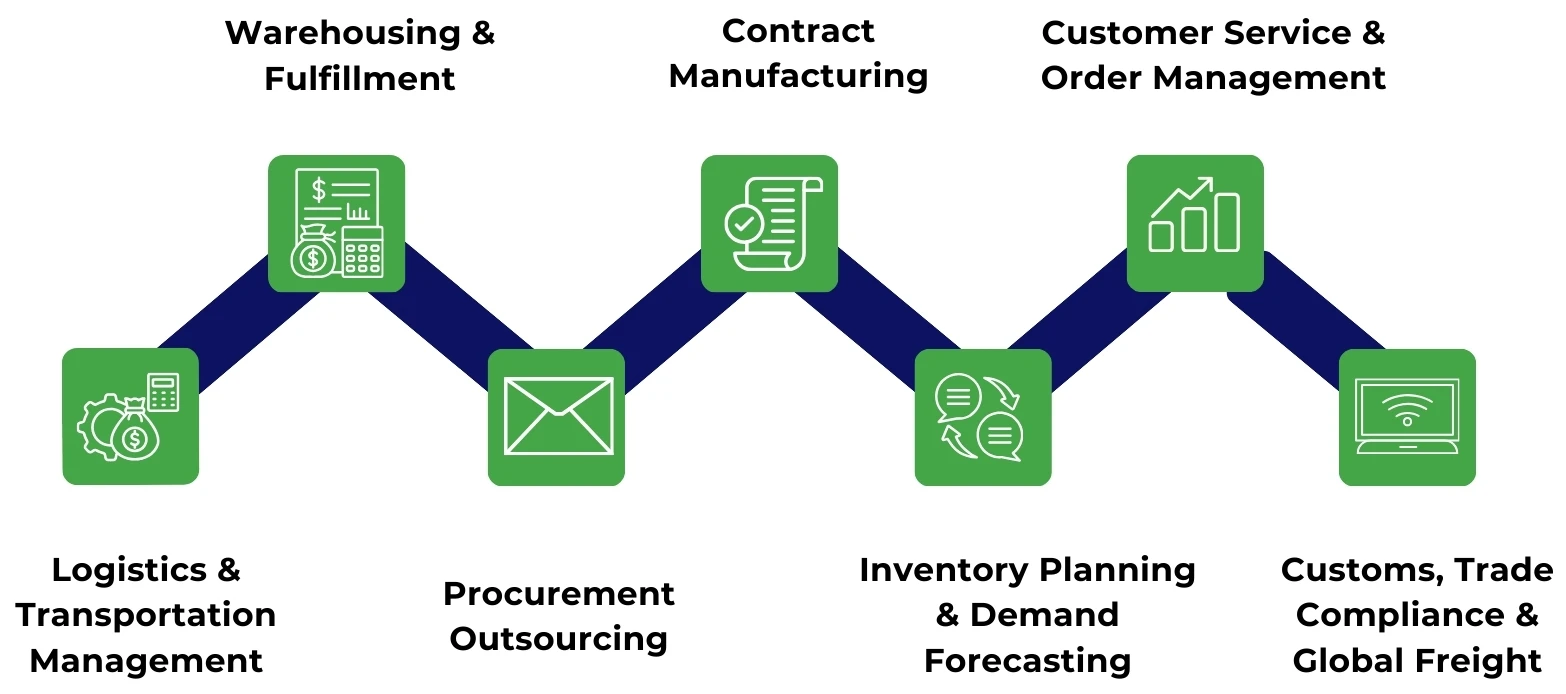
Logistics and Transportation Management
This is where outsourcing delivers immediate operational impact like speed, cost control, and visibility.
What gets handled:
- Carrier sourcing and rate negotiation
- Freight booking across modes
- Route optimization and shipment planning
- Claims management and exception handling
How it scales:
- Multi-modal coverage: FTL/LTL, drayage, intermodal, ocean, air, last-mile, parcel
- Centralized control via TMS (Transportation Management System)
- Real-time tracking and proactive issue resolution
Warehousing and Fulfillment
Outsourcing converts warehousing from a fixed asset into a scalable service layer.
Core operations:
- Receiving and put-away
- Picking, packing, and kitting
- Returns processing and cross-docking
What improves:
- Accuracy through RF scanning and cycle counts
- Space efficiency via slotting optimization
- Faster turnaround with 3PL fulfillment powered by WMS
- Structured reverse flows through reverse logistics
Procurement Outsourcing
Procurement outsourcing shifts focus from transactional buying to strategic cost control.
Key functions:
- Strategic sourcing and vendor onboarding
- RFQs/RFPs and contract negotiation support
- Spend analysis and compliance monitoring
What it enables:
- End-to-end P2P (procure-to-pay) visibility
- Stronger supplier performance via scorecards
- Structured category management and qualification frameworks
- Digitized sourcing through eSourcing tools
Manufacturing / Contract Manufacturing
This enables production scale without infrastructure ownership.
Outsourced scope:
- Full or partial production (co-manufacturing)
- Packaging and assembly
- Quality inspection and capacity planning
Execution models:
- OEM / ODM, depending on design ownership
- Standardized QA/QC processes
- Compliance with GMP or industry-specific protocols
- Advanced validation (e.g., PPAP in automotive)
Inventory Planning and Demand Forecasting
Outsourcing here improves decision quality not just execution.
Planning functions:
- Demand forecasting and replenishment
- Safety stock design and inventory balancing
- S&OP alignment across functions
What changes:
- Data-driven planning using MRP, EOQ and ABC analysis
- Reduced variability and stock imbalances
- Mitigation of systemic risks like the bullwhip effect
Customer Service and Order Management
Execution doesn’t end at delivery, this layer controls customer experience.
Operational scope:
- Order processing and status updates
- Exception management and issue resolution
- Returns and refund coordination
Performance drivers:
- Central orchestration via OMS (Order Management System)
- KPI tracking: CSAT, OTIF (On-Time In-Full)
- Structured handling through exception queues
Customs, Trade Compliance, and Global Freight
Critical for cross-border efficiency and risk control.
What’s outsourced:
- Customs brokerage coordination
- Classification and documentation
- Duty optimization and compliance checks
What it ensures:
- Accurate HS code classification
- Correct use of Incoterms (EXW, FOB, DDP)
- Regulatory compliance via denied party screening
- Strategic use of FTZ (Foreign-Trade Zones) to reduce costs and delays
What are the Key Benefits of Supply Chain Outsourcing Services?
Supply chain outsourcing improves cost control, delivery performance, scalability, and access to advanced capabilities without heavy investment.
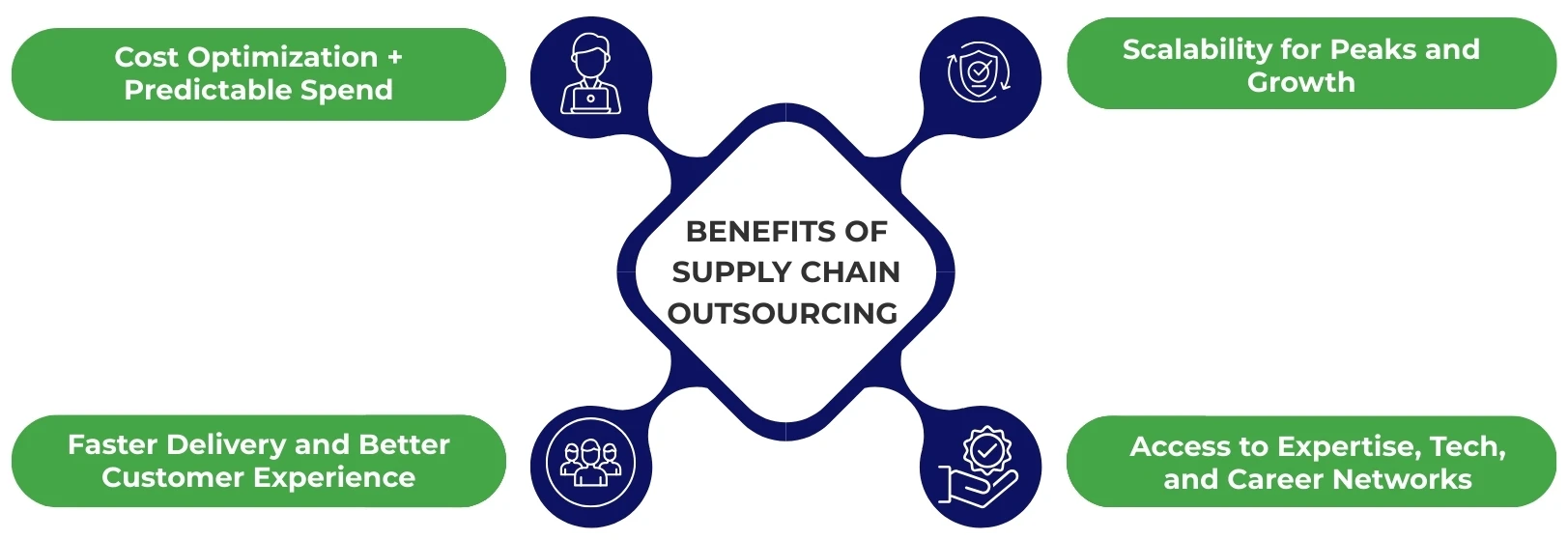
Cost Optimization + Predictable Spend
Most companies underestimate how much supply chains actually cost, not in isolation, but across the system. Outsourcing shifts the focus from fragmented cost-cutting to controlling the total cost -of ownership (TCO).
Instead of investing in warehouses, fleets, and systems (capex), businesses move toward opex-based models where costs scale with volume. This removes idle capacity risk and aligns spend with demand.
Faster Delivery and Better Customer Experience
Speed is no longer a competitive advantage; it’s expected. What outsourcing changes is consistency.
Execution improves across the chain:
- Orders move faster through optimized fulfillment flows
- Delivery accuracy increases, reducing rework and customer friction
Performance is tracked through metrics like OTIF (On-Time In-Full) and perfect order rate, ensuring reliability doesn’t drop at scale.
Scalability for Peaks and Growth
Growth breaks in-house operations before it rewards them. Outsourcing absorbs that pressure.
When demand spikes, seasonal peaks, promotions, or rapid expansion occur, capacity doesn’t need to be built from scratch. It already exists.
This becomes critical when:
- SKU counts increase rapidly (SKU proliferation)
- New markets are launched simultaneously
- Demand patterns become unpredictable
Behind the scenes, providers adjust labor planning and infrastructure dynamically, enabling execution to scale without operational disruption.
Access to Expertise, Tech, and Career Networks
Building supply chain capability internally is slow and expensive. Outsourcing compresses that timeline instantly.
Instead of assembling tools and teams, businesses plug into:
- Integrated systems like WMS, TMS, and OMS
- Real-time visibility through track-and-trace and control tower models
- Seamless data exchange via EDI and API integrations
But the real advantage isn’t just technology, it’s execution maturity. Established providers bring tested processes, optimized workflows, and carrier ecosystems that would take years to replicate internally.
What are Risks and Challenges? (and How to Mitigate Them)
Supply chain outsourcing introduces risks in control, quality, cost, and compliance, but each can be managed with the right structure and governance.
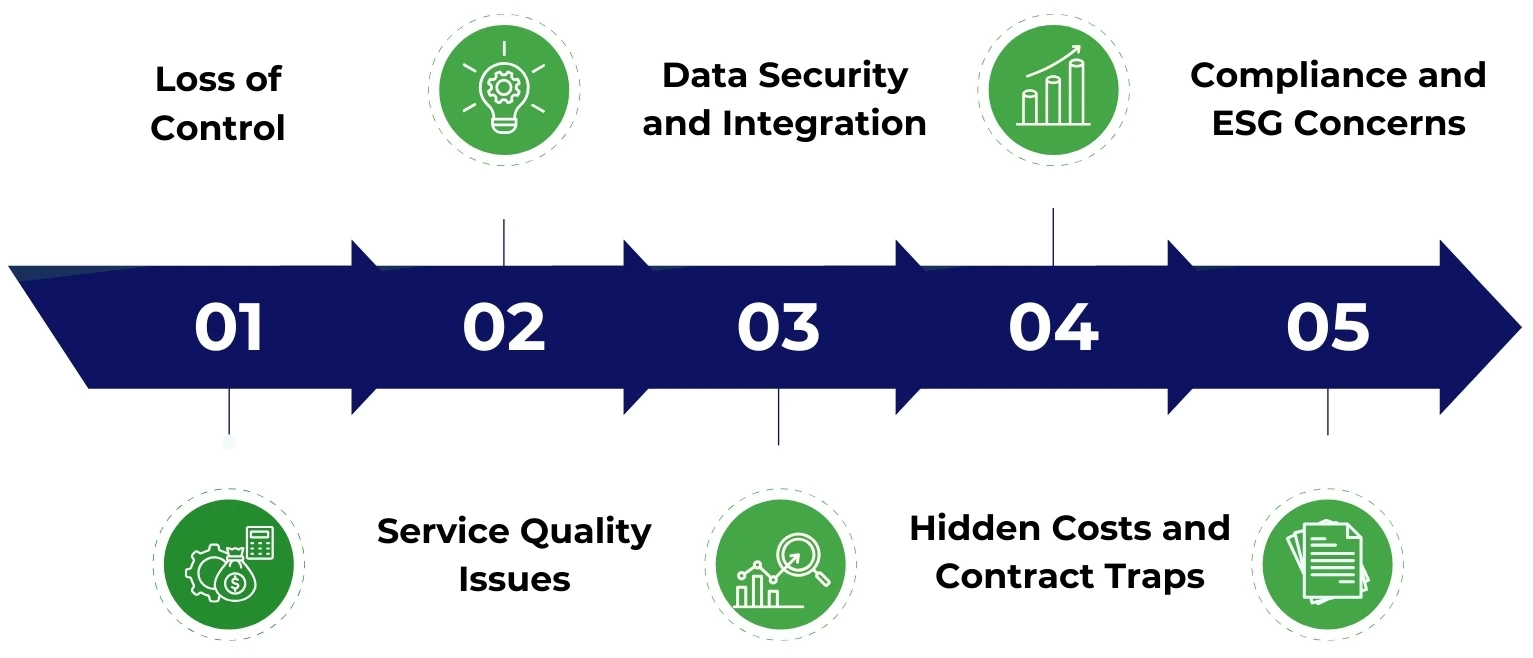
Loss of Control / Visibility
The biggest concern isn’t losing operation, it’s losing clarity.
When execution moves outside, blind spots appear:
- Limited visibility into day-to-day decisions
- Delayed response to disruptions
- Misalignment between priorities and execution
Mitigation comes from structure, not oversight.
Define ownership early using RACI frameworks, track performance through clearly defined KPIs, and manage operations via centralized dashboards.
Mature setups rely on a control tower model where visibility, exception management, and decision-making stay unified, even if execution is distributed.
Service Quality Issues
Outsourcing doesn’t guarantee quality; it standardizes it. The difference lies in how performance is enforced.
Without structure, issues compound quietly:
- Declining accuracy
- Inconsistent service levels
- Reactive problem-solving
Strong partnerships operate on accountability loops.
SLAs define expectations, but enforcement happens through QBRs (Quarterly Business Reviews), where performance is reviewed, gaps are addressed, and priorities are reset.
Data Security and Integration Problems
Most failures don’t happen in operations; they happen in integration.
Disconnected systems lead to:
- Data mismatches across orders and inventory
- Delayed information flow
- Increased manual intervention
Mitigation starts before go-live.
Hidden Costs and Contract Traps
The visible price is rarely the real cost.
Unexpected charges surface through:
- Accessorials tied to exceptions
- Storage tiers and minimum volume commitments
- Fuel surcharges and handling fees
- Delays leading to demurrage/detention
Mitigation requires precision in contracts.
A detailed fee structure, clearly defined volume bands, and strict change control prevent cost creep. Benchmarking pricing against market standards ensures competitiveness while eliminating ambiguity in how services are billed.
Compliance and ESG Concerns
Outsourcing extends your supply chain but also your risk exposure.
Non-compliance can emerge from:
- Poor supplier practices
- Lack of documentation or traceability
- Misalignment with environmental and regulatory standards
Mitigation is proactive, not reactive.
Regular supplier audits, enforced codes of conduct, and end-to-end traceability frameworks ensure accountability. Certifications like ISO 9001 and ISO 14001 act as baseline indicators, while ESG reporting aligns operations with broader regulatory and stakeholder expectations.
What Should You Outsource vs Keep In-House?
Outsource execution-heavy, repeatable operations; retain strategic, differentiating functions that define control and competitive advantage.
Great Candidates for Outsourcing
Not everything creates value internally. The strongest candidates are operations that are critical but not differentiating.
Think of areas like:
- Fulfillment ops where scale and speed matter more than ownership
- Freight audit and transportation execution, which rely on process discipline
- Returns processing, where efficiency directly impacts cost recovery
- Procurement ops, especially transactional sourcing and vendor coordination
The logic is simple: if performance improves with scale and standardization, outsourcing usually wins.
Keep In-House When
Some parts of the supply chain are too close to strategy to externalize.
These include areas where decisions, not execution, drive value.
For example:
- Network design, where location strategy defines cost and speed
- Strategic supplier negotiations, which impact long-term margins and risk
- Product quality ownership, especially in regulated or brand-sensitive industries
- S&OP leadership, where cross-functional alignment shapes the entire supply chain
How to Choose the Right Supply Chain Outsourcing Provider?
The right provider aligns with your operations, tech stack, and growth model, not just your budget.
Step 1 — Define Scope and Outcomes
Clarity upfront prevents misalignment later.
Define:
- Processes, geographies, and service zones
- SKU profiles, volumes, and channels
- Current-state workflows using lane data
Without this, pricing and performance expectations will break.
Step 2 — Decide the Provider Type (3PL vs 4PL vs specialist)
Match the model to the need:
- 3PL → execution (warehousing, transport)
- 4PL / LLP → network orchestration
- Specialists → freight forwarder, customs broker
Wrong model = structural inefficiency.
Step 3 — Evaluate Capabilities and Fit
Look for proven relevance, not generic capability.
Focus on:
- Industry experience (cold chain, hazmat if needed)
- B2B vs B2C vs omnichannel alignment
- Network reach and peak readiness
Fit is operational, not theoretical.
Step 4 — Validate Tech Stack and Integration
Execution depends on system compatibility.
Check:
- Core systems: WMS, TMS, OMS
- Integration: EDI, API
- ERP/eCom connectivity (SAP, NetSuite, Shopify, etc.)
Poor integration creates downstream failures.
Step 5 — Assess Operational Excellence
Processes define consistency.
Validate through:
- Site visits and SOP adherence
- KPI history (pick accuracy, cycle time)
- Continuous improvement practices (Lean/Kaizen)
Execution maturity is visible on the floor, not slides.
Step 6 — Contract, Pricing, and Governance
This defines long-term control.
Ensure:
- Clear SLAs, SOW, and MSA
- Transparent pricing and change control
- Defined review cadence and exit plan
Weak governance leads to cost and performance drift.
Provider Checklist
- SLAs (OTIF, order accuracy, inventory accuracy, cycle time)
- QA process + reporting cadence (daily/weekly dashboards, QBRs)
- Tool stack (WMS/TMS/OMS, visibility/control tower, EDI/API)
- Network footprint (warehouses, carrier partners, cross-border capability)
- References + case studies (similar industry and order profile)
- Security + compliance posture (SOC 2 if applicable, ISO 9001, trade compliance)
What are Pricing Models for Supply Chain Outsourcing Services?
Supply chain outsourcing pricing varies by activity, complexity, and volume, impacting total cost of ownership (TCO) beyond base rates.
Common Pricing Structures
Pricing is rarely flat; it’s tied to how work is performed.
Most providers break it down into activity-based components:
- Per-order or pick/pack rates for fulfillment
- Per-pallet or bin-based storage fees
- Per-shipment charges for transportation
- Fixed management fees for oversight
On top of this, accessorials (exceptions, special handling) and variable costs like fuel surcharges often define the real spend, not the base rate.
What drives Cost Up or Down
Two operations with the same volume can have completely different costs.
Key drivers include:
- Order complexity (multi-line vs single-line orders)
- Returns rate and reverse handling intensity
- SKU velocity and storage behavior
Costs increase when operations require:
- Kitting or customization
- Lot/serial tracking for traceability
- Specialized handling like hazmat or cold chain
- Additional value-added services beyond standard flows
How to Estimate ROI
Cost comparison alone is misleading. The real question is: what changes after outsourcing?
ROI should be evaluated across:
- Cost per order and cost per shipment
- Reduction in overhead and fixed infrastructure
- Improvement in service metrics like OTIF
What are Implementation Best Practices (So Outsourcing Actually Works)
Successful outsourcing depends on structured onboarding, standardized execution, and continuous performance management, not just vendor selection.
Onboarding Plan and Transition Timeline
Most failures happen in the first 60–90 days, not because of capability, but poor transition design.
A strong transition plan doesn’t rush execution. It stages it:
- Phased rollout instead of full-scale switch
- Parallel runs to validate accuracy before dependency
- A defined cutover moment with zero ambiguity
SOPs, Playbooks, and Exception Handling
Outsourcing only works when execution is standardized.
This means documenting not just tasks, but decisions:
- Clear SOPs defining how work flows end-to-end
- Playbooks for non-standard scenarios
- Structured exception codes to categorize issues
KPI Management + Continuous Improvement
Outsourcing is not “set and forget.” Performance needs active management.
At a minimum:
- Monthly reviews tied to operational KPIs
- Regular QBRs to align on performance and priorities
When issues occur, they must translate into action:
- RCA (Root Cause Analysis) to identify breakdowns
- CAPA to fix and prevent recurrence
FAQs About Supply Chain Outsourcing Services
Conclusion
Supply chain outsourcing works when execution is externalized, but control, visibility, and strategy remain internal.
Outsource where scale, standardization, and efficiency drive value like logistics, fulfillment, and procurement ops. Retain control over areas that define advantage, such as network design, supplier strategy, and planning.
Choosing the right partner comes down to fit, not cost alone. A strong provider aligns with your operations, integrates with your systems, and operates under clear SLAs—ensuring performance without constant oversight.
About the Author

As CEO, Ali Din oversees the overall strategy and direction for Premier NX. With senior leadership roles at global HR and recruiting platforms, Indeed and ADP. Ali has over 25 years of experience in the IT and advanced technology sector. Ali’s time is focused on transformation in the business, both for professional development and for clients, to enhance business outcomes.