

Outsourced controller services help growing businesses gain financial clarity, compliance control, and scalable reporting without hiring a full-time controller.
As companies expand, financial management becomes more complex. Increased transaction volume, evolving compliance requirements, and growing reporting demands can strain internal resources.
By introducing structured oversight across Financial Reporting and Business Administration functions, outsourced controller services improve accuracy, strengthen internal controls, enhance cost efficiency, and provide strategic financial insight aligned with growth
What are Outsourced Controller Services?
Outsourced controller services provide professional Financial Controller oversight to manage reporting, controls, and financial strategy without a full-time executive hire.
A Financial Controller is responsible for ensuring accurate accounting records, structured financial reporting, and strong internal controls. When outsourced, this role is delivered by an external finance expert or team that integrates with the company’s accounting systems and leadership.
Core Responsibilities
- Bookkeeping records daily transactions.
- Accounting ensures proper classification and financial statement preparation.
- Controller oversees reporting integrity, compliance, controls, and financial analysis.
- Chief Financial Officer (CFO) focuses on high-level capital strategy, investor relations, and long-term corporate finance planning.
An outsourced controller bridges operational accounting and executive financial strategy, providing structure without CFO-level overhead.
How do Outsourced Controller Services Work?
Outsourced controller services integrate with your accounting systems to deliver structured financial oversight on a recurring engagement model.
- Remote or Hybrid Delivery Model: Services are delivered remotely or through a hybrid structure, providing flexibility without disrupting internal operations.
- Integration with Accounting Systems: Controllers work directly within platforms such as QuickBooks, Xero, NetSuite, or other cloud-based accounting systems to maintain real-time financial visibility.
- Monthly, Quarterly, or Ongoing Engagement: Engagements are structured around reporting cycles, managing month-end close, quarterly reviews, or continuous financial oversight.
- Collaboration with Business Owners & CPAs: Controllers coordinate with leadership teams and external advisors, including CPAs aligned with standards from the American Institute of Certified Public Accountants (AICPA), ensuring reporting accuracy and compliance consistency.
Who needs Outsourced Controller Services?
Outsourced controller services are designed for businesses that require structured financial oversight but are not ready for a full-time controller hire.
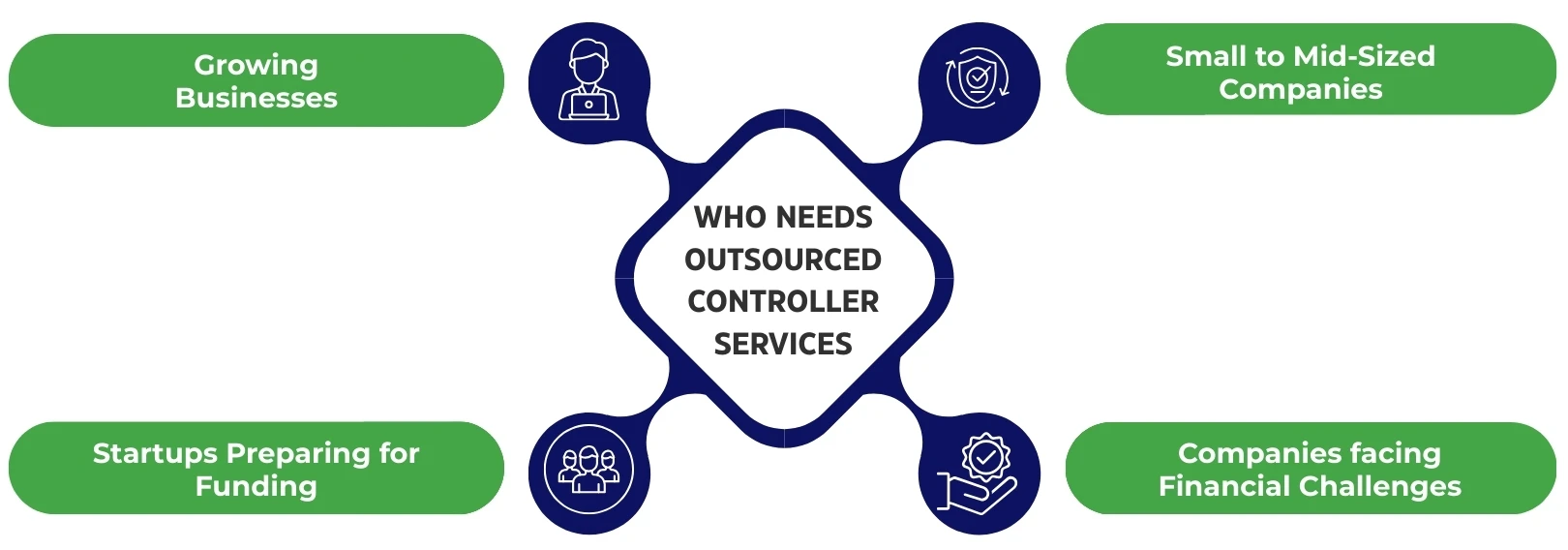
Growing Businesses
Companies experiencing rapid business growth often outpace their accounting infrastructure. As revenue scales, transaction complexity increases, and reporting demands expand, structured financial controls and accurate forecasting become critical.
Startups Preparing for Funding
Startups seeking venture capital require investor-ready financial statements, reliable financial modeling, and defensible forecasts. An outsourced controller ensures clean financial reporting, structured budgets, and data integrity before due diligence begins.
Small to Mid-Sized Companies
Many firms within small business management lack internal finance leadership beyond bookkeeping. Outsourced controller services introduce reporting discipline, internal controls, and strategic financial visibility without the cost of a senior full-time hire.
Companies facing Financial Challenges
Organizations dealing with cash flow volatility, compliance gaps, or restructuring pressures require stronger risk management oversight. During corporate restructuring or financial uncertainty, a controller provides stability through improved reporting accuracy and financial control frameworks.
What Are the Key Benefits of Outsourced Controller Services?
Outsourced controller services deliver structured financial oversight, cost efficiency, compliance strength, and strategic decision support.
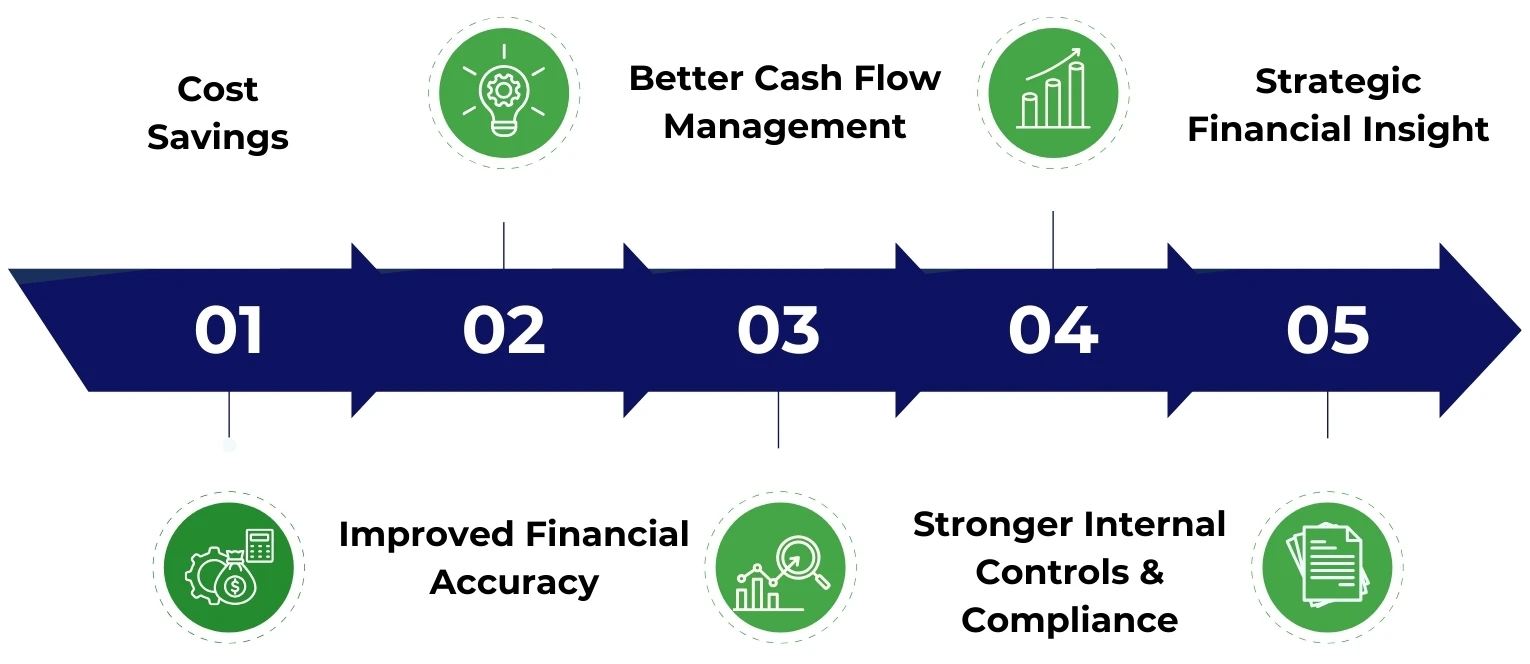
Cost Savings
Through disciplined cost accounting oversight and optimized financial processes, businesses reduce fixed salary overhead while gaining access to senior-level financial expertise on a scalable engagement model.
Improved Financial Accuracy
Controllers strengthen reporting integrity by standardizing reconciliations, enforcing documentation discipline, and aligning statements with audit-ready standards consistent with auditing best practices.
Better Cash Flow Management
Proactive monitoring of working capital, receivables cycles, payables timing, and liquidity forecasting reduces cash surprises and improves operational stability.
Stronger Internal Controls & Compliance
Structured control frameworks aligned with guidance from the financial Accounting Standards Board (FASB) and principles underlying the Sarbanes-Oxley Act improve reporting reliability and reduce regulatory exposure.
Strategic Financial Insight
Beyond reporting, controllers support strategic management through variance analysis, scenario modeling, and performance metrics that inform pricing, expansion, and investment decisions.
Outsourced Controller vs. In-House Controller
Choosing between an outsourced Controller (accounting) model and an in-house hire depends on cost structure, scalability, and access to expertise.
| Feature | Outsourced Controller | In-House Controller |
|---|---|---|
| Cost | Lower, service-based engagement | Salary + benefits + overhead |
| Expertise | Team-based expertise across accounting and compliance domains | Dependent on a single hire’s experience |
| Scalability | Flexible engagement aligned with business growth | Limited by hiring cycles and budget constraints |
| Technology | Access to advanced financial systems and automation tools | Varies based on internal investment |
| Availability | On-demand support aligned with reporting cycles | Fixed working hours |
What Are the Signs Your Business Needs an Outsourced Controller?
Recurring reporting delays, cash instability, and forecasting gaps often indicate the need for structured controller-level oversight.
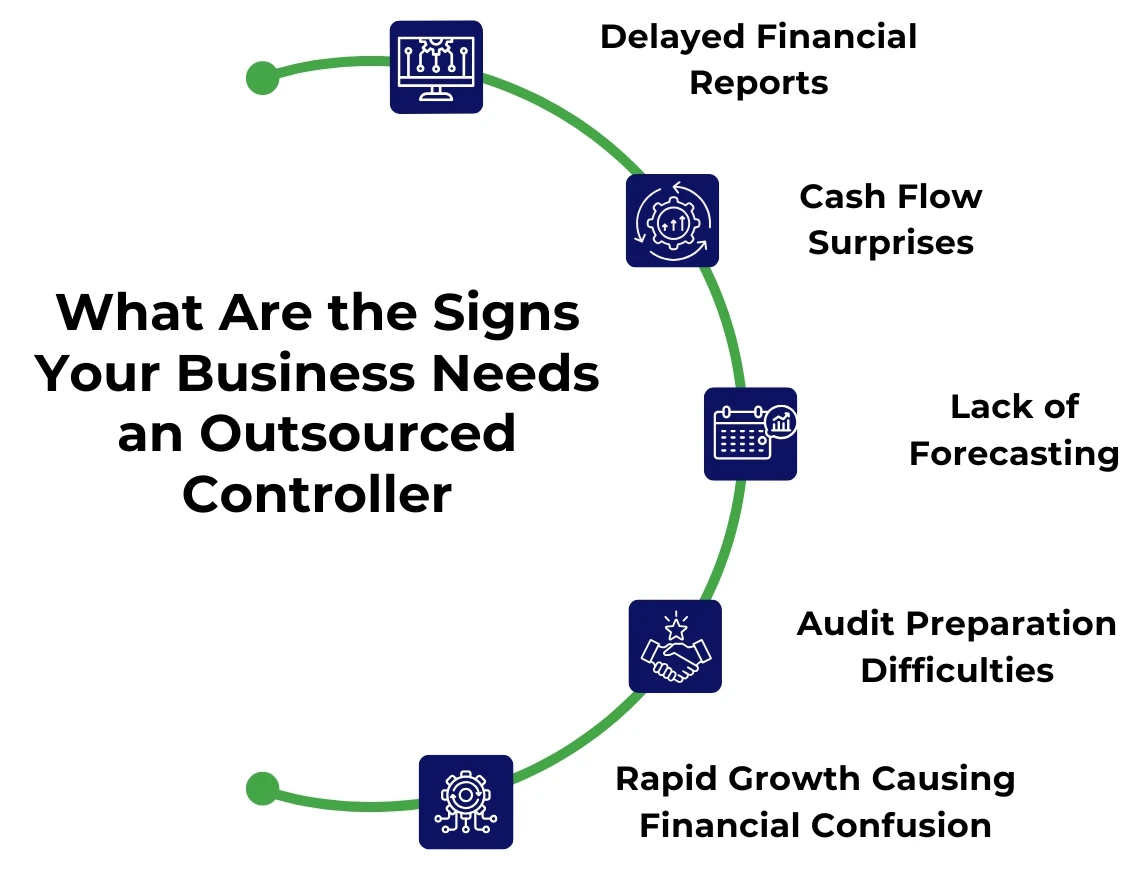
- Delayed Financial Reports: If monthly statements are consistently late or incomplete, financial visibility and decision-making suffer.
- Cash Flow Surprises: Unexpected liquidity shortfalls signal weak Working Capital monitoring and insufficient cash flow forecasting.
- Lack of Forecasting: Absence of structured Financial Planning limits growth strategy, budgeting discipline, and performance tracking.
- Audit Preparation Difficulties: Struggles during audits indicate weak documentation, inconsistent reconciliations, and inadequate internal controls.
- Rapid Growth Causing Financial Confusion: Expansion without aligned financial systems disrupts reporting accuracy and requires business process improvement to restore control.
What to Look for in an Outsourced Controller Service Provider?
Selecting the right provider requires evaluating expertise, technology capability, pricing clarity, and long-term scalability.
- Industry experience: Choose a provider with demonstrated experience in your sector’s accounting standards, compliance requirements, and reporting complexity.
- Cloud accounting expertise: Ensure proficiency in platforms such as NetSuite, Sage Intacct, QuickBooks, or Xero for real-time financial visibility and automation.
- Transparent pricing: Look for clearly defined pricing models with no hidden fees and scope clarity aligned with reporting expectations.
- Data security practices: Verify strong Information Security protocols, access controls, and secure data handling standards.
- Scalability: Confirm the provider can adjust engagement scope as your reporting complexity and transaction volume grow.
What Are the Typical Costs of Outsourced Controller Services?
Outsourced controller costs vary based on engagement scope, reporting complexity, and business size rather than a fixed salary structure.
Common Pricing Models
- Hourly: Billed based on actual time spent handling reporting, reconciliations, and advisory tasks.
- Monthly retainer: A fixed recurring fee covering defined controller responsibilities and reporting cycles.
- Tiered packages: Structured service levels aligned with business needs, offering scalable support under a defined Pricing Strategy.
Factors That Influence Cost
- Business size & complexity: Multi-entity structures, industry regulations, and operational diversity increase oversight requirements.
- Transaction volume: Higher sales, payroll entries, and vendor transactions require more reconciliation and review time.
- Reporting requirements: Advanced financial analysis, board reporting, compliance documentation, or audit preparation increases service scope.
How to Get Started with Outsourced Controller Services?
Getting started requires a structured evaluation of financial gaps, clear objectives, and disciplined onboarding.
- Assess financial gaps: Identify weaknesses in reporting accuracy, internal controls, cash flow visibility, and Financial Planning processes.
- Define goals & reporting needs: Establish clear expectations for monthly close timelines, forecasting depth, compliance requirements, and management reporting.
- Choose a provider: Select a firm with relevant industry expertise, cloud accounting capability, and scalable service structure.
- Onboarding & integration: Implement a structured transition plan aligned with Project Management and Change Management principles to ensure system access, reporting alignment, and process continuity.
Frequently Asked Questions (FAQs)
Conclusion
Outsourced controller services provide financial clarity, operational control, and scalable oversight to support sustainable business growth.
By strengthening reporting accuracy, internal controls, and cash flow visibility, businesses gain disciplined financial management without expanding fixed overhead. The model offers scalability and efficiency, adapting as reporting complexity and transaction volume increase.
Organizations seeking stronger business strategy alignment should evaluate whether their current financial systems provide timely, reliable insight or whether structured controller oversight is the next step toward stability and growth.
About the Author

As CEO, Ali Din oversees the overall strategy and direction for Premier NX. With senior leadership roles at global HR and recruiting platforms, Indeed and ADP. Ali has over 25 years of experience in the IT and advanced technology sector. Ali’s time is focused on transformation in the business, both for professional development and for clients, to enhance business outcomes.