

What Is Outsourcing IT Support Services?
Outsourcing IT support services is the practice of engaging a third-party IT provider to manage, monitor, and secure business technology environments under defined service agreements.
IT support outsourcing enables organizations to delegate critical functions such as help desk operations, network administration, cybersecurity monitoring, cloud infrastructure management, and system maintenance to specialized experts.
Through outsourced IT services and managed IT support models, businesses gain structured technical oversight, proactive issue resolution, and operational stability without expanding internal IT headcount.
What IT Support Services are Commonly Outsourced?
Businesses outsource core IT operations to ensure continuous system performance, security, and technical reliability.
- IT help desk outsourcing: Provides Tier 1 and Tier 2 remote IT support to resolve user issues quickly and maintain productivity.
- Network monitoring and maintenance: Continuously tracks network performance to prevent outages and optimize connectivity.
- Server and infrastructure management: Oversees physical and virtual servers to ensure stability, scalability, and uptime.
- Cloud services and backups: Manages cloud environments, data storage, and automated backups for resilience and recovery.
- Cybersecurity and threat monitoring: Detects, prevents, and responds to security threats through proactive monitoring and controls.
- Software updates and patch management: Ensures systems remain secure and compliant through timely updates and vulnerability remediation.
- Endpoint management and device support: Maintains desktops, laptops, and mobile devices to enforce security and performance standards.
- Disaster recovery and business continuity support: Establishes recovery protocols to minimize disruption during system failures or cyber incidents.
Why do Companies Outsource IT Support Services?
Companies outsource IT support services to improve operational efficiency, strengthen system reliability, and access specialized expertise without expanding internal IT overhead.
Top reasons include:
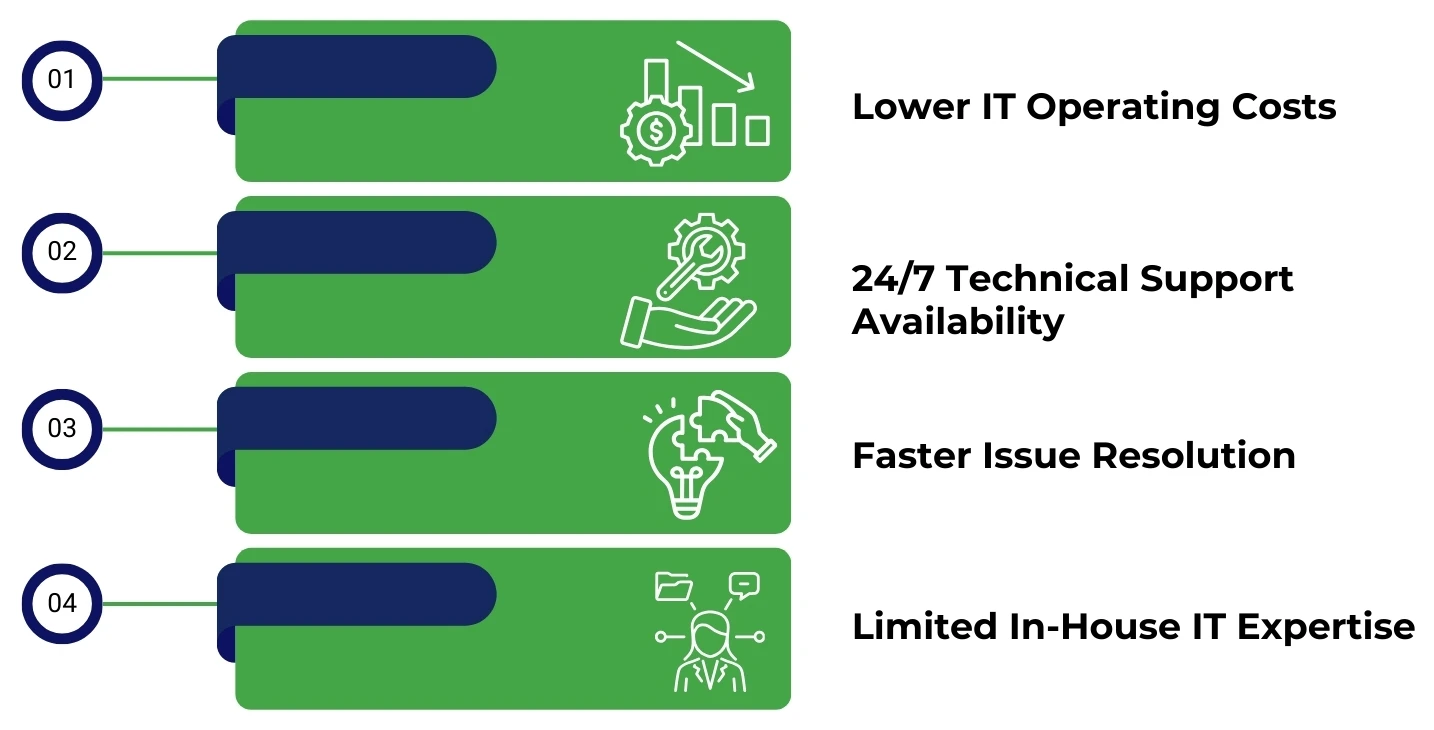
- Lower IT operating costs: Converts fixed IT expenses into predictable service-based pricing models.
- 24/7 technical support availability: Ensures continuous monitoring and rapid response beyond standard business hours.
- Faster issue resolution: Reduces downtime through structured escalation processes and defined SLAs.
- Limited in-house IT expertise: Bridges skill gaps with outsourced IT advantages across specialized technologies.
These benefits of outsourcing IT support enable organizations to shift focus from technical firefighting to strategic growth initiatives.
What are the Benefits of Outsourcing IT Support Services?
Outsourcing IT support services delivers measurable cost control, stronger security oversight, and scalable technology management aligned with business growth.
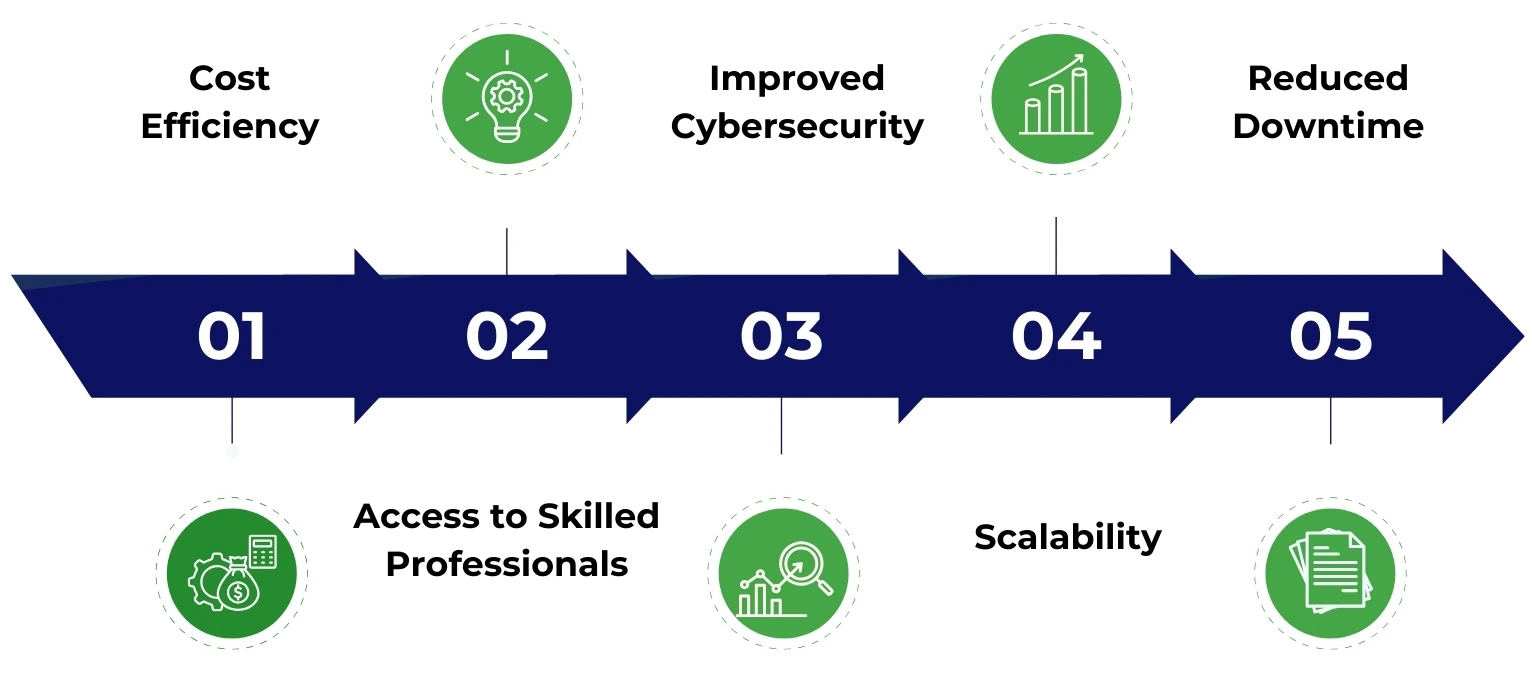
Cost Efficiency
Outsourced IT support benefits include predictable monthly pricing models that reduce capital expenditure and improve IT cost savings through operational efficiency.
Access to Skilled Professionals
Organizations gain certified engineers and specialists across cloud, infrastructure, and cybersecurity without long-term hiring commitments.
Improved Cybersecurity
Proactive monitoring, threat detection, and vulnerability management strengthen risk mitigation and regulatory compliance posture.
Scalability
IT scalability allows businesses to expand or reduce services based on growth, seasonal demand, or digital transformation initiatives.
Reduced Downtime
Defined SLAs, structured escalation paths, and proactive system monitoring improve uptime and accelerate issue resolution.
What are the Types of IT Support Outsourcing Models?
IT outsourcing models differ by scope of control and service delivery structure, allowing organizations to align IT governance with business objectives.
- Fully outsourced IT support: A third-party provider assumes complete responsibility for IT operations, infrastructure, security, and user support.
- Co-managed IT support: Internal IT teams collaborate with external specialists to extend capabilities without relinquishing strategic oversight.
- Onshore IT outsourcing: Services are delivered by local providers within the same country, ensuring regulatory familiarity and time-zone alignment.
- Offshore IT support: Remote global teams provide cost-efficient, scalable technical services with extended coverage hours.
When Should You Outsource IT Support Services?
Businesses should evaluate IT support outsourcing when operational strain, rising risk exposure, or growth demands exceed internal IT capacity.
You should consider outsourcing IT support if:
- Your business experiences frequent system downtime: Recurring outages signal gaps in proactive monitoring and infrastructure management.
- IT costs are increasing without performance improvements: Escalating expenses without measurable uptime or efficiency gains indicate poor resource optimization.
- Cybersecurity risks are rising: Increasing threats, compliance requirements, or audit pressures require specialized security oversight.
- Your internal IT team is overwhelmed: Limited bandwidth restricts innovation, strategic projects, and timely issue resolution.
- Your business is scaling rapidly: Expansion across users, locations, or cloud platforms demands scalable managed IT services.
Recognizing these triggers helps leaders make a structured IT outsourcing decision aligned with operational resilience and growth.
How to Choose the Right IT Support Outsourcing Provider?
Selecting the right IT outsourcing provider requires evaluating technical depth, security maturity, and operational accountability.
Key factors to evaluate:
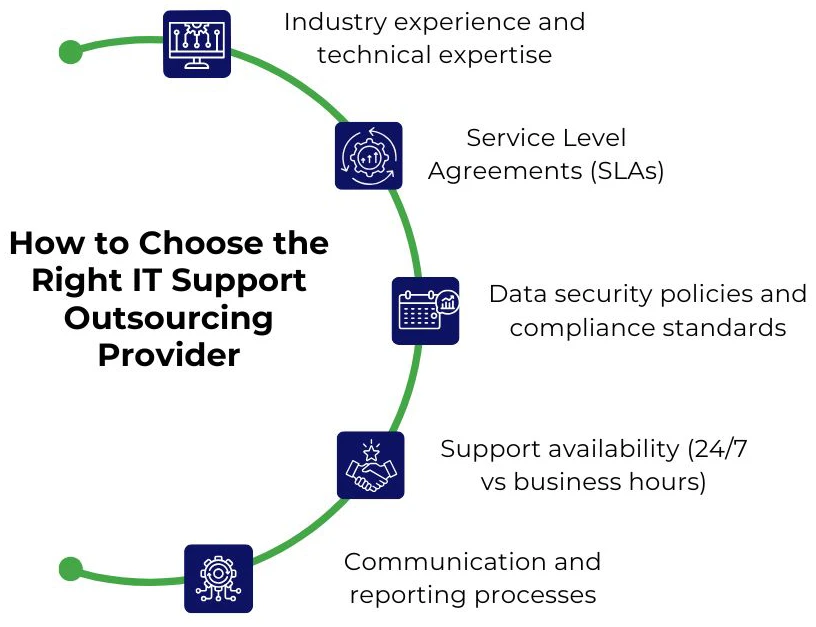
- Industry experience and technical expertise: Choose a managed IT service provider with proven experience in your industry, infrastructure, and compliance landscape.
- Service Level Agreements (SLAs): Ensure clearly defined SLAs covering uptime guarantees, response times, escalation paths, and performance metrics.
- Data security policies and compliance standards: Verify adherence to cybersecurity frameworks, data protection regulations, and audit readiness practices.
- Support availability (24/7 vs business hours): Align support coverage with your operational model, especially for global or high-availability environments.
- Communication and reporting processes: Assess structured reporting, KPI transparency, and governance reviews to support informed IT vendor selection decisions.
What are the Challenges of Outsourcing IT Support and How Can They Be Overcome?
While IT support outsourcing improves efficiency, organizations must proactively manage governance, security, and performance expectations to mitigate risk.
| Challenge | Solution |
|---|---|
| Communication gaps | Establish clear SLAs, defined escalation paths, and structured reporting cadences |
| Data security concerns | Enforce strong security policies, access controls, compliance audits, and regular vulnerability assessments. |
| Loss of control | Implement a co-managed IT support model with shared visibility and governance checkpoints. |
| Service quality issues | Define measurable KPIs, conduct performance reviews, and maintain continuous improvement frameworks. |
Outsourcing IT Support vs In-House IT Team
The choice between outsourced and in-house IT depends on cost structure, expertise depth, scalability needs, and availability requirements.
| Factor | Outsourced IT Support | In-House IT Team |
|---|---|---|
| Cost | Lower and predictable through service-based pricing models. | Higher fixed costs including salaries, benefits, and infrastructure. |
| Expertise | Broad, specialized skill sets across multiple technologies and certifications. | Limited to the knowledge and experience of the internal team. |
| Availability | 24/7 monitoring and remote IT support coverage. | Typically restricted to standard business hours. |
| Scalability | High flexibility to scale services up or down based on demand. | Limited scalability due to hiring cycles and resource constraints. |
What are the Future Trends in Outsourced IT Support Services?
The future of IT support is driven by automation, cybersecurity resilience, and cloud-centric service delivery models.
- AI-powered IT support and automation: Intelligent monitoring, predictive issue detection, and automated remediation are reducing manual intervention and improving response speed.
- Increased focus on cybersecurity outsourcing: Organizations are relying on specialized providers for continuous threat monitoring, incident response, and zero-trust security frameworks.
- Cloud-first IT support models: Managed IT services are increasingly designed around multi-cloud environments, SaaS ecosystems, and hybrid infrastructure governance.
- Remote and hybrid IT support services: Distributed support teams deliver 24/7 remote IT support aligned with global operations and hybrid workforce structures.
These IT outsourcing trends are reshaping the future of IT support toward proactive, data-driven, and resilience-focused operations.
Frequently Asked Questions (FAQs)
Conclusion
Outsourcing IT support services enables organizations to convert complex technology management into a structured, performance-driven function. Through managed IT support and specialized third-party IT support providers, businesses achieve predictable IT cost control, strengthened cybersecurity posture, and improved operational uptime.
By selecting the appropriate IT outsourcing model and aligning with a capable partner, companies can maintain resilient infrastructure while focusing internal resources on innovation, growth, and strategic priorities.