

Payroll outsourcing removes payroll execution, tax handling, and compliance work so your team stops managing complexity and starts managing outcomes.
Late paychecks, incorrect tax deposits, and multi-state payroll rules don’t show up as “minor errors”; they surface as compliance exposure, employee distrust, and hours of rework your team never budgeted for.
Add remote hires, shifting state requirements, or seasonal staff, and payroll transforms from routine processing into a weekly operational risk.
Payroll outsourcing solves this by transferring all payroll calculations, tax filings, and compliance-sensitive tasks to a provider operating on controlled workflows, governed timelines, and audited systems.
In this guide, you’ll get a clear breakdown of what payroll outsourcing includes, how the cost structure works, the real benefits and risks leaders should evaluate, the questions that separate strong providers from weak ones, and the exact steps for a clean transition without pay delays or compliance gaps.
What are Outsourcing Payroll Services?
Payroll outsourcing shifts payroll calculations, tax work, and compliance oversight to a provider that runs each pay cycle under structured controls.
Payroll outsourcing means handing the execution of payroll, calculations, taxes, filings, adjustments, and compliance to a third-party team that specializes in running payroll accurately and consistently. You approve the results; they handle the complexity.
Here’s the practical difference leaders care about:
- In-house: you run the software, reconcile errors, monitor compliance, and carry the full risk.
- Outsourced: a provider executes payroll end-to-end, including taxes and filings, while you retain decision rights.
- Hybrid: you keep your system, but specialists handle filings, corrections, and compliance-sensitive tasks that internal teams struggle to scale.
Who typically outsources?
- SMBs without dedicated payroll expertise
- Startups expanding into multiple states
- Distributed and remote teams need uniform treatment
- Seasonal operations with fluctuating headcount
Example scenario: A company with 25 employees across three states faces different tax rates, filing schedules, and reporting rules. Outsourcing eliminates those variables and ensures every cycle follows the correct jurisdictional requirements without internal monitoring.
What Services are Included in Payroll Outsourcing?
Payroll outsourcing covers pay calculations, tax filings, compliance tasks, and optional HR add-ons managed under standardized workflows.
Outsourced payroll isn’t a single service; it’s a structured bundle of operational tasks your provider handles end-to-end, so your team stops managing calculations, deadlines, and statutory requirements.
Here’s what’s typically included:
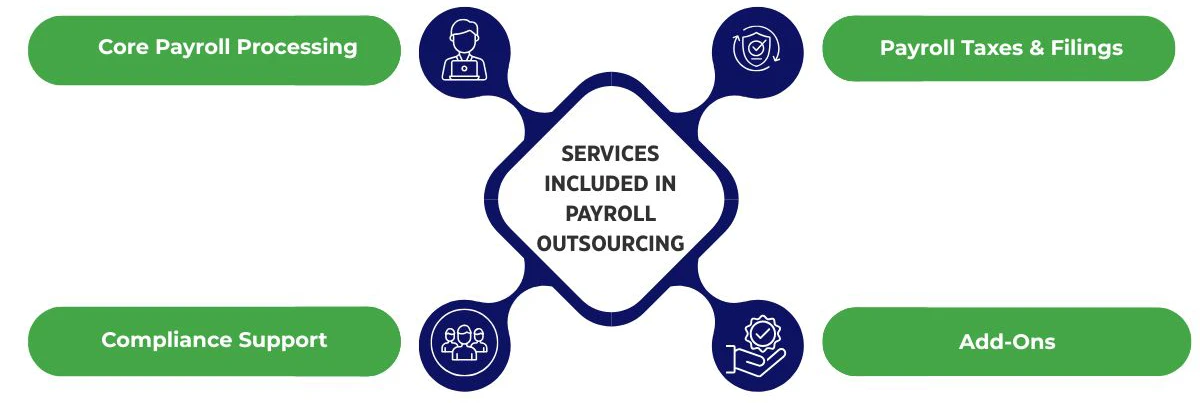
Core Payroll Processing
- Pay runs, gross-to-net calculations, and scheduled payroll cycles
- Direct deposit or check issuance
- PTO, leave accruals, and overtime rule application
- Pay stub creation and employee record updates
- Labor cost, department cost, and job-costing payroll reports
Payroll Taxes & Filings
- Withholding and employer tax calculations
- Federal, state, and local tax filing and deposit management
- W-2 and 1099 preparation, distribution, and corrections
- Year-end balancing and reconciliation support
Compliance Support
- New hire reporting across required jurisdictions
- Multi-state registration guidance for expanding teams
- Administration of garnishments, levies, and mandated deductions
- Record retention, audit support, and documentation accuracy checks
Add-Ons
- Time and attendance system integration
- Benefits administration and deduction syncing
- HRIS or employee self-service portals
- Contractor payment management
- Global payroll or employer-of-record support when operating internationally
What’s Not Included
Legal counsel, HR policy creation, employment classification decisions, and broader workforce strategy are not part of standard payroll outsourcing; these remain the employer’s responsibility.
What are the Key Benefits of Outsourcing Payroll?
Outsourcing payroll cuts admin work, reduces errors, improves compliance, elevates employee experience, and scales smoothly with growth.
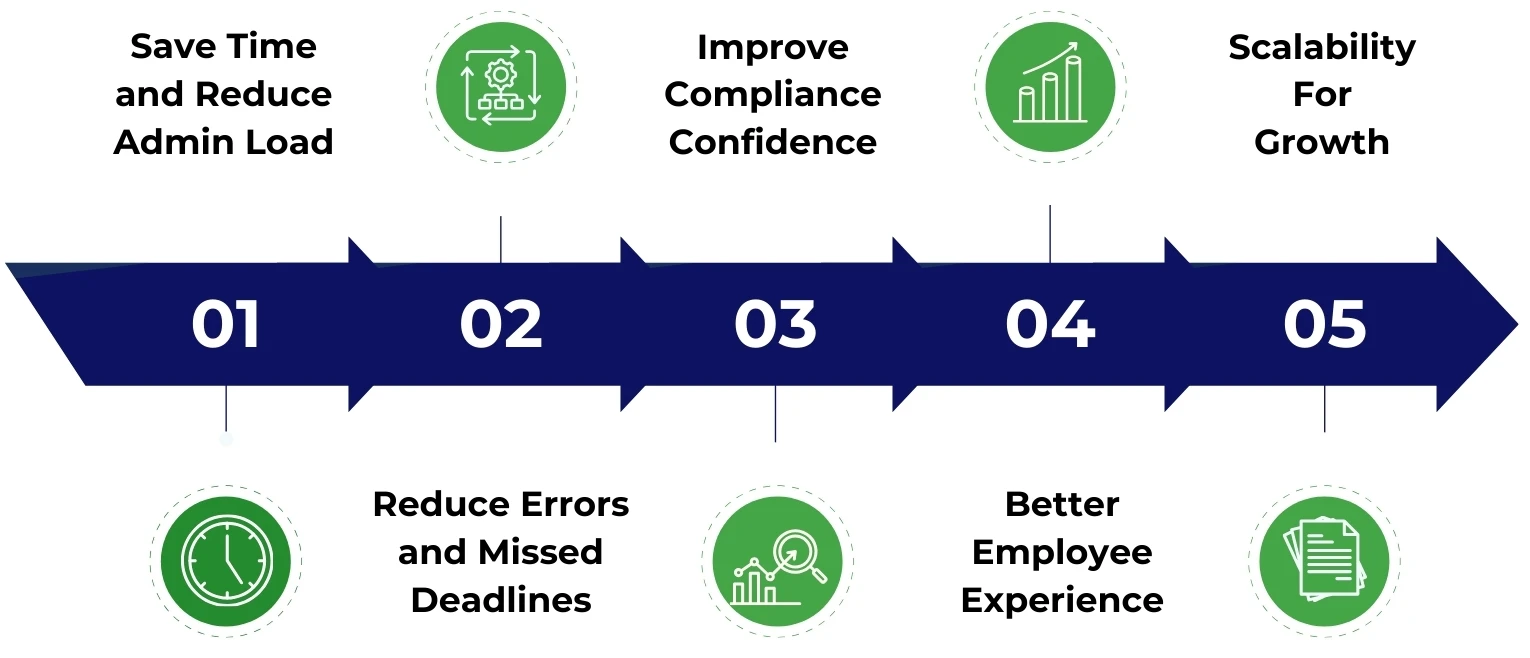
Save Time and Reduce Admin Load
Outsourcing removes the repetitive work that slows teams down, like rate updates, reconciliations, and retro fixes. Payroll shifts from a weekly interruption to a managed process that your team no longer has to chase.
Reduce Errors and Missed Deadlines
- Automated gross-to-net calculations
- Provider-managed tax calendars
- Built-in validation before every pay run
This eliminates the error cycles that typically come from time pressure, not incompetence.
Improve Compliance Confidence
Regulations change faster than most teams can track. Providers apply updated tax rules, thresholds, and filing schedules automatically, reducing the operational risk behind compliance, even though the legal responsibility stays with the employer.
Better Employee Experience
On time, accurate pay creates trust. Self-service access to pay stubs and clearer documentation reduces HR tickets and eliminates the back-and-forth employees face when payroll is handled manually.
Scalability For Growth
- Faster onboarding and offboarding
- Smooth expansion into new states
- No need to add internal payroll headcount
As complexity grows, outsourced workflows expand with it without disrupting operations.
What are the Potential Drawbacks and How to Avoid Them
Outsourcing reduces control and adds security, cost, and service risks, but each can be prevented with clear standards and vendor due diligence.
Less Direct Control
Outsourcing shifts execution to a provider, which means you no longer see every step of the process. This loss of visibility can feel risky if you’re used to hands-on oversight.
How to avoid it:
- Define SLAs clearly
- Set approval workflows
- Establish firm cut-off times for payroll changes
Data Security and Privacy Concerns
Payroll houses the most sensitive data in your organization, including SSNs, bank accounts, and tax IDs. Moving that data outside your firewall increases exposure unless the provider operates under strict controls.
How to avoid it:
- Confirm encryption standards
- Require SOC 2 or ISO certifications
- Ask about access controls and breach response protocols
Hidden Fees And Contract Lock-Ins
Some vendors look affordable upfront, then charge for filings, amendments, multi-state payroll, or year-end forms. Long contracts without exit terms make this worse.
How to avoid it:
- Request a complete fee schedule
- Clarify add-on charges
- Review cancellation terms before signing
Service Quality Varies
Not all providers deliver the same responsiveness or expertise. Ticket-only support, slow resolutions, and a lack of ownership can disrupt payroll cycles.
How to avoid it:
- Ask for client references
- Verify support hours and escalation paths
- Confirm whether you get a dedicated rep or a shared queue
How Much Does It Cost to Outsource Payroll Services?
Payroll outsourcing costs use base fees plus per-employee pricing, influenced by headcount, locations, pay cycles, and added HR functions.
Pricing Structure
- Base monthly platform or service fee
- Per-employee or per-pay-run charge
- Tier upgrades for automation or full-service processing
- Add-ons for tax filing, HR modules, time tracking, or multi-state support
This model scales with your workforce instead of applying a flat, inaccurate rate.
Cost Drivers
- More employees = more calculations and reports
- Higher pay frequency = more cycles processed
- Multiple states = additional tax registrations and filings
Each factor directly increases the operational work required for accurate payroll.
ROI Considerations
- Internal hours saved from calculations and corrections
- Avoided penalties from late or incorrect tax filings
- Eliminated the need for multiple software tools
- Fewer payroll disputes and reversals
- Reduced compliance monitoring workload
Example
A 15-employee, biweekly payroll typically pays a base fee plus per-employee charges, with incremental cost only for multi-state payroll or HR integrations.
When Does Payroll Outsourcing Make the Most Sense?
Outsourcing makes sense when payroll becomes time-heavy, error-prone, multi-state, or beyond the expertise and tools of your internal team.
Checklist: Payroll Outsourcing Is a Strong Fit When
- You’re spending several hours each week running payroll instead of focusing on strategic work
- You’ve dealt with errors, late deposits, or tax penalties
- You’re hiring in multiple states or managing contractors across jurisdictions
- You need stronger reporting, integrations, or clearer cost visibility
- You don’t have dedicated payroll expertise in-house
- Your headcount is growing quickly, and internal payroll can’t scale with demand
These indicators usually signal that the operational risk and workload of in-house payroll are outpacing current capacity.
When Keeping Payroll In-House Might Be Better
- You have a very small, stable team with simple pay structures
- Your internal finance or payroll function has strong expertise and bandwidth
- You operate under strict industry compliance rules that require tightly controlled internal oversight
How To Choose the Right Payroll Outsourcing Provider
Choose a payroll provider by evaluating pricing clarity, tax capabilities, compliance depth, integrations, support quality, security, and exit terms.
Questions To Ask
These are the non-negotiables that quickly reveal whether a provider can handle your payroll environment:
- What’s included in base pricing vs. add-ons?
- Do you handle payroll tax filings and year-end forms end-to-end?
- What’s your accuracy guarantee or penalty policy?
- What compliance support do you offer for multi-state payroll?
- Which integrations do you support: accounting, time tracking, and HRIS?
- What does implementation look like, and who owns data migration?
- What are your support hours? Is there a dedicated rep or a shared support team?
- What security standards do you follow (SOC 2, ISO, encryption protocols)?
- What is the cancellation process and data export policy?
These questions surface scope, risk exposure, long-term cost, and the provider’s operational maturity.
Red Flags
A strong provider eliminates uncertainty; a weak one creates it. Watch for:
- Vague or shifting pricing and long-term contracts without exit terms
- No formal security documentation or unclear data handling practices
- Slow response times during sales (a preview of real support)
- No references from companies of a similar size or industry
Any one of these signs typically indicates future service friction.
Must-Have Features By Company Type
Different organizations need different levels of capability. Match features to your operating model:
- Small Business: simple setup, responsive support, and reliable tax filing
- Multi-State Teams: strong compliance management and local tax handling
- Hourly Workforces: integrated time tracking and precise overtime rules
- Fast-Growth Companies: automated onboarding workflows and HRIS integrations
Choosing a provider aligned with your operating complexity ensures long-term stability, not just short-term convenience.
Step-by-Step: How To Transition to Outsourced Payroll
A smooth payroll transition requires clean data prep, a structured implementation flow, and a 90-day validation period to stabilize operations.
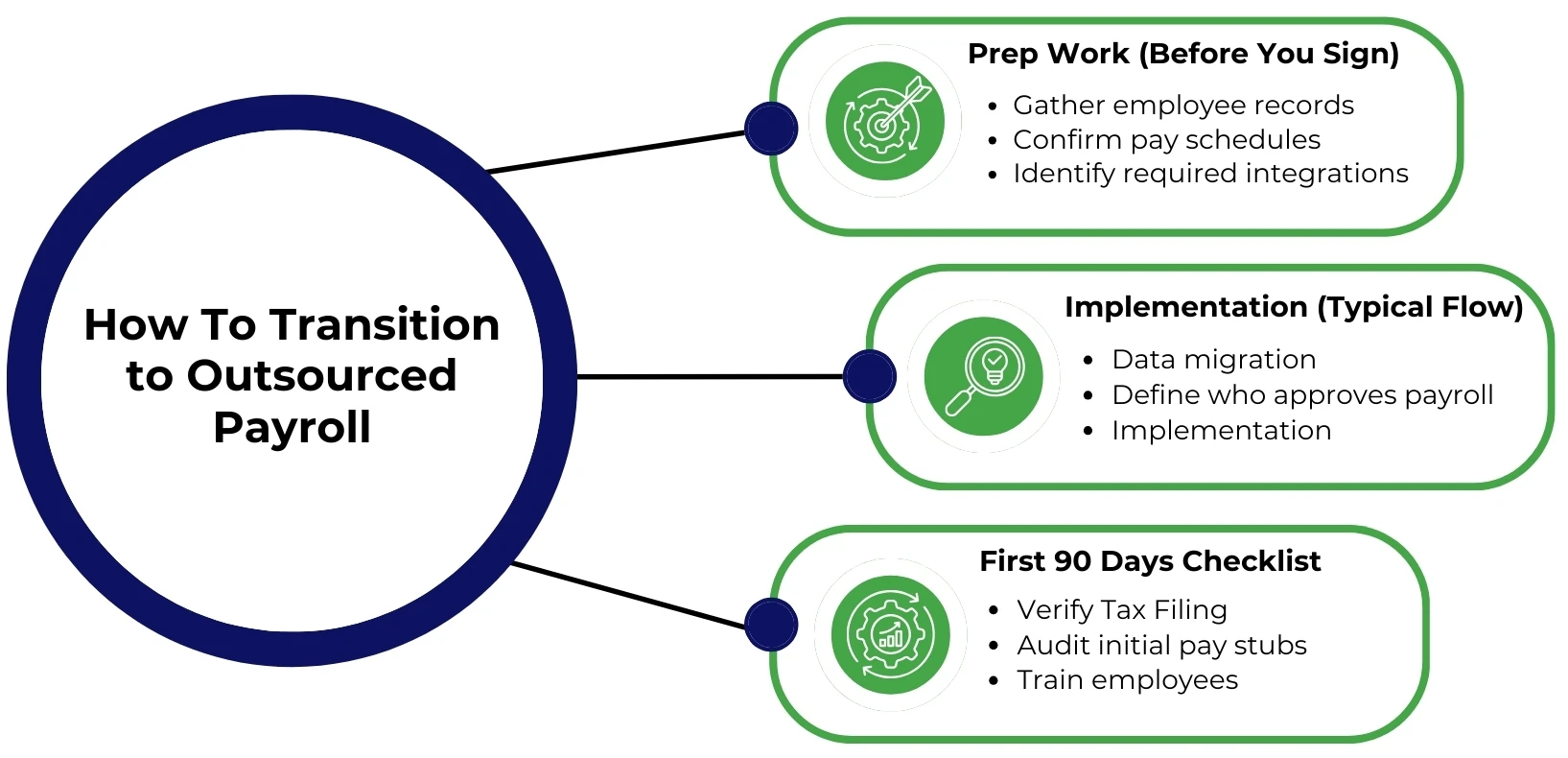
Step 1: Prep Work (Before You Sign)
Before implementation begins, the quality of your data determines the quality of your first payroll run. This stage removes surprises and ensures the provider has everything needed to build accurate calculations.
- Gather employee records, historical payroll data, tax IDs, and all benefit/deduction details
- Confirm pay schedules, earning types, and internal payroll policies
- Identify required integrations such as HRIS, time tracking, or accounting systems
A clean data package shortens onboarding and reduces error cycles later.
Step 2: Implementation (Typical Flow)
Implementation is where your new payroll engine gets built. The goal is accuracy, not speed.
- Data migration → validation → parallel run → go-live
- Define who approves payroll each cycle and the cutoff for submitting changes
The parallel run is critical: it tests real calculations against your current payroll before the new system takes over.
Step 3: First 90 Days Checklist
The first three months are about confirming stability and tightening controls.
- Verify that federal, state, and local tax filings are being submitted correctly
- Audit initial pay stubs to confirm deduction accuracy and benefit alignment
- Train employees on self-service tools to reduce support tickets
By day 90, payroll should be predictable, accurate, and fully embedded into your operations.
FAQs About Outsourcing Payroll Services
Conclusion
Payroll outsourcing delivers the most value when payroll becomes time-heavy, multi-state, error-prone, or beyond your team’s internal expertise.
The decision ultimately hinges on three elements: pricing transparency, security standards, and a clear understanding of compliance ownership.
To move forward, evaluate providers with structured questions, confirm total cost before signing, and ensure the transition plan includes data verification, a parallel run, and a 90-day stabilization window.
Ready to streamline payroll? Connect with Premier NX and talk to our experts who will assess your current setup and outline the right-fit solution.
About the Author

As CEO, Ali Din oversees the overall strategy and direction for Premier NX. With senior leadership roles at global HR and recruiting platforms, Indeed and ADP. Ali has over 25 years of experience in the IT and advanced technology sector. Ali’s time is focused on transformation in the business, both for professional development and for clients, to enhance business outcomes.