


Why Is Outsourcing RCM on the Table Now?
Revenue Cycle Management (RCM) has become a financial pressure point, which is intensified by staffing shortages, mounting administrative burden, and rising claim denials.
For today’s CFO or practice manager, internal teams are strained, cash flow is inconsistent, and the patient financial experience is often fragmented. Outsourcing revenue cycle management (RCM) offers a path to stabilize performance that reduces overhead, accelerates reimbursements, and improves revenue integrity at scale.
This piece explores where outsourcing delivers the most measurable gains and how to evaluate readiness, scope, and partner fit.
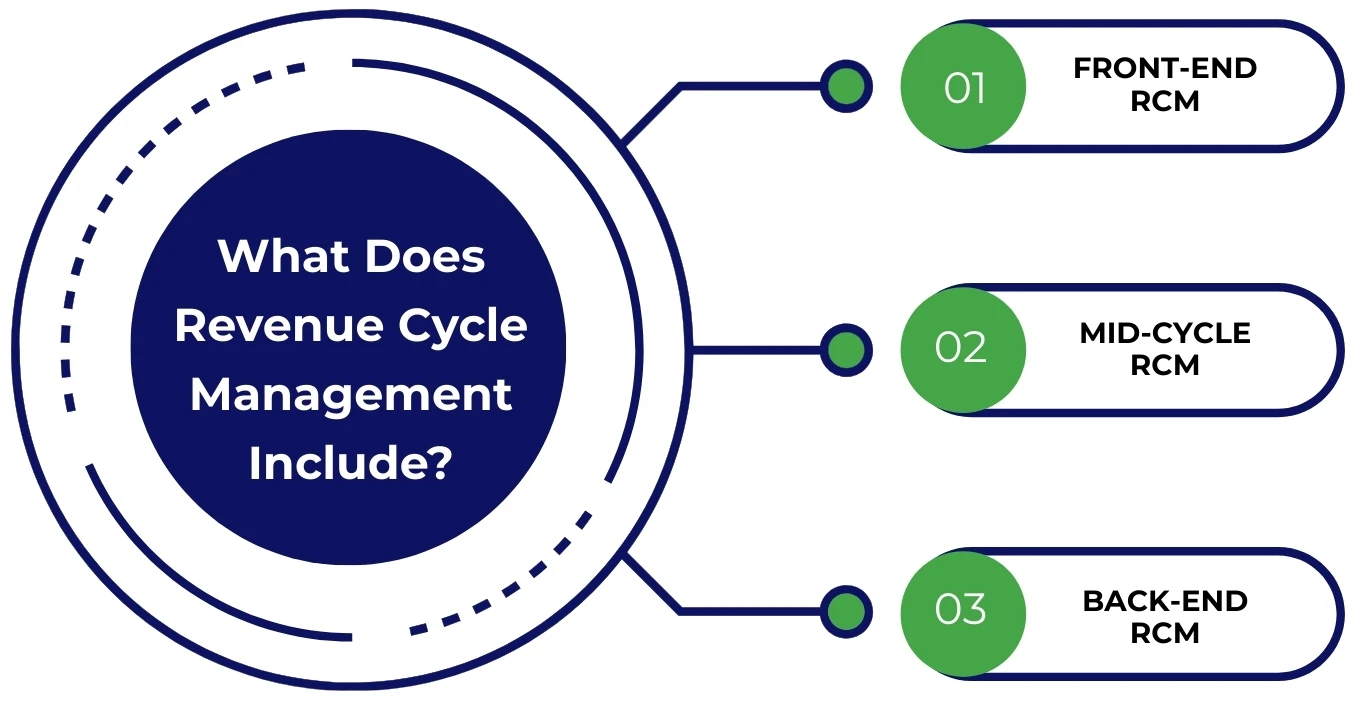
What Does Revenue Cycle Management Actually Include?
RCM spans the full payment lifecycle, from pre-visit verification to post-payment reconciliation. It requires seamless coordination across multiple systems and checkpoints.
Front-End RCM
Front-end RCM secures reimbursement before the visit, through accurate intake, payer checks, and authorization workflows.
It includes scheduling, patient registration, demographics capture, and eligibility and benefits verification via EHR/PM systems or payer portals. Prior authorizations, especially for Medicare/Medicaid, must be resolved upfront to avoid downstream denials.
Mid-Cycle RCM
Mid-cycle focuses on clinical documentation and coding, where accuracy directly impacts claim value and audit risk.
This phase includes charge capture, documentation integrity, and medical coding using ICD-10-CM, CPT, HCPCS, and CDI frameworks. Managed typically by HIM professionals, this layer is essential to reflect medical necessity and ensure claim compliance.
Back-End RCM
Back-end RCM turns coded encounters into revenue through clean claims, payment tracking, and denial resolution.
It involves claim generation (EDI 837), clearinghouse submissions, payment posting (ERA/835), and follow-up on denials and appeals. Key controls include claim scrubbing, mapping denial codes (CARC/RARC), interpreting EOBs/ERAs, and managing aging accounts receivable (AR).
What Are the Top Benefits of Outsourcing Revenue Cycle Management?
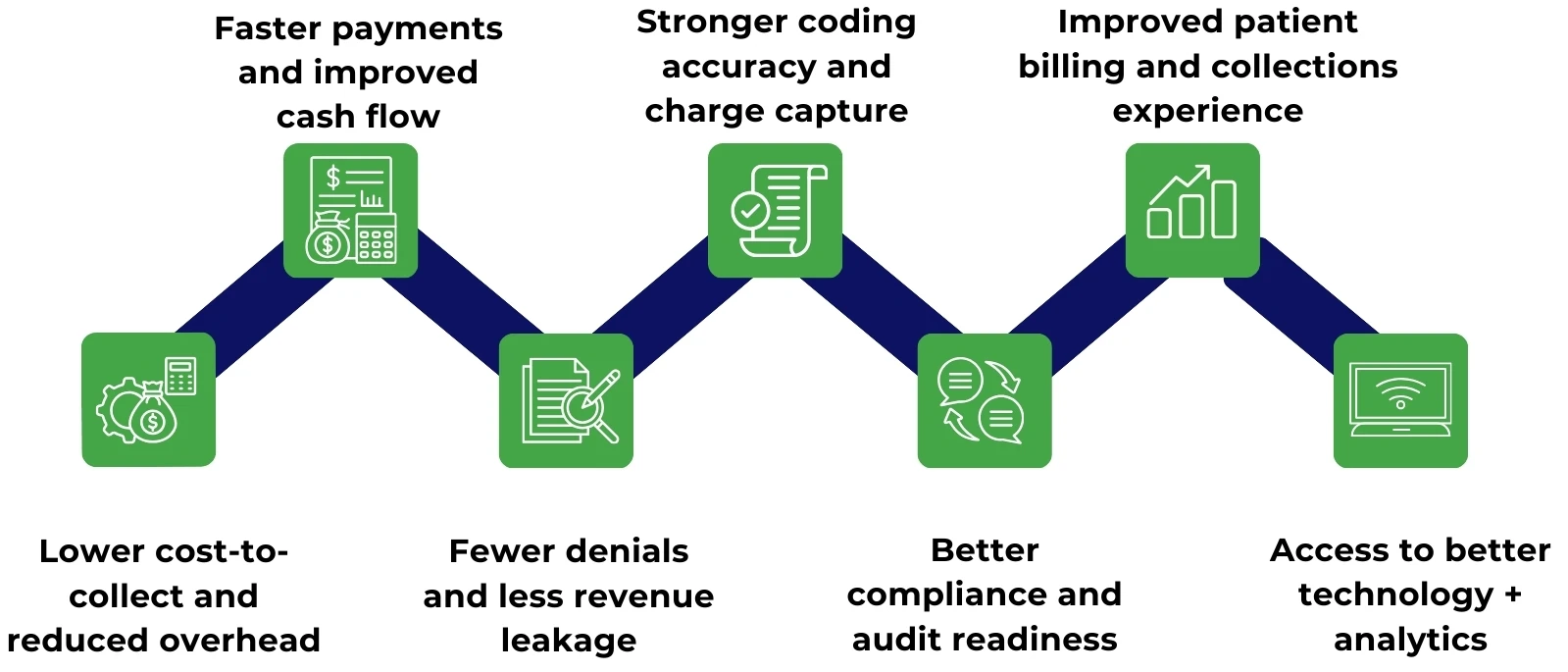
RCM outsourcing isn’t just operational relief, it’s strategic optimization. Each phase of the revenue cycle becomes tighter, faster, and more accountable.
Lower cost-to-collect and reduced overhead
Managing coders and billers in-house creates invisible costs, including turnover, training gaps, and administrative drag. Outsourcing compresses this into a leaner model:
- No internal recruiting or credentialing delays
- Predictable pricing via fixed fee or percent-of-collections
- Immediate access to skilled teams already working at scale
Faster payments and improved cash flow
Cash flow bottlenecks are rarely clinical; they’re process-driven. Delays in submission, edits, or eligibility checks stretch out days in AR. An outsourced partner compresses that timeline:
- Clean claims go out faster.
- Rejections drop.
- Reimbursements land on schedule.
And with first-pass resolution rates climbing, revenue starts cycling, not stalling.
Fewer denials and less revenue leakage
Denials aren’t random; they’re systemic. Outsourcing brings preemptive precision that prevents leakage before it starts:
- Eligibility and prior authorization are verified before the visit
- Coding aligned with payer edits and medical necessity
- Real-time tracking of underpayments and write-offs
The outcome is measurable: fewer denials, faster appeals, and tighter revenue retention.
Stronger coding accuracy and charge capture
Specialty coding isn’t one-size-fits-all. That’s why outsourced teams bring certified experts with vertical fluency:
Think ICD-10 precision, CPT modifier compliance, and charge master alignment—tailored to your practice or facility type.
With credentialed coders (AAPC/AHIMA) handling this layer, missed revenue opportunities disappear, and audit risk drops.
Better compliance and audit readiness
Regulatory pressure isn’t easing, like payer audits, CMS scrutiny, and HIPAA obligations are now constant. An outsourced model bakes compliance into every function:
- Real-time rule updates
- Structured documentation trails
- Access controls and encryption standards that support HIPAA, BAA, and OIG-aligned protocols
Compliance moves from a checklist to a continuous posture.
Improved patient billing and collections experience
Patients are payers now, and their financial journey needs clarity, not confusion.
Outsourced RCM makes it easier to pay and harder to abandon:
- Simplified statements
- Payment plans tailored to financial capacity
- Portal-based reminders that align with patient preferences
Access to better technology + analytics
You don’t need to build infrastructure to benefit from it. Top-tier RCM vendors deliver:
- Integrated automation
- Dashboards that track KPIs in real time
- Reporting cadence that supports weekly governance
You get the tech, insights, and scale without licensing, upgrades, or IT overhead.
What Should You Outsource First in Revenue Cycle Management?
RCM outsourcing doesn’t have to be all or nothing. The right starting point depends on where your process breaks down.
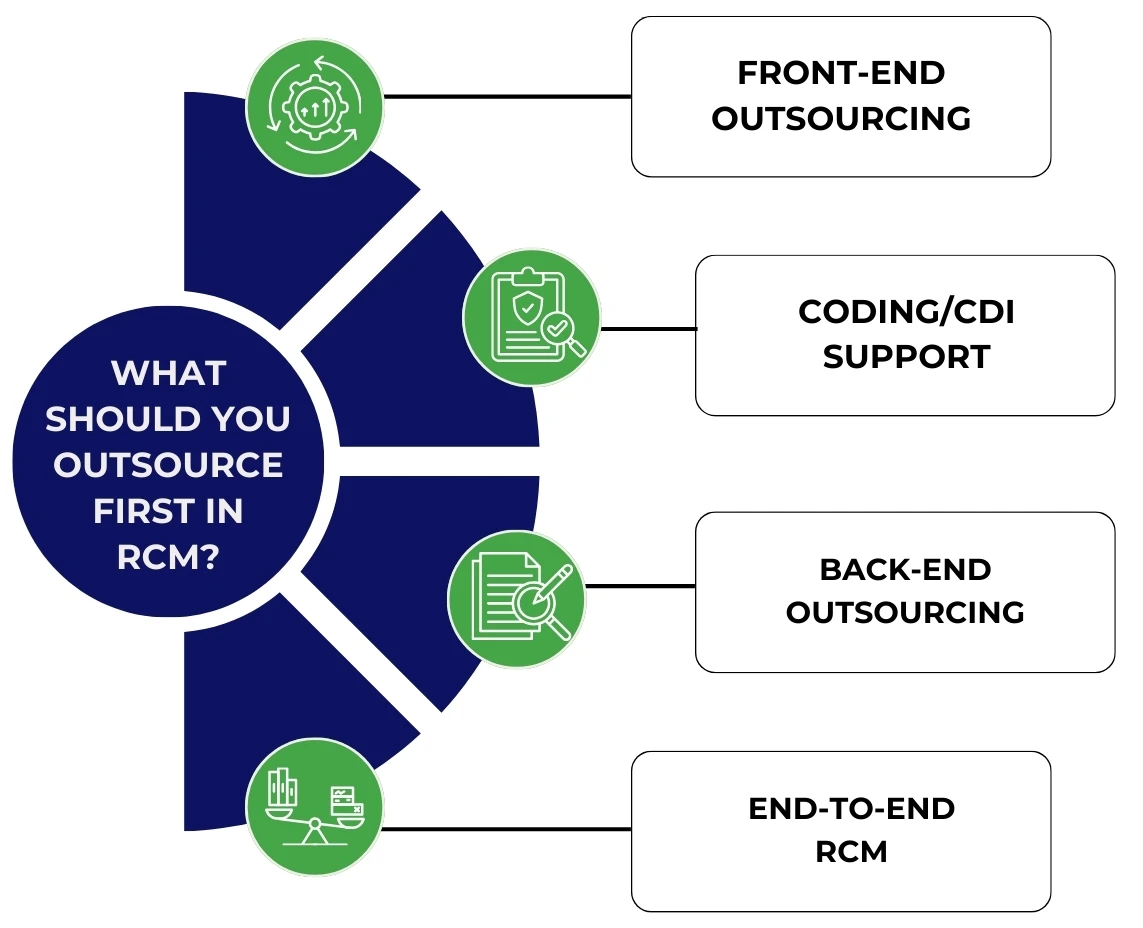
Option A: Front-End Outsourcing
Ideal if most denials stem from coverage gaps or authorization failures.
Front-end inefficiencies create downstream chaos if eligibility verification or prior authorization is inconsistent or delayed.
Outsource front-end if:
- Eligibility checks are manual or inconsistent
- Prior authorizations get missed or delayed
- Payer rules vary widely and aren’t being tracked
Option B: Coding/CDI Support
Right fit when documentation quality or coding accuracy stalls revenue.
Coding errors don’t just delay reimbursement; they trigger audits, underpayments, and missed revenue. Outsourcing this layer brings:
- Certified coders fluent in ICD-10, CPT, and specialty-specific modifiers
- Clinical Documentation Improvement (CDI) is aligned with HIM standards
- Structured review that supports medical necessity and claim integrity
Option C: Back-End Outsourcing
Critical if aging AR is growing and denial recovery is reactive.
If claims sit untouched, denials go unworked, or underpayments aren’t tracked, your revenue is leaking. Outsourcing back-end RCM introduces:
- AR follow-up workflows based on aging buckets
- Dedicated teams for denial appeals and underpayment recovery
- ERA posting that’s timely and reconciled
Choose this when your revenue is earned but not collected.
Option D: End-to-End RCM
Best for organizations needing transformation, accountability, and visibility.
When internal teams are stretched and oversight is fractured, outsourcing the full RCM stack drives systemic improvement:
- SLAs and governance models ensure accountability
- Unified reporting across front, mid, and back-end functions
- A single operating model aligned to revenue integrity and scalability
This isn’t just outsourcing, it’s RCM rearchitecture.
What Are the Risks of RCM Outsourcing and How Do You Mitigate Them?
Outsourcing RCM has proven upside, but it also shifts operational control. Knowing the trade-offs and how to neutralize them is key.
Loss of Control / Visibility
Outsourcing doesn’t mean losing oversight, but without structure, it can feel that way.
Mitigation Strategy:
- Define SLAs upfront with measurable benchmarks
- Establish a clear reporting cadence (weekly or bi-weekly)
- Create an escalation path for performance deviations
- Use dashboards with real-time KPIs for transparency
Data Security & Compliance Risk
PHI, payer data, and financial records must be protected with enterprise-grade controls. This is non-negotiable.
Mitigation Strategy:
- Ensure HIPAA compliance and a signed BAA
- Confirm SOC 2 certification or equivalent for vendor systems
- Enforce role-based access, encryption, and audit logs
Security isn’t just IT, it’s your regulatory foundation.
Patient Experience Risks
Outsourced billing teams interact directly with patients. Therefore, tone, clarity, and empathy all impact satisfaction.
Mitigation Strategy:
- Use approved call center scripts and tone guides
- Build a closed-loop dispute workflow for issue resolution
- Monitor patient satisfaction metrics across RCM touchpoints
Done right, outsourced teams don’t dilute the experience; they elevate it.
How Do You Choose the Right RCM Outsourcing Partner?
The right partner does more than process claims; they align with your systems, standards, and outcomes. Here’s what to evaluate before you commit.
Capabilities & Scope
- Supports your specialty billing needs
- Handles diverse payer mix (Medicare, Medicaid, commercial)
- Offers both modular and end-to-end RCM models
Look for: flexibility in deployment and depth in vertical-specific experience.
Integrations
- Proven compatibility with your EHR and practice management (PM) system
- Supports HL7 and EDI 837/835 workflows
- Seamless integration with clearinghouses and billing platforms
Look for: minimal IT disruption and scalable interoperability.
Performance Management
- SLAs that define accountability
- KPI tracking: days in AR, denial rate, net collection rate (NCR), clean claim rate
- Baseline analysis with clear improvement targets
Look for: real-time dashboards, regular cadence, and outcome-based reporting.
Compliance & Security
- HIPAA-compliant with a signed BAA
- Role-based access, audit logging, and incident response protocols
- Encryption of data, both at rest and in transit
Look for: SOC 2 or equivalent certifications and a security policy stack that matches your risk posture.
References & Transparency
- Verifiable client references in your specialty
- Sample reports, governance structure, and RCM ops playbook
- Benchmarking data that proves impact over time
Look for: evidence of success, not just promises.
What KPIs Should You Track After Outsourcing RCM?
Within the first 90 days, measurable impact should emerge. Set a baseline, track trends, and surface early warning signs or wins.
Days in AR
- Shorter cycles = healthier cash flow.
- Track by AR aging buckets to identify slow-moving claims and bottlenecks in reimbursement.
Denial Rate + Top Denial Reasons
- Are denials dropping or shifting?
- Categorize by denial reason codes (eligibility, prior auth, documentation) to pinpoint systemic fixes.
Clean Claim Rate
- This reflects pre-submission quality.
- An increasing clean claim rate signals stronger edits, better data capture, and fewer resubmissions.
Net Collection Rate (NCR)
- What percentage of allowable revenue are you actually collecting?
- A rising NCR indicates reduced revenue leakage and better payer compliance.
Patient Responsibility Collection Rate
- Are patients paying their portion?
- Track collection efficiency across copays, deductibles, and balances, especially as financial counseling and portals come online.
Cost-to-Collect
- Are you spending less to earn the same or more?
- Monitor cost trends post-transition and assess efficiency gains against outsourcing fees.
Conclusion
RCM outsourcing isn’t just about doing the same work for less; it’s about doing better work, faster, and with built-in accountability. For leaders facing shrinking margins, growing payer complexity, and rising patient demands, this isn’t a tactical shift. It’s a strategic reset.
The question isn’t if you should outsource. It’s where you start and how fast you want results.