

What if the biggest threat to your patient satisfaction scores isn’t clinical error—but a missed interaction?
Today, patient loyalty hinges less on clinical outcomes and more on operational experience, how quickly a call is answered, how clearly a bill is explained, and how smoothly care is coordinated.
For mid-market healthcare providers, this shift is urgent. Administrative complexity is now a top barrier to quality care—slowing revenue, burning out staff, and frustrating patients.
Outsourcing still feels risky to many. “Can an external team understand our patients, our workflows, our compliance needs?”
It’s a fair concern, especially for those exploring outsourcing for the first time. But the model has evolved. And so have the stakes.
A quiet revolution is underway. Forward-thinking healthcare organizations aren’t outsourcing to create distance from patients—they’re doing it to get closer. By reimagining non-clinical functions as strategic experience drivers, they’re not just reducing costs, they’re amplifying care.
The Shifting Landscape: Why “Business as Usual” Is Failing Patients
Operational friction is now a clinical issue. Administrative complexity is no longer background noise—it’s undermining the care experience for both patients and providers.
Here’s what that looks like on the ground:
- Clinicians are buried in tasks
A survey by the Harris Poll found that clinicians spend nearly 28 hours per week on administrative duties—an overload that directly correlates with burnout.1 - Patient frustration is rising
Long wait times, unclear billing, and fragmented communication have become routine—and are now major drivers of patient churn. - Burnout is accelerating
Operational overload is pushing skilled teams to the brink, impacting morale, retention, and ultimately, care quality.
For first-time outsourcers, the shift is not about handing over controls but refocusing internal talent on what matters most: delivering great care.
Common Questions First-Time Outsourcers are Right to Ask
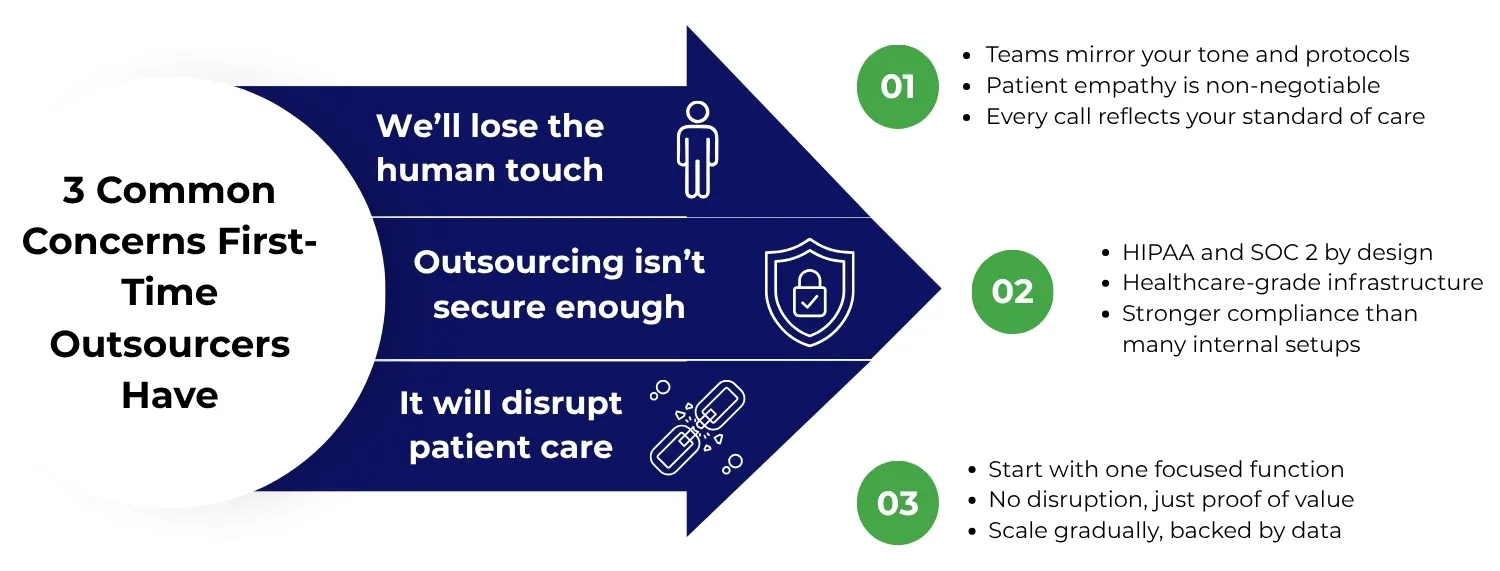
Q 1: Will we lose the human touch?
Not if it’s built into the model.
The right partner doesn’t replace your voice; they extend it. Dedicated teams trained in your protocols and tone ensure every interaction reflects your standard of care.
Q 2: Is outsourcing really secure enough for healthcare?
Yes—when compliance is foundational, not optional.
Top-tier partners operate with HIPAA, SOC 2, and healthcare-grade security by default. In many cases, their infrastructure is more auditable and resilient than overstretched internal systems.
Q 3: Won’t this be disruptive to patient care?
Not with a phased approach.
Starting with one high-impact, low-risk function allows organizations to validate value early and scale with confidence—no operational shock, just steady progress.
The Three Pillars of the Patient Experience Revolution
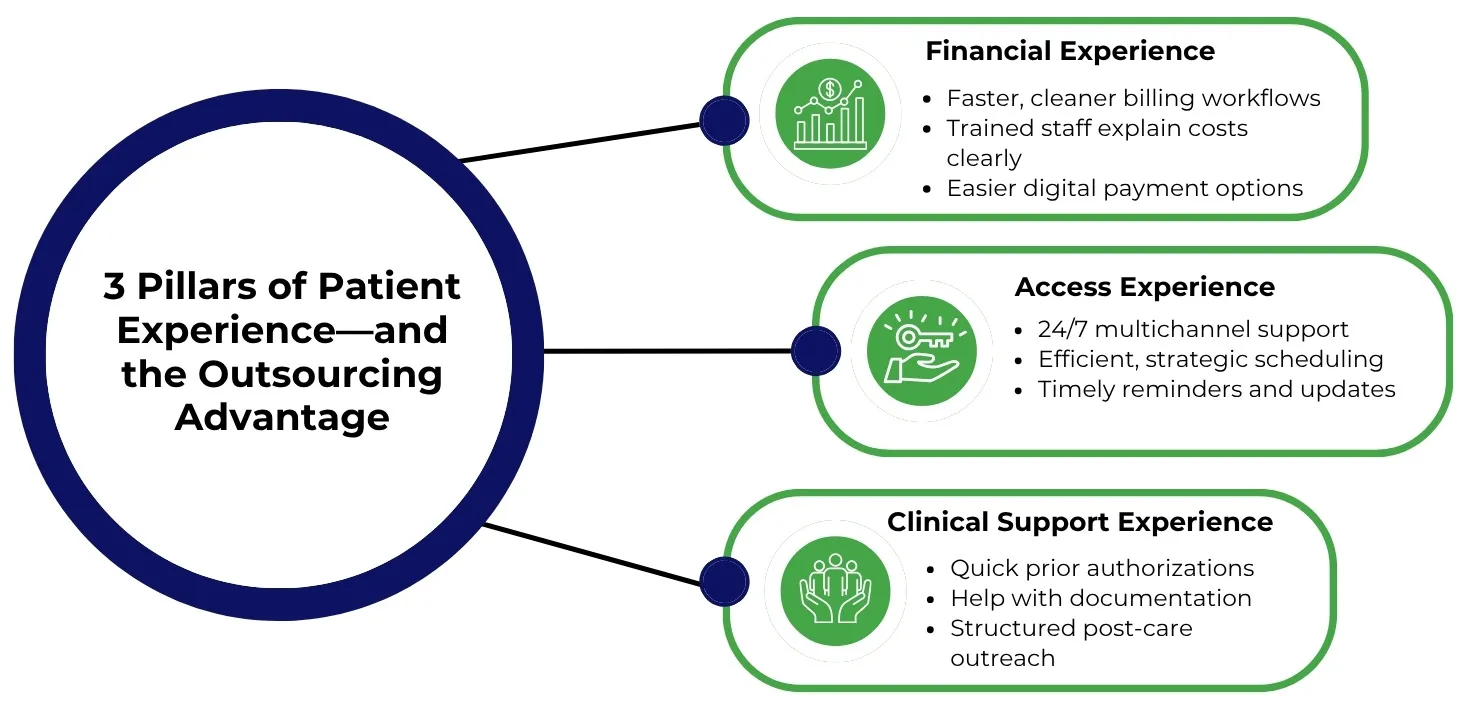
Financial Experience: From Confusion to Clarity
Patients are often left confused by unclear bills, long wait times for answers, and rigid payment processes that feel disconnected from care.
How outsourcing improves it:
- Streamlined billing and coding to reduce denials and accelerate reimbursement
- Financial advocates who offer clear, empathetic cost explanations
- Digital payment workflows that increase transparency and ease
Access Experience: From Delays to Responsiveness
When patients struggle to schedule or reach someone who can help, it signals operational inefficiency and erodes trust.
How outsourcing improves it:
- 24/7 multichannel support across phone, chat, and email
- Efficient scheduling to reduce no-shows and optimize provider time
- Proactive reminders and follow-ups that strengthen continuity
Clinical Support Experience
Administrative burden is consuming clinical capacity—pulling providers away from patient care and accelerating burnout.
How outsourcing improves it:
- Dedicated prior-authorization teams that accelerate approvals
- Documentation and data-entry support to relieve clinicians
- Patient outreach teams that enhance adherence and post-care follow-up
A Blueprint for First-Time Success: The Premier NX Phased Approach
For providers taking a first step into outsourcing, structure matters. Premier NX follows a phased methodology designed to reduce disruption, align teams, and build confidence in the model.
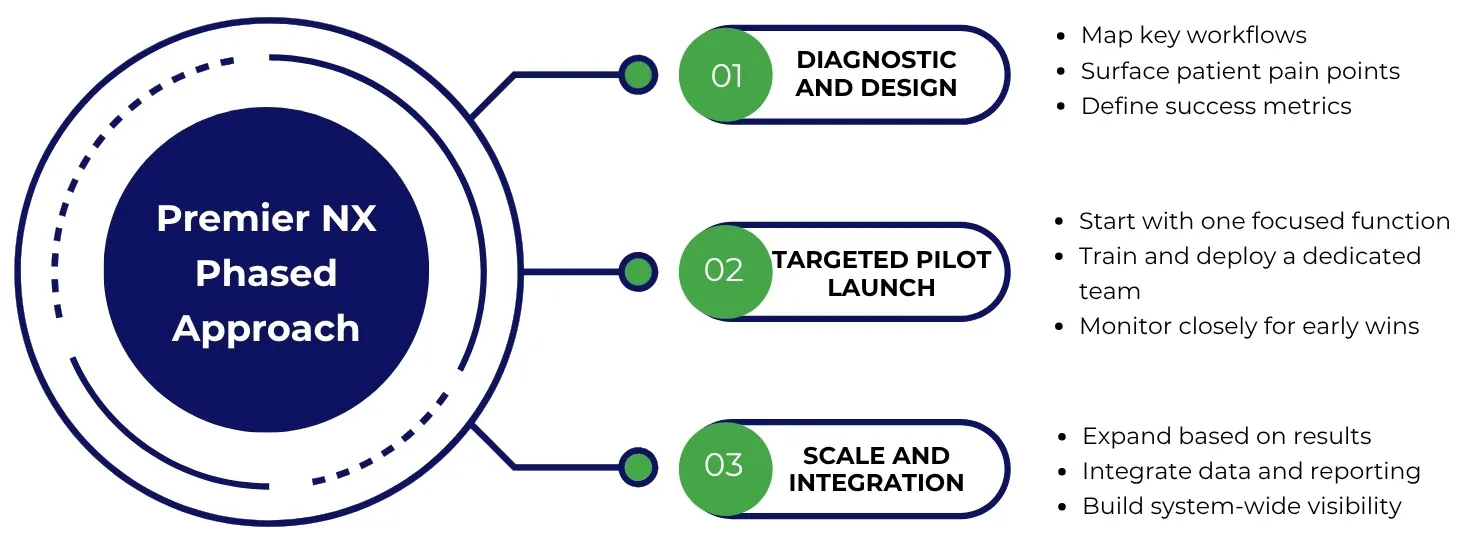
- Diagnostic and Design
Mapping workflows, identifying operational gaps, and understanding patient pain points. - Targeted Pilot Launch
Deploying a dedicated, trained team in a single high-impact area under controlled conditions. - Scale and Integration
Expanding into additional functions with continuous monitoring, performance data, and unified reporting.
This approach isn’t about outsourcing broadly—it’s about solving specific operational challenges with clarity and discipline.
Lead the Shift, Don’t Follow It
Outsourcing isn’t about giving up control; it’s about reinforcing your core mission with specialized support. For first-time adopters, the right model doesn’t replace your operations; it strengthens them.
What could your teams accomplish if clinical staff were fully focused on care—and every administrative interaction delivered the experience your patients expect?
The shift in patient experience is already underway. The organizations that lead it will define the next standard of care.
If your organization is exploring this shift, our team can walk you through your current patient journey and highlight where targeted operational support can deliver immediate impact.