


Businesses are outsourcing help desks to meet rising demand for instant support and seamless customer experiences.
Customer expectations have shifted; speed, availability, and consistency are now baseline requirements, not differentiators. Businesses are expected to resolve issues quickly while maintaining a seamless experience across every interaction.
To keep up, many organizations are turning to outsourced help desk services, allowing them to delegate IT and customer support to specialized teams without stretching internal resources.
At the same time, the rise of cloud platforms like Zendesk and Freshdesk has made outsourcing far more accessible. Support operations can now be deployed, managed, and scaled efficiently without heavy infrastructure or complexity.
As a result, outsourcing is no longer viewed solely as a cost-saving measure; it has become a strategic tool for enabling growth, maintaining service quality, and meeting modern customer expectations.
What are Outsourced Help Desk Services?
Outsourced help desk services involve third-party providers managing IT and customer support operations on behalf of a business.
These services shift day-to-day support functions to external teams that specialize in handling high-volume, multi-channel interactions efficiently.
Core functions typically include:
- Ticket management to track and resolve issues systematically
- Troubleshooting for technical and system-related problems
- User support for employees or customers across use cases
- Omnichannel communication covering voice, chat, email, and more
To ensure consistency and scalability, providers rely on established platforms such as:
- ServiceNow
- Jira Service Management
This structure allows businesses to maintain organized, responsive support operations without building or managing them in-house
What are the Types of Help Desk Outsourcing?
Help desk outsourcing includes IT support, customer service, multi-level technical support, and fully managed service desks aligned with ITIL standards.
Organizations adopt different outsourcing models based on the type and complexity of support required.
Common types include:
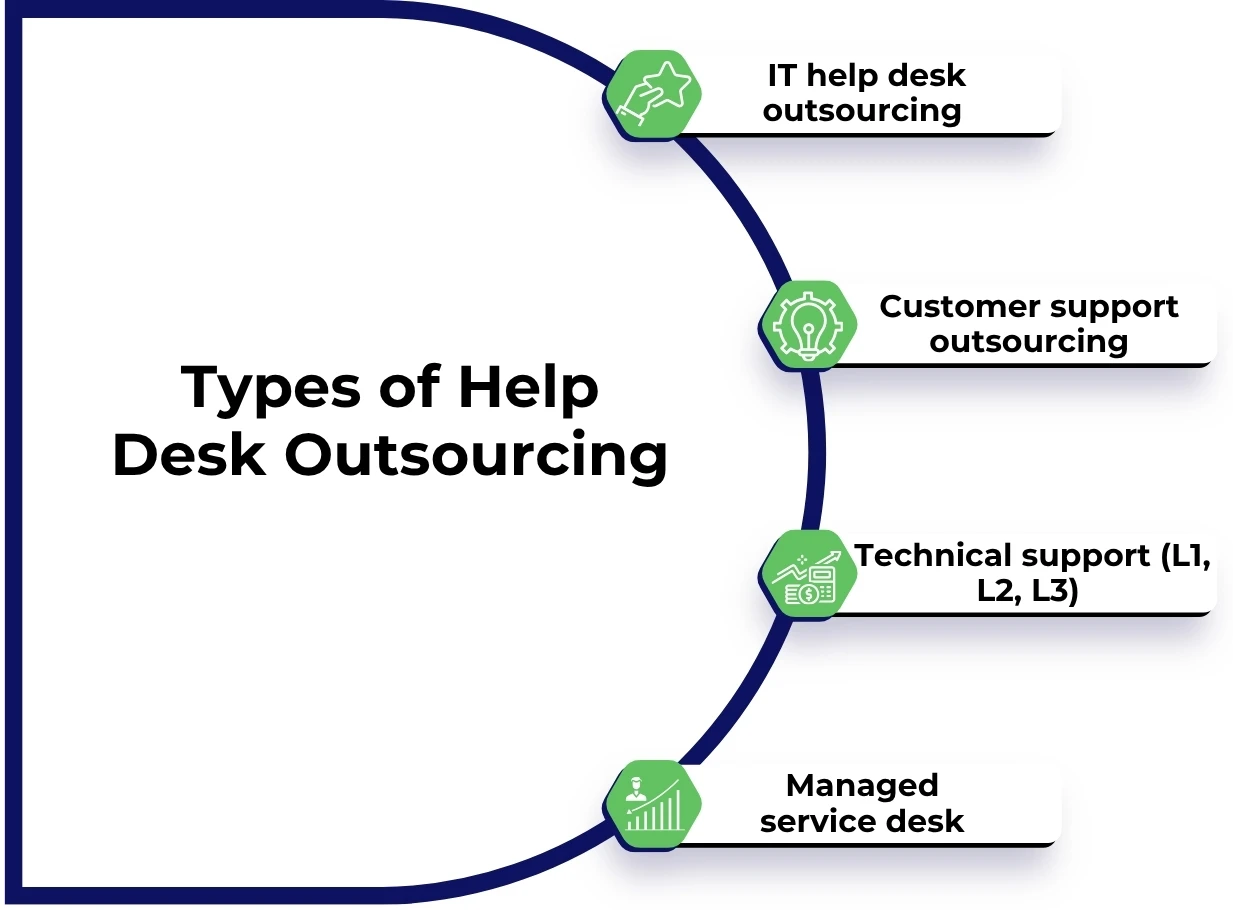
- IT help desk outsourcing for internal employee support, system access, and infrastructure issues.
- Customer support outsourcing focused on handling external customer queries and service requests.
- Technical support (L1, L2, L3) structured by issue complexity—from basic troubleshooting to advanced technical resolution.
- Managed service desk that follows ITIL frameworks, delivering standardized processes, governance, and continuous improvement.
Each model enables businesses to align support capabilities with operational needs while maintaining structured, scalable service delivery.
Why are Businesses Outsourcing Help Desk Services?
Businesses outsource help desks to meet rising expectations, support global operations, ensure 24/7 availability, and optimize costs efficiently.
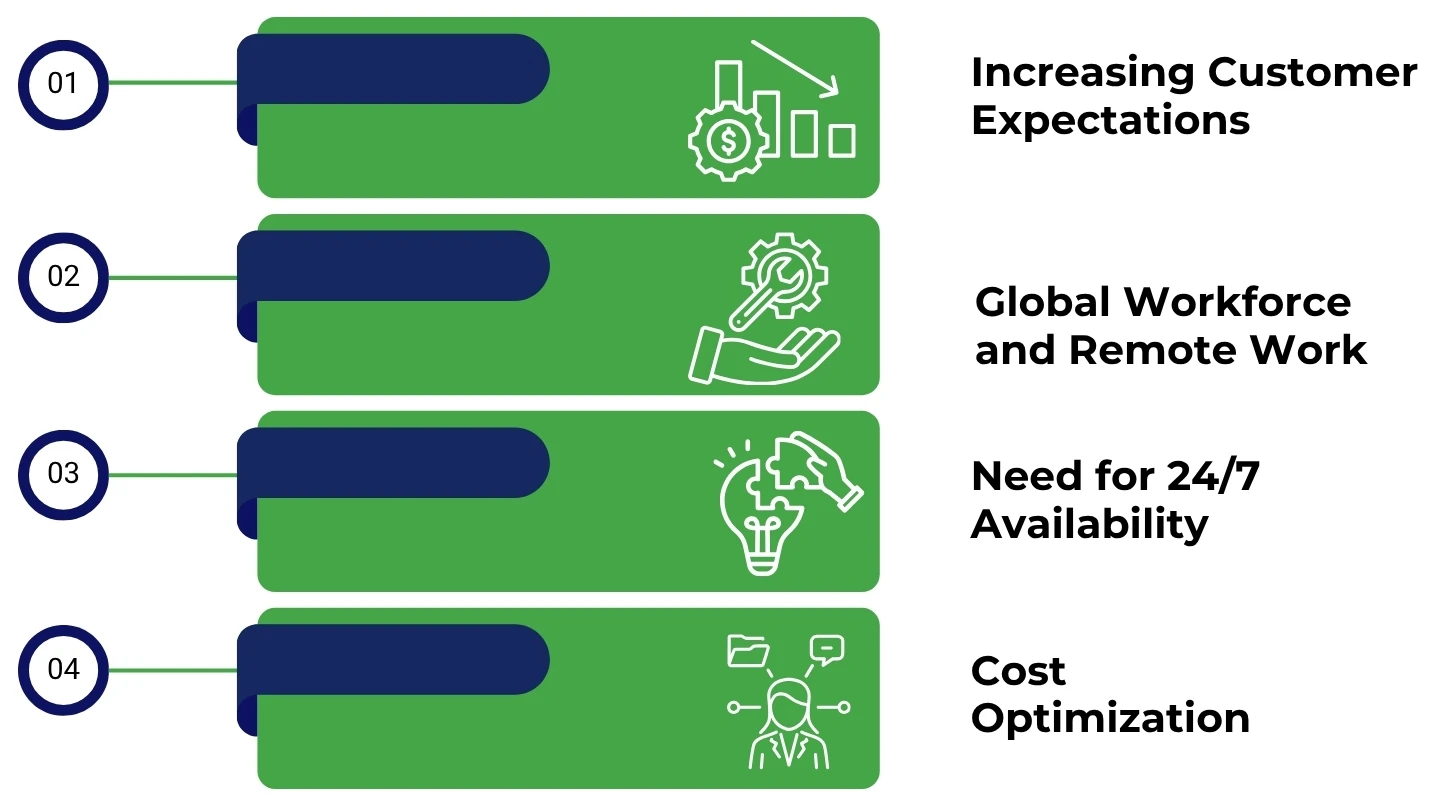
Increasing Customer Expectations
Customers now expect fast, consistent support across every interaction. Delays or poor resolution directly impact retention and brand perception.
Global Workforce and Remote Work
Distributed teams require centralized support that can operate across locations, systems, and time zones without disruption.
Need for 24/7 Availability
Business operations no longer follow fixed hours. Continuous support is essential to prevent downtime and maintain service continuity.
Cost Optimization
Building in-house support at scale requires significant investment in hiring, training, and infrastructure, making outsourcing a more efficient model.
Companies like IBM and Accenture have long adopted outsourcing as a core operational strategy.
What are the Key Benefits of Outsourced Help Desk Services?
Cost Savings
Outsourcing removes the overhead of recruiting, training, and maintaining in-house teams. Instead of fixed operational costs, businesses shift to flexible pricing models that align with actual support demand.
24/7 Support
With globally distributed teams, support is no longer limited by business hours. This helps uninterrupted service availability, reduces downtime, and allows issues to be addressed, immediately regardless of user location.
Access to Expertise
Outsourcing provides access to specialized professionals with experience across multiple tools, platforms, and industries. This eliminates the need for continuous internal training while ensuring consistent, high-quality issue handling.
Scalability
Support operations can be scaled up or down based on workload fluctuations. Whether it’s rapid growth or seasonal demand spikes, outsourcing enables businesses to adjust capacity without delays or long-term commitments.
Faster Resolution Times
Established workflows, automation, and advanced ticketing systems enable faster triage and issue resolution. This reduces backlog, improves response times, and enhances overall operational efficiency.
Improved Customer Experience
Using platforms like Salesforce Service Cloud, outsourced teams can deliver consistent, personalized support across channels. This leads to better interaction quality and stronger customer satisfaction.
Focus on Core Business
By offloading support operations, internal teams can concentrate on strategic initiatives such as product development, growth planning, and innovation rather than routine issue management.
Security & Compliance
Reputable providers follow established frameworks like ISO 27001, ensuring data security, compliance, and standardized processes across all support activities.
What are the Challenges of Outsourcing Help Desk Services?
Outsourcing help desks can create communication gaps, reduce control, introduce security risks, and increase dependency on external vendors.
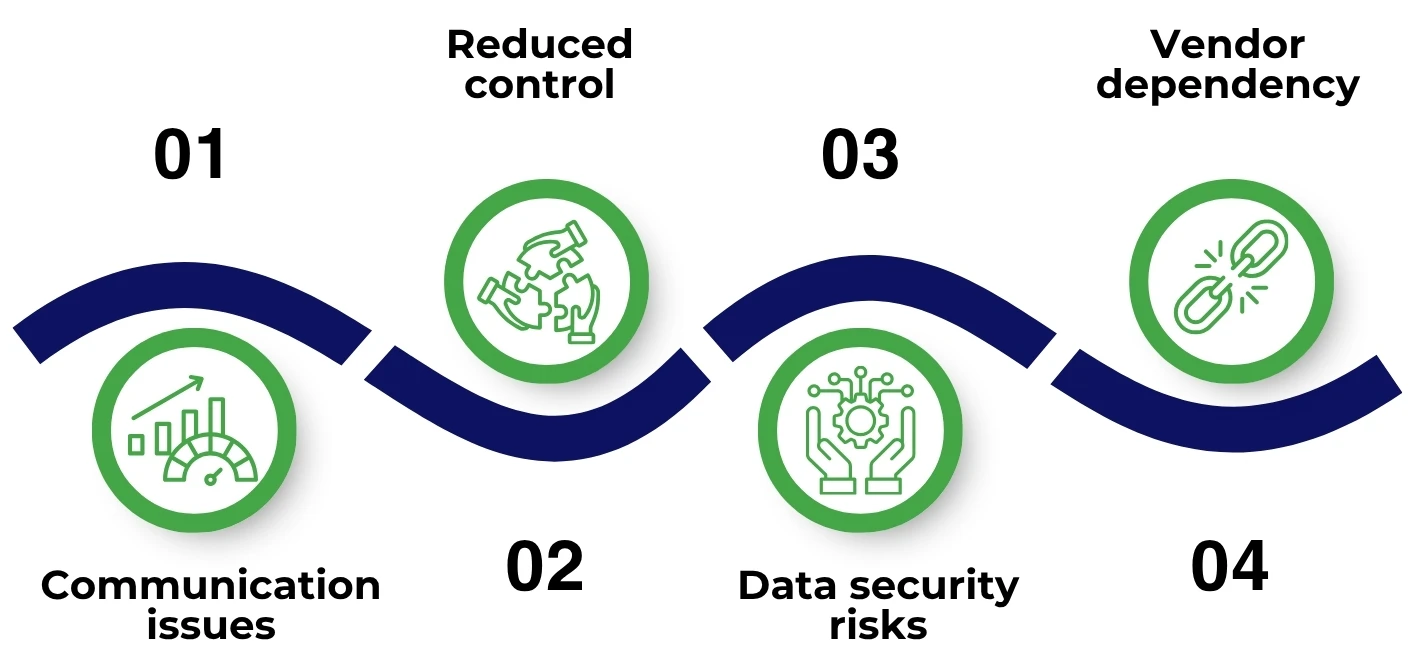
- Communication issues: Distributed teams can lead to misalignment in processes, expectations, and response quality without clear workflows.
- Reduced control: Limited direct oversight can make it harder to manage day-to-day operations and enforce immediate changes.
- Data security risks: External handling of sensitive data increases risk if proper compliance and security frameworks are not enforced.
- Vendor dependency: Relying heavily on one provider can reduce flexibility and create risk if performance declines.
These challenges are mitigated through strong SLAs, structured governance, and continuous performance tracking to ensure accountability and control.
What is the Difference between an Outsourced and an In-House Help Desk?
Outsourced help desks offer lower costs, broader expertise, and 24/7 scalability, while in-house teams provide greater control but limited flexibility.
| Factor | Outsourced | In-House |
|---|---|---|
| Cost | Lower | Higher |
| Expertise | Broad | Limited |
| Availability | 24/7 | Limited |
| Scalability | High | Low |
| Control | Less | Full |
What are the Latest Trends in Outsourced Help Desk Services (2025–2026)?
Outsourced help desks are evolving with AI, predictive analytics, omnichannel delivery, cloud platforms, and hybrid human-AI support models.
AI & Automation
AI is reducing dependency on manual support by handling repetitive queries through chatbots and automated workflows. This allows human agents to focus on complex issues, improving efficiency without increasing headcount.
Predictive Support
Support is shifting from reactive to proactive. By leveraging analytics, providers can identify patterns, predict potential failures, and resolve issues before they impact users, reducing ticket volumes.
Omnichannel Support
Businesses are moving toward unified support across voice, chat, email, and social platforms. This ensures consistent interactions and eliminates fragmented customer experiences across channels.
Cloud-Based Help Desk
Cloud infrastructure, powered by platforms like Amazon Web Services, enables remote, scalable, and secure support operations without dependency on physical infrastructure.
Hybrid Support Models
Modern help desks combine AI-driven automation with human expertise. AI handles speed and scale, while human agents manage context, complexity, and customer experience.
Which Industries Benefit the most from Outsourced Help Desk Services?
Industries with high customer interaction, technical complexity, and scalability needs benefit the most from outsourced help desk services.
- SaaS – Requires continuous technical support for users, uptime management, and rapid issue resolution.
- E-commerce – Handles high volumes of customer queries, order issues, and real-time support demands.
- Healthcare – Needs secure, compliant support for patient systems and administrative operations.
- Finance – Demands accurate, secure, and always-available support for Startups & SMBscritical financial services.
- – Leverage outsourcing to access expertise and scale support without heavy investment.
How can you Choose the Right Outsourced Help Desk Provider?
Choosing the right provider requires evaluating experience, SLAs, security, technology, and scalability to ensure long-term operational alignment.
Step 1: Assess Experience
Evaluate the provider’s track record across industries, support environments, and complexity levels to ensure they can handle your specific requirements.
Step 2: Review SLAs
Ensure clear service level agreements are in place for response times, resolution targets, and uptime to maintain accountability and performance.
Step 3: Verify Security Compliance
Confirm adherence to security standards and data protection protocols to safeguard sensitive information and ensure regulatory compliance.
Step 4: Evaluate Technology Stack
Check the tools and platforms used for ticketing, automation, and reporting to ensure compatibility and operational efficiency.
Step 5: Ensure Scalability
Choose a provider that can scale support operations based on business growth, demand fluctuations, and changing requirements.
What are the Best Practices for Successful Help Desk Outsourcing?
Successful outsourcing requires clear KPIs, strong communication, phased implementation, structured knowledge transfer, and continuous performance tracking.
- Define KPIs – Establish clear metrics for response time, resolution rate, and service quality to measure performance.
- Maintain communication – Ensure consistent alignment through regular updates, reporting, and feedback loops.
- Start with pilot projects – Test processes and workflows on a smaller scale before full implementation.
- Ensure knowledge transfer – Document systems, processes, and use cases to enable smooth onboarding and accuracy.
- Monitor performance – Continuously track outcomes and optimize processes to maintain service standards.
How much do Outsourced Help Desk Services Cost?
Outsourced help desk costs vary by pricing model, support complexity, coverage hours, and delivery location.
Pricing Models
- Per ticket – Costs are based on the number of support requests handled, ideal for variable or low-volume environments.
- Per agent – Fixed cost per dedicated resource, suitable for consistent support needs and predictable workloads.
- Monthly subscription – Bundled pricing covering services, tools, and support levels for ongoing operations.
Cost Factors
- Support level – Advanced technical support (L2/L3) increases cost compared to basic support (L1).
- Coverage hours – 24/7 support models cost more than limited-hour coverage due to staffing requirements.
- Location – Offshore, nearshore, or onshore delivery impacts pricing based on labor and operational costs.
Is Outsourced Help Desk Services Right for Your Business?
Outsourced help desks are ideal for scalable, cost-efficient support needs but less suitable where full control or strict data handling is required.
- Ideal if you need 24/7 support – Ensures continuous service availability without building internal round-the-clock teams.
- Ideal if you want to reduce costs – Eliminates expenses tied to hiring, training, and infrastructure.
- Ideal if you lack internal expertise – Provides immediate access to skilled support professionals and structured processes.
- Not ideal if you require full control – In-house teams offer more direct oversight and operational control.
- Not ideal if handling highly sensitive data without safeguards – Requires strong security frameworks and compliance measures before outsourcing.
What is the Future of Outsourced Help Desk Services?
Outsourced help desks are evolving into AI-driven, self-service-enabled, and strategically integrated support ecosystems.
- AI-first ecosystems – Support operations will increasingly rely on AI to automate workflows, reduce manual effort, and handle high-volume queries.
- Self-service portals – Knowledge bases and automated solutions will empower users to resolve issues independently, reducing ticket dependency.
- Personalized CX – Data-driven insights will enable more contextual, tailored support experiences across every interaction.
- Strategic outsourcing partnerships – Providers will move beyond execution to become long-term partners, driving efficiency, insights, and continuous improvement.
Frequently Asked Questions (FAQs)
Conclusion
Outsourced help desks drive efficiency, scalability, and better customer experience while evolving into a strategic business advantage.
Outsourcing is no longer just about reducing costs; it enables businesses to scale support, improve service quality, and maintain operational continuity.
Evaluate your current support model to determine if outsourcing can enhance performance, flexibility, and long-term growth.