

Key Takeaways
- 1Trusted data gives CPG teams a consistent foundation for reporting, analysis, and decision-making.
- 2Business intelligence and diagnostic analytics reveal what changed, why it changed, and where action is needed.
- 3Retail analytics and predictive AI help brands improve commercial execution and respond earlier to demand or performance shifts.
- 4End-to-end CPG analytics creates value by connecting insight to accountable action and measurable KPIs.
Consumer packaged goods (CPG) brands rarely lack data; they lack a shared view across retailer, sales, product, supply-chain, and finance systems. A Gartner survey of 504 data and analytics executive leaders found that only 22% of organizations measured and communicated business impact across most analytics use cases.1
CPG analytics improves operational performance when trusted data, reporting, diagnostic analysis, retail intelligence, and predictive models operate as one decision system.
End-to-End CPG Analytics: Five Capabilities That Drive Operational Performance
End-to-end CPG analytics improves operational performance by connecting five core capabilities: Data Management, Business Intelligence, Diagnostic Analytics, Retail Analytics, and Advanced Analytics and AI.
Together, they create a shared decision system that gives CPG brands trusted data, operational visibility, root-cause insights, commercial intelligence, and predictive decision support.
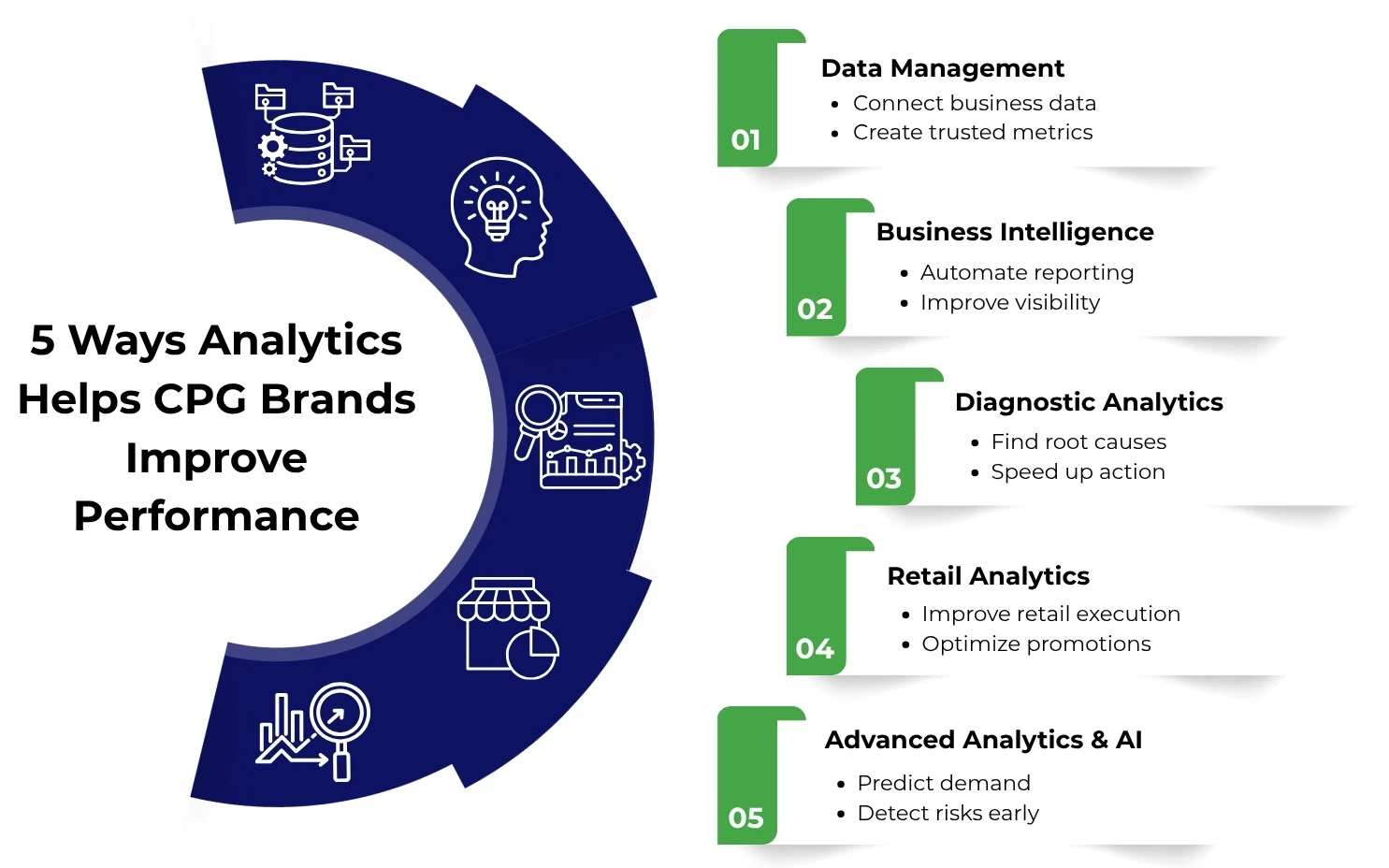
The five analytics capabilities every CPG brand needs to improve operational performance.
1. Data Management: Create One Trusted Operating View
CPG data management integrates, cleans, standardizes, and governs business data so every team works from consistent metrics.
- What: Connect ERP, point-of-sale, retailer, e-commerce, supply-chain, and finance data.
- Why: Reduce manual reconciliation, duplicate records, and conflicting KPI definitions.
- Track: Data-quality pass rate, refresh time, and reconciliation exceptions.
2. Business Intelligence: See Performance Without Rebuilding Reports
Business intelligence converts trusted data into dashboards and scorecards that show what is happening across products, retailers, channels, and regions.
- What: Automate executive reporting and operational KPI dashboards.
- Why: Replace spreadsheet consolidation with a consistent performance view.
- Track: Report-preparation time, data latency, and dashboard adoption.
3. Diagnostic Analytics: Find Why Performance Changed
Diagnostic analytics identifies the patterns, exceptions, and root causes behind changes in cost, margin, inventory, service, and sales performance.
- What: Analyze trends, relationships, variances, and process exceptions.
- Why: Direct teams toward corrective action instead of additional reporting.
- Track: Root-cause cycle time, exception-resolution time, and recurring variance.
4. Retail Analytics: Improve Commercial Execution
Retail analytics connects sales, distribution, promotion, retailer, and channel data to show where commercial execution is helping or hurting performance.
- What: Compare products, retailers, locations, channels, and promotions.
- Why: Identify distribution gaps, weak promotions, and changing demand earlier.
- Track: Sell-through, on-shelf availability, promotional lift, and channel margin.
5. Advanced Analytics and AI: Act Before Problems Surface
Advanced analytics and AI use predictive models to anticipate demand, detect anomalies, and improve plans before performance misses appear in standard reports.
- What: Apply forecasting, anomaly detection, and scenario modeling.
- Why: Give operations teams more time to adjust inventory, capacity, and commercial plans.
- Track: Forecast accuracy, inventory exceptions, and alert-to-action time.
What Should CPG Leaders Retain In-House?
External specialists can support data integration, reporting, and model development, but business accountability should remain with CPG leadership.
- Metric ownership: Approve definitions, targets, and data-quality rules.
- Decision rights: Define who acts when an insight reveals an exception.
- Business context: Supply retailer priorities, constraints, and promotional plans.
From Data to Operational Action
Premier’s CPG Decision-to-Action Stack connects trusted data, shared visibility, diagnosis, prediction, and accountable action because analytics creates value only when it changes a decision, workflow, or measurable KPI.
About the Author

Lisa Murray is a Consumer Goods Industry Advocate at Premier NX, helping North American CPG brands strengthen support for consumers, retailers, internal teams, and day-to-day operations. Focus centers on building scalable onshore, offshore, and right-shore service models that improve trust, efficiency, insight, and growth across the business.