


Legal Process Outsourcing (LPO) enables law firms and in-house counsel to delegate high-volume legal work to specialized providers to achieve cost, speed, and scalability gains.
Legal teams are under pressure to reduce legal spend while managing rising matter volume and tighter cycle times. Traditional hiring cannot scale efficiently.
Legal Process Outsourcing (LPO) addresses this by shifting process-driven work, such as eDiscovery, contract review, and compliance, to external providers through onshore, offshore, or nearshore models.
With the rise of Alternative Legal Service Providers (ALSPs) and the maturation of Legal Ops functions, LPO now operates as a managed legal services provider, improving staffing leverage and integrating with systems such as CLM (Contract Lifecycle Management).
What are Legal Process Outsourcing Services?
Legal Process Outsourcing (LPO) enables legal teams to externalize routine legal work to specialized providers, improving efficiency, cost control, and scalability.
Definition of LPO
LPO is the outsourcing of legal support services, such as contract and document review, to external teams operating as managed services.
LPO vs. BPO vs. ALSPs
LPO focuses on legal workflows, BPO on general processes, while ALSPs deliver specialized legal solutions that often overlap with managed services.
BPO handles generic back-office tasks, while ALSPs (including firms such as Deloitte, PwC, EY, and KPMG) offer broader legal and consulting capabilities.
LPO sits within this ecosystem, focused on scalable, process-driven legal execution through managed services.
Who Uses LPO?
LPO is used by law firms, in-house legal teams, and high-compliance industries to manage scale, cost, and operational complexity.
Adopted by law firms (including Am Law 100), in-house teams led by the General Counsel (GC), and industries like financial services, healthcare, SaaS, insurance, and pharma, where legal demand is high and continuous.
What are the Types of Legal Process Outsourcing Services?
LPO services span litigation, contracts, research, IP, and compliance. It enables legal teams to offload high-volume work without compromising control or quality.
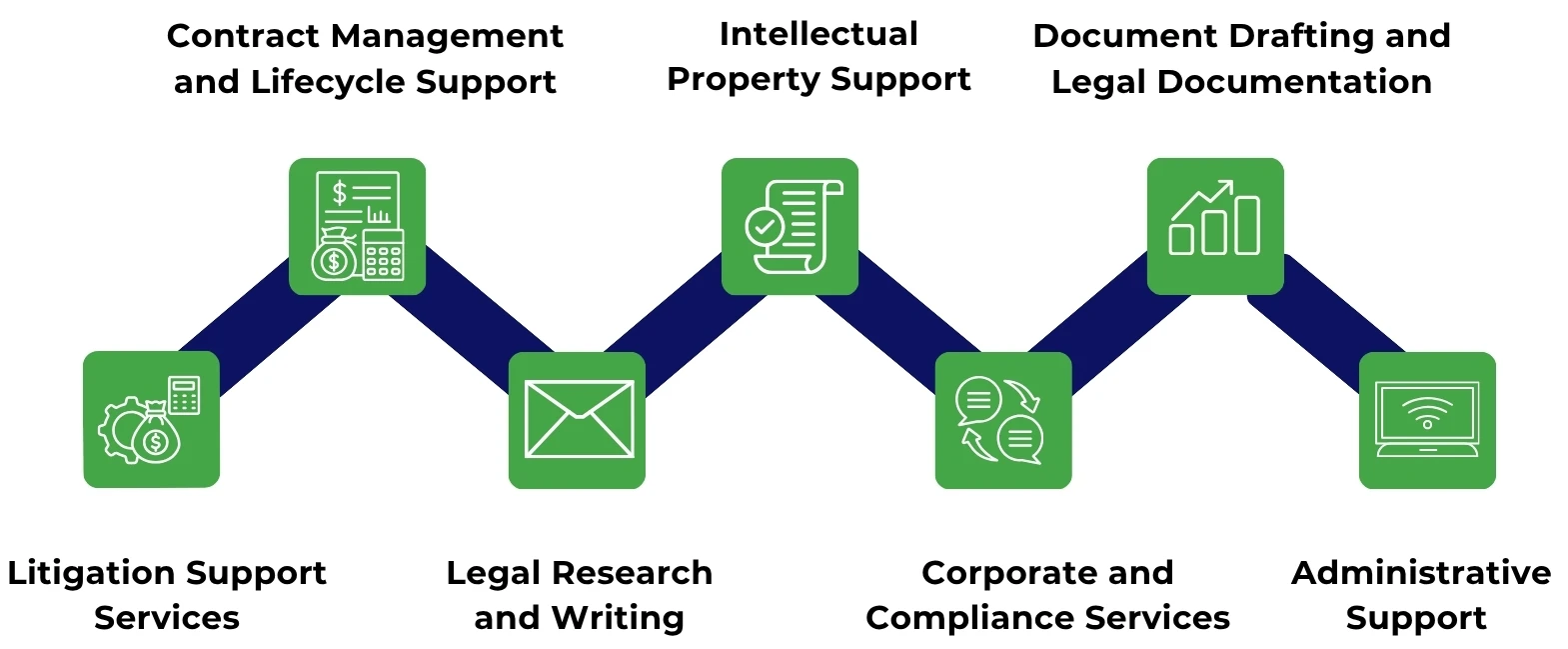
Litigation Support Services
Litigation support in LPO covers document review, eDiscovery coordination, and case preparation to manage scale and reduce review timelines.
Core functions include:
- Document review and privilege review using TAR (technology-assisted review)
- eDiscovery workflows aligned with EDRM and legal hold requirements
- Deposition summaries and case chronology
Executed on platforms like Relativity, Everlaw, DISCO, and Nuix for speed and defensibility.
Contract Management and Contract Lifecycle Support
LPO streamlines contract workflows through abstraction, clause analysis, and playbook-driven review integrated with CLM systems.
Includes:
- Contract abstraction and clause extraction
- Redlining based on predefined playbooks and clause libraries
- Support across NDA, MSA, SOW, and DPA agreements
Integrated with CLM tools like Icertis, Ironclad, DocuSign CLM, and Agiloft.
Legal Research and Writing
LPO supports legal research and drafting with structured, citation-compliant outputs to accelerate advisory and litigation workflows.
Covers:
- Case law research and jurisdictional analysis
- Drafting legal memos and brief support
- Cite-checking aligned with Bluebook or OSCOLA standards
Leveraging tools like Westlaw, LexisNexis, and Bloomberg Law.
Intellectual Property Support
LPO enables IP teams to scale patent and trademark workflows through research, docketing, and prosecution support.
Key areas:
- Patent and trademark search and prior art research
- Docketing and filing support
- Assistance across filings with USPTO, WIPO, EPO
Aligned with frameworks like PCT and the Madrid Protocol for global coverage.
Corporate and Compliance Services
LPO supports compliance-heavy operations with KYC, AML, and regulatory tracking to reduce risk and maintain audit readiness.
Typical scope:
- KYC and AML checks, sanctions screening
- Policy drafting and regulatory monitoring
- Compliance with GDPR, CCPA/CPRA, HIPAA
Delivered under secure environments aligned with SOC 2 Type II and ISO 27001 standards.
Document Drafting and Legal Documentation
LPO standardizes legal documentation through templates and automation, improving consistency and turnaround time.
Includes:
- Drafting NDAs and standard agreements
- Pleadings templates and formatting
- Cite-checking and document consistency
Supported by tools like Microsoft Word (styles), Adobe Acrobat, iManage, and NetDocuments.
Paralegal and Administrative Legal Support
LPO extends operational capacity through paralegal and administrative support across intake, billing, and matter management.
Key functions:
- Matter intake, calendaring, and docketing
- Billing support and eBilling workflows
- Database updates and transcription
Managed through systems like Clio, Onit, and Simple Legal.
What are the Key Benefits of Legal Process Outsourcing Services?
Legal Process Outsourcing (LPO) delivers cost efficiency, faster execution, scalable capacity, and access to specialized legal expertise and technology.
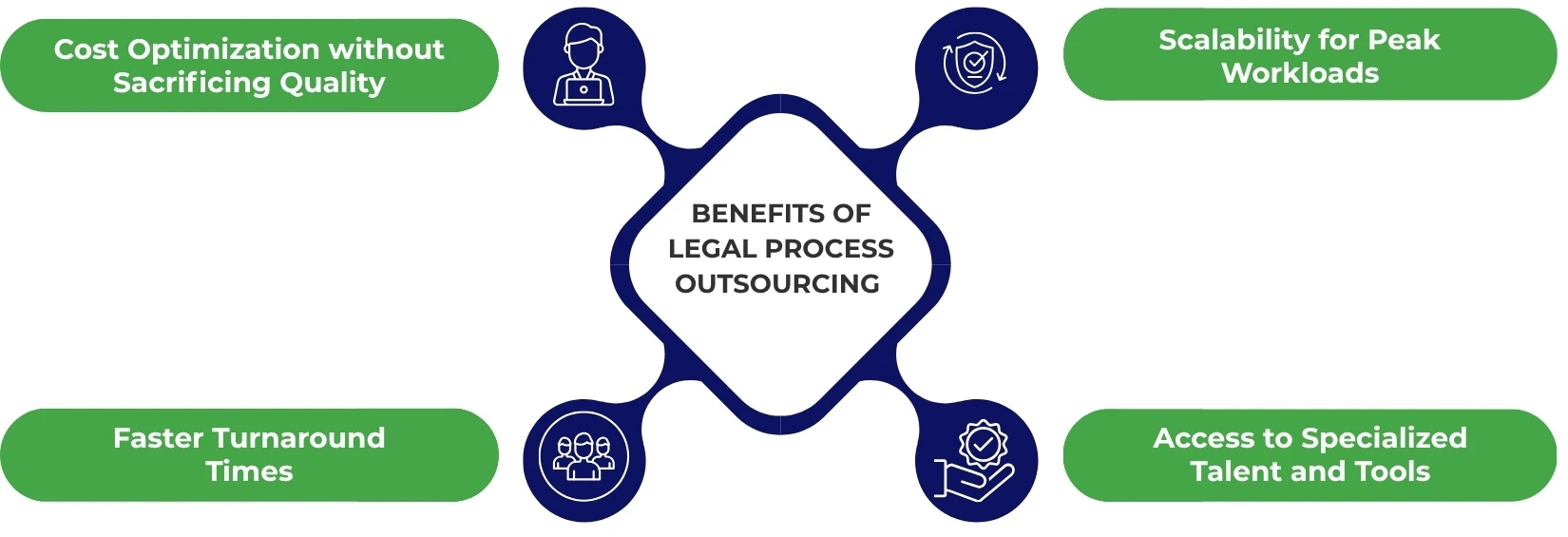
Cost Optimization without Sacrificing Quality
LPO reduces fixed overhead by shifting to flexible pricing models, such as fixed-fee and cost-per-matter, without compromising output quality.
Legal teams are moving away from high internal costs toward structured pricing models, such as alternative fee arrangements (AFAs), rate cards, and fixed-fee engagements.
Faster Turnaround Times
LPO accelerates delivery through global teams, optimized workflows, and automation, significantly reducing turnaround time (TAT).
Using a global delivery model, providers operate follow-the-sun workflows with dedicated teams.
Combined with workflow automation, this compresses turnaround time (TAT) across review, contracting, and compliance tasks.
Scalability for Peak Workloads
LPO enables legal teams to scale instantly during high-demand periods without increasing permanent headcount.
Supports surge scenarios such as:
- Due diligence during M&A
- Second requests (antitrust) and litigation spikes
- High-volume peak contracting cycles
Access to Specialized Talent and Tools
LPO provides immediate access to legal SMEs and advanced tools that are costly to build in-house.
Teams gain:
- Domain-specific SMEs and foreign language review capabilities
- Technology for OCR, data extraction, and analytics
- Platforms like Relativity and enterprise CLM tools
This combination improves accuracy, speed, and insight across complex legal workflows.
What are Common Concerns and Risks (and How to Mitigate Them)
LPO risks around security, quality, communication, and compliance can be mitigated through structured governance, controls, and clear operating frameworks.
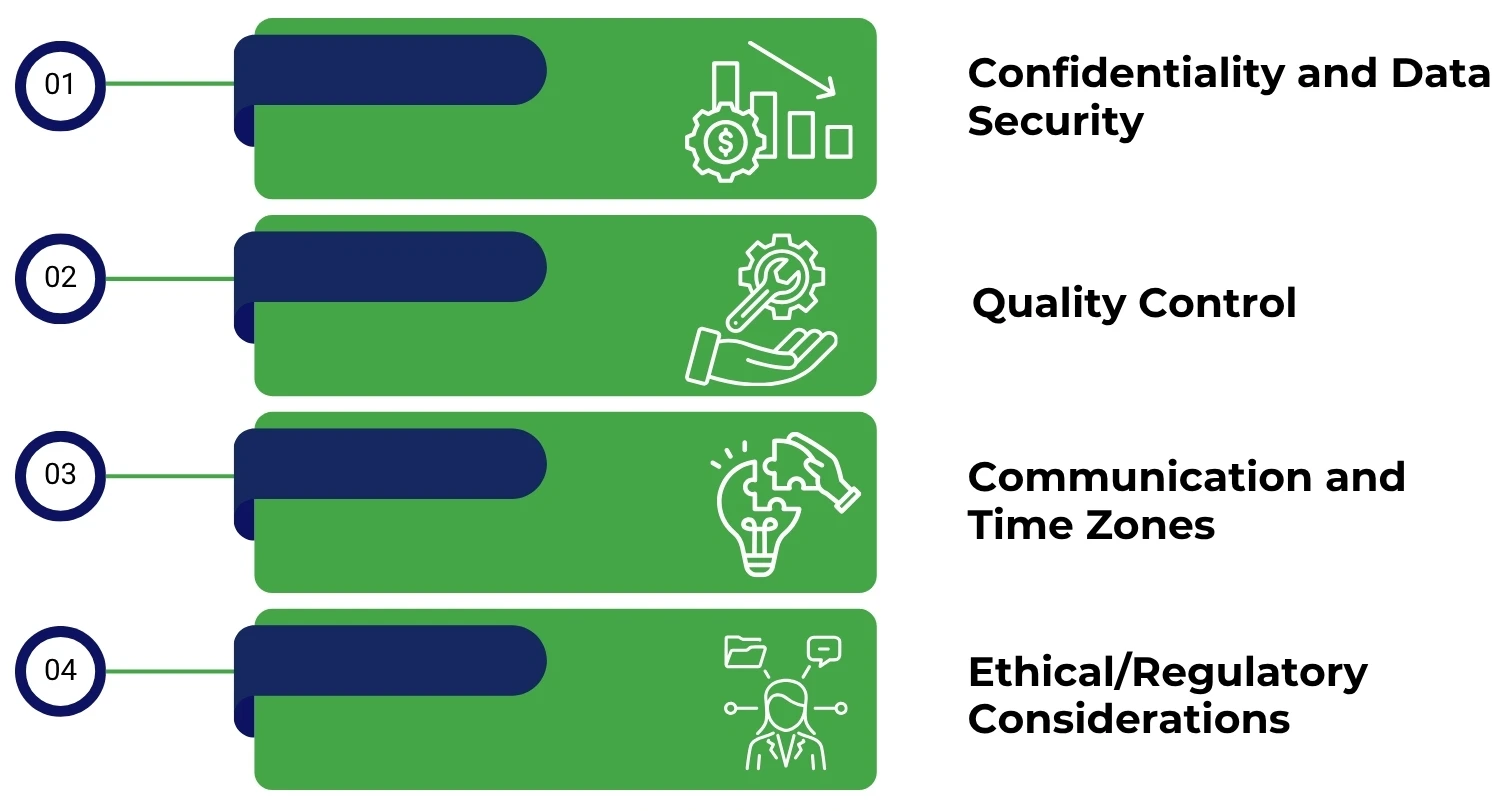
Confidentiality and Data Security
Strong security measures such as NDAs, encryption, and access controls protect sensitive data and preserve the attorney-client privilege in LPO models.
Mitigation requires:
- Enforced NDAs aligned with attorney-client privilege and work product doctrine
- RBAC-based access control and data residency policies
- Encryption at rest/in transit with audited environments
Quality Control
Defined SLAs, structured QA processes, and continuous calibration ensure consistent quality in outsourced legal work.
Execution depends on:
- Clear acceptance criteria within SLAs
- Ongoing QA/QC using a defined sampling plan
- Monitoring error rate and rework rate
Communication and Time Zones
Structured communication models and defined response protocols eliminate delays and misalignment across distributed teams.
Effective setups include:
- Defined overlap hours and response time rules
- Governance via RACI matrix and escalation matrix
- Daily standups and ticketing through systems like Jira or ServiceNow
Ethical/Regulatory Considerations
LPO must operate within strict ethical boundaries, with proper supervision and safeguards against unauthorized practice of law (UPL).
Key controls include:
- Adherence to ABA Model Rules and jurisdictional requirements
- Avoidance of UPL (unauthorized practice of law)
- Robust conflict checks and supervision of non-lawyers
What Tasks Should You Outsource vs. Keep In-House?
Outsource high-volume, process-driven legal work; retain strategic, advisory, and high-risk decisions within in-house legal teams.
Best Candidates for Outsourcing
Repetitive, rules-based, and scalable tasks are ideal for LPO to improve efficiency and reduce internal workload.
Best suited for outsourcing:
- Document review and large-scale review workflows
- Contract abstraction and data extraction
- Due diligence checklists in transactions
- Ongoing compliance monitoring
Keep In-House When
Strategic, high-risk, and client-facing legal work should remain in-house to maintain control, judgment, and accountability.
Retain internally:
- Litigation strategy and case positioning
- Settlement authority and negotiation
- Complex regulatory advice
- Courtroom advocacy and client counsel
How to Choose the Right Legal Process Outsourcing Provider
Choosing the right LPO provider requires clear scope definition, domain alignment, strong governance, and validated performance through structured evaluation.
Step 1 — Define Scope and Success Metrics
Clear scope and measurable KPIs ensure alignment on outcomes, performance, and expectations from the outset.
Define:
- Work volume and expected throughput
- Target TAT (turnaround time) and accuracy %
- Acceptable backlog thresholds
Step 2 — Evaluate Expertise and Domain Fit
Domain expertise determines accuracy, speed, and the provider’s ability to handle complexity without rework.
Assess:
- Industry specialization (e.g., financial services, healthcare)
- Experience across contract types (MSA, SOW, DPA) and case types
- Access to SMEs and multilingual capability
Misalignment here directly impacts quality and efficiency.
Step 3 — Validate Security and Compliance
Robust security and compliance frameworks are non-negotiable for handling sensitive legal data.
Verify:
- Certifications like SOC 2 Type II and ISO 27001
- Regular pen testing and a documented incident response plan
- Controls around data residency and audit logs
Business continuity via BCP/DR
Step 4 — Review Operating Model and Team Structure
The delivery model determines scalability, accountability, and long-term success of the engagement.
Evaluate:
- Dedicated vs shared teams
- Defined roles: delivery manager, account manager
- Structured onboarding and ongoing training
- Clear governance cadence and escalation paths
Strong operating models reduce friction and variability.
Step 5 — Pilot Project Before Full Rollout
A pilot validates capability, benchmarks quality, and reduces implementation risk before scaling.
Run a POC/pilot with:
- Defined sample size and acceptance criteria
- Agreed timeline and measurable outputs
- Benchmarking against internal standards
- Calibration sessions using a gold standard set
This establishes baseline performance.
Step 6 — Pricing and Contract Terms to Compare
Transparent pricing models prevent cost overruns and align incentives with outcomes.
Compare:
- Per-hour, per-unit pricing, and fixed-fee models
- Monthly retainer structures
- Hidden costs: tooling, QA, rework
Provider Evaluation Checklist
Use this as a final filter:
- SLAs are defined for KPIs, TAT, and error rate
- Documented QA process with sampling, dashboards, and audit trails
- Proven tool stack (e.g., Relativity, Everlaw, Icertis, Ironclad)
- Flexible delivery: onshore, offshore, or nearshore within a global delivery model
- Verified references and case studies with similar-industry proof
- Security backed by SOC 2, ISO 27001, and GDPR readiness
What are Pricing Models for Legal Process Outsourcing Services?
LPO pricing depends on structure, complexity, and volume, with ROI driven by lower cost per matter and improved team utilization.
Typical Pricing Structures
LPO uses hourly, per-unit, and fixed-fee models based on workload predictability and scope clarity.
- Time & materials (hourly)
- Per-unit pricing (per document/contract)
- Fixed-fee / fixed bid
- Subscription or retainer under a managed services agreement
What Drives Cost Up or Down
Costs vary based on complexity, urgency, data types, and quality control requirements.
- Privilege intensity and sensitivity
- Data types (email, chat, PDF)
- Language requirements
How to Estimate ROI
ROI comes from reduced costs, faster cycle times, and freeing internal teams for higher-value work.
- Lower cost per matter
- Faster cycle time
- Improved utilization rate
- Cost avoidance and better opportunity cost allocation
Best Practices for Implementing LPO Successfully
Successful LPO requires structured workflows, clear governance, performance tracking, and continuous optimization to sustain quality and scale.
Create SOPs and Playbooks
Standardized SOPs and playbooks ensure consistency, reduce errors, and enable scalable execution across legal workflows.
Set Up a Clear Workflow
Defined workflows eliminate ambiguity and ensure smooth execution of tasks across internal and external teams.
Include:
- Structured matter intake and intake forms
- Task routing via ticketing systems
- Clear approvals, version control, and integration with DMS
Measure Performance Monthly
Ongoing measurement ensures accountability, identifies gaps, and maintains service quality.
Track:
- Error rate and rework %
- Turnaround time and throughput
- Insights via dashboards, KPIs, and QA audits
Use variance analysis and RCA (root cause analysis) to fix recurring issues.
Build a Continuous Improvement Loop
Continuous improvement frameworks help refine processes, enhance accuracy, and adapt to evolving legal needs.
Establish:
- Regular calibration sessions
- Updated knowledge base and training cycles
- Feedback loops for ongoing optimization (continuous improvement / Kaizen-light)
FAQs About Legal Process Outsourcing Services
Conclusion
Legal Process Outsourcing (LPO) enables legal teams to offload process-driven work, optimize costs, and scale operations through structured, managed legal services.
LPO is most effective when applied to high-volume, repeatable tasks while retaining strategic work in-house.
Move from evaluation to execution with a structured approach:
- Request a workflow assessment to identify outsourcing opportunities and efficiency gaps
- Get a pilot project quote to validate delivery, quality, and scalability
- Download a vendor scorecard to compare providers across capability, security, and performance