


Most outsourcing failures don’t come from choosing the wrong partner. They stem from failing to ask the right questions up front.
For midmarket leaders, outsourcing is often driven by capacity gaps, hiring challenges, or complexity. But too often it’s treated as a vendor search rather than a strategic redesign.
Outsourcing doesn’t solve unclear operating models. It exposes them.
Before comparing providers, ask these questions. The answers determine whether outsourcing creates leverage or adds complexity.
We’ve gathered insights from CFO peers who’ve successfully navigated this; their experience reinforces one truth: clarity of your model matters more than the name on the contract.
Why Most Outsourcing Decisions Fail
In the “Muddy Middle” (100–1,000 employees; $100M–$1B), conversations start with whom to partner, not with what needs to change. Outsourcing is positioned as adding capacity rather than redesigning work. Controls and visibility are addressed reactively.
Even a strong partner can’t fix an unclear model. Clarity starts before you choose.
Five Questions That Define the Outcome
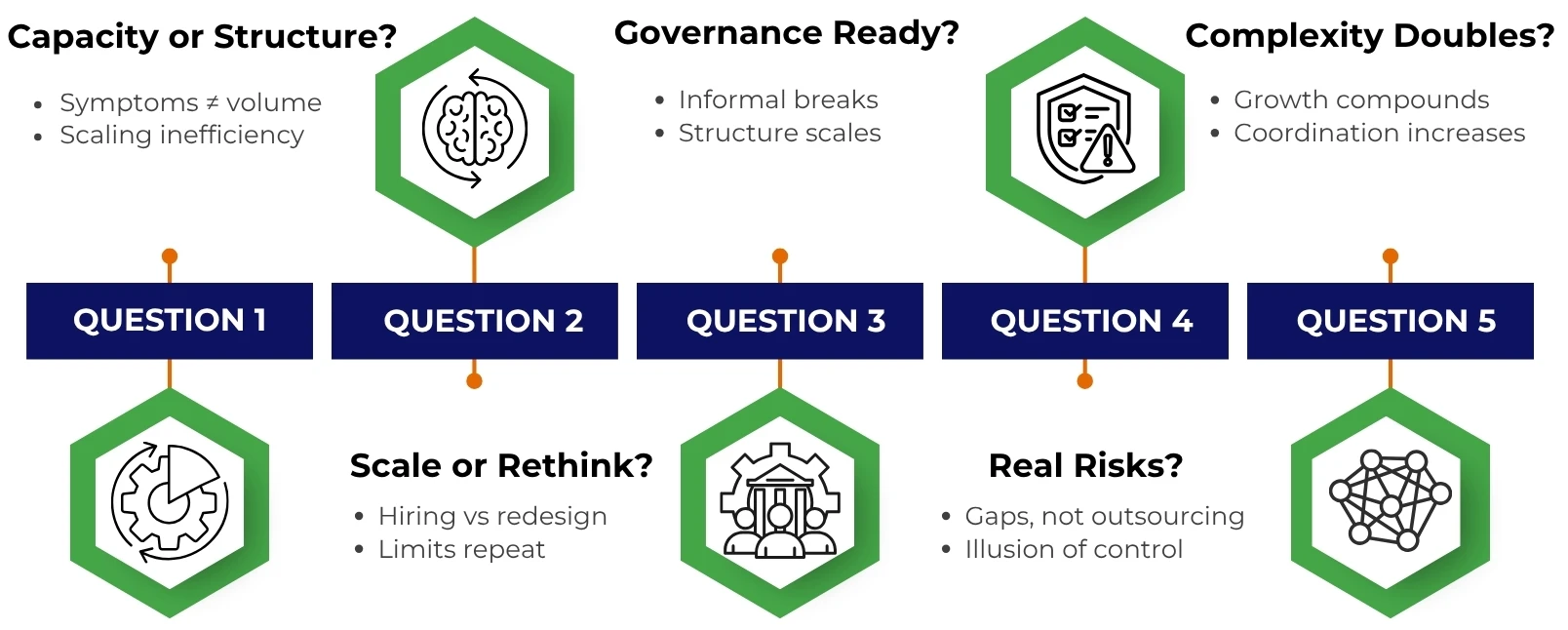
1. Capacity or Structural Problem?
Symptoms like backlogs and stretched teams are often structural, not volume driven.
- CFO insight: “Use outsourcing as a scaling strategy—manage volume and complexity in healthy operations, not as a fix for broken processes.”
If the issue is structural, adding capacity (internal or outsourced) only reinforces it.
2. Scaling Headcount or Rethinking the Model?
Outsourcing is often treated like hiring. At a certain stage, the real question is whether your finance model still fits.
- CFO insight: “Design an integrated operating model—seamless workflows between internal leadership and external execution.”
Using outsourcing to extend the current model replicates its limits. Using it to rethink the model removes them.
3. Do we have Governance to Scale?
Processes that evolved organically may work today, but break under higher complexity.
- CFO insight: “Structure governance to overcome skepticism—build clear controls and accountability, don’t resist outsourcing itself.”
Outsourcing doesn’t create scalability; it depends on whether the underlying model is structured to support it.
4. What Risks are we Really Protecting Against?
Risk concerns (control, visibility, quality) often mask a lack of underlying structure.
- CFO insight: “Start with transactional functions—begin with routine tasks, establish governance, then expand strategically.”
Outsourcing doesn’t introduce risk; it removes the illusion of control where structure doesn’t exist.
5. What Happens when Complexity Doubles?
Growth compounds complexity. The question isn’t whether the function works today, but whether it can sustain a much higher level tomorrow.
- CFO insight: “Unlock ROI through leadership capacity—shift finance leaders from execution to FP&A and strategic decision making.”
If the model isn’t built to scale, adding resources increases coordination overhead rather than agility.
What Changes When You Get It Right
When outsourcing aligns with a clear operating model:
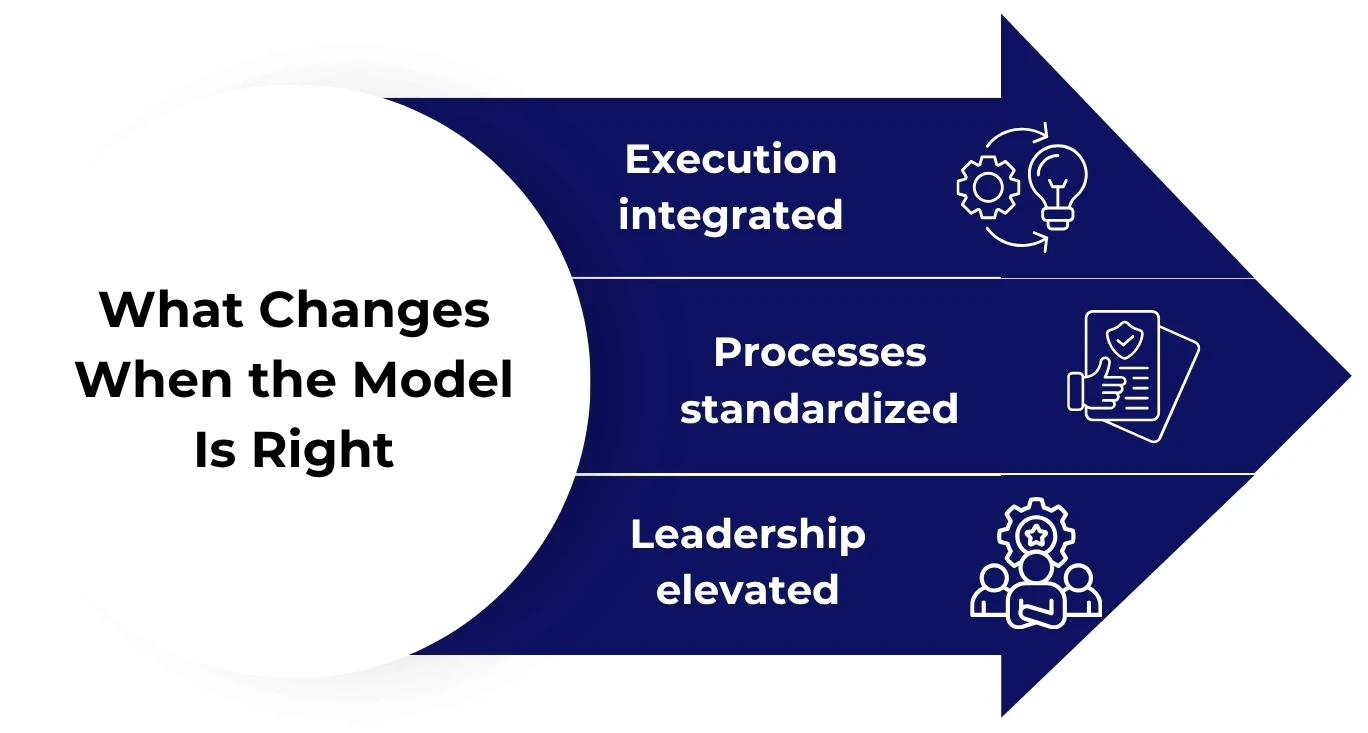
- Execution becomes integrated, not managed externally.
- Processes become consistent and repeatable.
- Leadership shifts from oversight to strategy.
CFOs who’ve done this didn’t just gain capacity—they built a finance function that scales.
What to Look for in a Partner (The Premier NX Difference)
For midmarket leaders, the right partner offers:
- Strategic fit – immersed in your growth goals and tech roadmap.
- Midmarket understanding – enterprise capabilities without bureaucracy.
- End-to-end capability – from AP to FP&A under one model.
- Human in the loop + tech – AI efficiency with judgment and trust.
- Proven compliance – SOC 2, ISO, GDPR, clear data governance.
- Start small, scale fast – seamless onboarding, infrastructure to grow.
- Measurable outcomes – faster close, improved DSO, audit readiness.
- Cultural & time zone fit – a true extension of your team.
- Continuous innovation – thought leadership that moves you forward.
Define the Model Before the Partner
Outsourcing is a design decision, not just a vendor choice. When your current model no longer aligns with your scale, the first step isn’t evaluating providers—it’s defining what needs to change:
- Where is the model breaking under pressure?
- What should be standardized, not managed?
- What should leadership no longer have to oversee?
A structured evaluation with Premier NX brings clarity to where your model stands today and what it needs to become next. We help you answer the right questions first, so that when you’re ready to choose a partner, the choice is obvious.
About the Author

As CEO, Ali Din oversees the overall strategy and direction for Premier NX. With senior leadership roles at global HR and recruiting platforms, Indeed and ADP. Ali has over 25 years of experience in the IT and advanced technology sector. Ali’s time is focused on transformation in the business, both for professional development and for clients, to enhance business outcomes.