

Key Takeaways
- 1Most companies have enough CX data; the real gap is turning insight into action.
- 2Dashboards, VoC, and frontline teams often stay disconnected from daily operations.
- 3Better CX operators reduce decision latency through ownership, workflows, QA, and coaching.
Customer experience data does not improve CX unless it changes how the business operates. Dashboards, CSAT, NPS, QA scores, support tickets, call recordings, CRM notes, and sentiment analysis create visibility. Still, CX improves only when those signals influence staffing, coaching, escalation, quality assurance, and frontline execution.
Most mid-market companies can now clearly see customer friction. The harder challenge is reducing the distance between insight and action.
For many organizations, customer intelligence is accumulating faster than teams can operationalize it. Reports are more detailed. Dashboards are more advanced. But customers still repeat themselves, escalations still rise, and leaders still ask why the business “knows” so much but improves so slowly.
Why CX Data Fails to Improve Customer Experience
CX data fails when it remains separate from daily operations.
The issue is rarely the dashboard itself. The issue is what happens after the dashboard reveals a pattern. If customer insights do not influence staffing decisions, frontline coaching, escalation paths, QA standards, or service recovery workflows, the business becomes better at observing customer problems than resolving them.
For mid-market companies operating in the muddy middle, this gap is costly. Customers expect enterprise-level responsiveness, but internal teams often work with lean resources, fragmented systems, and limited capacity for transformation.
Forrester’s 2025 CX Index found that customer experience quality in North America declined for the fourth consecutive year, reaching an all-time low.
In the U.S., 25% of brands saw CX scores decline, while only 7% improved.1
Use the CX Insight-to-Action Scorecard to evaluate how effectively your organization turns customer signals into staffing decisions, escalation handling, QA improvements, and frontline execution.
The Gap Between CX Insight and Operational Action
The core issue is the distance between what a company knows about customer friction and how quickly it can act on that knowledge.
This gap matters because customer experience is no longer only a service issue. It is an operating model issue.
A company may know that CSAT is declining, complaints are increasing, or escalations are concentrated around a specific journey stage. But unless that insight changes ownership, workflows, staffing, coaching, or QA, the customer experience remains largely unchanged.
The practical question for leaders is simple:
Does our CX data change how we operate, or does it only describe what already happened?
Where CX Data Breaks Down Operationally
CX data usually falls into three categories: Dashboards, Voice of Customer programs, and Frontline Execution.
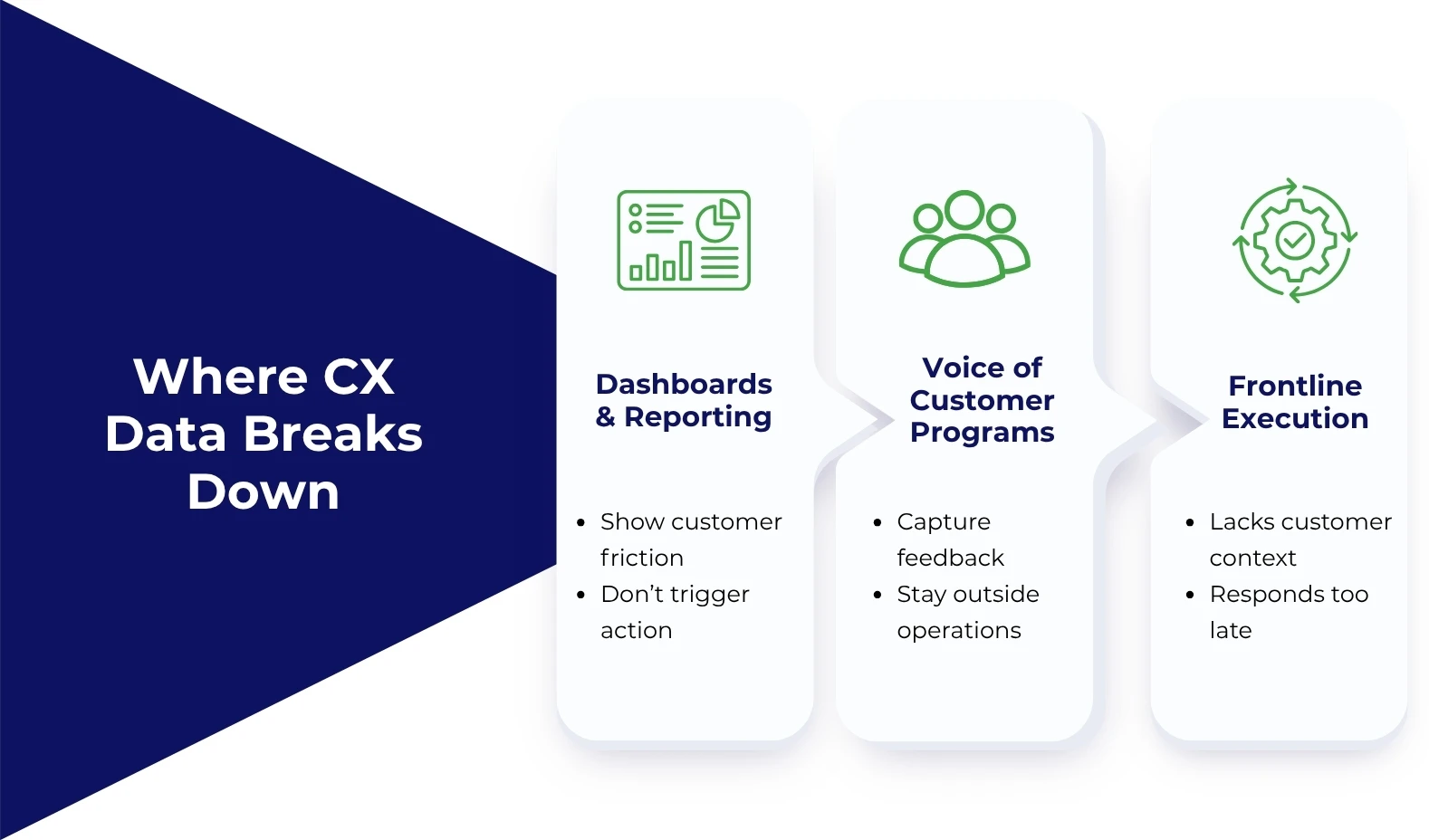
Dashboards Inform, But Do Not Drive Decisions
Dashboards create visibility, but visibility alone does not improve customer experience.
Many CX metrics remain observational. CSAT declines are discussed but not tied to corrective action. Escalation trends are identified but not assigned to accountable owners. Reporting cycles explain what happened rather than changing what happens next.
Customer experience improves when metrics trigger operational change, not when they generate better reporting.
Voice of Customer Lives Outside Operations
Voice of Customer programs collect customer feedback through surveys, reviews, support interactions, social channels, and sentiment analysis.
The problem is that feedback often lives outside the teams responsible for fixing the experience. Marketing may own surveys. CX may own sentiment. Operations may own delivery. Support may own escalations.
The customer experiences one company. Internally, the organization manages separate functions.
Voice of Customer becomes valuable when it influences workforce management, QA frameworks, escalation processes, training, and service design. Otherwise, feedback becomes archival instead of actionable.
Customer Intelligence Stops Before the Frontline
In many organizations, executives have more visibility into customer friction than the teams speaking with customers every day.
That creates operational latency. Agents may lack context. Supervisors may react only after an issue escalates. Frontline teams may optimize tasks without understanding the broader impact on customers.
The companies improving CX faster are reducing the distance between analytics, workflows, AI-enabled support, and human decision-making.
What Better CX Operators Do With Data
Better CX operators use data to reduce decision latency. They do not simply collect more information; they create stronger connections between customer signals and operational response.
High-performing CX models do four things well: recognize friction quickly, prioritize operational impact, assign ownership, and change the response through staffing, coaching, QA, workflows, or automation rules.
The advantage is not more visibility. The advantage is organizational responsiveness.
How AI Helps Turn CX Data Into Action
AI-enabled CX should improve operational judgment, not remove people from the experience.
The most effective AI models help teams surface customer context, detect friction patterns, summarize interaction themes, route issues faster, and reduce operational noise. But human teams still own trust, judgment, escalation, empathy, and relationship management.
This is where human-in-the-loop CX matters. AI can help identify what is happening at scale. People still decide how to respond when customer trust, risk, emotion, or brand reputation is involved.
The goal is not automation for its own sake. The goal is operational clarity at scale.
Premier NX Perspective: CX as an Operating Capability
Premier NX helps mid-market organizations turn customer intelligence into operational action.
Rather than treating CX as a standalone support function, Premier NX connects customer experience, analytics, operational support, and AI-enabled workflows into a more responsive operating model.
That includes AI-infused customer experience, multichannel customer engagement, analytics and operational insights, QA and escalation support, frontline workflow support, and human-in-the-loop operating models.
For Premier NX, the future of CX is not more reporting. It is the ability to connect analytics with execution, reduce decision latency, and support customers with both technology and human judgment.
Turn Customer Signals Into Faster Operational Action
CX data only creates value when it helps the business recognize patterns, escalate risks, and respond before customer friction becomes a larger trust issue.
For mid-market organizations, the next phase of CX is not more reporting. It is the ability to connect customer intelligence with the teams responsible for action: operations, quality, frontline support, escalation owners, and leadership.
The strongest CX models do more than measure complaints, CSAT, NPS, QA scores, and sentiment. They help the business see what customers are already signaling and respond with greater speed, consistency, and accountability.
Assess Your CX Operating Model
If you want a clearer view of whether your CX operating model can turn customer signals into timely action, book a complimentary CX operating model review with our team.
We’ll evaluate how concerns move from intake to visibility to escalation, where customer intelligence slows down, and whether your workflows, QA processes, support model, and reporting structure are helping teams act before patterns become larger customer or brand risks.
Then we’ll outline practical next steps to improve coordination, consistency, responsiveness, and scale.