


Your company has reached $200M in revenue—but your back office still runs like it’s $50M.
Finance is reactive. HR is stretched. Data is fragmented. Your top talent is buried in administrative work instead of driving growth. Opportunities are missed. Risk builds quietly.
Many mid-market leaders recognize the need to evolve, but myths about back office outsourcing keep them tied to labor-heavy models that limit agility, visibility, and scale.
At Premier NX, we’ve helped mid-market firms navigate this exact transition. What we’ve consistently found is that breaking through these myths is the first step toward building a more resilient and growth-ready operation.
The Myth vs. The Reality
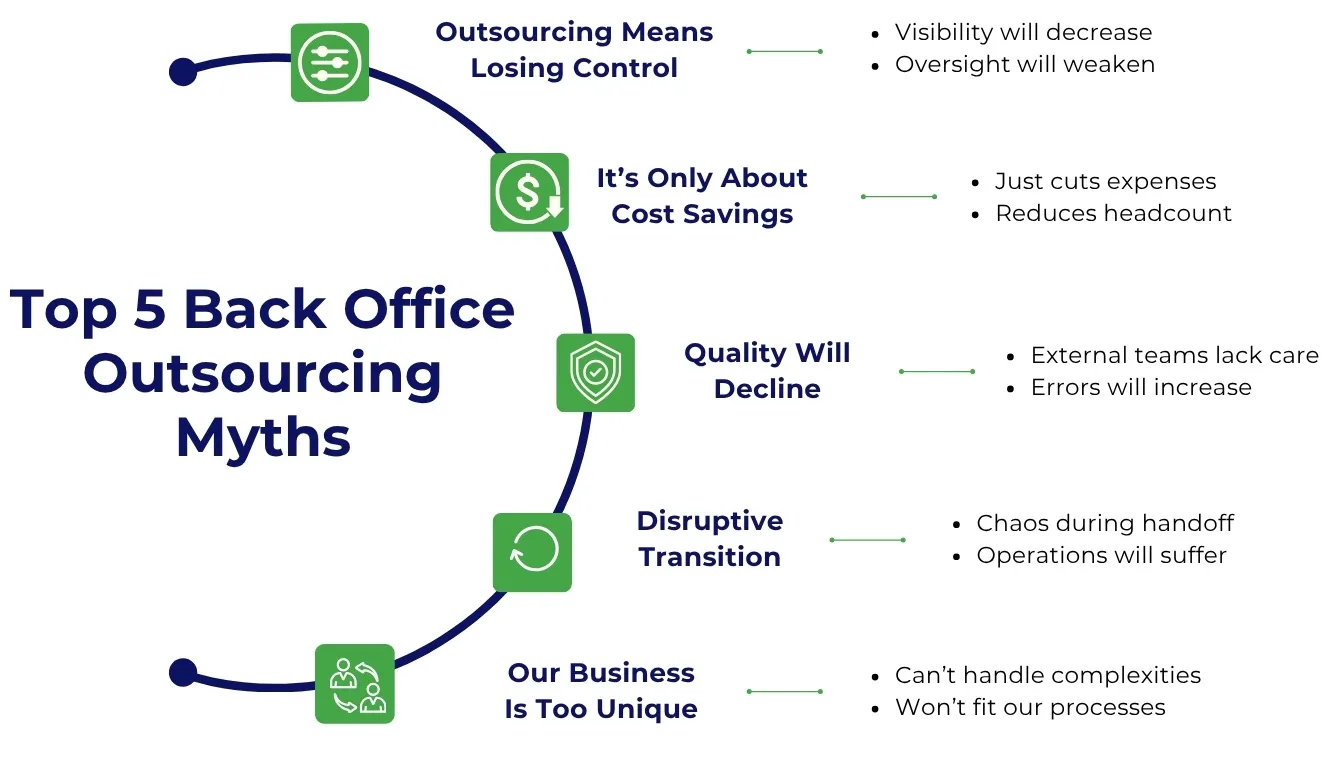
Myth 1: Back-Office Outsourcing Means Losing Control
You’ll hand over your operations to a faceless vendor and lose visibility into critical business functions.
Reality: Modern outsourcing provides structured, performance-based controls that are often superior to internal management.
Today’s top outsourcing models are build on Governance by Design. That means control is systematized:
- Service Level Agreements (SLAs): Every outcome is defined, measured, and tied to business performance, not effort.
- Real-Time Dashboards: You gain continuous visibility into workflows, KPIs, and exceptions—without waiting for a monthly report.
- Dedicated Team Model: You don’t get a call center. You get a small, consistent group of professionals embedded in your business context.
- Regular Business Reviews: Strategic check-ins ensure alignment, adaptation, and forward momentum.
For companies with 100–500 employees, this model often provides greater visibility and accountability than relying on overstretched internal teams to juggle daily execution and ad hoc reporting.
When was the last time you had real-time visibility into all your back-office operations—or were you relying on fragmented updates from already busy managers?
Myth 2: It’s Only About Cost Reduction
The primary value of outsourcing is cutting expenses through labor arbitrage.
Reality: Strategic outsourcing transforms cost centers into capability engines that drive growth.
For forward-looking organizations, cost efficiency is only the starting point. The true return comes from what outsourcing enables—speed, precision, and strategic focus. Modern partnerships activate three value levers that go well beyond expense management:
- Operational Excellence: Streamlined processes, improved accuracy, and builtin compliance standards that raise overall performance.
- Strategic Bandwidth: Internal leaders can redirect focus to initiatives that grow revenue and advance the business.
- Scalable Infrastructure: Access to enterprise-grade systems and talent without the fixed cost or complexity of building them internally.
Outsourcing allows mid-market firms to redeploy valuable internal capacity toward strategic initiatives—unlocking greater business value over time.
For growth stage companies, the greater risk isn’t the cost of doing the work externally—it’s the lost opportunity of keeping top talent trapped in routine operations.
Myth 3: Quality Will Suffer with External Teams
External providers can’t match the quality and care of internal employees.
Reality: Specialized providers often deliver higher quality through standardized processes and dedicated expertise.
Quality doesn’t decline with outsourcing—it scales. The best providers build performance into the process itself through what we call the Quality Multiplier Effect:
- Standardized Processes: Every task follows defined procedures—not tribal knowledge or workaround habits.
- Specialized Expertise: Teams bring depth in specific functions, not generalist support spread thin.
- Continuous Improvement: Optimization isn’t a side project—it’s a requirement baked into service delivery.
- Quality Assurance Layers: Structured checkpoints catch errors before they become issues.
While internal teams often juggle competing priorities, external teams are designed to execute with singular focus and measurable precision—raising the ceiling on what consistent quality looks like.
Are your current quality standards defined by what’s possible—or by what your overburdened team can manage?
Myth 4: The Transition Will Be Too Disruptive
Migrating operations will cause chaos and interrupt business continuity.
Reality: A phased, methodical approach minimizes disruption while building toward long-term stability.
Leading partners follow a Staged Transition Methodology that maintains continuity while laying the foundation for long-term success:
- Phase 1: Process Documentation & Parallel Run
Map current workflows, identify risk points, and run shadow operations for calibration. - Phase 2: Phased Handoff with Hyper-Care
Transition responsibilities in controlled waves, with high-touch support and immediate feedback loops. - Phase 3: Optimization & Continuous Improvement
Refine processes, automate tasks, and introduce performance benchmarks that drive sustained results.
The difference isn’t just process—it’s experience. The right partner has guided dozens of transitions and knows where disruptions typically emerge—and how to prevent them.
Myth 5: Our Business Is Too Unique to Outsource
Our processes are too specialized or industry-specific for external providers to understand.
Reality: The best partners specialize in adapting their models to unique business contexts—not forcing standardization.
Complexity isn’t a disqualifier—it’s the case for outsourcing. The most effective partners embrace uniqueness through an Adaptive Partnership Model that aligns to your environment rather than asking you to conform to theirs:
- Deep Immersion: Teams learn your culture, workflows, and business priorities from day one.
- Customized Solutions: Processes are tailored to your operating model—not a generic playbook.
- Industry Expertise: Cross-sector experience provides an outside perspective to challenge inefficiencies.
- Flexible Scaling: Support adjusts in pace and scope as your business changes.
Your uniqueness doesn’t require protection from outside help—it demands the right kind of partner.
In fact, the very processes you consider too complex are often the ones most in need of fresh perspective and structured execution.
Back Office Outsourcing Myths Debunked
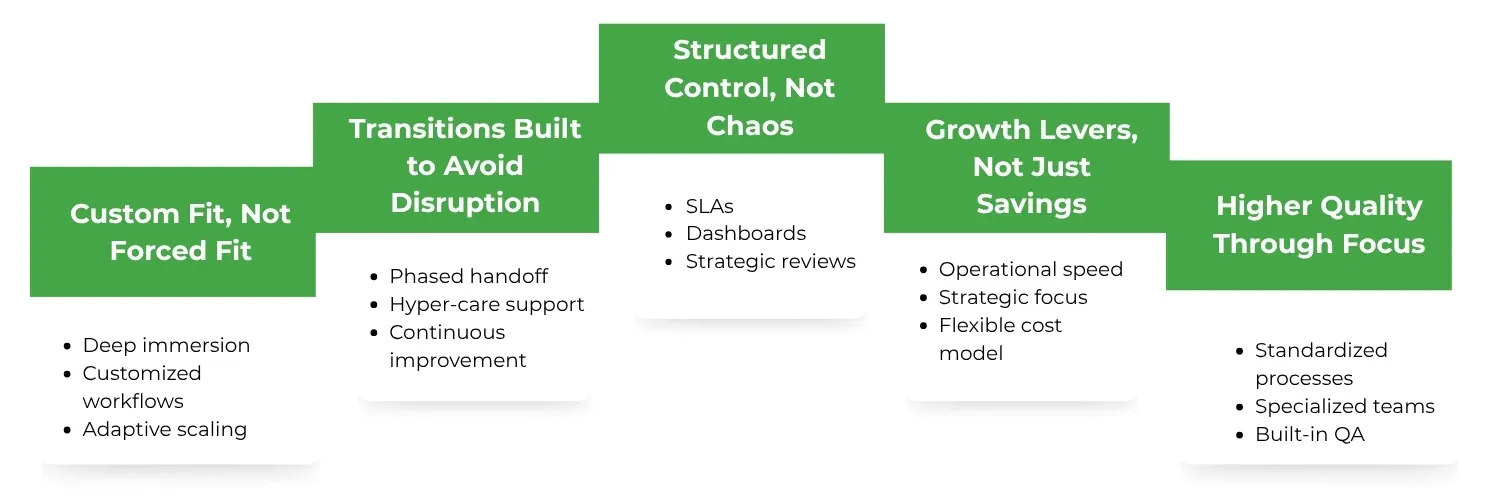
From Operational Burden to Strategic Advantage
When viewed through the lens of these modern realities, back-office outsourcing isn’t a cost-cutting tactic—it’s a strategic lever for growth. The myths that once stalled progress now give way to models built for control, quality, and scale.
At Premier NX, we specialize in helping mid-market companies shift from operational strain to strategic momentum. Our difference lies in:
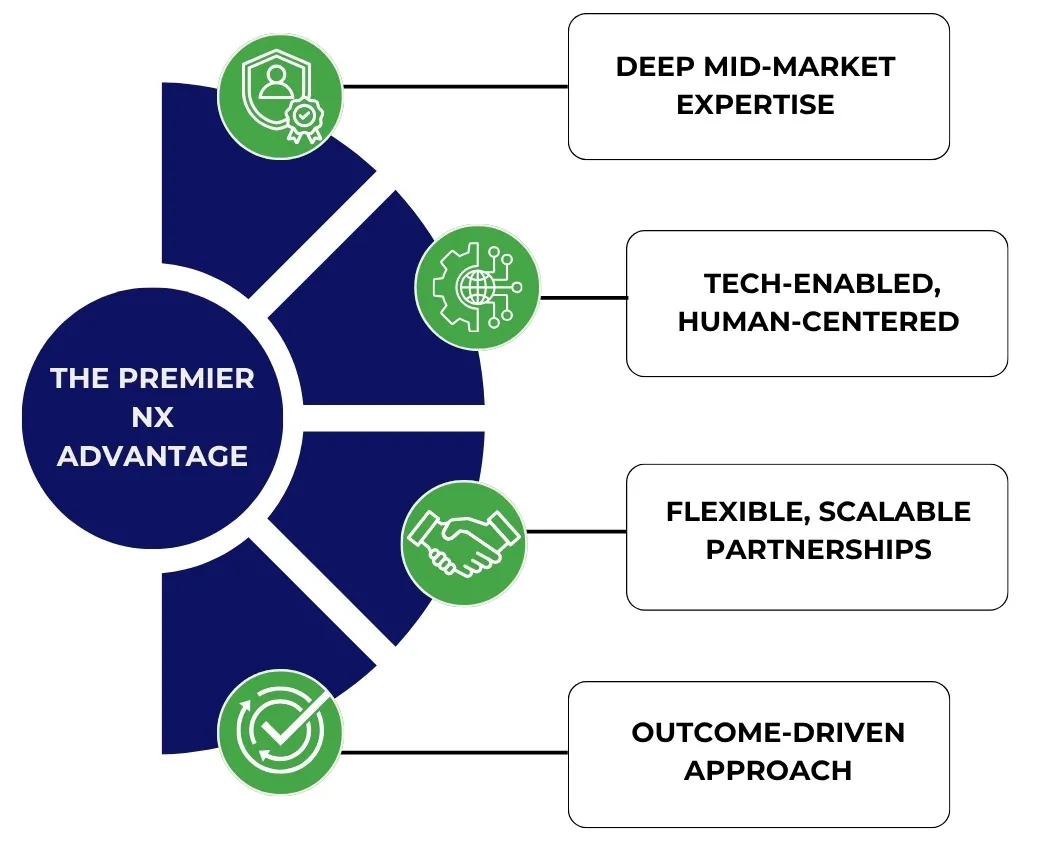
- A deep understanding of mid-market dynamics
- A tech-enabled, human-centered delivery model
- Flexible, scalable partnerships—not one-size-fits-all solutions
- An unwavering focus on measurable outcomes, not activity
What could your organization achieve if your leadership team were freed from back-office firefighting and focused entirely on growth?
Ready to separate fact from fiction in your back-office operations? Schedule a consultation with our experts to build a tailored model that aligns with your business ambitions.