


Every mid-market boardroom today echoes the same ambition: harness AI to drive growth, efficiency, and better customer experiences. Yet many leaders find themselves in what we call the “Muddy Middle”—a space where ambition meets constrained resources, fragmented data, and complex technology topographies.1 It’s not a lack of ambition that holds mid-market leaders back; it’s the need for a clear, practical roadmap to guide execution.
Mid-market companies often struggle with:
- Resource constraints: Limited budgets and capacity for experimentation.
- Talent constraints: Difficulty attracting and retaining AI-literate staff, with minimal investment in upskilling.
- Fragmented data and systems: Siloed systems and inconsistent records make integration and analytics challenging.
According to MIT research, as many as 95% of AI pilots fail—not due to flawed technology, but due to challenges in integrating AI into existing systems and workflows.2 For mid-market organizations, these challenges are magnified: internal teams are stretched, vendors are numerous, and resources are limited. The key question is how to adopt AI thoughtfully without overextending capacity.
Practical Challenges and Approaches for AI Adoption
Even experienced leaders face tangible constraints. Recognizing these realities can inform a structured, realistic approach to AI adoption.
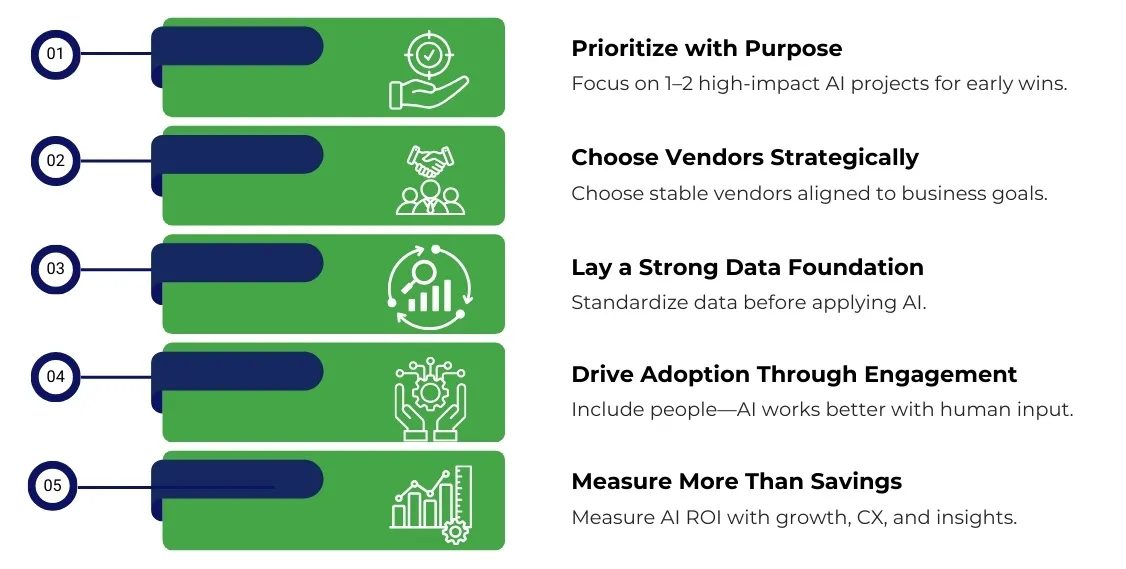
1. Limited Resources Require Strategic Focus
It’s tempting to pursue enterprise-wide AI transformation. Yet for mid-market companies, spreading teams too thin often slows progress and increases risk.
Suggested Approach: Start with one or two high-impact initiatives that deliver measurable value quickly, such as automating knowledge bases, streamlining HR workflows, or improving customer touchpoints. Early results build momentum and internal confidence.
2. Vendor Selection Can Make or Break Outcomes
The AI landscape is crowded with emerging vendors and flashy solutions. Choosing a tool without considering long-term stability or integration capabilities can result in wasted effort and delayed ROI.
Suggested Approach: Choose partners with proven operational experience and alignment to business objectives. Consider long-term stability and integration capabilities rather than short-term features.
3. Data Complexity is the Hidden Barrier
AI cannot deliver insights from silos, inconsistent records, or unstructured sources. Data issues often manifest as stalled projects or inaccurate predictions.
Suggested Approach: Standardize and integrate key datasets before layering AI solutions. A clear data foundation reduces risk and accelerates value.
4. People and Adoption Matter as Much as Technology
Resistance is natural if employees feel excluded or fear replacement. A solution without engagement rarely drives sustainable outcomes.
Suggested Approach: Engage frontline teams throughout planning and execution. A Human-in-the-Loop approach helps employees view AI as a support tool rather than a replacement.
5. Focusing Solely on Cost Can Limit Value
Efficiency gains are compelling, but cost reduction alone underestimates AI’s potential. Mid-market leaders risk missing growth opportunities or customer insights if they focus narrowly on savings.
Suggested Approach: Evaluate success using multiple KPIs, including operational efficiency, customer satisfaction, predictive insights, and revenue impact, in addition to cost savings.
Turning Insight into Structured Action for AI Success
Successful AI adoption comes from structured execution, not isolated technology investments. Organizations benefit from a structured approach that combines operational rigor, data readiness, and human collaboration.
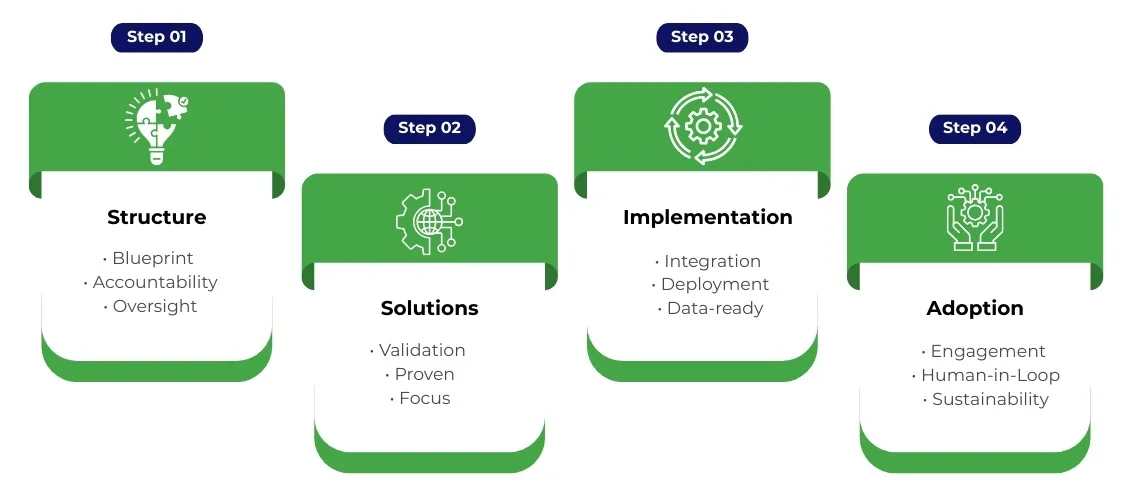
- Bring Structure to Complexity: Solution Architects translate ambition into actionable blueprints. Our Program Management Office (PMO) ensures execution stays on track, reducing risk and clarifying accountability.
- Prioritize Proven Solutions: Through our AI Innovation Lab, we validate technologies against real-world use cases, helping leaders cut through the noise and focus on what works.
- Enable Seamless Implementation: We handle integration, deployment, and data readiness so internal teams can concentrate on strategy and business outcomes.
- Support Sustainable Adoption: A Human-in-the-Loop model ensures solutions are embraced, delivering lasting value beyond installation.
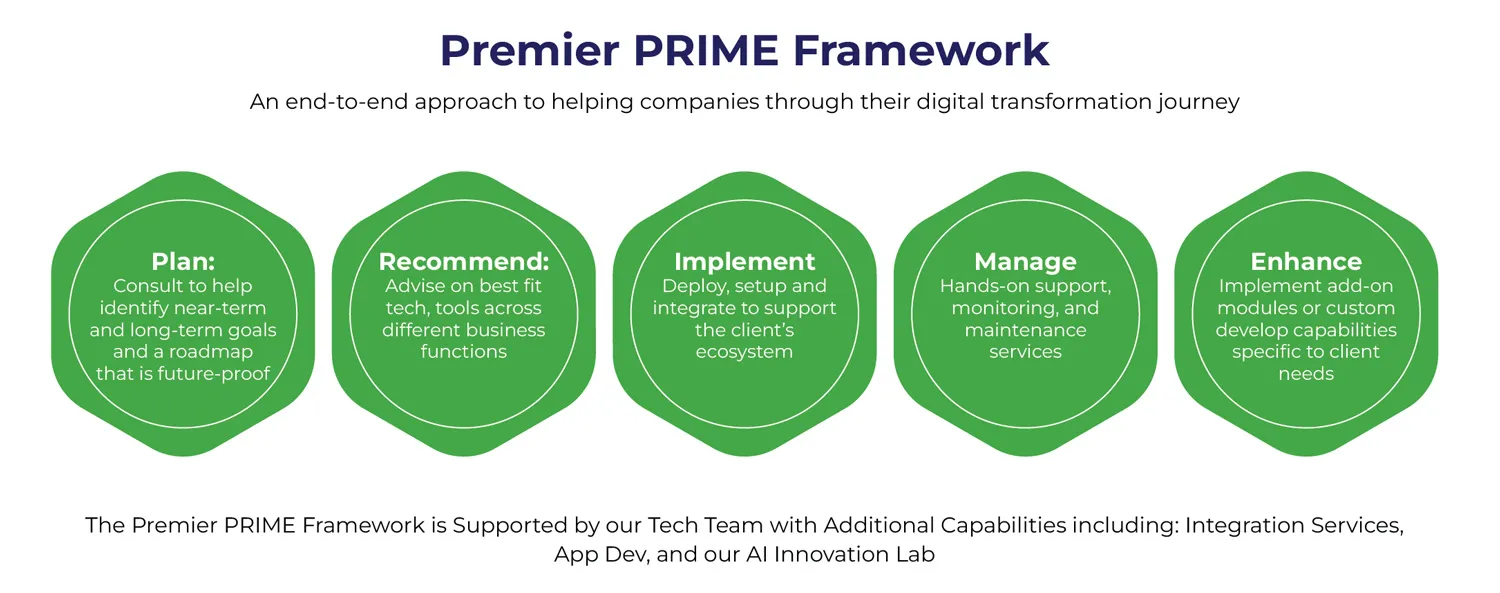
Using a structured approach like the Premier PRIME Framework, organizations can:
- Plan: Initiatives aligned to business objectives.
- Recommend: Select technologies suited to operational needs.
- Implement: Solutions without disrupting ongoing operations.
- Manage: Monitor and optimize performance.
- Enhance: Evolve systems to support growth over time.
Mid-market organizations that succeed are those that combine clear planning, structured execution, and investment in both people and data. A strategic partnership can help ensure AI initiatives deliver a measurable impact.
Connect with our team to see how mid-market organizations can adopt AI thoughtfully, accelerate results, and build sustainable capabilities.
About the Author

As CEO, Ali Din oversees the overall strategy and direction for Premier NX. With senior leadership roles at global HR and recruiting platforms, Indeed and ADP. Ali has over 25 years of experience in the IT and advanced technology sector. Ali’s time is focused on transformation in the business, both for professional development and for clients, to enhance business outcomes.