

Tech stacks rarely fail because of missing tools—they fail because of misaligned foundations.
In mid-market organizations, the ERP anchors everything from financials to reporting to operational workflows. When it underperforms, the rest of the stack—CRM, analytics, automation—loses alignment.
Many firms invest in platforms like NetSuite, Sage Intacct, or QuickBooks Online—but cannot leverage their full potential. The problem isn’t the software. It’s the lack of bandwidth, integration, and governance required to unlock real performance.
To truly maximize your tech stack, you don’t start with what’s missing—you start with what’s misaligned. ERP optimization isn’t a backend fix—it’s a strategic move that unlocks stack-wide value.
Elevating Stack Efficiency Starts with the ERP Core
In mid-market organizations, the ERP isn’t just another system; it’s the operational nucleus. Yet many firms begin optimization at the edges: cutting licenses, tightening integrations, layering on AI.
Without stabilizing the ERP, these efforts compound inefficiencies instead of resolving them. Fragmented workflows, inconsistent data, and manual workarounds are symptoms—not standalone problems.
Reconfiguring ERP logic, streamlining modules, and aligning workflows to actual business needs creates structural clarity. That clarity amplifies the performance of CRM, analytics, automation, and every tool that follows.
For leaner, faster, and more scalable tech stacks, ERP optimization isn’t an IT task; it’s the strategic first step.
Where Mid-Market ERPs Fall Short—and What It’s Costing You
Most mid-market firms operate in an uncomfortable middle ground—complex enough to need enterprise-grade performance, but constrained by ERPs that weren’t built for cross-functional orchestration.
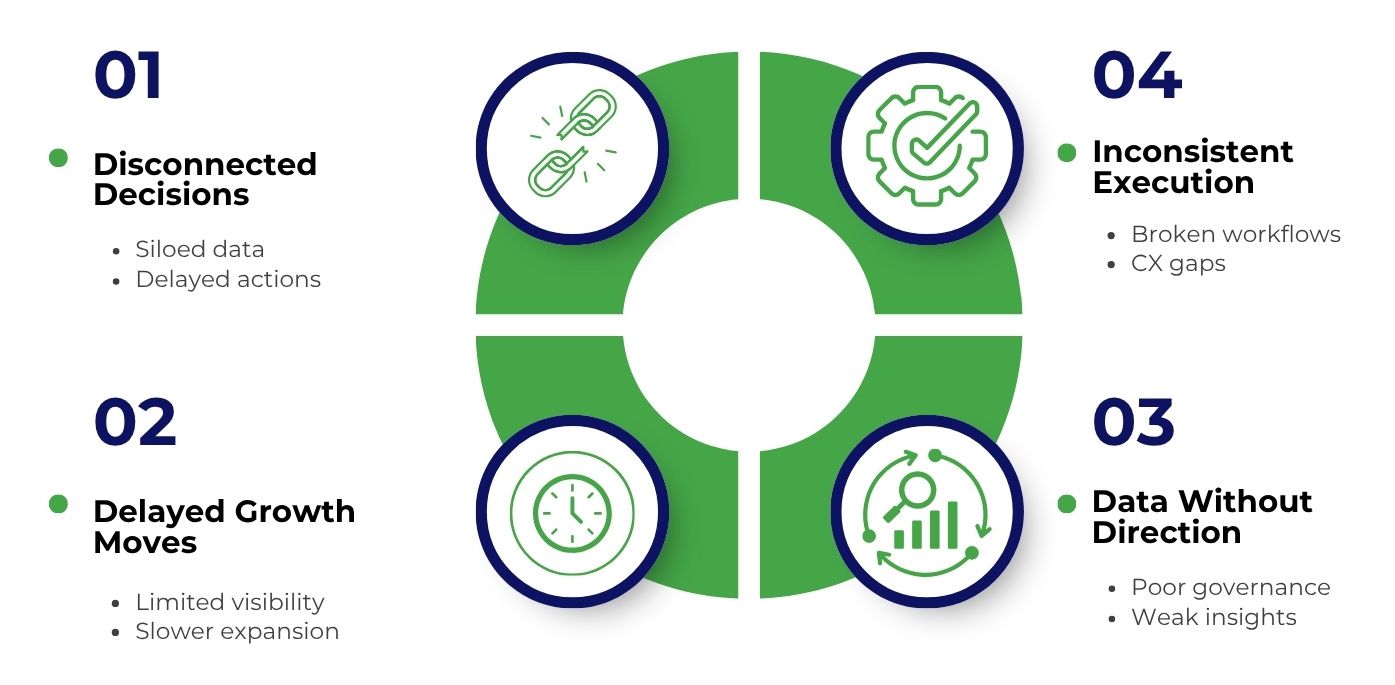
Disconnected Decisions: Finance, operations, and customer teams run on different versions of truth—ERP, CRM, billing—leading to delays, rework, and second-guessing at the leadership level.
Delayed Growth Moves: Expansion plans stall when core systems can’t support multi-entity consolidation, real-time financial visibility, or integrated planning.
Data Without Direction: Reporting tools exist, but insight doesn’t scale. Poor data governance at the ERP layer means analytics teams spend more time cleaning data than analyzing it.
Inconsistent Customer Execution: ERP misalignment creates fulfillment delays, inconsistent SLAs, and fragmented customer support. When operational data doesn’t flow cleanly across systems, CX suffers—even if CRM is best-in-class.
ERP as a Strategic Multiplier, Not a Tactical Fix
An optimized ERP doesn’t just solve operational gaps—it amplifies the performance of every connected system. For mid-market firms managing complexity with lean teams, it’s the force multiplier that turns local fixes into enterprise-wide gains.
This transformation happens by activating key levers:
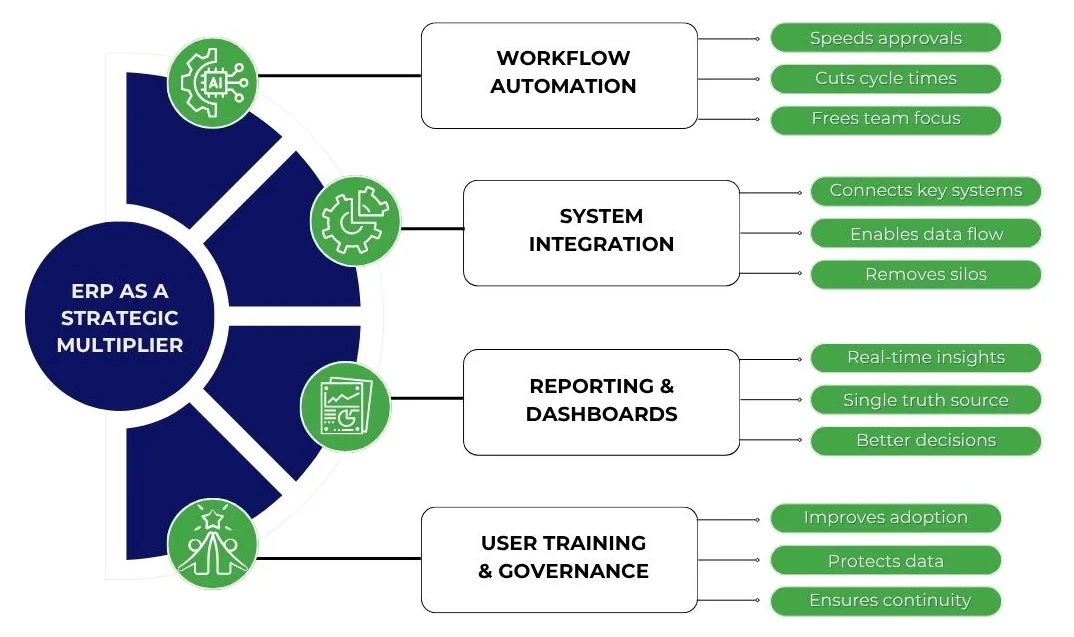
- Workflow Automation: Designing and implementing automated approval chains for expenses, invoices, and purchase orders, reducing cycle times and freeing your team to focus on exceptions.
- System Integration: Connecting your ERP to other critical systems—your CRM, HRIS, and billing platforms—creating a seamless flow of data that eliminates silos and manual entry.
- Reporting & Dashboards: Building customized, real-time reports and management dashboards that provide a single source of truth, giving you the visibility you need for confident decision-making.
- User Training & Governance: Ensuring your team can use the system effectively and establishing ongoing governance to maintain data integrity and system health.
The Tangible ROI of an Optimized System
This strategic approach to ERP optimization delivers measurable business outcomes that extend far beyond the IT department:
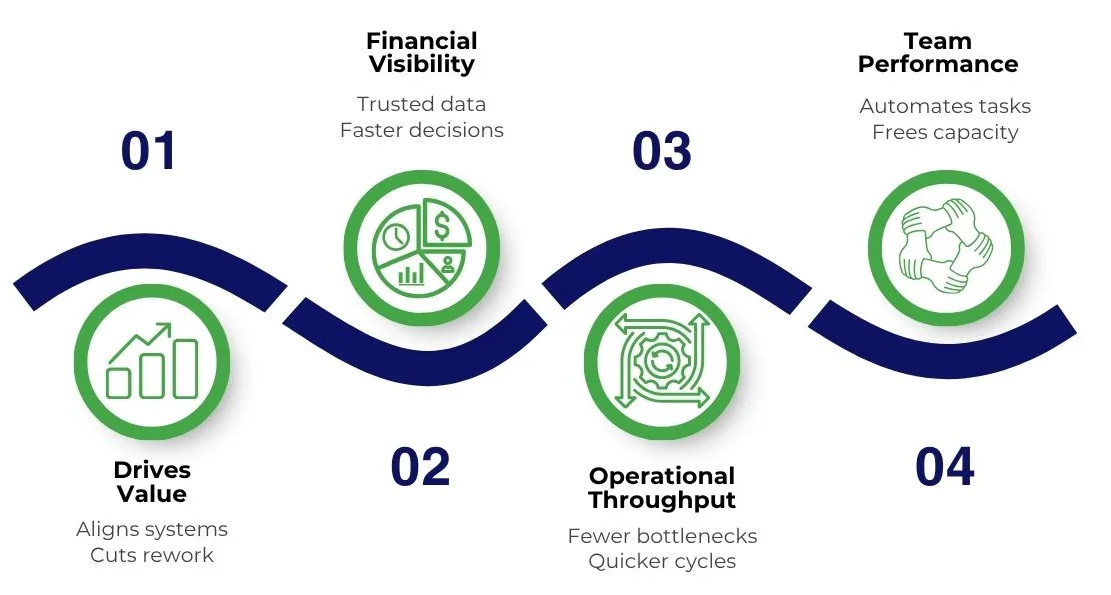
- Drives value across the stack
ERP-aligned workflows reduce CRM handoff issues, trigger billing events, and ensure HRIS inputs flow without re-entry. When ERP is synced with business logic, adjacent systems work efficiently, with less friction and fewer workarounds.
- Strengthens financial visibility
Clean, structured ERP data feeds directly into board reporting, FP&A models, and compliance processes, eliminating spreadsheet stitching and last-minute reconciliations. Finance leaders get fast, trusted numbers to drive better decisions.
- Accelerates operational throughput
Optimized ERP flows—from order-to-cash to procure-to-pay—remove manual choke points, shorten cycle times, and improve coordination across teams. Fulfillment, invoicing, and vendor processes move faster with fewer exceptions.
- Elevates team performance
Automating core ERP tasks—approvals, reconciliations, period close—frees up bandwidth across finance, CX, and operations. Teams shift from managing transactions to driving insights, planning, and execution.
How Premier NX Anchors ERP in Stack-Wide Performance
At Premier NX, we don’t optimize ERP in isolation—we embed it into the operational core of finance, analytics, CX, and digital workflows.
Our model is built for the mid-market: co-sourced delivery, platform-native execution, and scalable transformation that aligns ERP with the tools you already use.
- We streamline ERP workflows to reduce rework in adjacent systems—CRM, billing, HRIS—amplifying stack efficiency.
- We connect ERP data with analytics pipelines and planning tools to create one source of financial truth.
- We support ongoing ERP health through governance, platform integration, and user enablement.
This isn’t backend support—it’s structural enablement that makes your tech stack perform like a system, not a set of tools.
Transform ERP into a Growth Engine
Mid-market leaders don’t need more tools—they need more performance from the tools they already own. Optimizing ERP isn’t a backend upgrade. It’s the strategic unlock for stack-wide alignment, insight, and scale.
At Premier NX, we work with mid-market companies to operationalize ERP across finance, CX, analytics, and digital. The result? Leaner systems, faster execution, and better decisions—without the enterprise bloat.
Talk to our experts to explore how ERP optimization can unlock performance across your tech stack.