

Key Takeaways
- 1Multi-entity finance complexity is driven more by variation and interdependencies than by entity count alone.
- 2Additional headcount can improve capacity without resolving the coordination issues surrounding fragmented processes.
- 3Greater consistency across recurring finance activities can reduce avoidable complexity while preserving legitimate entity-specific requirements.
- 4Clear ownership and group-level visibility help finance leaders focus attention where exceptions and risks are emerging.
Multi-entity finance rarely fails all at once. More often, deadlines are still met while the effort required to meet them keeps increasing.
One entity closes later than the others. Intercompany differences take longer to resolve. A reporting package needs another adjustment before consolidation. Approval paths vary by business unit. Controllers spend more time chasing exceptions and coordinating handoffs.
Individually, these issues may look operational. Collectively, they can signal that the finance operating model was designed for a simpler organization than the business has become.
The question is no longer only whether finance has enough capacity. It is whether finance can still produce consistent group-level outcomes without disproportionate coordination effort.
The Real Complexity of Multi-Entity Finance
Entity count alone says very little about how difficult a finance function is to operate. Five entities using consistent accounting structures, close routines, approval logic, reporting definitions, and systems may be easier to operate than three that developed independently.
The real complexity sits in the differences between them and in the dependencies those differences create. It can show up in several places:
- separate ERP or accounting environments;
- inconsistent charts of accounts and reporting structures;
- different control and approval requirements;
- uneven close practices and timelines;
- intercompany balances that require coordination across teams;
- entity-specific ownership of recurring finance activities.
These differences matter because they compound at the group level. Consolidated reporting may require normalization, intercompany activity may need additional investigation, and finance leaders may have to reconcile not only numbers but also the processes behind them.
The Limits of Headcount-Led Scaling
Adding capacity is often the most practical response when finance comes under pressure. More AP support may improve invoice throughput. Additional reconciliation capacity may reduce aging items. Another accountant may help protect the close.
But added capacity does not automatically remove the coordination surrounding the work.
If entities use different approval paths, close routines, reporting definitions, or informal handoffs, another person may help process the workload while leaving the variability intact. Finance can become better staffed without becoming easier to operate.
When volume is the constraint, capacity may be the right answer. When recurring pressure comes from cross-entity exceptions, inconsistent execution, unclear ownership, and repeated normalization, leadership should examine the operating model before assuming the next hire will solve the problem.
Redesign the Operating Model Around Group-Level Outcomes
A scalable model does not require every entity to operate the same way. It requires deliberate decisions about what should be common, what must remain entity-specific, and who is accountable when work crosses organizational boundaries.
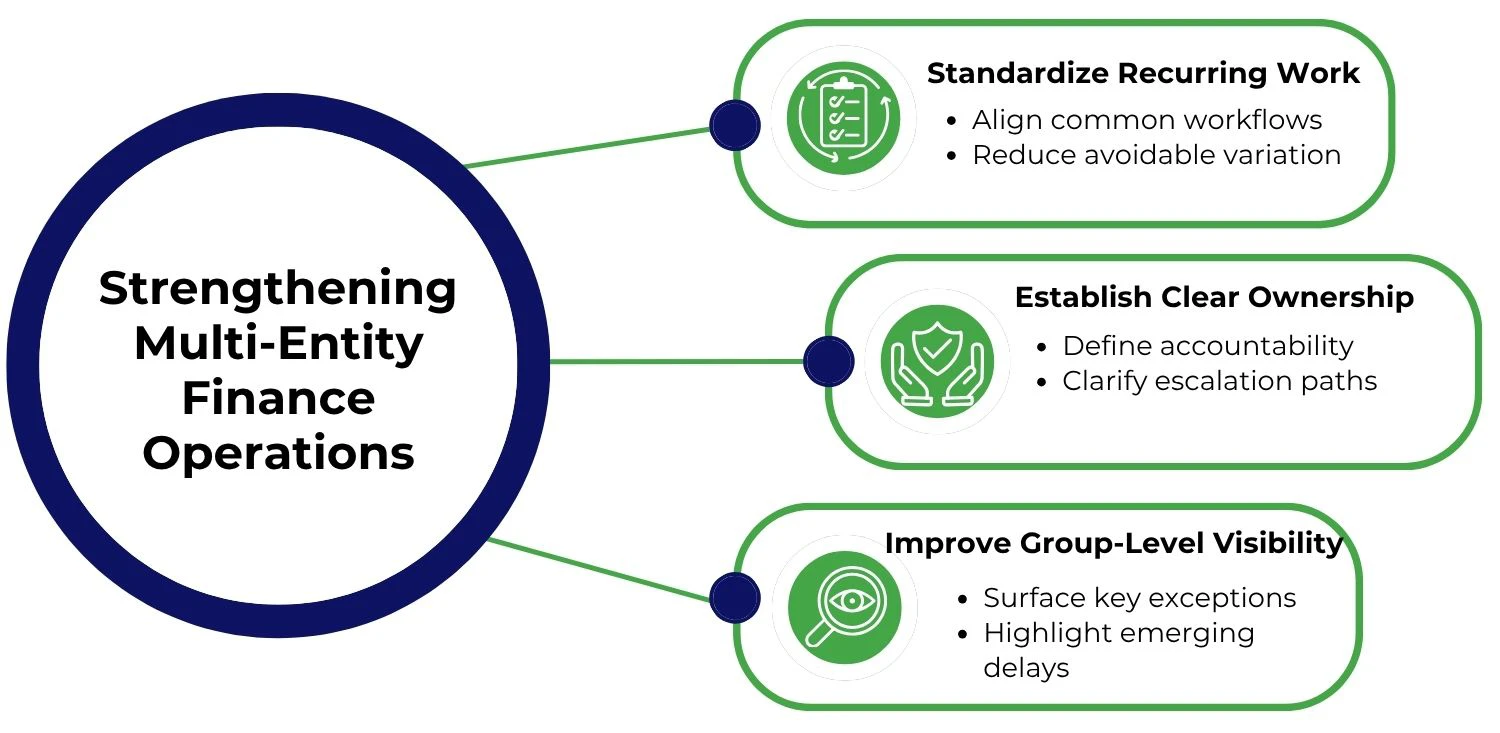
Three priorities for stronger multi-entity finance operations
Standardize Recurring Work Where Variation Adds No Value
Recurring activities should not differ without a business reason.
AP and AR workflows, reconciliation routines, close practices, reporting definitions, documentation, and handoffs are common areas to examine. The objective is not blanket centralization. It is to reduce avoidable variation while preserving legitimate entity requirements.
The operating question is whether each difference reflects a real requirement or simply history.
Establish Ownership Across Entity Boundaries
Multi-entity finance becomes harder when each team owns its local task, but no one owns the end-to-end outcome.
Leadership should clarify accountability for cross-entity exceptions, intercompany resolution, close dependencies, reporting consistency, and escalation. That accountability is different from execution.
Policy, approvals, material accounting judgment, interpretation, and controllership should remain with client finance leadership. Recurring execution, documentation, follow-up, reconciliation support, and reporting preparation can be organized around defined workflows.
Technology can reinforce those decisions. It cannot decide who owns the outcome.
Make Exceptions Visible at the Group Level
Multi-entity organizations can produce more reports while giving leadership less clarity.
The useful question is whether finance can see where exceptions, delays, or inconsistencies are accumulating before they create downstream reporting effort.
Group-level visibility should show which entities repeatedly delay close activities, where intercompany items remain unresolved, where reporting requires manual normalization, and where operational issues consume Controller attention.
That means less effort reconstructing what happened and greater confidence in where management intervention is needed.
The Premier NX Perspective: Build Execution Around the Operating Model
The objective is not to outsource financial judgment or hand over controllership. It is to create disciplined execution around the finance model leadership chooses.
Premier NX supports connected finance execution across AP, AR, reconciliations, close support, reporting, and recurring workflows within the client’s systems, governance, and operating requirements.
The role supports clearer process discipline, documented handoffs, reporting visibility, and coordinated execution across the areas in scope. Client finance leadership retains financial policy, approvals, accounting interpretation, material judgment, and final accountability.
Real-World Case Study: Supporting a Growing Multi-Entity Finance Operation
One of our clients in the third-party administration industry was managing a more complex finance environment across multiple legal entities, accounting platforms, and workflows.
The Challenge: Financial operations were split between NetSuite and QuickBooks, while manual intercompany and credit card reconciliations increased reconciliation effort and contributed to delayed reporting and less predictable month-end closes.
Our Response: Premier NX supported the migration of financial operations from NetSuite to QuickBooks, multi-entity accounting, intercompany and credit card reconciliations, month-end close activities, standardized financial reporting, and documented operating procedures.
The Impact:
- Financial closes across all entities were consistently completed by the 15th of each month.
- More than 7,000 member accounts were reconciled and discrepancies resolved.
- Leadership gained clearer visibility into financial performance through structured reporting.
Finance Must Evolve with the Business
No entity count threshold makes a finance operating model obsolete.
A stronger signal is the leadership effort required to compensate for variation between entities. If Controllers increasingly spend time reconciling processes as well as numbers, resolving ownership gaps, or coordinating recurring exceptions, the organization may have outgrown the way finance currently operates.
At that point, the next question should not automatically be, “Which role do we add?”
It should be, “What needs to change so finance can operate consistently across the organization we have become?”