


Key Takeaways
- 1Financial complexity often grows faster than revenue in mid-market companies.
- 2Adding headcount alone does not create scalable finance capacity.
- 3Longer closes, weaker forecasts, and delayed decisions are early warning signs.
- 4Flexible finance support can help the organization absorb growth without adding unnecessary complexity.
Finance capacity is an organization’s ability to support growth without degrading financial accuracy, control, visibility, compliance readiness, or decision speed. It becomes a constraint when business complexity grows faster than finance’s operating model can absorb it. Building capacity requires standardized workflows, well-governed automation, timely data, and scalable execution support, not simply more headcount.
Revenue can rise quickly. Finance must then absorb more transactions, systems, approvals, entities, reporting requests, and risk. If the function still relies on processes designed for a smaller business, close cycles lengthen, forecast confidence weakens, and leaders wait longer for answers.
Why Financial Complexity Can Outrun Revenue Growth
Financial workload does not rise only with transaction volume. It expands with every dependency that must be coordinated, reconciled, approved, and reported.
As a mid-market company grows, finance may need to manage:
- More invoices, payments, collections, bank accounts, and reconciliations.
- New entities, regions, currencies, tax obligations, and approval paths.
- Additional systems whose data must be integrated and validated.
- More stakeholders requesting forecasts, scenarios, and performance views.
Each layer creates new handoffs, exceptions, and control points. That is why revenue growth can be linear while financial complexity compounds.
What Scalable Finance Capacity Actually Requires
Finance capacity is not how much work a team can absorb today. It is how much complexity the operating model can absorb without degrading control or decision speed.
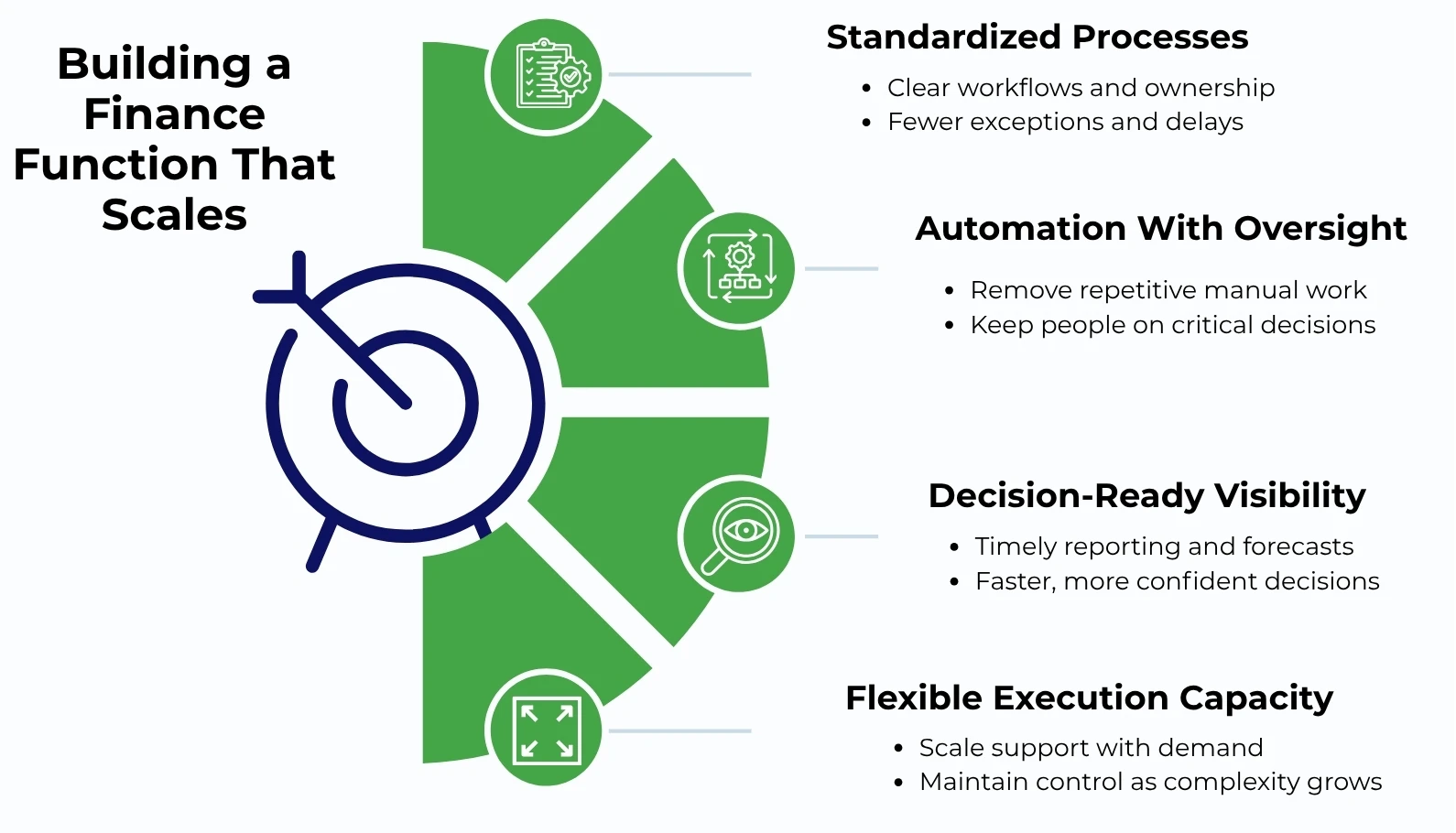
The next stage of growth demands a stronger finance function.
1. Standardization Before Expansion
Standardization gives recurring finance work a defined workflow, owner, timetable, approval path, and review step. Accounts payable (AP), accounts receivable (AR), reconciliations, month-end close, and management reporting should not depend on individual memory or inconsistent handoffs.
Standard processes reduce exceptions before higher volume magnifies them. They also create the stable foundation that automation and external support need to work effectively.
2. Automation With Human Oversight
Automation creates capacity by removing repetitive work, improving consistency, and shortening cycle times. Deloitte’s Q4 2025 CFO Signals survey found that 49% of North American CFOs cited automating processes to free employees for higher-value work as a top finance talent priority for 2026.1
Human-in-the-loop automation keeps people accountable for exceptions, unusual transactions, control reviews, and judgment-based decisions. The goal is not maximum automation. It is the right division of work between technology and experienced professionals.
3. Visibility Fast Enough to Guide Decisions
Financial visibility is the ability to see the current cash position, operating performance, forecast movements, and emerging variances early enough to act.
Reliable reporting, cash projections, budget-to-actual analysis, and forecast updates turn transaction processing into decision support. When information arrives late or requires repeated reconciliation, finance remains occupied with validating the past instead of preparing the business for what comes next.
4. Execution Capacity That Scales With Demand
More employees can increase output, but hiring alone does not repair fragmented processes or delayed data. Scalable execution capacity combines clear internal ownership with flexible support for repeatable, measurable finance operations.
This allows internal leaders to retain responsibility for policy, approvals, risk, and strategy while adding delivery capacity where workload is constraining the team.
Five Leading Indicators That Finance Capacity Is Tightening
Finance capacity is likely under pressure when:
- Month-end close keeps taking longer.
- Reconciliations or transaction backlogs persist.
- Forecast updates arrive too late to guide decisions.
- Finance spends more time validating data than analyzing performance.
- Approvals, controls, or compliance documentation become harder to manage.
These are leading indicators of operating-model strain, not isolated productivity issues. If several appear together, adding another person may relieve pressure temporarily without removing the underlying constraint.
The Premier NX Difference: More Capacity, Not More Complexity
Premier NX uses a co-sourced delivery model. Our teams work within the client’s systems, processes, and governance while internal finance retains ownership of strategy, policy, approvals, and key decisions.
Depending on the required scope, Premier NX Finance and Accounting support can include bookkeeping, AP, AR, billing and collections, reconciliations, month-end close, financial reporting, cash projections, budgeting, forecasting, and financial planning and analysis (FP&A) support.
Automation is applied to repeatable work, while experienced professionals manage exceptions, validation, controls, and judgment-based activities. The objective is not to displace internal finance. It is to provide dependable execution capacity and a clearer operating rhythm, allowing senior finance talent to spend more time on forecasting, scenario planning, profitability, and business decisions.
Build Finance Capacity Before Growth Tests It
Sustainable growth depends on whether finance can absorb more complexity without losing speed, accuracy, visibility, or control. The strongest time to address capacity is before delayed closes, weak forecasts, and control pressure begin shaping business decisions.
Ready to identify the first operational change that can restore room to grow?
About the Author
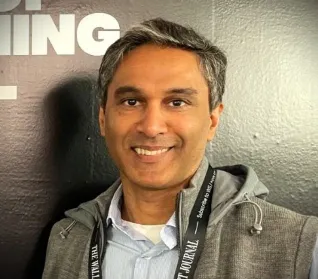
As CEO, Ali Din oversees the overall strategy and direction for Premier NX. With senior leadership roles at global HR and recruiting platforms, Indeed and ADP. Ali has over 25 years of experience in the IT and advanced technology sector. Ali’s time is focused on transformation in the business, both for professional development and for clients, to enhance business outcomes.