


Key Takeaways
- 1Strong bookkeeping creates the financial foundation for sustainable business growth.
- 2Continuous reconciliation and cash visibility help leaders make faster decisions.
- 3Automation should improve efficiency while strengthening financial accuracy and control.
- 4Scalable finance processes enable businesses to grow with confidence, not complexity.
Growing businesses rarely outgrow bookkeeping; they outgrow the processes, controls, and reporting structure around it. The warning signs include delayed reconciliations, longer close cycles, recurring report corrections, and limited visibility into cash movement.
Scalable bookkeeping creates accurate financial data, continuous control, clear cash visibility, and decision-ready reporting that can support growth.
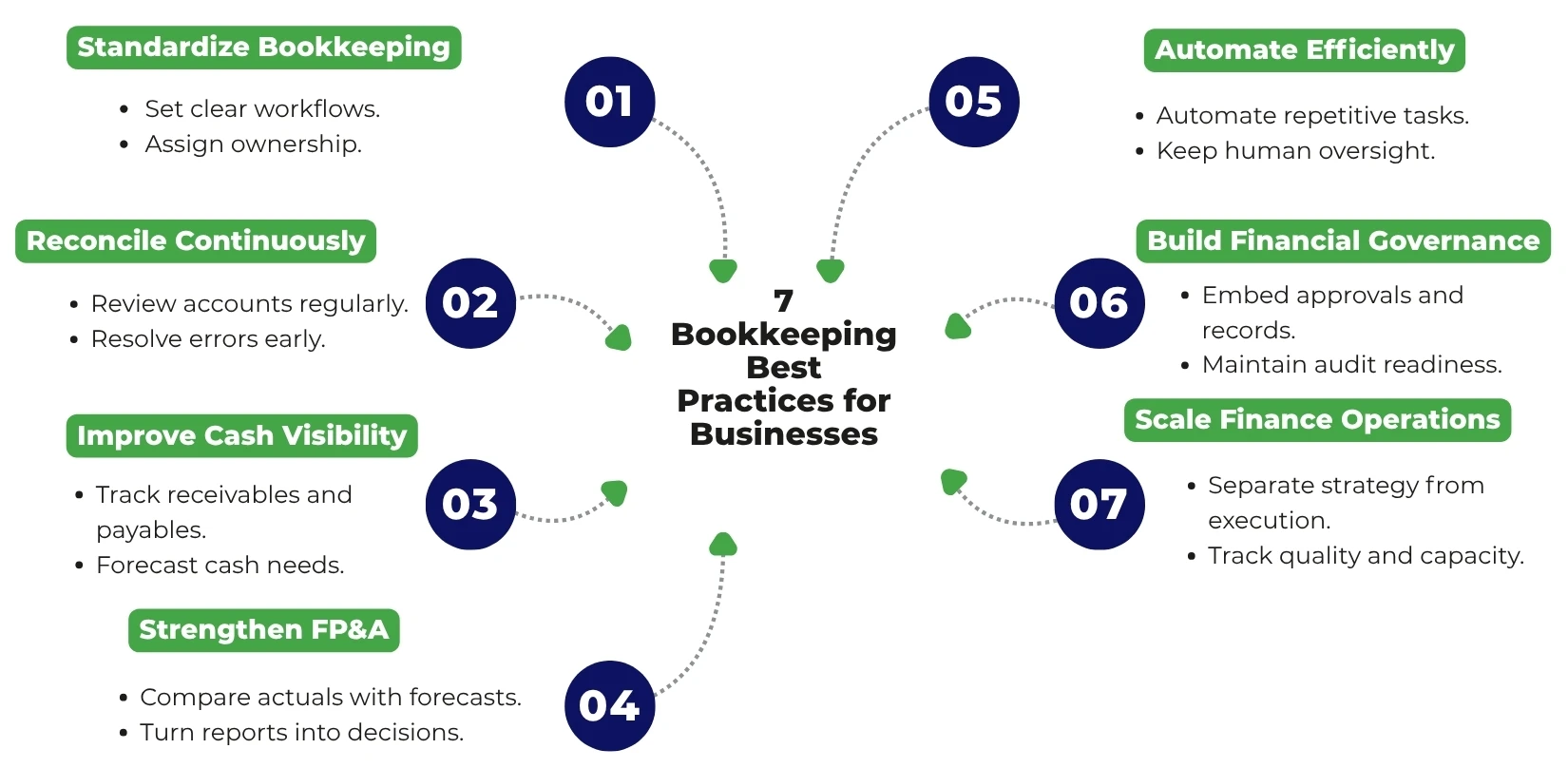
Seven bookkeeping best practices that strengthen financial control
1. Standardize Bookkeeping Before Volume Creates Variance
Standardized bookkeeping gives every recurring finance activity a defined workflow, owner, timetable, and review step.
Account coding, transaction entry, documentation, approvals, and handoffs should follow consistent processes. Finance leaders should monitor corrections, late entries, missing support, and activities that depend on one employee.
If a process exists only in one employee’s memory, it is not yet scalable.
2. Treat Reconciliation as a Continuous Financial Control
Reconciliation; the comparison of financial records with independent sources should operate throughout the month, not as a month-end cleanup.
Apply a risk-based cadence:
- Reconcile cash and high-volume payment accounts daily or weekly.
- Review accounts receivable and payable aging throughout the month.
- Assign discrepancies to named owners with resolution deadlines.
Monitor reconciliation completion, unresolved variance age, recurring discrepancies, and days to close.
3. Connect Bookkeeping Data to Cash-Flow Management
Bookkeeping becomes decision-useful when transaction data is connected with collections, payment timing, and working capital requirements.
Profit does not equal liquidity. A growing company can report strong revenue while struggling to meet payroll, supplier obligations, or expansion costs because cash remains trapped in receivables or poorly timed payment cycles.
Connect bookkeeping data with cash forecasting and monitor:
- Cash forecast variance
- Days sales outstanding and days payable outstanding
- Overdue receivables and upcoming obligations
4. Turn Financial Data into Strategic Insight with FP&A and Reporting
Financial reporting explains what happened; financial planning and analysis connects actual results with forecasts, operational drivers, and future decisions.
Management reporting should provide a consistent view of cash, revenue, margin, cost-to-serve, and budget performance. FP&A then turns that information into variance analysis, updated forecasts, and executive-level insight.
Useful measures include reporting cycle time, forecast accuracy, manual corrections, and unexplained variances.
5. Automate Volume, Not Judgment
Automate stable, rules-based activity while keeping people responsible for exceptions, material approvals, and financial judgment.
A human-in-the-loop model should:
- Automate invoice capture, data entry, matching, document routing, and recurring report preparation.
- Route incomplete, unusual, or higher-risk transactions to trained reviewers.
- Preserve approval authority for material or sensitive financial decisions.
Measure accuracy, processing time, exception rates, and the percentage of transactions completed without manual intervention.
6. Strengthen Financial Governance with Compliance-Ready Processes
Compliance-ready bookkeeping embeds approvals, documentation, evidence, and audit trails into everyday finance activity.
Define control owners, approval thresholds, record-retention standards, and resolution procedures before financial complexity increases. This makes compliance part of the workflow instead of something finance must reconstruct later.
Monitor missing documentation, policy exceptions, audit response times, and remediation progress.
7. Design a Finance Operating Model That Can Scale
A scalable finance operating model defines who performs the work, where it is performed, how quality is controlled, and which decisions remain with finance leadership.
The model should separate strategic ownership from repeatable execution:
- Retain internally: Capital allocation, financial policy, risk, material judgment, forecasting assumptions, and business partnering.
- Use dedicated operational capacity: Bookkeeping, reconciliations, invoice processing, reporting support, and financial documentation.
Evaluate the model through service levels, backlogs, error rates, close performance, and available finance capacity.
Build Financial Control Before Complexity Compounds
Effective bookkeeping is more than accurate recordkeeping. It is the control layer connecting transactions, cash, reporting, governance, and business decisions.
Premier NX supports growing businesses across bookkeeping, reconciliation, treasury and cash management, FP&A, compliance, expenditure management, and specialized Finance Operations.
Ready to strengthen financial control without adding unnecessary complexity?