


Key Takeaways
- 1The right finance model is not fully in-house or fully outsourced, but structured around where judgment, control, and repeatability belong.
- 2Strategic financial ownership should remain close to leadership, while recurring accounting work can be scaled through co-sourcing.
- 3A well-designed operating model can reduce pressure on internal teams, improve close predictability, and make controls more explicit as transaction volume grows.
- 4The strongest finance functions add execution capacity without increasing management complexity or weakening accountability.
For mid-market companies, the best accounting model is rarely fully in-house or fully outsourced. The stronger operating model keeps financial judgment, control, ownership, and accountability close to leadership while shifting repeatable execution into a structured, scalable delivery environment.
The decision matters because growth usually increases transaction volume faster than finance capacity. If every new invoice, reconciliation, exception, and reporting request requires more internal headcount, the finance function can become a bottleneck precisely when the business needs faster visibility.
Scale Finance Without Losing Control
In-House vs. Outsourced Accounting: Use Judgment and Repeatability to Decide What Stays In-House
The most useful dividing line is not “internal versus external.” It is judgment versus repeatability.
Activities that depend on enterprise context, materiality, policy interpretation, or executive accountability should stay close to the CFO and Controller. Activities driven by volume, standardization, throughput, and disciplined exception handling are stronger candidates for co-sourcing.
Use four questions to evaluate any finance activity:
- How much business judgment does the work require?
- How repeatable is the workflow?
- How sensitive is performance to transaction volume?
- Can approvals, exceptions, and quality controls be explicitly documented?
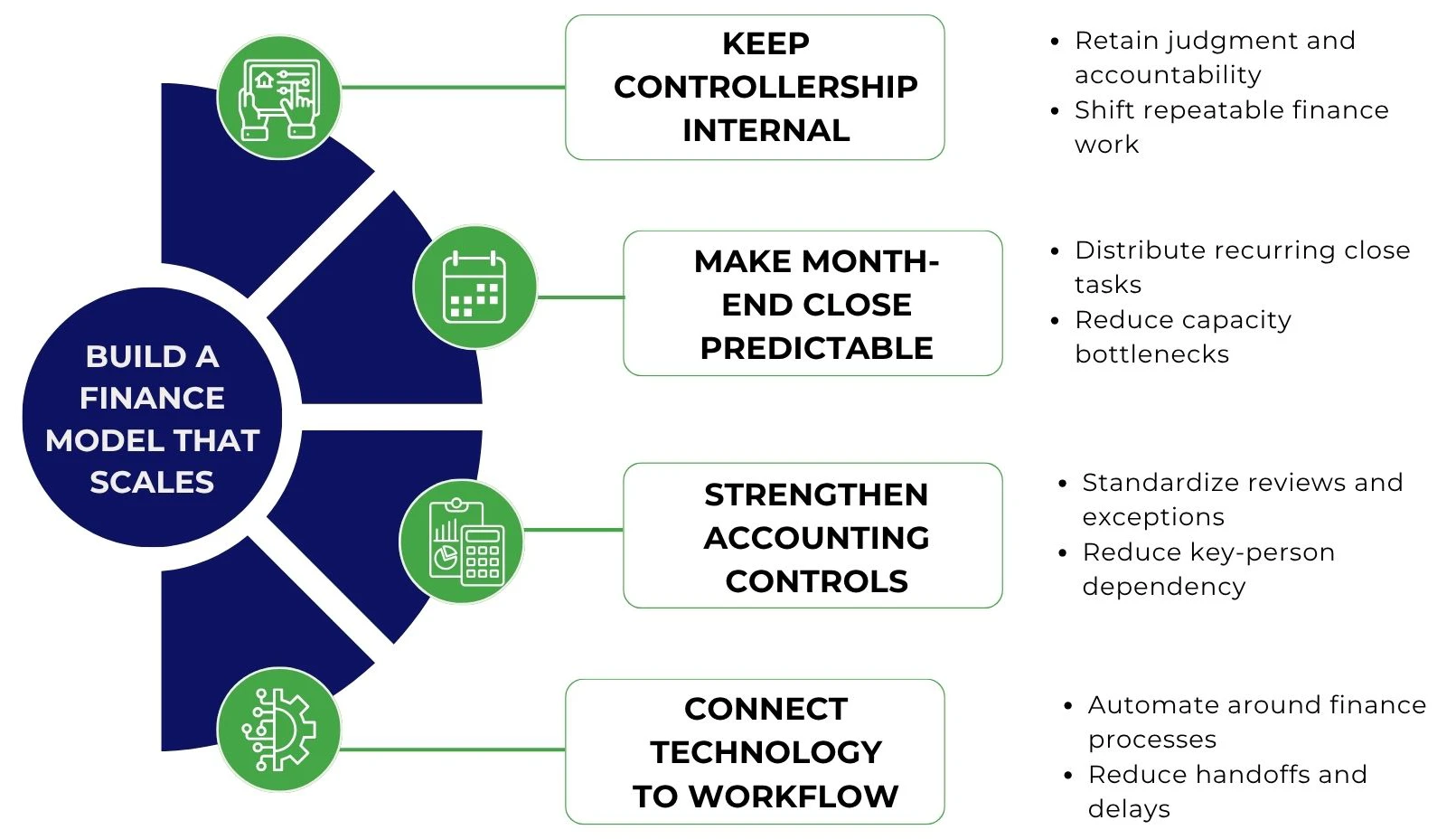
Keep Controllership Internal; Move Capacity Around It
Controllership should not be diluted simply because execution is distributed. Accounting policy, materiality thresholds, final approvals, significant adjustments, governance, and interpretation of financial performance remain leadership responsibilities.
What Can Shift: Dedicated resources can handle reconciliations, invoice processing, bookkeeping, reporting support, and other recurring workflows with standardized review routines.
Finance Implication: Senior finance talent spends less time absorbing transaction volume and more time applying judgment where it changes business outcomes.
Treat Month-End Close as a Capacity Design Problem
A slow close is often framed as a process problem, but for mid-market companies it is frequently a capacity-allocation problem. Reconciliations, adjustments, invoice activity, and unresolved exceptions all compete for the same finite internal bandwidth.
What Can Shift: Recurring close activities can be distributed across dedicated resources and defined review cadences without requiring the internal team to expand around every workload spike.
Finance Implication: Close performance becomes less sensitive to key-person availability, volume volatility, and manual coordination, giving finance leaders more predictable reporting and review cycles.
Use Outsourcing to Make Accounting Controls More Explicit
The common concern is that distributed execution weakens control. Poorly designed outsourcing can, but well-structured co-sourcing can make approvals, reconciliations, exception paths, documentation standards, review ownership, and escalation thresholds more visible and consistent.
What Can Shift: Routine accounting execution can move into structured workflows where control points, review responsibilities, and exception handling are clearly documented and monitored.
Finance Implication: Finance becomes less dependent on individual habits or institutional knowledge, reducing key-person risk and making recurring accounting work easier to monitor, audit, and improve.
Connect Finance Technology to Workflow, Not Tool Count
Most mid-market finance teams do not suffer from a lack of software. The bigger issue is fragmented workflows across ERP platforms, spreadsheets, reporting tools, and manual handoffs that create unnecessary coordination and delay.
What Can Shift: Shift can redesign data movement, workflow automation, reporting routines, and exception management around the accounting process rather than managing them through disconnected tools and manual steps.
Finance Implication: Finance leaders can reduce manual coordination, surface exceptions earlier, and shorten the path from transaction processing to usable financial insight.
Which Accounting Responsibilities Should Stay In-House?
For mid-market businesses, the responsibilities that should remain in-house are generally those where financial judgment, enterprise context, and accountability matter more than processing efficiency.
- Accounting policy and control design
- Final approvals and material accounting decisions
- Strategic planning, budgeting, and capital allocation
- Interpretation of financial performance
- Governance and accountability for financial integrity
Build a Finance Operating Model That Can Scale Before It Has To
The strongest finance model is not the one with the most internal headcount or the lowest external cost. It preserves control while adding capacity without creating proportional management complexity.
Premier NX supports that balance through a co-sourcing approach across core accounting, treasury and cash management, financial reporting and compliance, procurement and expenditure management, and specialized financial operations.
Ready to evaluate which accounting responsibilities should remain in-house and which can be outsourced more effectively?