


Key Takeaways
- 1Bookkeeping becomes a financial control issue when growing complexity outpaces the processes supporting it.
- 2A stronger close depends on resolving exceptions throughout the period, not discovering them at month-end.
- 3AP, AR, collections, and reporting create more value when they improve cash visibility and direct management attention.
- 4Finance maturity depends on stable bookkeeping that supports the progression from Record to Control, Visibility, and Foresight.
The most damaging bookkeeping mistakes occur when manual workflows, delayed reconciliations, disconnected AP and AR, limited financial analysis, and backward-looking reporting prevent accurate financial data from becoming timely management insight.
For mid-market companies, the standard should therefore be higher than clean books. Bookkeeping maturity is the progression from Record → Control → Visibility → Foresight: capturing transactions accurately, controlling exceptions early, understanding financial position, and using that foundation to anticipate what’s next.
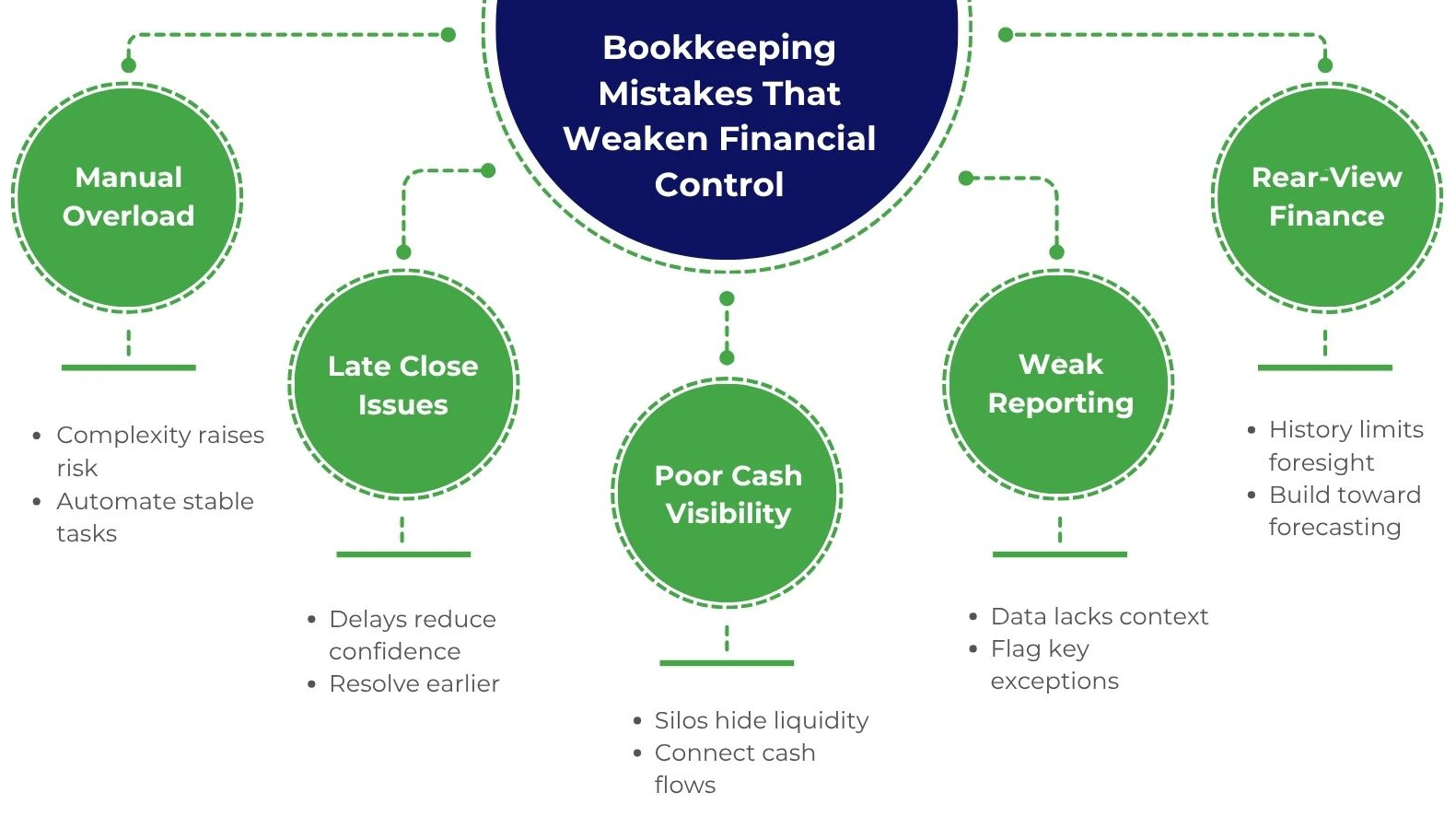
Better bookkeeping turns financial records into better decisions.
1. Manual Bookkeeping Becomes a Control Problem Before a Capacity Problem
Manual bookkeeping is not inherently inefficient. The problem begins when transaction complexity outpaces the controls and workflows that support it.
At that point, adding people may increase processing capacity without improving control. Reconciliations, invoice handling, transaction validation, and exception management become increasingly dependent on individual intervention.
Operating implication: The control environment becomes person-dependent. Accuracy increasingly relies on experienced employees remembering exceptions, workarounds, and undocumented process rules.
Strategic response: Automate only after distinguishing stable rules from unstable exceptions. The objective is not maximum automation; it is fewer uncontrolled decisions embedded inside repetitive workflows.
2. Month-End Close Should Validate the Period, Not Reconstruct It
A healthy month-end close confirms financial integrity. It should not be the first point at which reconciliation gaps, posting errors, or unresolved exceptions become visible. When corrective work accumulates until close, the problem is usually upstream.
Operating implication: Finance teams spend the close investigating exceptions rather than validating results, extending reporting cycles and reducing confidence in period-end numbers.
Strategic response: Shift control upstream through disciplined reconciliations, clearer process ownership, and earlier exception resolution so the close becomes a validation process rather than a recovery exercise.
3. Managing Payables, Receivables, and Collections Without a Clear View of Cash
Accounts payable, accounts receivable, invoicing, and collections are often managed as separate workflows. Leadership, however, experiences their combined effect as liquidity.
Operating implication: Finance may know what is owed and what is due, yet still lack a reliable picture of timing, working-capital pressure, and near-term cash requirements.
Strategic response: Connect AP, invoicing, receivables, and collections to a broader cash view so transaction-level accuracy contributes to stronger liquidity visibility and more informed financial decisions.
4. Financial Reporting Should Surface Exceptions, Not Just History
Accurate reports explain what happened. Mature finance operations go further by helping leadership determine what changed, why it matters, and where action is required.
That means financial reporting should expose trends, exceptions, and performance drift, not simply organize completed transactions into period-end statements.
Operating implication: Leadership receives accurate reports but still lacks context around what is changing, where performance is drifting, or which financial patterns require attention.
Strategic response: Shift reporting from balance presentation toward exception prioritization. The reporting process should make it easier to answer four questions: What changed? Why did it change? Does it materially affect performance or cash? Who owns the response?
5. Rear-View Bookkeeping Limits Finance Maturity
Historical accuracy is essential, but it should be the foundation of finance maturity rather than its endpoint. Forecasting, planning, and FP&A capabilities become more valuable only when the underlying transaction data is structured, timely, and consistently controlled.
Operating implication: A business may invest in dashboards, forecasting, or FP&A, even as the underlying financial data still requires manual correction and interpretation.
Strategic response: Build bookkeeping processes and data structures that support the progression from accurate reporting to forecasting, planning, and more strategic financial insight.
Better Bookkeeping Creates Better Financial Decision
The question for a growing business is no longer simply, “Are our books accurate?” It is, “Does our finance operation give us enough control and visibility to make decisions with confidence?”
Premier NX helps mid-market finance teams move from Record to Control, Visibility, and Foresight by combining finance expertise, structured workflows, automation, reporting, and analytics across the transaction lifecycle.
Ready to identify where your bookkeeping processes may be limiting financial control and visibility?