


Businesses are outsourcing service desks to reduce complexity, ensure 24/7 support, and improve IT performance at scale.
IT now underpins daily operations, making system uptime and support responsiveness business-critical. In-house service desks struggle with rising costs, fragmented tools, and scaling challenges across modern, distributed environments.
IT service desk outsourcing introduces a structured, SLA-driven model with specialized expertise and global coverage. It enables organizations to stabilize operations, accelerate issue resolution, and scale support without expanding internal teams.
Outsourcing is no longer just about cost savings; it is a strategic move to strengthen IT reliability, user experience, and operational continuity.
What is IT Service Desk Outsourcing?
IT service desk outsourcing delegates IT support operations to a third party that manages incidents, requests, and user issues under defined SLAs.
It typically includes:
- Incident management: Resolving system errors and disruptions
- Service request handling: Managing access, configurations, and routine requests
- Ticket management: Tracking, prioritizing, and resolving issues efficiently
- End-user support: Assisting employees across devices, applications, and networks
Unlike a basic help desk, a service desk operates within structured frameworks like ITSM and ITIL and enables standardized workflows, proactive support, and alignment with overall IT operations.
What is the Difference Between an IT Service Desk and an IT Help Desk?
A help desk resolves issues reactively, while a service desk manages IT services proactively with structured, business-aligned processes.
A help desk focuses on immediate problem resolution, like handling tickets, troubleshooting errors, and restoring functionality. Its scope is limited to break-fix support.
A service desk operates at a broader level. It manages the full lifecycle of IT services, aligning support with business needs, improving system performance, and preventing recurring issues.
It follows structured frameworks like ITSM and ITIL, enabling standardized workflows, consistent service delivery, and continuous improvement across IT operations.
Why are Businesses Outsourcing IT Service Desks?
Businesses outsource service desks to handle rising IT complexity, ensure 24/7 support, and access skilled expertise without expanding internal teams.
Key drivers include:
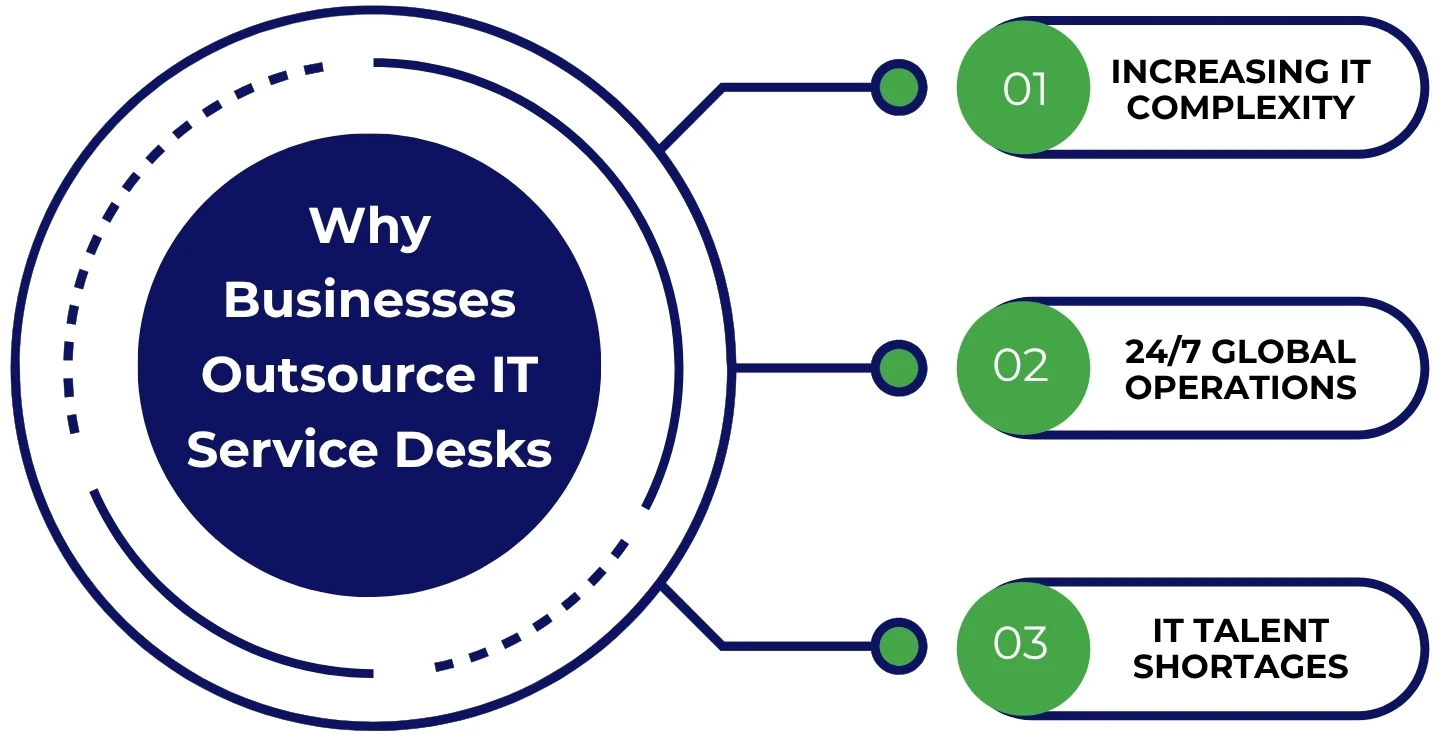
- Increasing IT complexity: Managing cloud, SaaS, and cybersecurity requires specialized, evolving skill sets
- 24/7 global operations: Always-on businesses need continuous support across time zones
- IT talent shortages: Hiring and retaining skilled professionals is costly and time-consuming
Outsourcing provides immediate access to experienced teams, standardized processes, and scalable support without the overhead of building in-house capabilities.
What are the Key Benefits of IT Service Desk Outsourcing?
Outsourcing delivers cost control, 24/7 coverage, specialized expertise, and scalable IT support aligned with business growth.
Cost Efficiency & Predictable Pricing
Outsourcing converts fixed IT support costs into a predictable operating model. It eliminates expenses tied to hiring, infrastructure, and continuous training. Instead of maintaining full-time teams for fluctuating workloads, businesses pay based on usage or scope, significantly improving cost control and budget forecasting.
24/7 Support & Global Coverage
Outsourced service desks operate across time zones, ensuring uninterrupted support. This reduces system downtime, accelerates issue resolution, and maintains business continuity.
Access to Skilled IT Experts
Organizations gain immediate access to certified professionals with cross-technology expertise. This removes the delays and risks associated with hiring, while ensuring that complex issues are handled by experienced specialists from day one.
Scalability & Flexibility
Support capacity can be scaled up or down based on demand, seasonal spikes, or business growth. This flexibility allows organizations to adapt quickly without restructuring internal teams or overcommitting resources.
Improved Employee Productivity
Faster resolution times reduce employee downtime and frustration. With reliable IT support in place, internal teams can focus on their core responsibilities instead of troubleshooting recurring technical issues.
Enhanced Customer & User Experience
Consistent response times, structured workflows, and SLA-driven performance improve overall service quality. This leads to fewer escalations, smoother user interactions, and a more reliable IT experience across the organization.
Access to Advanced Technology
Outsourcing providers invest in AI, automation, and analytics tools to optimize support operations. Businesses benefit from these technologies without the need for internal investment, enabling faster resolutions and smarter issue management.
Focus on Core Business Functions
By offloading routine IT support, internal teams can redirect efforts toward strategic initiatives, innovation, and business growth, rather than being consumed by operational support tasks.
What are the Challenges of IT Service Desk Outsourcing?
Outsourcing can introduce control, communication, and security risks if not managed with the right partner and governance model.
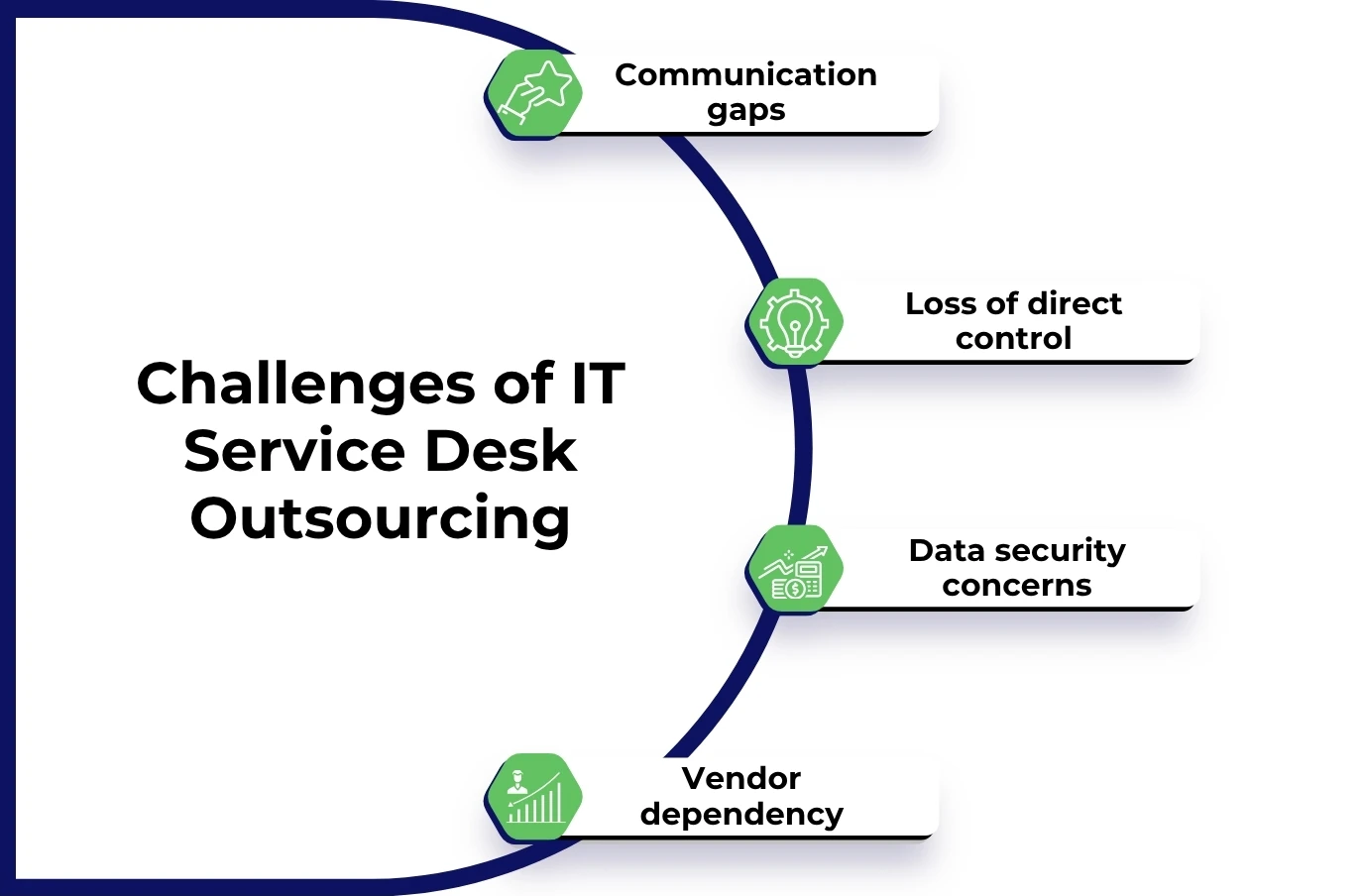
- Communication gaps: Misalignment can occur across time zones, processes, or unclear escalation paths
- Loss of direct control: Reduced visibility into day-to-day operations without proper reporting structures
- Data security concerns: Handling sensitive systems requires strict compliance, access controls, and monitoring
- Vendor dependency: Over-reliance on a provider can impact flexibility and internal capability
Choosing the right partner with strong SLAs, transparency, and security frameworks is critical to mitigating these risks.
How does IT Service Desk Outsourcing Compare to In-House Support?
| Factor | Outsourced | In-House |
|---|---|---|
| Cost | Lower, predictable | High fixed costs |
| Expertise | Wide, specialized | Limited |
| Availability | 24/7 support | Limited hours |
| Scalability | High, on-demand | Slow, resource-dependent |
| Control | Less direct | Full control |
What are the Latest Trends in IT Service Desk Outsourcing?
IT service desks are evolving with AI, predictive analytics, and cloud-based models, shifting from reactive support to proactive, strategic operations.
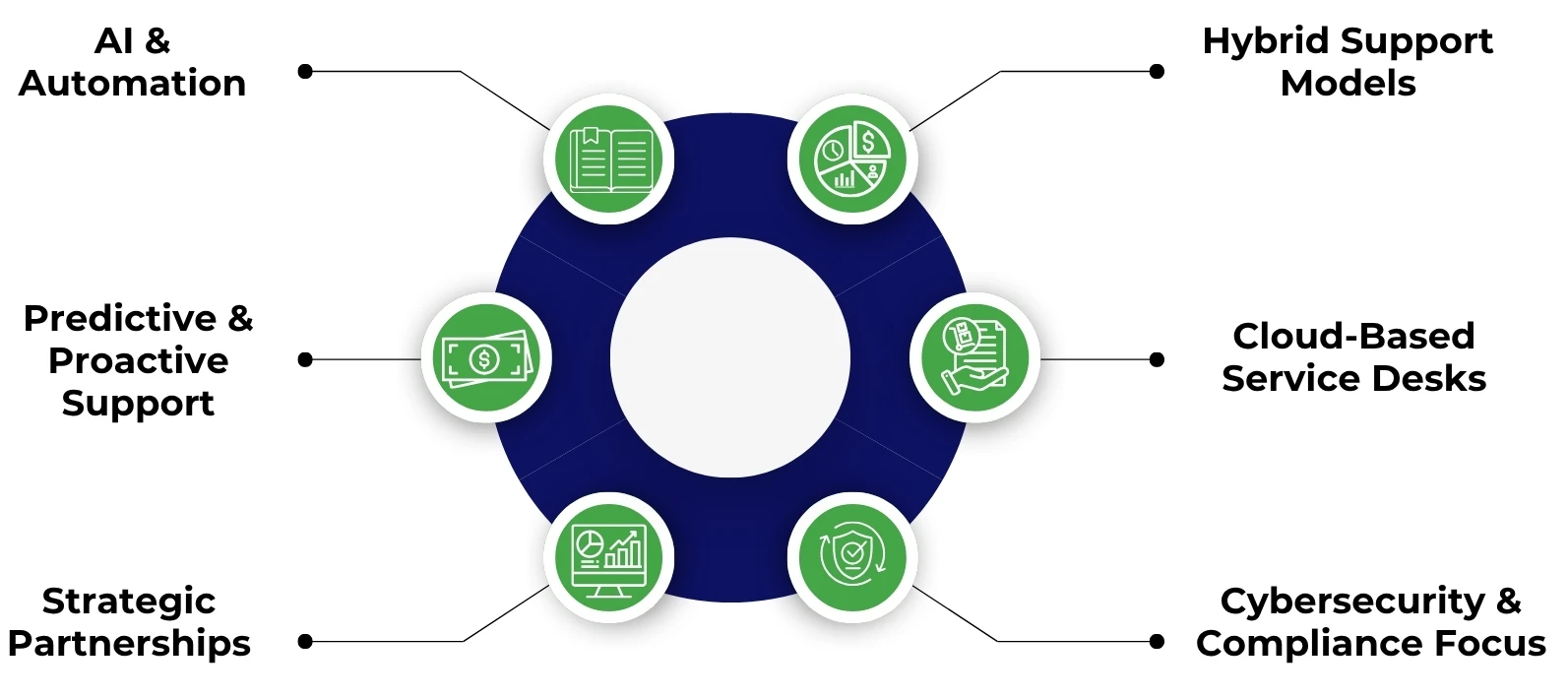
AI & Automation
AI-powered chatbots and automated ticketing systems are handling repetitive queries and workflows. This reduces response times and frees up human agents for more complex issues.
Predictive & Proactive Support
Advanced analytics are enabling early detection of system issues before they escalate. This shift reduces downtime and moves support from resolution to prevention.
Hybrid Support Models
Service desks are combining AI efficiency with human expertise. Routine tasks are automated, while critical or complex issues are escalated to skilled agents.
Cloud-Based Service Desks
Cloud infrastructure enables remote, scalable, and location-independent support. It allows faster deployment, centralized management, and seamless integration across systems.
Cybersecurity & Compliance Focus
With increasing threats, service desks are embedding stronger security protocols and compliance measures. This includes adherence to regulations like GDPR and continuous monitoring.
Strategic Partnerships (Not Just Vendors)
Outsourcing is moving toward long-term collaboration. Providers are becoming operational partners, contributing to process improvement, performance optimization, and business outcomes.
Which Industries Benefit Most from IT Service Desk Outsourcing?
Industries with high IT dependency, customer interaction, and operational scale gain the most from outsourced service desks.
- SaaS & Tech Companies: Require continuous uptime and rapid issue resolution for digital products
- E-commerce: Depend on uninterrupted platforms and real-time customer support
- Healthcare: Need secure, compliant IT support for critical systems and patient data
- Finance: Demand high reliability, security, and regulatory compliance in IT operations
- Global Enterprises: Operate across time zones, requiring a 24/7 scalable support infrastructure
How do You Choose the Right IT Service Desk Provider?
The right provider combines technical expertise, strong SLAs, security compliance, and scalable support aligned with your business needs.
Key criteria to evaluate:
- Experience & industry expertise: Proven track record in your domain ensures faster onboarding and relevant issue handling
- Service Level Agreements (SLAs): Clearly defined SLAs for uptime, response, and resolution ensure accountability
- Response & resolution times: Ability to meet strict timelines directly impacts business continuity and user experience
- Security & compliance: Adherence to standards and data protection protocols is critical for risk mitigation
- Technology capabilities: Use of AI, automation, and analytics improves efficiency and supports quality
- Scalability: Ability to scale resources based on demand without affecting performance or service levels
What are the Best Practices for Successful IT Service Desk Outsourcing?
Successful outsourcing depends on clear governance, structured onboarding, and continuous performance management.
- Define clear KPIs: Establish measurable metrics for response time, resolution rate, and service quality
- Establish strong communication channels: Ensure clear escalation paths and regular alignment between teams
- Start with a pilot project: Test processes, performance, and cultural fit before full-scale rollout
- Ensure knowledge transfer: Document systems, workflows, and use cases to enable seamless support
- Continuously monitor performance: Track SLAs, analyze trends, and optimize processes for ongoing improvement
What does IT Service Desk Outsourcing Cost?
Costs vary based on pricing model, support scope, and coverage requirements, with flexible options to match business needs.
Common pricing models:
- Per ticket: Pay based on the number of issues resolved
- Per user: Fixed cost per supported user, ideal for predictable environments
- Per agent: Dedicated resources billed monthly
- Managed service (monthly): End-to-end support for a fixed recurring fee
Key cost factors:
- Support level (L1–L3): Higher-tier technical support increases cost due to specialized expertise
- Coverage hours: 24/7 support costs more than business-hours-only models
- Geographic model: Offshore is cost-efficient, nearshore balances cost and proximity, and onshore offers maximum alignment at a higher cost
Is IT Service Desk Outsourcing Right for Your Business?
Outsourcing is ideal for organizations needing scalable, cost-efficient support but less suited for environments requiring full control or high sensitivity.
Ideal if you:
- Need 24/7 IT support across teams, systems, or geographies
- Want to reduce operational costs and shift to a predictable model
- Lack of in-house expertise for managing complex IT environments
Not ideal if you:
- Require full operational control over every support function
- Manage highly sensitive systems without strong security and compliance frameworks
What is the Future of IT Service Desk Outsourcing?
Service desks are evolving into AI-driven, proactive systems focused on automation, self-service, and data-led decision-making.
- AI-first service desks: Intelligent systems handling queries, routing, and resolution
- Automation-driven workflows: Reduced manual intervention and faster processing
- Self-service portals: Users resolving common issues independently
- Data-driven decision-making: Insights used to predict issues and optimize performance
Outsourcing is shifting from a cost-saving function to a strategic capability that drives efficiency, resilience, and continuous improvement.
Frequently Asked Questions (FAQs)
Conclusion
IT service desk outsourcing enables cost efficiency, scalability, and stronger IT performance while transforming support into a proactive, business-aligned function.
Outsourcing replaces fragmented, reactive support with structured, SLA-driven operations that improve uptime, accelerate resolution, and enhance user experience.
As IT becomes central to business performance, the service desk is no longer just a support function; it is a control layer for operational continuity and productivity.
Evaluate your current IT support model to determine if it is enabling growth or limiting it.