


If your growth plan had to accelerate by 2x in the next 18 months due to an acquisition, capital event, or market shift, which of your current partners would enable that acceleration and which would constrain it?
That is no longer a hypothetical scenario. It’s the real-world pressure test now facing mid-market firms navigating the $100M to $1B path in 2026.
In these moments, ambition isn’t the limiter. Vision isn’t the blocker.
It’s execution and more specifically, the system behind it.
Because many partner ecosystems were built for a different era:
Different priorities. Different complexity. A different scale of risk.
The question in 2026 isn’t “Is your strategy bold enough?”
It’s “Is your partner portfolio built to carry it?”
A Portfolio That Wasn’t Designed — Just Inherited
Most leadership teams inherit a partner ecosystem they did not architect; a mix of legacy vendors, tactical addons, and historical contracts shaped by urgency rather than intent.
Yet those partners are now expected to execute strategic priorities ranging from AI integration to market expansion.
The issue is not isolated.
That translates into structural drag on execution when every initiative assumes external capacity that may no longer exist.
Executive Checkpoint: If your operating strategy was built for 2026 but your partner ecosystem was built for 2018, where exactly will transformation take hold?
The 2026 Mandate: From Support Cast to Capability Multipliers
In the emerging operating model, external partners are no longer ancillary.
They form the adaptive infrastructure through which strategy becomes execution.
For mid-market firms approaching scale, internal capacity alone cannot deliver transformation. Agility, resilience, and speed increasingly come from outside the org chart.
By 2026, the mandate is clear:
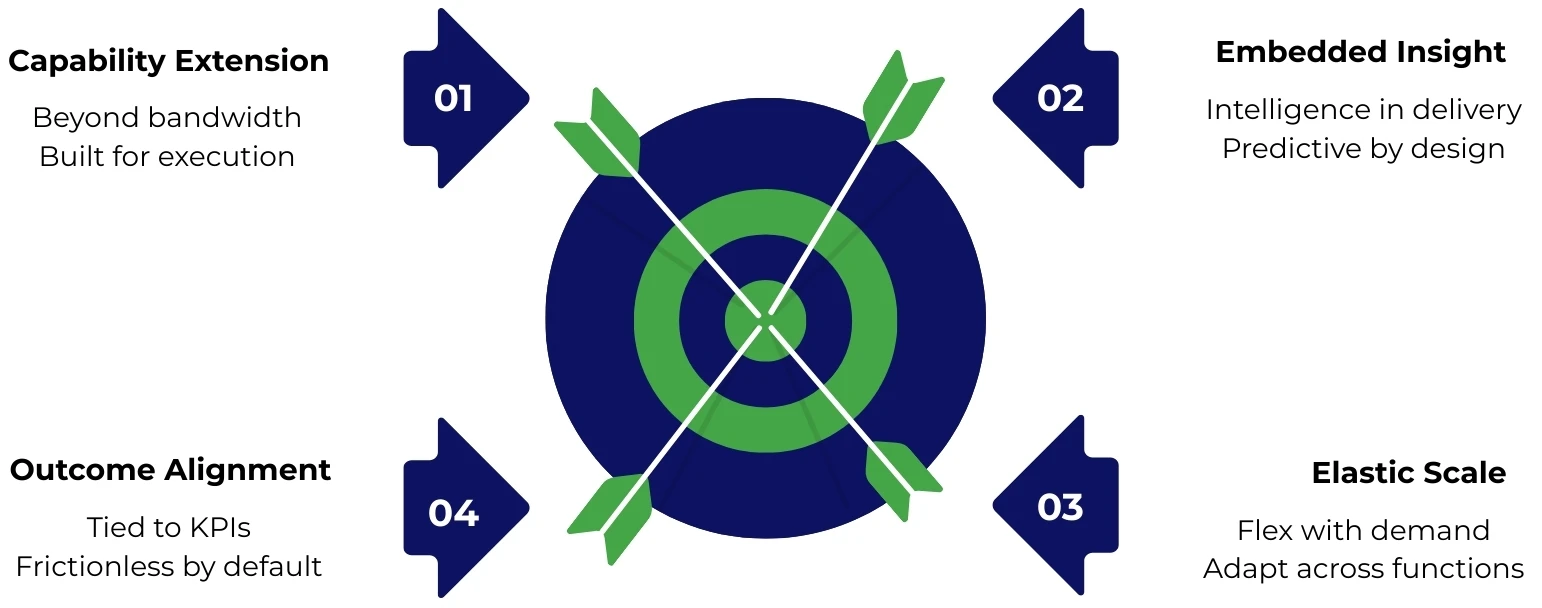
- Partners must extend not just your reach, but your capability
- They must deliver embedded intelligence, not manual output
- They must flex across geographies, volumes, and complexity
- They must align to outcomes, not just SLAs
These are not service providers.
They are strategic multipliers, amplifying execution, accelerating innovation, and enabling scale without friction.
What a 2026-Ready Partner Ecosystem Must Look Like
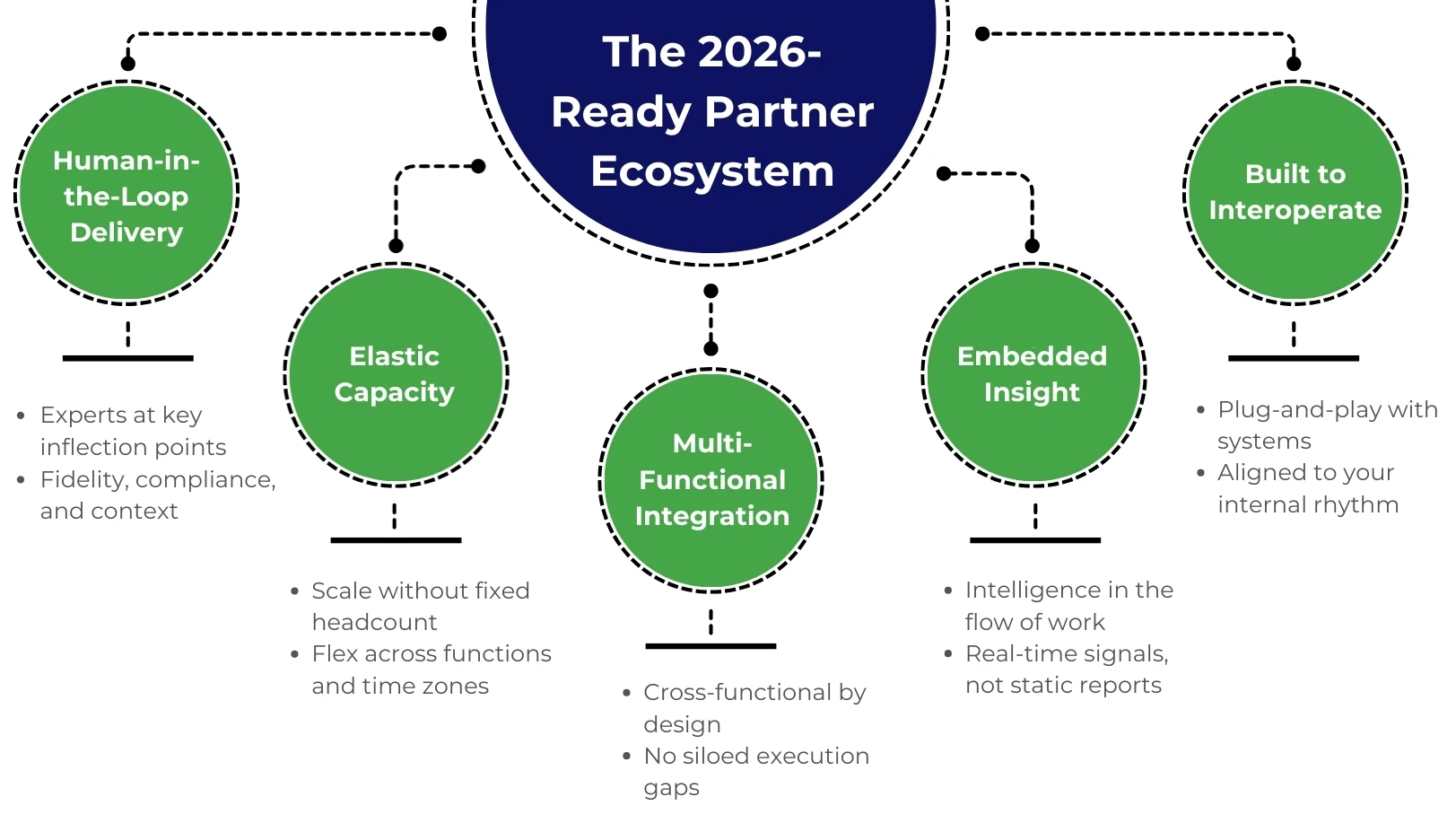
Future-ready portfolios aren’t built on contracts; they’re architected for executional advantage. These are the five structural characteristics Premier NX sees in firms preparing for 2026 and beyond.
1. Human-in-the-Loop by Design
In high-stakes operations, automation can move fast, but it can’t move with context.
Human-in-the-loop (HITL) delivery ensures strategic fidelity: experts embedded at key inflection points to validate, course-correct, and escalate.
It’s how leading firms scale without sacrificing nuance, compliance, or customer trust.
2. Elastic Capacity Without Fixed Overhead
Your partner ecosystem must flex like a capability, not behave like a headcount.
Look for partners who can:
- Scale up/down in real time across functions and time zones
- Absorb execution risk without expanding your org chart
- Maintain continuity under pressure, not just cost savings
3. Multi-Functional by Default
Strategy rarely lives in silos; execution shouldn’t either.
Whether launching a product, redesigning finance workflows, or improving retention, outcomes span CX, Finance, and IT outsourcing.
Future-ready partners bring cross-functional fluency, ensuring one initiative doesn’t break another.
4. Intelligence Embedded in Delivery
Insight should not require a separate request.
Advanced partners deliver intelligence as a default, not a deliverable.
Signals of intelligence in delivery include:
- Predictive reporting and anomaly detection
- Real-time operational visibility
- Embedded recommendations and scenario modeling
5. Built to Interoperate
Strategic momentum breaks when partners don’t talk to your systems or each other.
Future-ready portfolios prioritize composability:
- Plug into your platforms
- Reflect your workflows
- Flow across functions
That’s not convenience, that’s structural agility.
The Premier NX Perspective: Built to Orchestrate What’s Next
The most resilient partner portfolios aren’t defined by how many names are on the list, but by whether they move together.
Premier NX partners with mid-market firms to serve as their operational backbone, enabling strategies to scale, functions to synchronize, and execution to accelerate without friction. Here’s how that role takes shape:
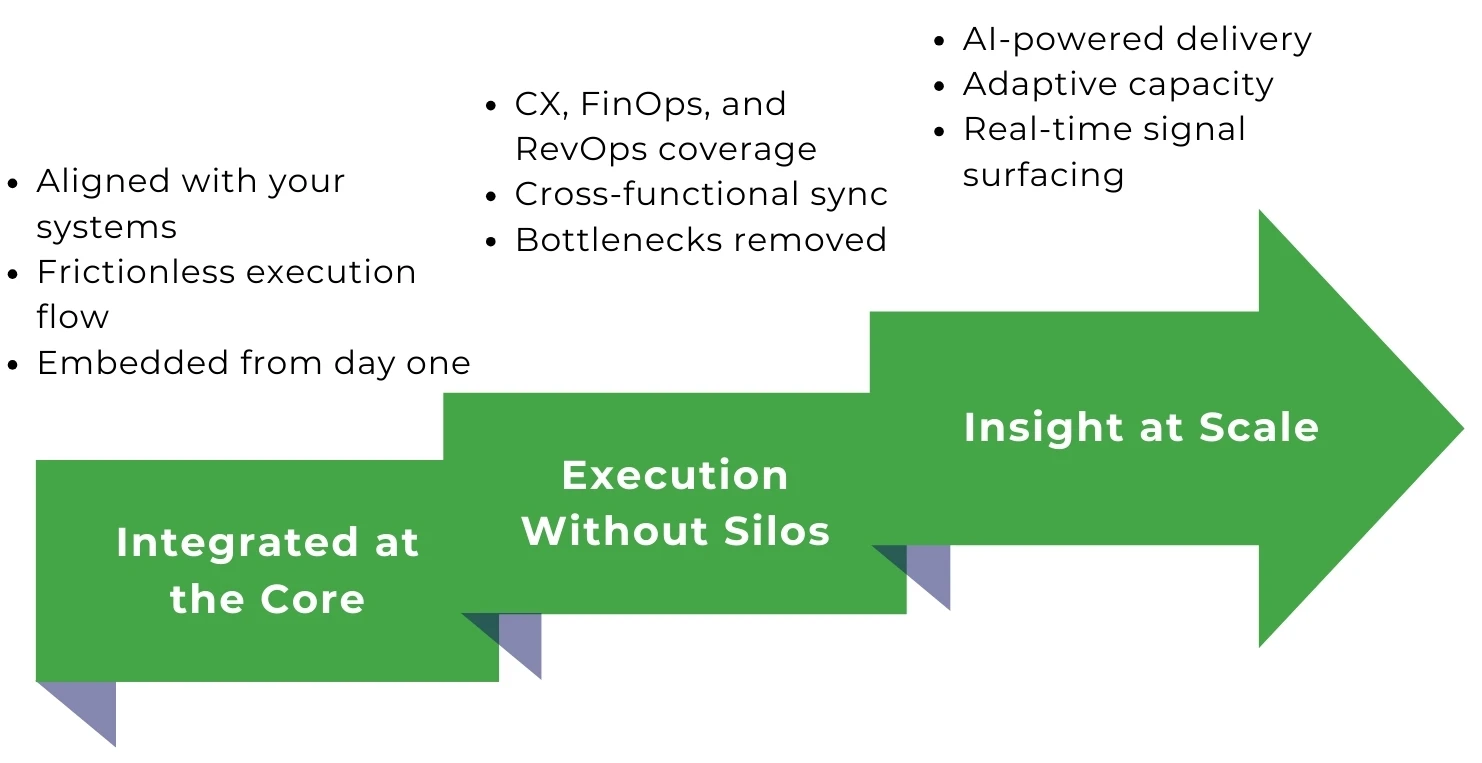
Step 1: We Integrate at the Core
We embed structurally, not peripherally.
- Align with your systems, processes, and strategic cadence
- Reduce friction between insight and action
- Operate as an extension of your team from day one
Step 2: We Execute Across the Whole
Work doesn’t happen in silos, and neither do we.
- Deliver across Finance, CX, and RevOps with shared context
- Create seamless workflows across functions and geographies
- Eliminate the bottlenecks that slow cross-functional initiatives
Step 3: We Scale with Embedded Insight
Adaptability is built in, not added later.
- Leverage our AI + Analytics Innovation Lab to embed insights into delivery
- Align capacity dynamically to strategic priorities and demand shifts
- Surface operational signals before lag turns into loss
Your Strategy Is Only as Scalable as Your Partners
2026 won’t reward ambition, it will reward execution.
And execution depends on the system behind the strategy.
If your partner portfolio was designed five years ago, it’s not ready for what’s next.
Ask yourself: If you had to rebuild your operating ecosystem tomorrow, who would you take with you?
Let’s map what you have against what 2026 will demand.
Premier NX helps mid-market firms rethink the partner layer, not as a list, but as a platform.
We’ll show you where your portfolio accelerates and where it quietly holds you back.
About the Author

As CEO, Ali Din oversees the overall strategy and direction for Premier NX. With senior leadership roles at global HR and recruiting platforms, Indeed and ADP. Ali has over 25 years of experience in the IT and advanced technology sector. Ali’s time is focused on transformation in the business, both for professional development and for clients, to enhance business outcomes.