


At a certain growth stage, the question shifts from “Can we grow?” to “Can we sustain it?”
For organizations between $50M and $1B in revenue, the answer often hinges on capacity, not just headcount, but structural readiness.
Growth introduces variability: spikes in demand, cross-functional dependencies, and rising customer expectations. Without a model built to absorb that volatility, capacity gaps quietly erode momentum through missed timelines, distracted leadership, and execution mired in friction.
As 2026 approaches, resilience will be defined by elasticity. A Strategic Capacity Model repositions capacity as an operating advantage: enabling growth without drag, and ambition without rework.
The Silent Limiter: What Capacity Actually Means in 2026
In many organizations, capacity is still shorthand for headcount or system bandwidth. But by 2026, capacity will be a function of adaptability.
Strategic capacity means the ability to:
- Convert demand into delivery without slowing workflows or decision velocity.
- Reallocate resources across functions without degrading performance.
- Expand throughput in RevOps, CX, FinOps, and IT without rebuilding infrastructure.
- Stay operational during stress points like launches, pivots, or churn.
- Align daily execution with strategic intent across time zones, tools, and teams.
The difference is critical: tactical bandwidth fills short-term gaps. Strategic capacity scales ambition predictably and precisely.
The Strategic Capacity Model: How Execution Must Evolve
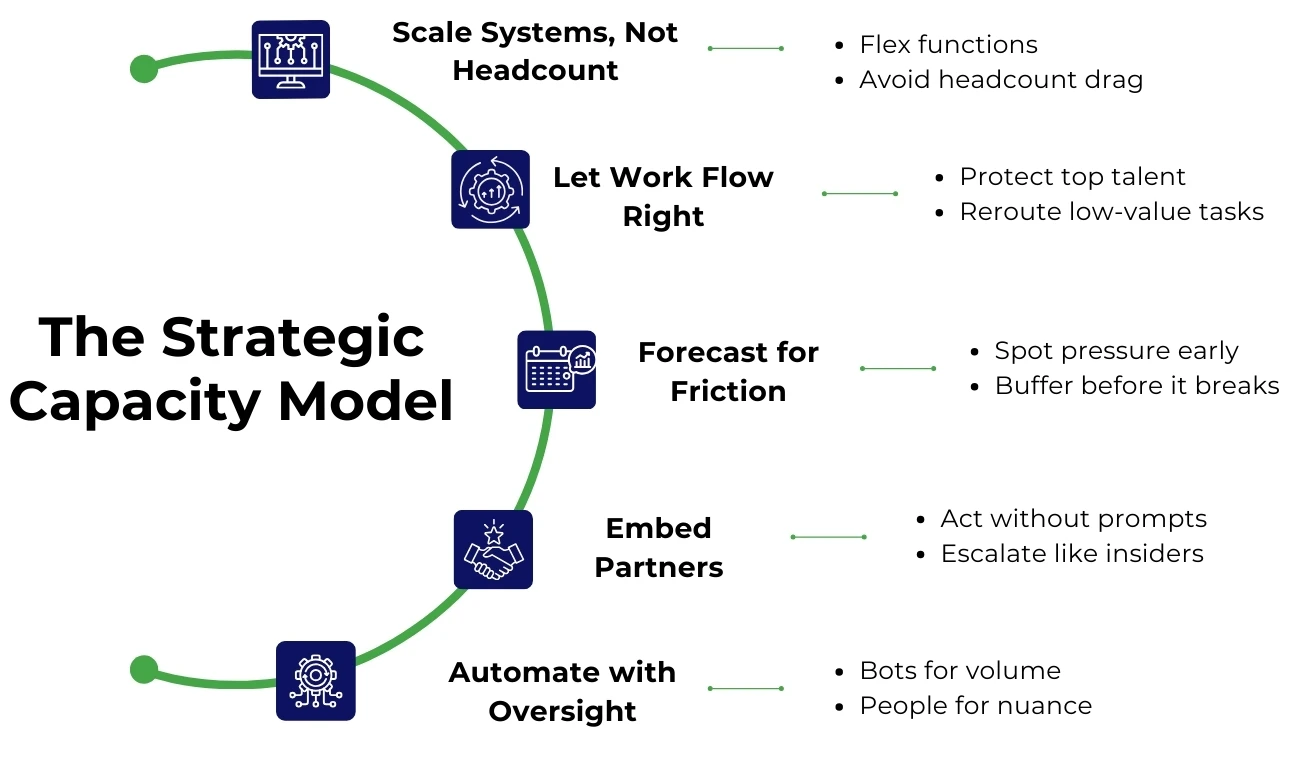
Scale Capabilities, Not Headcount
Bodies don’t scale. Systems do. That’s why modern resilience comes from scaling functional capabilities through a hybrid architecture; internal teams complemented by embedded capacity partners.
Need to flex CX during peak? Ramp FinOps for collections? You shouldn’t need to hire. You should be able to engage throughput already calibrated to your business.
Let Work Flow Where It Belongs
Bottlenecks aren’t always about overload; they’re often about misplacement. A finance analyst spending 30% of their time cleaning data isn’t driving value.
Executional maturity means:
- Strategic lanes aren’t blocked by repetitive tasks.
- Workflow trumps org chart.
- High-value work stays with high-value talent.
Forecast the Friction, Not Just the Future
Traditional forecasting models miss a key variable: operational stress. A product launch can break CX before it breaks revenue.
A modern capacity forecast answers:
- Where will pressure hit?
- Which function absorbs it?
- What backup exists: automation, coverage, escalation?
The intelligent leaders don’t just plan for growth, they pre-buffer its impact.
Partners Shouldn’t Feel Like Vendors
If you still need to “brief” your partner when things shift, that’s not strategic capacity, it’s a delay.
Embedded partners:
- Log in unprompted.
- Escalate like insiders.
- Extend your rhythm, not interrupt it.
Strategic elasticity demands continuity, not just cost arbitrage.
Intelligent Automation, By Design
Automation is essential but insufficient in isolation. Tier-0 tasks should be absorbed by intelligent systems. But what happens when nuance matters?
The most resilient models combine:
- Automation for volume.
- Human oversight for fidelity.
- Escalation paths for context.
Scale isn’t about removing people. It’s about architecting layered systems where tech and talent reinforce each other.
Build for Volume Without Volatility
The biggest risk isn’t that growth stalls; it’s that it accelerates beyond what your infrastructure can hold.
That’s when systems snap:
- SLAs falter.
- Cash cycles stretch.
- Talent burns out.
Strategic capacity means:
- Product expansion doesn’t derail service.
- High-volume seasons don’t dilute quality.
- Teams don’t collapse under friction.
In 2026, winners won’t just grow, they’ll grow with stability.
Signals You’re Capacity-Exposed in 2026
Strategic strain often shows up subtly. Ask yourself:
- Do you hesitate to chase growth because internal bandwidth won’t stretch?
- Are your best people stuck managing volume instead of driving change?
- Have new tools failed to reduce friction?
- Does scaling feel like a burden—not a breakthrough?
If yes, your challenge isn’t strategy, it’s infrastructure.
The Premier NX Approach: Engineering Capacity for Mid-Market Scale
Most mid-market firms don’t lack vision. They lack the day-to-day operational infrastructure that can deliver that vision consistently under pressure.
Premier NX is built to engineer this strategic capacity. We don’t just provide services; we provide the embedded, elastic operational layer that allows your core team to focus on growth.
Our approach is designed to deliver specific outcomes for leaders:
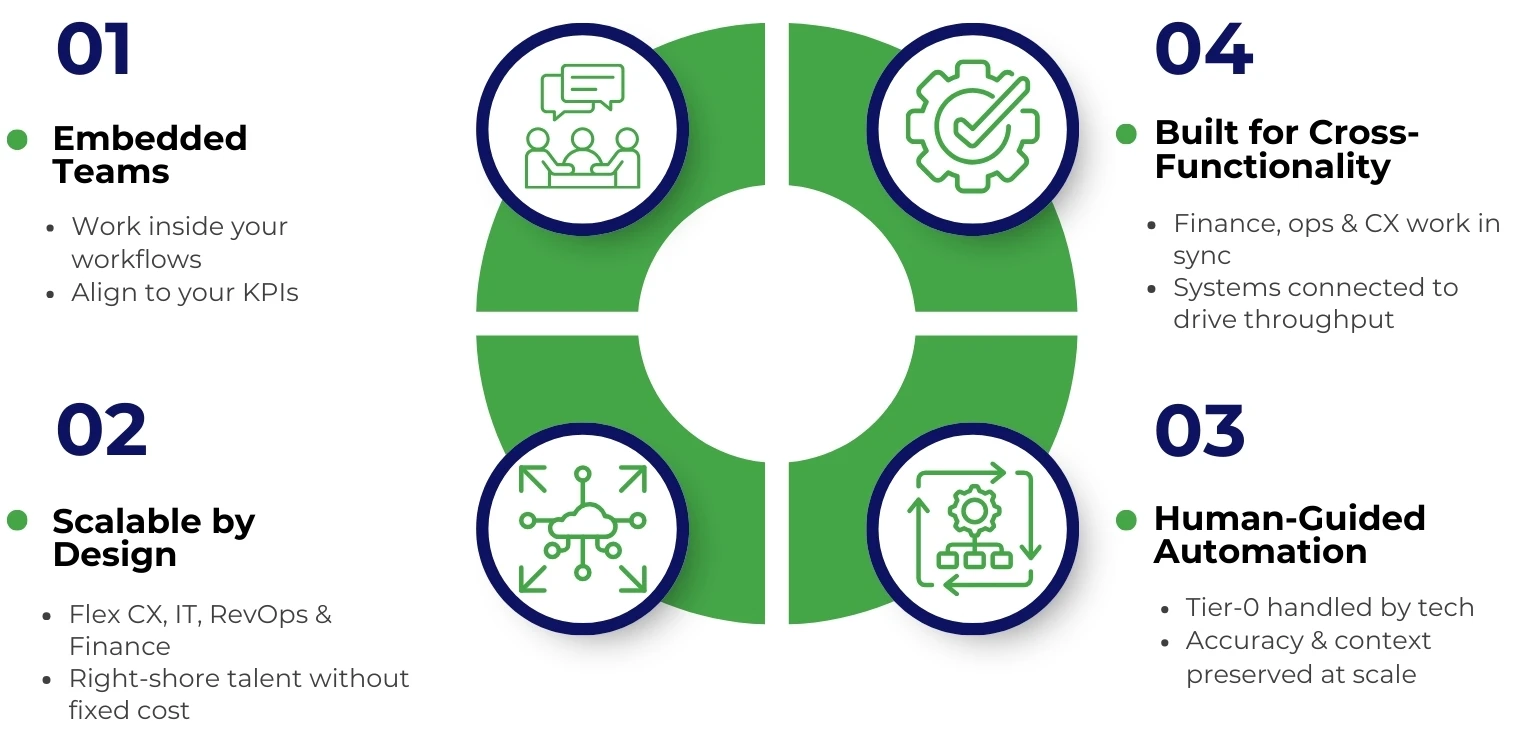
- You Gain Embedded Teams, Not Distant Vendors: Our dedicated pods function as an extension of your department, aligned with your KPIs and business rhythms, reducing your management burden.
- You Access Elastic, Cross-Functional Scale: We provide scalable capacity across Finance, CX, RevOps, and IT through a right-shore blend of onshore, nearshore, and global talent, allowing you to flex specific functions without enterprise-level fixed costs.
- You Benefit from Human-Guided Automation: We layer intelligent automation for volume with expert human oversight for judgment, context, and exception handling, ensuring scale doesn’t come at the cost of accuracy or customer trust.
- You Achieve Convergence, Not Silos: Our infrastructure connects workflows across systems, because solving today’s complex challenges, like a perfect order-to-cash cycle, requires finance, operations, and customer experience to work in concert.
Case Study: Clearing Backlog with Capacity-Ready Execution
The Challenge
A global manufacturing firm faced a backlog of over 5,000 pending Notices of Revision (NORs) tied to supplier and client pricing updates. The volume overwhelmed internal teams and risked delaying operational continuity. Simultaneously, high volumes of internal DRIVE IT tickets strained their systems support function.
The Approach
Premier NX deployed a dedicated support team to absorb NOR processing and IT ticket resolution. The team triaged and actioned legacy NORs while preparing to assist in ServiceNow transitions for the DRIVE IT environment, enabling internal resources to stay focused on core engineering and vendor functions.
The Result
- NOR Volume Reduced: The backlog dropped by 45%, from 5,065 to 2,327, despite daily new entries.
- Scope Expanded: With NOR processing stabilized, the team now supports purchase order and drawing request workflows, extending operational lift without additional internal hiring.
Architect for Agility, Not Exhaustion
2026 won’t reward the boldest strategy. It will reward the most scalable execution.
For mid-market leaders, this isn’t a matter of ambition. It’s a matter of design. And the question isn’t whether to scale but whether your capacity model is built to handle what’s coming.
About the Author

As CEO, Ali Din oversees the overall strategy and direction for Premier NX. With senior leadership roles at global HR and recruiting platforms, Indeed and ADP. Ali has over 25 years of experience in the IT and advanced technology sector. Ali’s time is focused on transformation in the business, both for professional development and for clients, to enhance business outcomes.