

Managed Services Partners (MSPs) don’t build products. They don’t generate revenue.
But every quarter, they dictate how fast you can move, how much you can adapt, and how quickly your strategy becomes reality.
The role of MSPs is shifting. What was once a cost-saving function is now a potential accelerator of growth, intelligence, and innovation.
By 2026, success will not be defined by operational efficiency alone. It will be defined by how much capacity your partner creates for transformation.
Before you renew the relationship, ask yourself:
Is your MSP reducing expenses or enabling progress?
This blog is the first in a two-part series:
- Part one explores the risks of outdated MSP models
- Part two will define how to redesign them for scale and speed.
The End of the “Your Mess for Less” Contract
For years, this was the standard pitch:
“Give us your IT headaches, and we’ll run them cheaper.”
And for a while, that was enough.
The goal was stability. The measure was cost. The relationship was transactional.
This model reduced effort. But it also reduced strategic capacity.
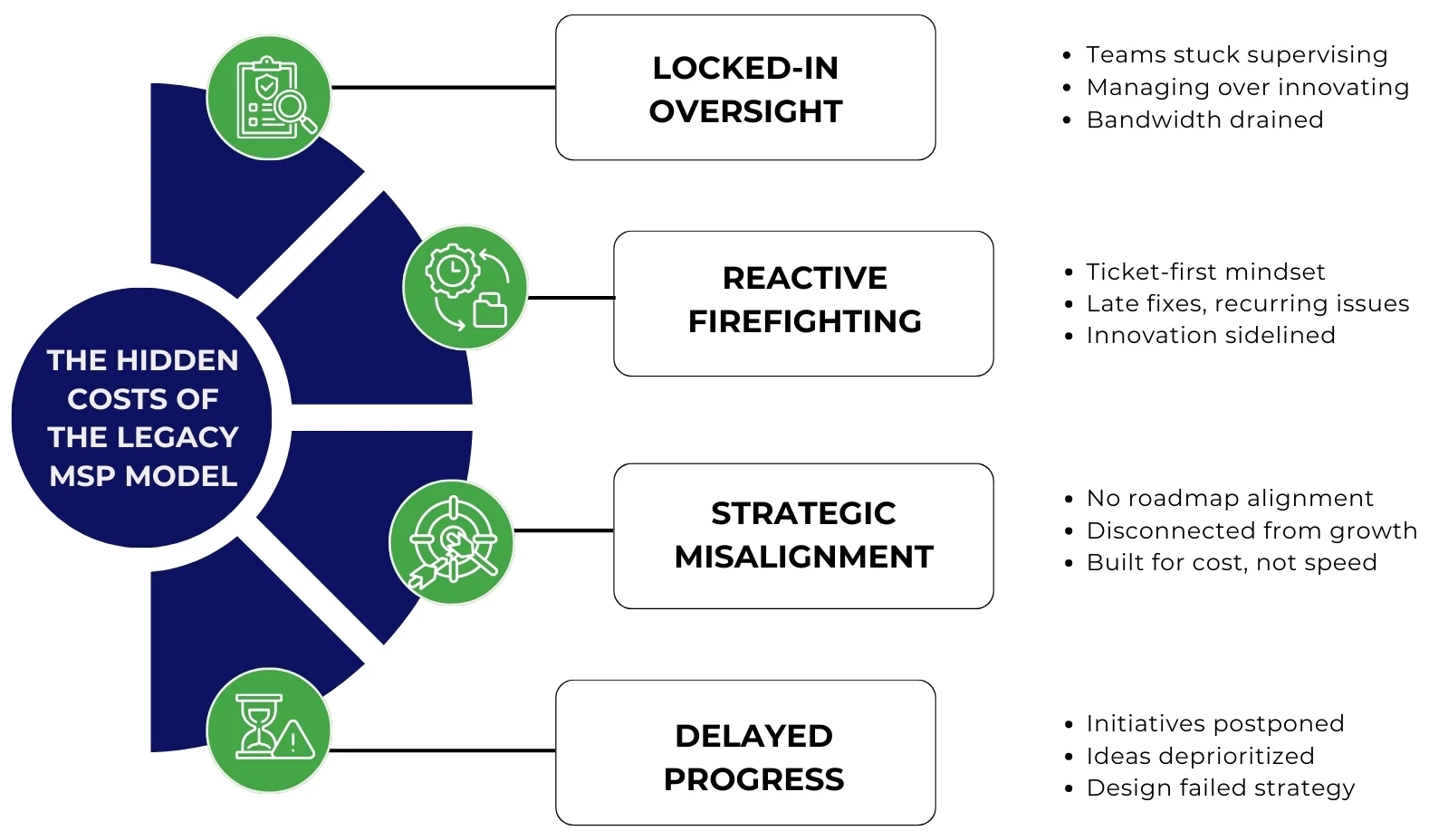
Consider the side effects many mid-market firms experienced:
- Teams trapped in oversight instead of advancement
- Firefighting is crowding out innovation
- Strategic initiatives delayed or deprioritized
This wasn’t a failure of service. It was a failure of design.
And in 2026, a model built for cost containment cannot support a business built for speed.
Because today, the real question is no longer “How do we run IT for less?”
It’s “How do we turn IT into a lever for what’s next?”
The 2026 Growth Engine Model: What Analysts See Coming
In the next wave of growth, MSPs are no longer just service providers.
They are force multipliers.
Mid-market leaders are already redesigning these relationships to move faster and unlock execution capacity across the business.
The emerging model is built on three new imperatives:
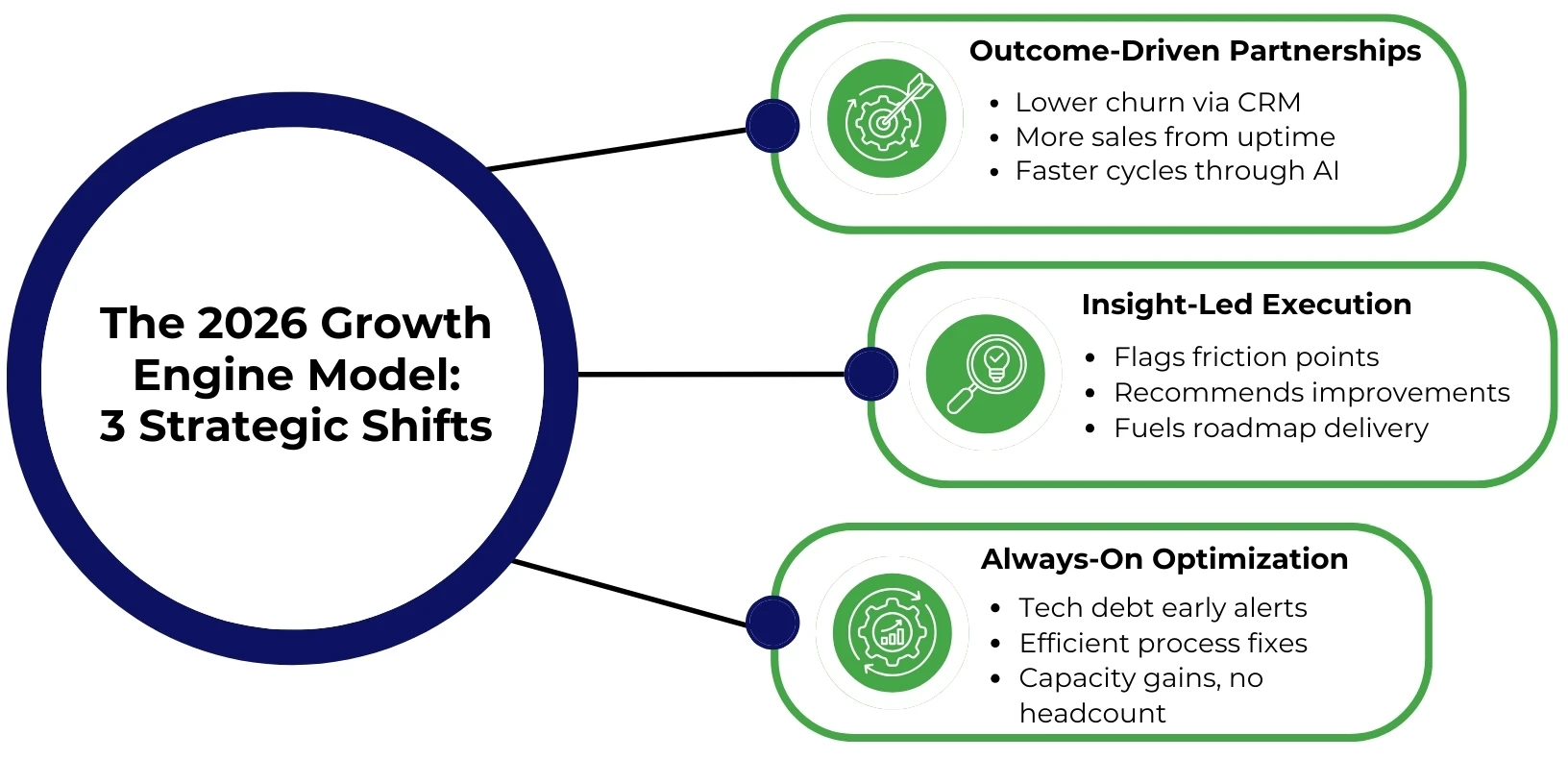
Business Outcomes, Not Service Outputs
Support metrics like ticket counts or uptime are no longer sufficient.
Leading firms are aligning MSP value to tangible business results:
- Reduced customer churn through CRM integration
- Increased sales from higher system reliability
- Shorter cycle times through automation and AI enablement
When your partner’s performance is tied to your revenue levers, they act differently.
They think like a stakeholder, not a vendor.
Strategic Insight, Not Isolated Support
MSPs sit at the intersection of infrastructure, workflow, and data.
The best ones use that visibility to generate insight.
They don’t wait for direction.
They surface friction, highlight inefficiencies, and recommend improvements that fuel strategic decisions.
The result?
Your MSP becomes not just a responder, but a contributor to roadmap execution.
Proactive Optimization, Not Reactive Maintenance
Support used to mean fixing issues fast.
Now it means preventing them and removing blockers before they appear.
With real-time monitoring, pattern recognition, and AI-backed tools, the new model enables:
- Early-warning systems for tech debt
- Automated process improvements
- Continuous identification of capacity unlocks
This is how operations scale without adding headcount.
And how mid-market firms outpace legacy competitors with half the overhead.
The Competitive Cost of Staying Transactional
For mid-market leaders, standing still is no longer neutral.
It’s falling behind while thinking you’re still in control.
Every quarter spent managing a transactional MSP is a quarter your competitors spend scaling AI, accelerating automation, and freeing internal teams for strategic work.
They’re not just reducing IT effort.
They’re compounding business advantage.
And if your partner isn’t doing the same, you’re not standing still.
You’re quietly losing ground.
The Partnership Is the Strategy
This shift is not about replacing a vendor.
It’s about redefining what partnership means in a growth-era operating model.
The first step is clarity, understanding that a transactional MSP limits your speed, capacity, and strategic potential.
The second is action, designing an operating model that frees internal talent and aligns external support with where your business is going.
If you’re evaluating your current partner or just want a fresh perspective, let’s connect for a quick, no-obligation discussion.
Up next in Part Two:
We will break down the operational architecture of a modern MSP partnership—one built to reclaim innovation capacity, accelerate execution, and move in lockstep with your strategic goals.