


Key Takeaways
- 1Finance pressure may surface as a headcount issue, but the real constraint often sits deeper in the process.
- 2Exceptions, handoffs, and rework can spread effort across connected finance activities and distort the true capacity need.
- 3A broader operating scope can improve execution without changing Finance’s ownership of controls, judgment, and accountability.
- 4Once the process is scoped correctly, leaders can determine whether the right answer is targeted support or broader capacity.
A vacancy, growing backlog, or delayed close can make a finance problem look like a staffing problem. Sometimes it is. But when capacity is sized before the underlying work is scoped, Finance risks solving the most visible symptom while leaving the operating constraint intact.
The more useful question is not simply how many people are missing. It is what work must be performed, under what control model, to what performance standard, and where the current process is failing to meet that requirement.
That distinction does not make headcount less important. It puts headcount in the right sequence: define the operating requirement first, then determine the capacity needed to deliver it.
Process Boundaries and Operating Dependencies
Finance organizations may assign accountability across AP, AR, payroll, reconciliations, reporting, and close. The work itself is less contained. Approvals, data quality, exceptions, handoffs, and control activities cross those organizational boundaries and can move effort downstream.
Consider a multi-entity business with an AP backlog. Additional invoice-processing capacity may be justified. But if a material share of the backlog is being driven by coding inconsistencies, approval exceptions, supplier-data issues, or repeated follow-up, the constraint is not contained within invoice processing. The same unresolved items can create reconciliation work, delay reporting, or require additional management intervention at month-end.
That changes the scoping question. The issue is no longer simply where the backlog appears. It is where work is being created, transferred, repeated, or delayed across the process.
The Economics of Process Friction
The economics of a finance process are not captured by salary cost or transaction volume alone. They are also shaped by the number of touches required to complete the work and by the exception handling, rework, escalation, and management attention embedded in the process.
A relatively low-cost activity can become expensive when it repeatedly creates downstream intervention. Likewise, a team can appear fully utilized while a meaningful share of its capacity is being consumed by preventable coordination rather than productive throughput.
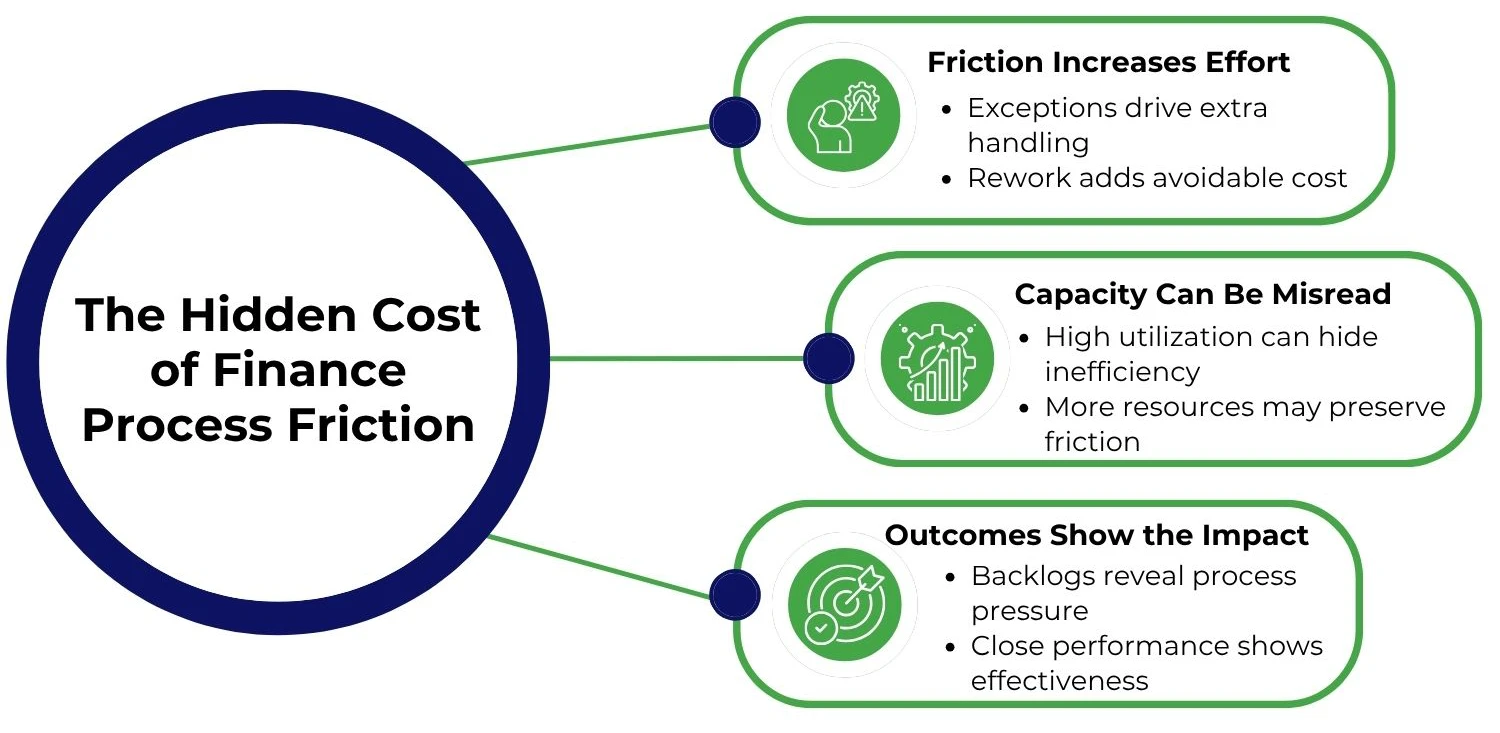
Finance efficiency starts where friction ends
This matters because capacity decisions based only on visible workload can institutionalize friction. Adding resources may improve short-term throughput while leaving the underlying demand pattern unchanged.
A stronger business case therefore asks where effort is being absorbed and what operating outcome is expected to improve: backlog aging, cycle time, accuracy, reconciliation completion, reporting timeliness, or close performance. Finance capacity should be evaluated against those outcomes, not in isolation from them.
When the Operating Model Has Changed
Finance operating models often outlive the conditions under which they were designed. An acquisition, ERP migration, carve-out, rapid growth, or increase in entity and transaction complexity can change the way work enters Finance, where controls sit, and which activities depend on one another.
The implication is not that every significant business change requires a broad transformation program. It is that material change should trigger a reassessment of whether yesterday’s process boundaries and resource model remain appropriate.
A scope that once made sense may now fragment connected work across teams, duplicate review activity, or place recurring exceptions with people whose time is better reserved for judgment and control.
Before adding capacity to the existing structure, Finance should determine whether that structure still reflects how the business now operates.
Finance Governance and Decision Rights
A broader operational scope does not require Finance to give up ownership of financial decisions or controls.
The relevant distinction is between recurring execution and retained accountability. Transaction processing, reconciliations, documentation, follow-up, and reporting support can be organized within a broader delivery scope while approval authority, material judgments, policy ownership, risk decisions, segregation-of-duties requirements, and financial sign-off remain with the retained finance organization.
This distinction matters in both directions. Governance concerns should not automatically force an unnecessarily fragmented execution model. At the same time, operational efficiency should not blur responsibility for decisions that belong inside Finance.
Defining the Finance Operating Scope
Before capacity is sized, the operating requirement has to be explicit. For a CFO or Controller, that means resolving a small set of questions that materially affect scope:
- What is driving demand? Transaction volumes, variability, entity structure, business-unit complexity, and system dependencies.
- Where is effort being absorbed? Exceptions, rework, handoffs, backlog, aging, and recurring management intervention.
- What must remain under Finance control? Approval authority, control ownership, escalation, judgment, and financial sign-off.
- What must the process deliver? Defined expectations for accuracy, cycle time, reconciliations, reporting, and close.
The result may still be a narrow requirement. If the evidence shows that the constraint is genuinely concentrated in one activity, adding one or two roles may be the right answer.
But if the pressure is distributed across connected processes, sizing only the visible role can understate the operating requirement. In that case, broader scope is simply a more accurate reflection of the work that must be managed.
Better Scope Leads to Better Capacity Decisions
The most useful finance transformation conversations begin before a role count has hardened into the scope.
Premier NX works with finance leaders to assess recurring finance operations across accounting, reconciliations, reporting and compliance, treasury, expenditure management, and related processes, helping define where the operating requirement is truly concentrated and where it extends across connected activities.
That makes the decision more useful than simply asking how many seats Finance needs.
The better question is: What operating scope will produce the finance outcomes the business needs and what capacity does that scope require?
About the Author

As CEO, Ali Din oversees the overall strategy and direction for Premier NX. With senior leadership roles at global HR and recruiting platforms, Indeed and ADP. Ali has over 25 years of experience in the IT and advanced technology sector. Ali’s time is focused on transformation in the business, both for professional development and for clients, to enhance business outcomes.