

Strategic plans rarely fail in the boardroom.
They stall in the workflow.
Across the mid-market ($100M–$1B), COO, CIO, and HR leaders invest heavily in growth, expansion, and market positioning. Yet inside the organization, employees navigate slow approvals, outdated IT systems, procurement bottlenecks, and fragmented HR processes.
The result is not dramatic failure; it is gradual friction. Teams spend more time managing systems than executing strategy.
In 2026, the constraint will not be ambition.
It will be operational friction.
Do your internal systems serve your strategy, or does your strategy accommodate your systems?
From Processing to Enabling: Rethinking the Role of the Back Office
Most back-office operations were designed for control, accuracy, compliance, and cost containment. Those objectives remain essential, but they are no longer sufficient.
For mid-market organizations, internal operations now shape execution speed. HR influences how quickly talent becomes productive. IT shapes collaboration and access. Procurement determines how fast capital becomes capability. When these functions operate in isolation, execution slows.
When these functions operate in isolation, execution slows. When digitally integrated, execution compounds.
The mandate for 2026 extends beyond efficiency. It requires velocity supported by:
- Automated, transparent workflows
- Integrated data across HR, IT, finance, and operations
- Reduced approval friction
- Systems designed around employee experience, not internal hierarchy
The objective is simple but strategic:
Internal operations should remove performance bottlenecks.
The 2026 Enablement Engine: Internal Infrastructure That Accelerates Teams
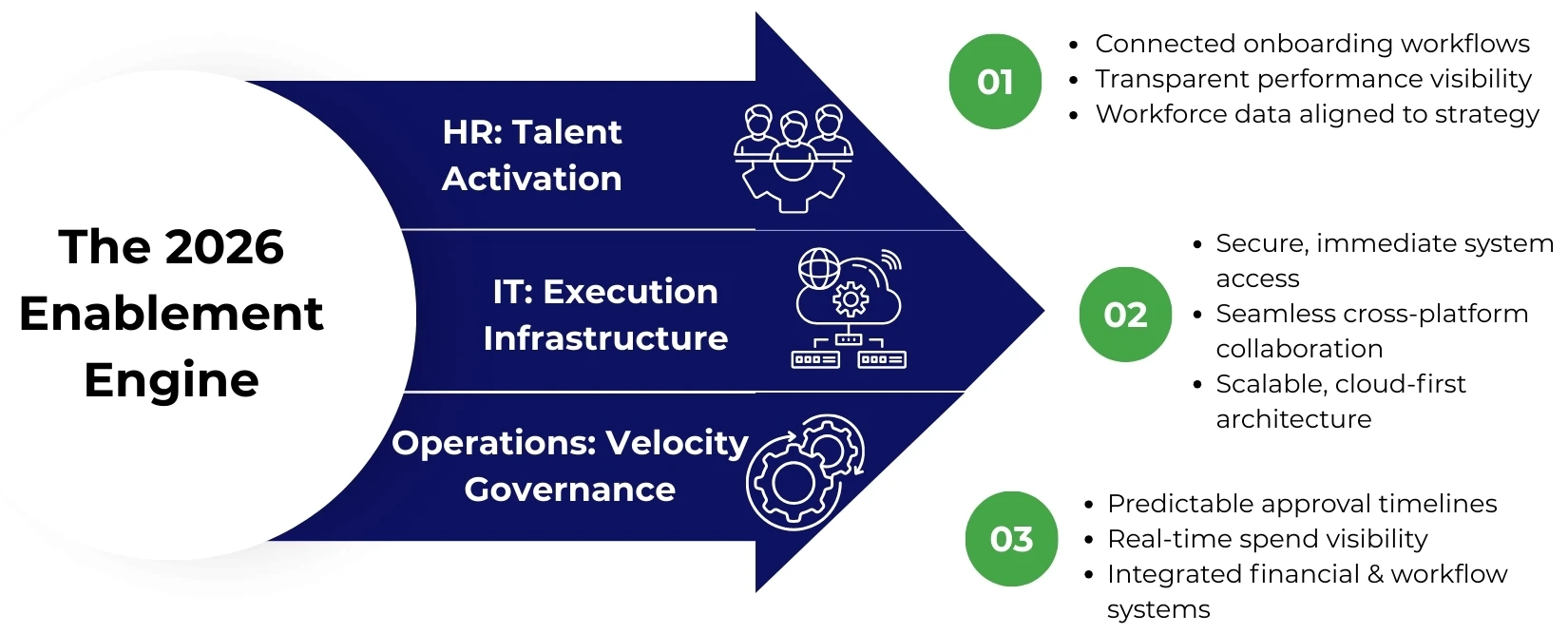
HR as a Growth Accelerator (Employee Experience Layer)
Employee experience is not an initiative. It is an operating condition.
When performance expectations are unclear, managers rely on interpretation rather than data.
An enabling HR function is designed around activation.
- Systems are connected.
- Performance visibility is transparent.
- Workforce data informs planning rather than reactive responses.
When HR is structured this way, employee experience becomes operational leverage rather than administrative overhead.
IT as an Enabler, Not a Gatekeeper
Teams lose momentum when access is delayed, tools fail to integrate, or infrastructure struggles to scale with growth. These issues are rarely catastrophic. They are cumulative.
Three conditions define an enabling IT model:
- Immediate, secure system access
- Seamless collaboration across platforms
- Infrastructure that scales without reconfiguration
Operational latency rarely appears in IT strategy decks. It appears in slower launches, extended project cycles, and unnecessary coordination.
Procurement & Internal Operations as Velocity Drivers
Procurement cycles influence how quickly initiatives move from approval to execution. Budget visibility shapes the confidence behind investment decisions.
Velocity improves when:
- Approval timelines are defined and predictable
- Spend visibility is real-time
- Financial and operational workflows share the same data backbone
In that environment, governance does not restrict growth. It guides it.
Designing for velocity requires more than isolated improvements.
Building the Enablement Engine: A Strategic Three-Phase Shift
Enablement does not happen through isolated upgrades. It requires deliberate redesign.
For COOs, CIOs, and Heads of People, internal infrastructure evolves through a clear sequence.
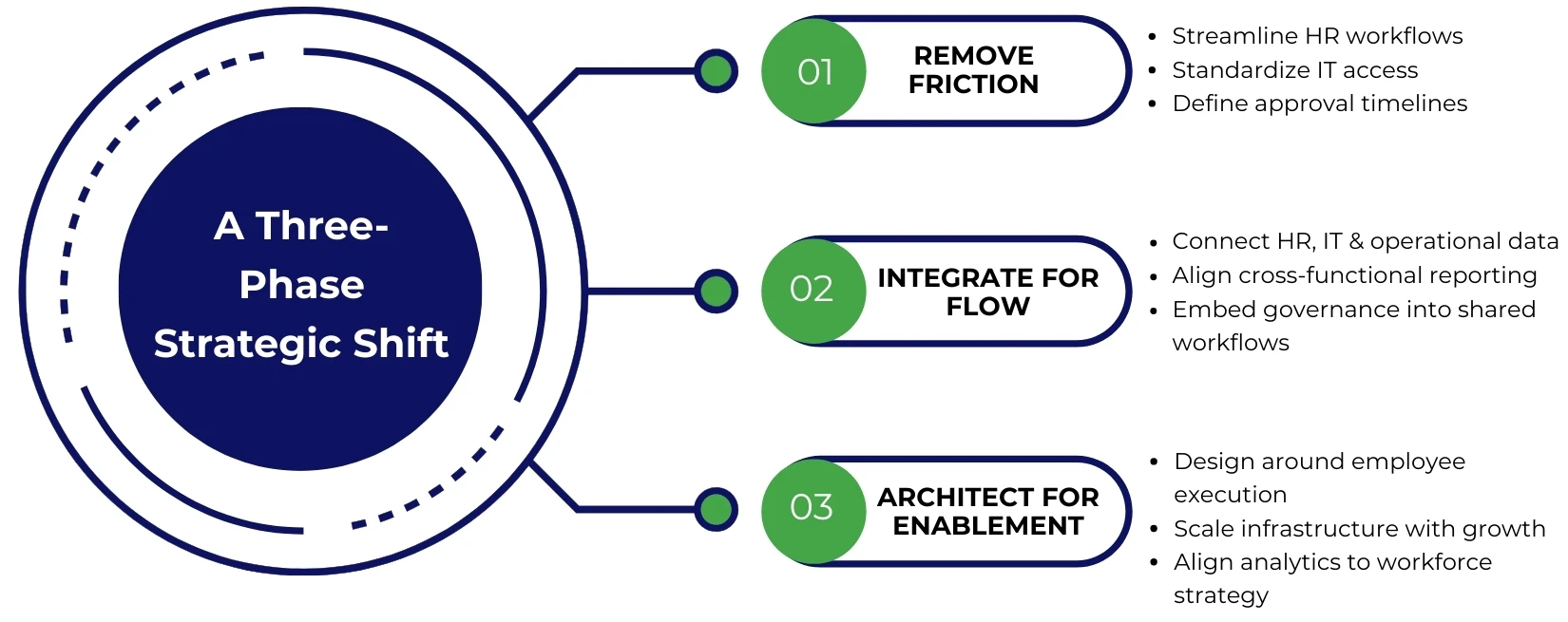
Phase I: Remove Operational Friction
Before enablement, there must be clarity.
- HR workflows must be streamlined.
- IT access must be predictable.
- Procurement approvals must be defined.
At this stage, leadership focuses on eliminating manual routing, reducing approval lag, and improving visibility across systems.
Premier NX supports this phase by modernizing core workflows through Digital Transformation and aligning HR, IT, and operational systems, reducing friction without destabilizing governance.
Phase II: Integrate for Flow
Once friction is contained, fragmentation becomes visible.
Departments operate efficiently but not cohesively.
The priority shifts to:
- Connecting HR, IT, and operational data
- Aligning reporting across functions
- Embedding governance into shared workflows
Integration is not about adding tools. It is about connecting them.
Premier NX connects workflows, systems, and data across HR, IT, and operations, so approvals, access, and reporting run end-to-end without fragmentation.
Phase III: Architect for Enablement
In the final phase, internal infrastructure is intentionally designed to support employee execution.
- Systems scale with headcount.
- Access is immediate but secure.
- Procurement cycles are predictable.
- Workforce data informs strategy.
Here, internal operations do not simply function. They accelerate performance.
As an architectural partner, Premier NX aligns infrastructure, governance, and analytics into a seamless environment that empowers teams rather than constraining them.
Internal Architecture Is the Multiplier
By 2026, strategy alone will not differentiate mid-market firms.
Execution capacity will.
And execution capacity is shaped by what happens behind the scenes — in HR workflows, IT infrastructure, procurement systems, and internal operations.
The organizations that lead in the next growth cycle will not simply hire faster or invest more.
They will design an internal infrastructure that enables their people to execute without resistance.
If your teams are compensating for the system rather than being supported by it, the architecture warrants review.
About the Author

As CEO, Ali Din oversees the overall strategy and direction for Premier NX. With senior leadership roles at global HR and recruiting platforms, Indeed and ADP. Ali has over 25 years of experience in the IT and advanced technology sector. Ali’s time is focused on transformation in the business, both for professional development and for clients, to enhance business outcomes.