


What does it actually mean to “choose” a finance & accounting partner in 2026?
At the point of selection, most partners appear comparable.
- Capabilities align
- Services overlap
- And pricing converges
The difference emerges later, when the finance function is tested under growth and increasing complexity.
In 2026, finance is no longer be defined by reporting cycles or transactional accuracy. It is expected to provide continuous visibility across evolving structures, systems, and regulatory demands.
For mid-market organizations with $100M to $1B in revenue, this creates a distinct reality. Growth does not just add volume; it exposes structural limits within the finance function.
The choice is no longer simply between in-house and outsourced finance.
It is between maintaining finance as a functional layer and enabling it to operate within the business’s decision-making infrastructure.
What follows is a strategic lens to evaluate finance & accounting partners against that standard.
What Has Changed in Finance Partner Decisions
On the surface, the process of choosing a finance & accounting partner appears unchanged. Capabilities are compared, costs are evaluated, and service coverage is assessed.
What has changed is not the process but the pressure behind it.
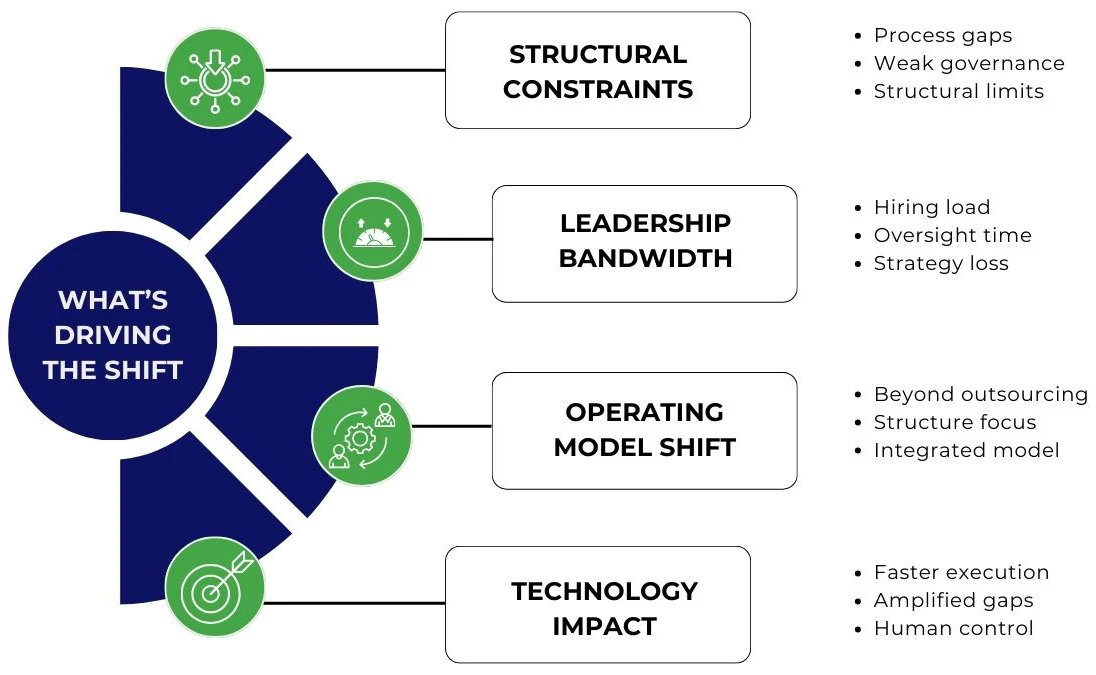
Finance Constraints Are Now Structural, Not Just Operational
As organizations scale, challenges are no longer limited to workload or volume. Growth begins to expose gaps in processes, governance, and team design.
Implication:
The right partner must support how finance is structured, not just how work is executed.
Leadership Bandwidth Has Become the Limiting Factor
Finance leaders are increasingly constrained by time spent on hiring, training, and managing execution. As complexity grows, this limits their ability to focus on planning, analysis, and strategic initiatives.
Implication:
The decision is no longer about adding capacity; it is about enabling leadership to operate at the right level.
The Decision Has Shifted From Outsourcing to Operating Model Design
Outsourcing is no longer a standalone solution. Its effectiveness depends on how well it integrates into the broader finance function.
Implication:
The question is not whether to outsource, but how to structure finance to scale with the business.
Technology Amplifies the Model, Not Replaces It
AI and automation are increasingly embedded in finance workflows. However, their impact depends on the underlying structure in which they operate.
Implication:
Technology improves outcomes only when paired with well-defined processes and human oversight.
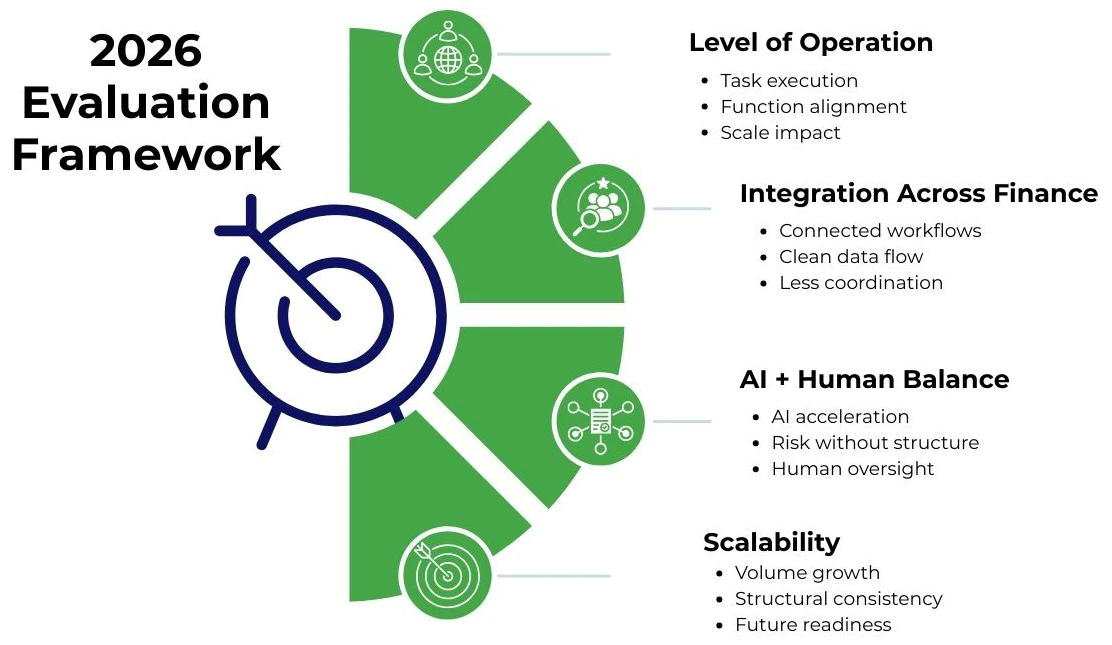
The 2026 Evaluation Framework: Four Strategic Considerations
Choosing a finance & accounting partner is no longer a matter of comparing services.
As many finance leaders experience, the real challenge emerges later when growth exposes gaps in structure, visibility, and capacity.
In that context, the decision becomes one of alignment: how well a partner fits the way your finance function needs to operate.
1. The Level at Which the Partner Operates
Most partners can execute tasks. Fewer influence how finance actually functions.
The distinction is not visible early but becomes critical at scale.
- Task-level support helps manage workload
- Function-level alignment shapes how finance is structured and improved
- The latter determines whether complexity is absorbed—or pushed back onto leadership
The question is not what they do, but the level at which they operate.
2. Integration Across the Finance Function
In many organizations, finance operates in fragments; accounting, reporting, and analysis work in parallel rather than as a system.
This is manageable early. It does not hold under scale.
What to look for:
- Alignment across accounting, reporting, and analysis workflows
- Consistent data flow without manual reconciliation layers
- Reduced dependency on coordination between teams
What happens if not:
- Delays in reporting
- Gaps in reconciliation
- Limited visibility across the business
3. AI Application, With Human Accountability
AI is now embedded across finance, but its value depends on how it is applied.
The risk is not a lack of automation. It is automation without structure.
- AI accelerates execution across transactions, forecasting, and anomaly detection
- But without human oversight, it introduces risk rather than clarity
- Human-in-the-loop ensures:
- Context
- Accuracy
- Control
Technology does not fix broken workflows; it amplifies them
4. Will This Still Work at 2× Scale?
This is where many decisions fail, not at selection, but over time.
A model that works today may not hold as true:
- Transaction volumes increase
- New entities or markets are added
- Reporting requirements evolve
Key considerations:
- Can capacity scale without restructuring the model?
- Will processes remain consistent as complexity increases?
- Does the partnership reduce future disruption or create it?
The cost of switching later is often higher than the cost of choosing correctly now.
How Finance Leaders Are Approaching This Decision
In a recent CFO discussion hosted by Premier NX, one pattern stood out:
The decision to outsource finance is rarely driven by cost. It emerges when the existing model begins to break under scale.
Early concerns focus on control, quality, and visibility. In practice, the constraint is structural, how finance is organized to handle increasing complexity.
What Changes at That Point
- From adding capacity → to restructuring how finance operates
- From outsourcing tasks → to integrating execution into the function
- From managing work → to enabling leadership focus
What High-Performing Models Prioritize
- Defined processes and governance
- Integration across accounting, reporting, and analysis
- Built-in continuity across hiring, training, and execution
- Leadership time redirected toward FP&A and strategic decisions
Your Next Step: From Selection to Alignment
Choosing a finance & accounting partner is ultimately a decision about how finance will operate as your business evolves.
The question is not simply who can deliver the work, but where your current model falls short.
Is the gap in:
- Operational consistency
- Visibility and insight
- Or the ability to scale without added complexity
Clarity on that point often determines the right path forward.
When you’re ready to evaluate this more closely, a structured discussion can help map your current state against what your finance function needs to become.
Schedule a conversation with Premier NX to assess your current model and identify the most practical next step.
About the Author

As CEO, Ali Din oversees the overall strategy and direction for Premier NX. With senior leadership roles at global HR and recruiting platforms, Indeed and ADP. Ali has over 25 years of experience in the IT and advanced technology sector. Ali’s time is focused on transformation in the business, both for professional development and for clients, to enhance business outcomes.