


The files were finalized. The freelancer signed off. The team moved on.
Then someone asked, ‘Why does it work like this?’
…Silence.
No notes. No rationale. Just a trail of decisions no one can explain—and a ticking clock as your team scrambles to reverse-engineer someone else’s logic.
For organizations leaning on freelance talent, this isn’t a rare event; it’s a recurring risk. While freelancers provide short-term agility, they rarely offer long-term continuity. Over time, this talent churn erodes institutional knowledge, forcing organizations to relearn, rebrief, and rework efforts that should have been scalable assets.
In this fourth installment of our Rethinking Freelancers series, we address a critical but often overlooked cost of freelance-heavy workforce strategies: knowledge drain. Our previous blogs have explored the hidden costs of freelance models, their inability to support mid-market scale, and the compliance vulnerabilities they introduce.
What Freelancers Can’t Deliver: Continuity
Large U.S. companies lose an average of $47 million annually in productivity due to inefficient knowledge sharing and duplicated work.1
For all businesses, institutional knowledge is foundational. It informs decisions, anchors continuity, and compounds over time to create a strategic advantage. But when transient contributors like freelancers hold that knowledge, its value never materializes. Unlike embedded teams who learn, evolve, and scale with the business, freelancers operate in short bursts, often without the systems, context, or incentive to retain and transfer critical information.
In environments where freelance engagements dominate, and specialized knowledge exists with the individual, the impact compounds, disrupting continuity, inflating overhead, and undermining both execution speed and service reliability.
Why Freelance Models Fail at Retaining Knowledge
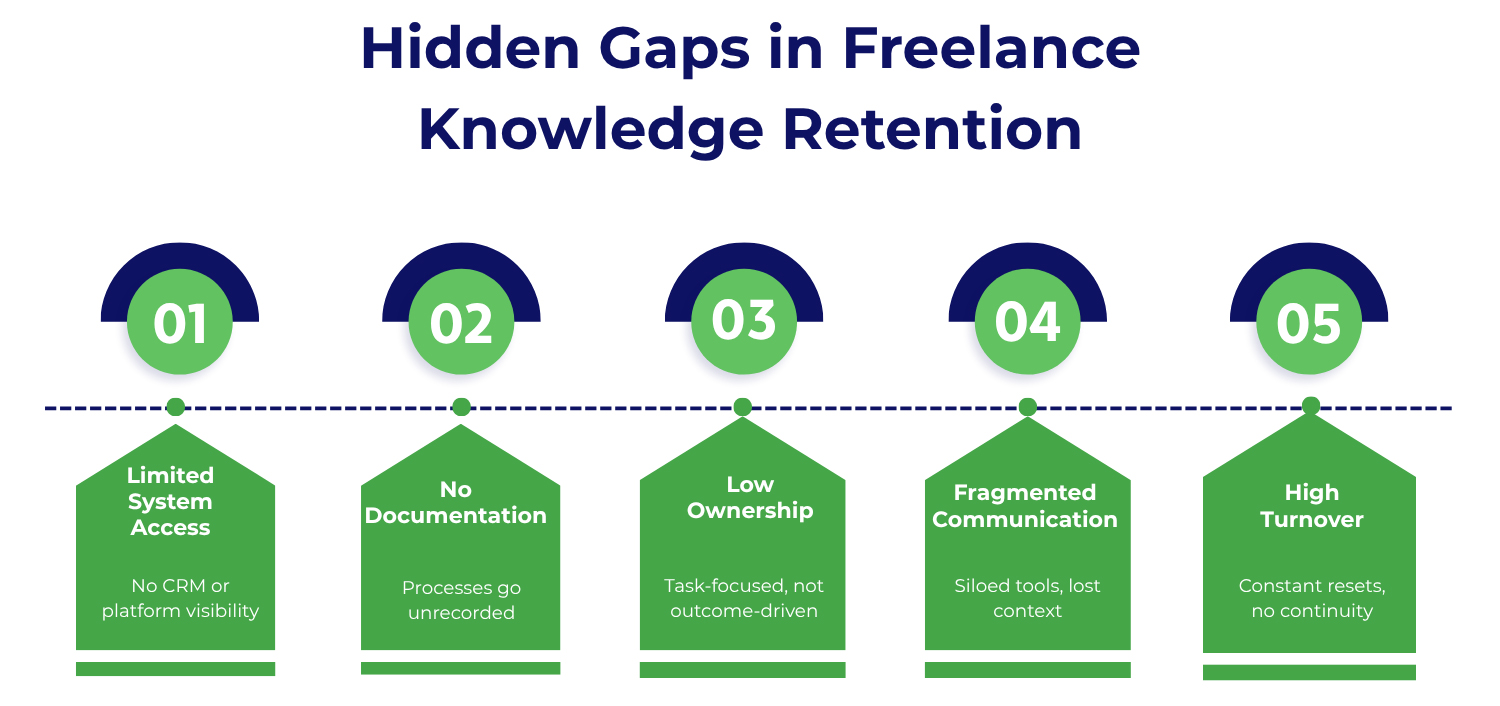
Limited Access to Core Systems
Freelancers often work outside a company’s primary platforms, such as CRMs, knowledge bases, and project management tools, which restrict their exposure to the full operational context. This limits their ability to internalize how and why things are done.
No Mandate for Documentation
Because freelance roles often prioritize task completion over process integration, formal documentation of decisions, methods, and lessons learned is rarely required. As a result, key knowledge is lost when the individual leaves.
Transactional Engagements Lack Ownership
Freelancers are engaged to deliver outputs, not outcomes. Without shared accountability for long-term success, there’s no inherent incentive to invest in knowledge continuity or improvement cycles.
Communication Silos Block Transfer
Freelancers typically operate in peripheral communication channels—external emails, temporary access, or ad hoc meetings, which result in fragmented updates and unshared insights.
High Churn Eliminates Continuity
The short-term nature of freelance contracts guarantees turnover. Without a mechanism to retain individuals or transfer learning systematically, companies face repeated resets that slow momentum.
The Hidden Costs of Knowledge Drain
Extended Onboarding Cycles: Without preserved context, new contributors must be re-briefed from scratch, slowing ramp-up and diverting internal resources.
Duplicated Work & Process Redundancy: When prior efforts aren’t captured, teams unknowingly recreate solutions, wasting time and budget.
Missed Opportunities for Iteration & Innovation: Insights from past work never feed forward, preventing optimization and continuous improvement.
Weak Client Continuity: In customer-facing roles, freelancer turnover breaks relationship momentum, forcing clients to re-explain, re-engage, and recalibrate expectations.
The Case for Co-Sourcing: An Effective Model for Sustained Value
| Category | Freelance-Based Model | Embedded Co-Sourced Teams |
|---|---|---|
| Knowledge Retention | Context exists with the individual | Knowledge is captured, refined, and institutionalized |
| Process Alignment | Task-focused, loosely integrated | Trained on internal systems, aligned with core workflows |
| Continuity | High churn, limited visibility | Long-term engagement, consistent team presence |
| Compliance Readiness | Unstandardized access and offboarding | Unstandardized access and offboarding |
How Premier NX Solves the Knowledge Drain Problem
Freelance models deliver speed, but not staying power. Premier NX offers a continuity-first approach through embedded, long-term teams designed to retain institutional knowledge, align with your strategy, and scale value over time.
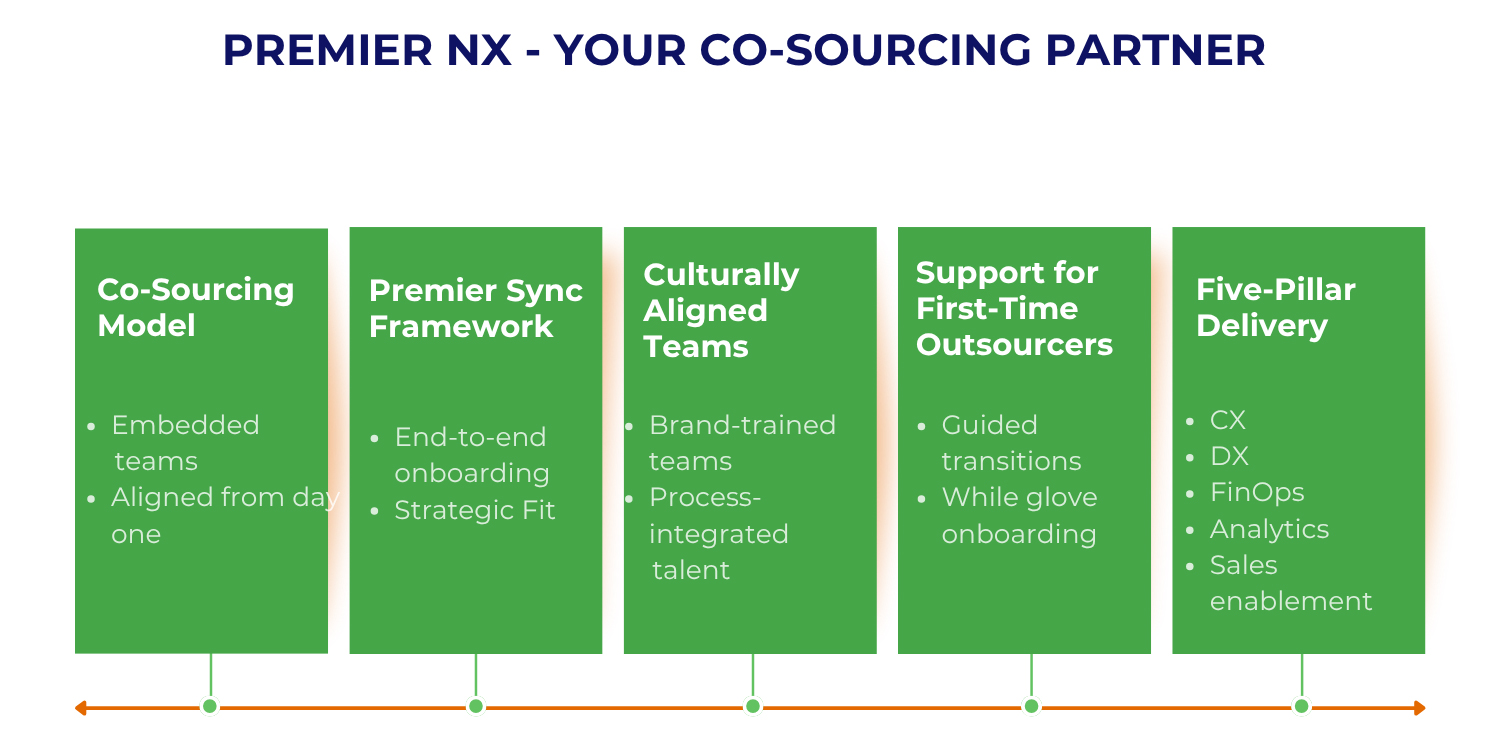
- Co-Sourcing Model: Premier provides dedicated teams embedded within your workflows, offering full operational continuity and strategic alignment from day one.
- Premier Sync Framework: At Premier, we approach our client relationships with a partnership mentality that enables us to tackle the entire recruiting and onboarding process while collaborating on business goals.
- Tailored, Culturally Aligned Teams: We emphasize deep cultural immersion, ensuring that every team understands your brand’s voice, decision-making logic, and operational priorities.
- Support for First-Time Outsourcers: Premier helps first-time outsourcers transition from fragmented models to structured partnerships, delivering white-glove onboarding and integration support.
- Five-Pillar Delivery Framework: We deliver across five strategic areas: Customer Experience, Digital Transformation, FinOps, Analytics, and Sales Enablement.
Build a Workforce That Scales & Delivers
Knowledge continuity is a strategic necessity. Premier NX helps you embed expertise, retain context, and drive long-term value through co-sourced teams built for your business.
Contact us to discover how our experts can help you achieve your next stage of growth.
About the Author

As CEO, Ali Din oversees the overall strategy and direction for Premier NX. With senior leadership roles at global HR and recruiting platforms, Indeed and ADP. Ali has over 25 years of experience in the IT and advanced technology sector. Ali’s time is focused on transformation in the business, both for professional development and for clients, to enhance business outcomes.