


Key Takeaways
- 1Warranty delays often stem from disconnected workflows, not customer service alone.
- 2Missing information, unclear ownership, and poor coordination create claim bottlenecks.
- 3A connected process improves intake, validation, coordination, and follow-up.
- 4Faster warranty resolution reduces repeat contacts, escalations, and customer frustration.
Household product warranty claims slow down customer service when support, documentation, approvals, dispatch, billing, and follow-up are not connected. What looks like a service delay is often an operational workflow problem.
For household product, appliance, equipment rental, repair, maintenance, and home services brands, customers usually contact support after something has already gone wrong. A fast response protects trust. A slow or unclear process creates repeat contacts, complaints, and avoidable escalations.
What Causes Warranty Claim Delays?
Warranty claim delays occur when intake, eligibility review, approvals, and fulfillment are handled in separate steps without clear ownership.
Customers may need to submit proof of purchase, product details, photos, warranty registration, issue history, or service information. When those details are missing or spread across systems, agents spend more time chasing information than resolving the claim.
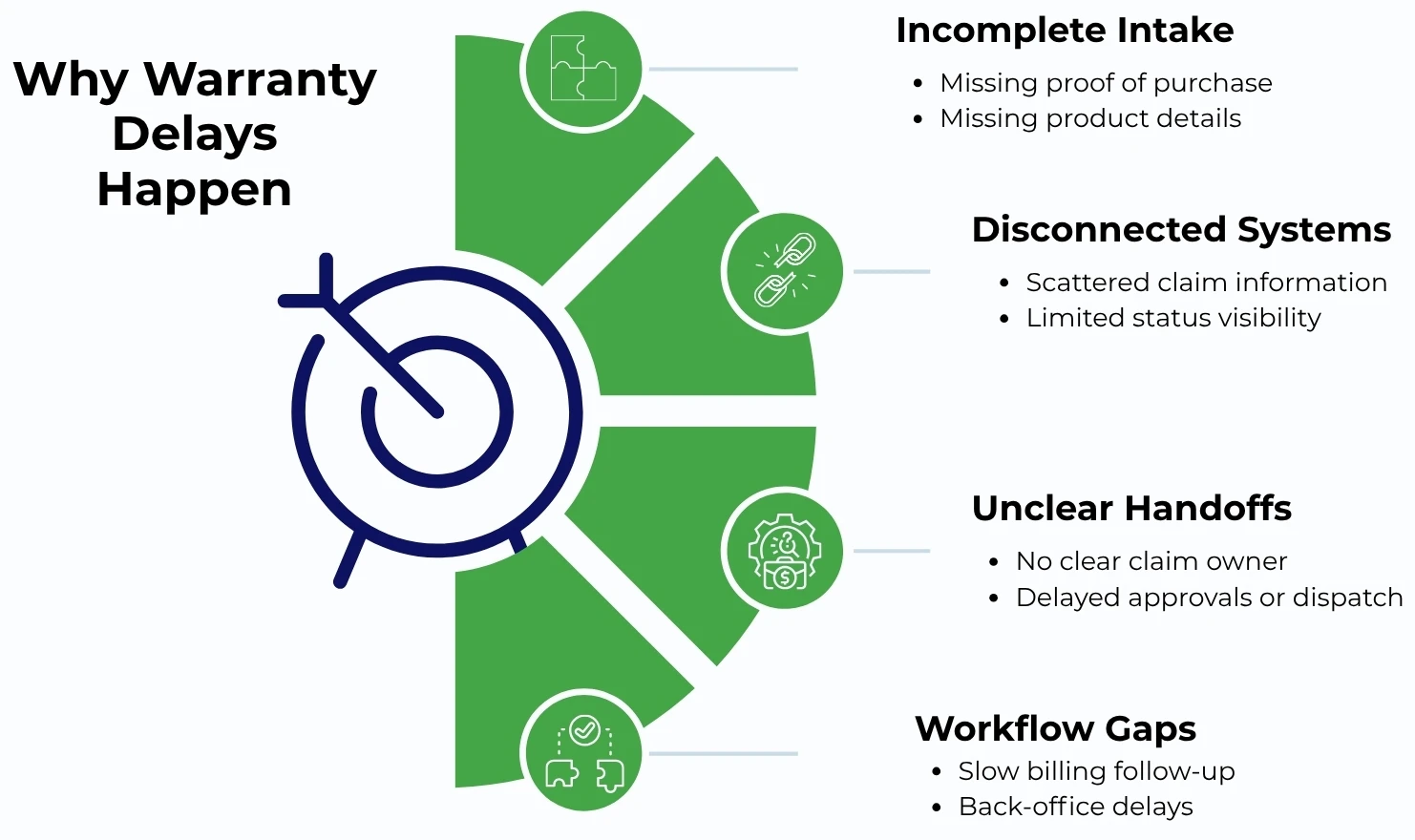
Most warranty delays are workflow issues not customer service issues.
Delays grow when support teams cannot see where the claim stands. Customer service may collect the issue, operations may approve the replacement, dispatch may schedule service, and billing may manage refunds or adjustments. If those handoffs are not structured, the customer waits.
Premier NX helps household product and home services companies identify gaps in support, back-office, dispatch, and follow-up that delay warranty resolution.
How Do Warranty Claims Create Customer Service Bottlenecks?
Warranty claims create bottlenecks because they require verification, coordination, and a decision.
Unlike a general inquiry, a warranty claim may depend on warranty terms, product data, repair availability, replacement inventory, shipping status, service windows, billing rules, or escalation guidelines.
When warranty claims are routed to the same queue as standard questions, support teams lose speed. Customers then follow up because they do not know what happens next. One delayed claim can become multiple calls, emails, chats, and escalations.
How Can Household Brands Improve Warranty Claim Resolution?
Household brands improve warranty claim resolution by treating warranty support as a connected workflow rather than a support queue.
A strong model connects four stages: intake, validation, coordination, and follow-up. Intake captures the right product and customer details. Validation confirms warranty coverage and approvals. Coordination connects the claim to repair, replacement, dispatch, billing, or fulfillment. Follow-up keeps the customer informed until the issue is resolved.
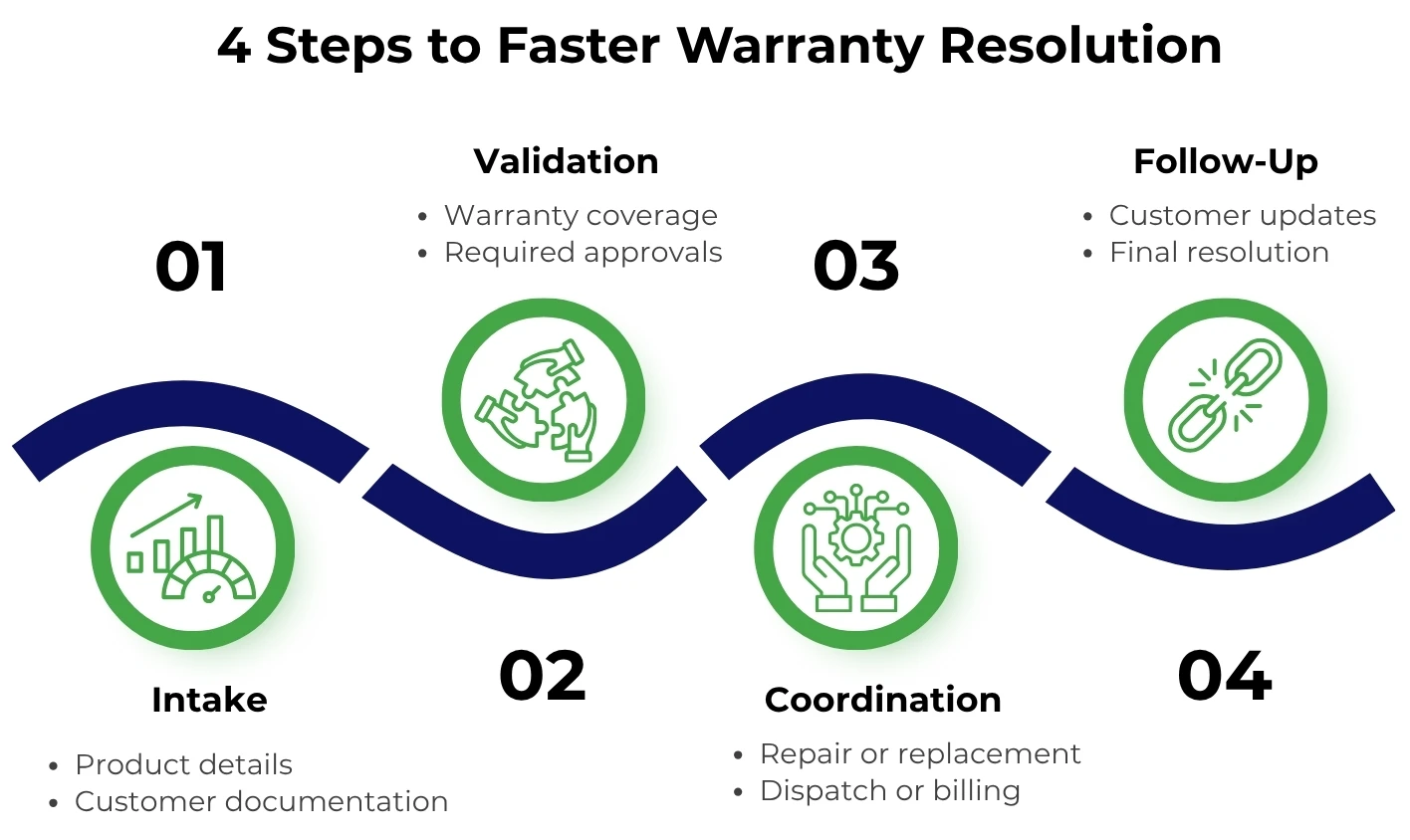
Connected workflows help warranty claims move faster.
This reduces rework because agents know what to collect, where to route the claim, and when to update the customer.
How Can Support Teams Reduce Response Times?
Support teams reduce response times by separating simple inquiries from complex warranty claims and shifting repeatable admin work away from frontline agents.
Agents slow down when they search across systems, request missing documents, wait for approvals, or manually coordinate with repair, dispatch, fulfillment, and billing teams.
Back-office support can manage documentation checks, CRM updates, eligibility preparation, appointment confirmations, replacement order support, and routine follow-up. That gives agents more time for issues that require judgment, empathy, or product knowledge.
What Should Household Brands Outsource First?
Household brands should outsource repeatable warranty support tasks that cause delays, but workflows, SLAs, QA, and escalation rules can govern that.
Strong starting points include claim intake, documentation collection, CRM updates, basic eligibility checks, customer follow-up, appointment confirmations, replacement order support, billing inquiries, and dispatch coordination.
Outsourcing should not remove control from the brand. It should add structure, speed, and visibility around the work that slows resolution.
What Does Good CX Look Like for Household Products?
Good CX for household products means customers receive prompt acknowledgment, clear instructions, accurate claim handling, proactive updates, and a fair resolution without having to repeat themselves.
For customers, the experience should answer four questions: What do I need to submit? What happens next? How long will it take? Who owns the outcome?
For leaders, warranty CX should be measured by response time, resolution time, repeat-contact rate, escalation rate, claim backlog, dispatch-scheduling time, replacement-processing time, and CSAT after resolution.
When Should Household Product Brands Consider a CX Partner?
Household product brands should consider engaging a CX partner when warranty volume, response times, repeat contacts, documentation, dispatch coordination, or follow-up exceed internal capacity.
Warning signs include growing backlogs, rising escalations, missed service windows, manual workarounds, unclear ownership, and agents spending more time on administration than on customer resolution.
Premier NX supports household product and home services companies with customer care, warranty claim intake, documentation review, complaint management, dispatch coordination, order processing, billing support, escalation handling, and back-office workflows.
Premier’s view is simple: warranty support improves when customer care, back-office operations, and dispatch coordination work as one connected system. If warranty claims are slowing customer experience, start with the workflow before adding more headcount.
When Should Household Product Brands Get Help Reducing Warranty Delays?
Household product brands should seek help reducing warranty delays when claim volume, repeat contacts, documentation, dispatch coordination, or follow-up exceed internal capacity.
In a free 30-minute warranty support assessment, Premier NX reviews your current claim workflow, identifies where delays are happening, and outlines practical next steps to improve response times, reduce repeat contacts, and create a more structured support model.
Frequently Asked Questions (FAQs)
About the Author

Lisa Murray is a Consumer Goods Industry Advocate at Premier NX, helping North American CPG brands strengthen support for consumers, retailers, internal teams, and day-to-day operations. Focus centers on building scalable onshore, offshore, and right-shore service models that improve trust, efficiency, insight, and growth across the business.