

Key Takeaways
- 1Customer experience is shaped by operational discipline long before customers contact support.
- 2The Prevention Gap reveals where preventable friction creates unnecessary customer effort and higher contact volumes.
- 3High-performing organizations use customer interactions to uncover root causes, improve cross-functional alignment, and continuously reduce friction.
- 4By turning contact center insights into operational improvements, businesses can create more consistent experiences while lowering service demand.
Customer experience rarely breaks in the contact center; it breaks in the business processes that customers encounter long before they ask for help.
Operational disconnects among teams, systems, and ownership create preventable friction that eventually manifests as higher contact volumes, lower satisfaction, and rising service costs.
Mid-market organizations often respond to declining customer satisfaction by adding agents, implementing AI, or investing in new CX platforms. Those investments can improve responsiveness, but they rarely eliminate the root causes creating customer effort in the first place.
Why Customer Experience Problems Start Before Customer Service
The issue is rarely a single failed interaction. It is usually the result of small disconnects that accumulate across the business before the customer ever reaches support.
A company may promise speed, clarity, personalization, or consistency. But those promises depend on whether teams share the right information, ownership is clear, knowledge stays current, demand is anticipated, and systems support one view of the customer.
When these elements are not aligned, channels such as calls, chats, self-service, and AI only reveal the gap. The customer may not see the internal cause, but they feel the result: more effort, less confidence, and an experience that does not live up to the promise.
What Is the Prevention Gap in Customer Experience?
The Prevention Gap is the difference between an organization’s ability to resolve customer issues and its ability to prevent those issues from occurring.
High contact volume is often less a staffing problem than a business signal. Every repeat call, escalation, or complaint may indicate an upstream process that needs improvement.
A useful rule is:
Every customer interaction is a symptom. The root cause usually lies elsewhere in the business.
Organizations that close the Prevention Gap reduce customer effort instead of simply improving recovery.
Not sure where your organization stands?
Use our Prevention Gap Assessment to quickly evaluate whether your teams are preventing customer issues or simply resolving them after they occur.
What High-Performing Customer Experience Organizations Get Right
High-performing organizations recognize that customer experience is an outcome of operational discipline, not customer service alone. Rather than optimizing every interaction, they focus on reducing the friction that creates unnecessary interactions in the first place.
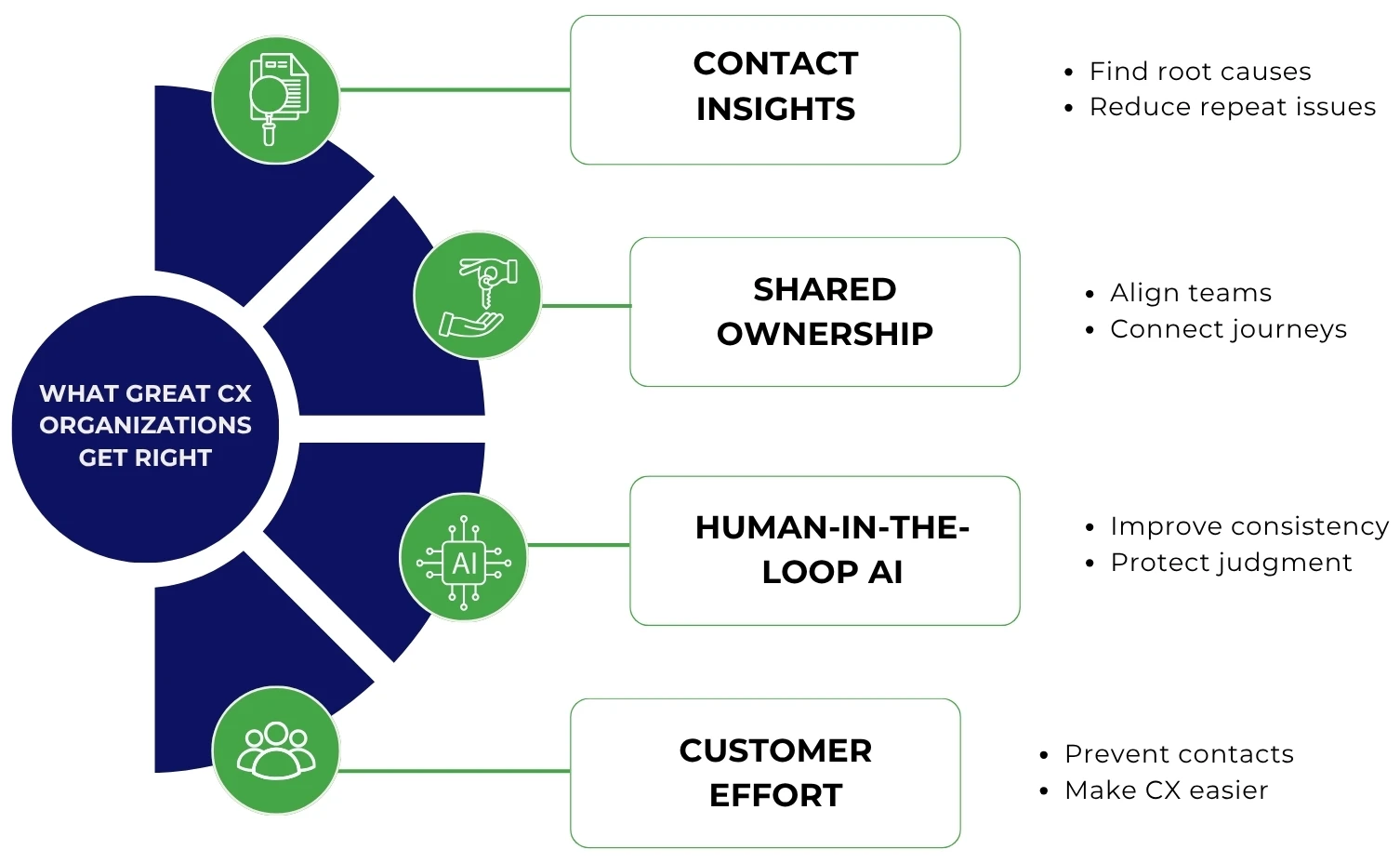
How high-performing organizations improve customer experience.
Customer Contacts Drive Better Business Decisions
Leading organizations treat customer contacts as operational intelligence, not just service demand. Every repeat contact, escalation, or complaint is an opportunity to identify where the business can remove friction before it reaches the customer.
Instead of asking, “How quickly did we resolve it?” they ask, “What allowed this issue to happen in the first place?”
Customer Journeys Have Shared Ownership
Customers experience one business, not individual departments. High-performing organizations align functions around the customer journey rather than optimizing them independently.
This means connecting decisions across:
- Sales and Operations
- Finance and Customer Support
- Technology and Business Teams
The result is a more consistent experience, regardless of where the customer enters the business.
AI Needs Human-in-the-Loop Accountability
AI can surface patterns, guide agents, improve consistency, and reduce manual effort. But the moments that shape trust often require context, discretion, and accountability. A delayed order, a billing concern, a retention risk, or a sensitive escalation cannot be managed by speed alone.
The best CX organizations use automation to improve execution, while human oversight protects the quality of decisions.
Customer Effort Becomes the Measure of Success
Response times and service levels remain important, but they are only part of the picture.
High-performing organizations also ask:
- Could this interaction have been prevented?
- What operational change would eliminate this issue?
- How can we make it easier for customers to achieve their goal?
The most valuable CX improvements often come from reducing the need for customer support altogether.
Turning Contact Center Insight into CX Improvement
The next stage of CX maturity is using customer interactions to identify where the business is creating preventable friction.
This is where Premier NX is aligned to the real opportunity. Through CX support operations, QA, analytics, workforce management, knowledge support, and human-in-the-loop AI, Premier NX helps mid-market organizations understand what drives contact volume, where consistency breaks down, and which operational changes can reduce customer effort.
The goal is not to make the contact center absorb more of the business. It is about using what the contact center reveals to improve the business before the customer notices the breakdown.
Build Customer Experience Before the Customer Needs Support
Customer experience does not break because the contact center is the weakest point. It reaches the contact center because something earlier in the business created effort, confusion, or inconsistency.
For mid-market organizations, the opportunity is to stop treating CX improvement as a front-line fix and start addressing the operating conditions that shape the experience before support is needed.
Ready to uncover your Prevention Gap and discover where operational improvements can create your next customer experience advantage?