

Key Takeaways
- 1CSAT and NPS can show how customers feel while leaving the operational cost of achieving that outcome hidden.
- 2Repeat contacts, transfers, escalations, corrections, and recovery costs can turn an apparently efficient interaction into an expensive one.
- 3Leaders should identify preventable contacts and process-generated work before automatically adding capacity.
- 4Technology should reduce repeat work, rework, escalations, and manual intervention, not simply move those costs elsewhere.
Customer experience is often discussed through satisfaction scores, loyalty, and service quality. Those measures matter, but they can leave an important question unanswered: what did the business have to spend, fix, or absorb to produce that experience?
For mid-market companies, that question becomes more consequential as customer volumes, channels, and operational complexity grow faster than the resources available to manage them. A customer may ultimately leave an interaction satisfied after multiple contacts, a transfer, an escalation, and a billing correction. The experience may have been recovered. The cost of the failure was not.
For leadership, CX becomes an economic issue rather than simply a service metric, and the ability to scale customer operations efficiently becomes as important as the experience itself.
Better CX Economics Start With Less Friction
Why CX Metrics Miss the Cost of Resolution
CSAT and NPS tell leaders how customers feel; they do not show how much operational effort was required to create that outcome. That distinction matters when support volume grows faster than headcount, budgets, or systems.
Qualtrics XM Institute estimates that poor customer experiences put nearly $3 trillion in global sales at risk in 2026, as consumers reduce or stop spending following bad experiences.1
Two customers can report the same satisfaction score while producing very different economics. One is resolved accurately on the first interaction. The other requires multiple contacts, a supervisor, back-office correction, and a credit.
A recovered experience can still be an expensive failure.
Cost-to-Serve: Where Customer Friction Becomes an Economic Issue
The economics of CX become clearer when leadership looks beyond the cost of individual interactions and examines the total effort required to resolve a customer need.
A lower handle time or cost per contact may look efficient. But if the issue leads to another call, a transfer, an escalation, rework, or a credit, that efficiency quickly erodes.
Efficient resolution:
Issue → accurate response → resolution
High-friction resolution:
Issue → repeat contact → transfer → escalation → rework → resolution
The outcome may be the same. The economics are not.
That is why cost-to-serve should be viewed alongside:
- Repeat contacts — unresolved demand consuming more capacity
- Transfers and escalations — more resources involved in one issue
- Rework and corrections — downstream cost created by upstream failure
- Refunds and credits — direct cost of service recovery
The stronger leadership question is not simply, “What does each interaction cost?” but “What does it cost us to resolve the customer’s need fully?”
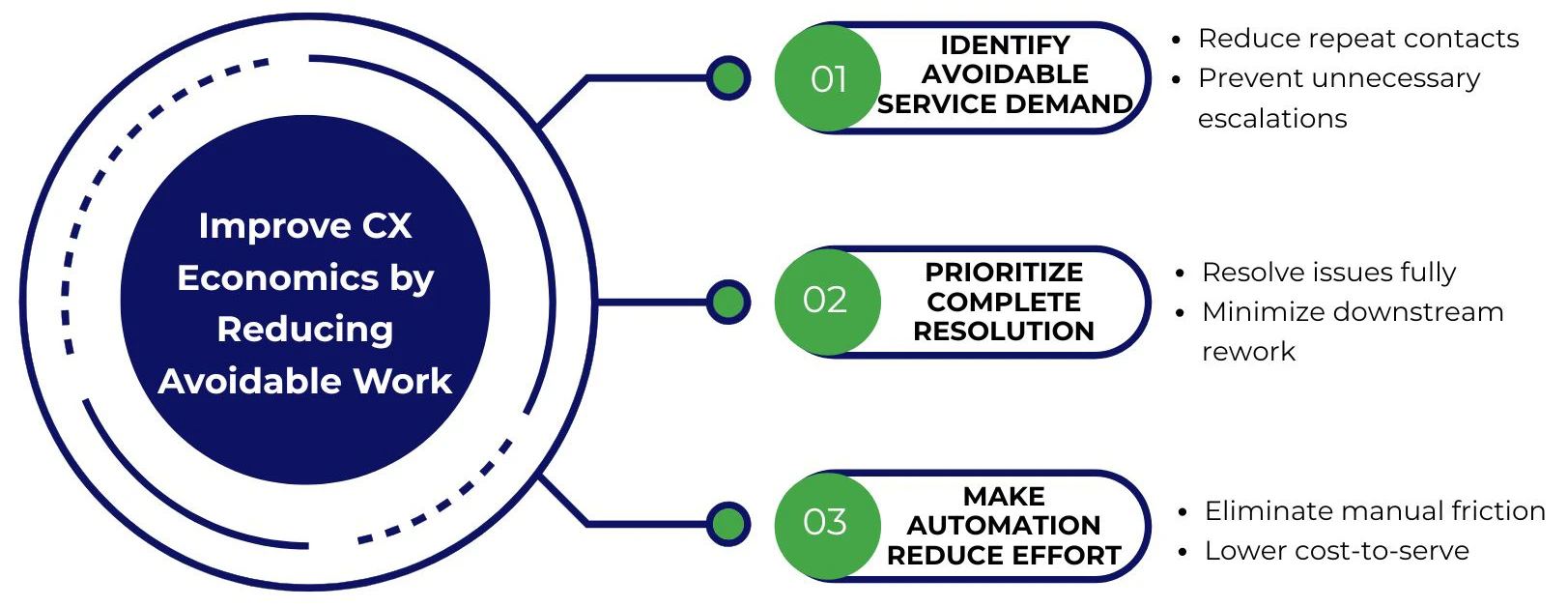
Better CX Economics Starts with Removing Avoidable Work
Once the cost becomes visible, the management question changes: is the business funding customer demand or funding the consequences of its own friction?
Before Adding CX Capacity, Separate Demand From Failure Demand
Rising service volume does not always signal growth. Some of it is failure demand: work created because the operation did not resolve the need correctly the first time.
Before hiring, adding outsourced capacity, or extending service hours, segment demand into:
- legitimate new customer needs;
- repeat contacts tied to unresolved cases;
- avoidable escalations caused by weak authority or knowledge;
- process-generated contacts caused by billing, fulfillment, product, or system errors.
This changes the capacity conversation. If part of your volume is preventable, staffing to absorb it may lock inefficiency into the operating model.
Resolution Is the Better Unit of Performance
A faster interaction is not necessarily a better economic outcome.
If the customer returns, the work was only deferred. The stronger operating question is whether teams have the context, authority, and workflow support to resolve the need without creating another contact, escalation, or correction downstream.
AI and Automation Should Remove Work, Not Relocate It
AI, self-service, intelligent routing, agent assist, automation, and analytics can improve CX economics but only when they reduce total effort across the resolution journey.
A chatbot that ends in a call has not necessarily removed demand. An automated workflow that still requires manual correction has not eliminated cost. It has moved it.
Automation creates value when it removes total effort, not when it relocates effort.
That means evaluating technology against resolution outcomes: fewer repeat contacts, fewer escalations, less rework, faster resolution, and lower recovery spend.
Turning CX Economics into Operating Advantage
For mid-market companies, that often means combining customer operations, process improvement, analytics, automation, and AI-enabled support rather than treating CX as a standalone service function.
Premier NX brings together customer operations, process optimization, analytics, automation, and AI-enabled support to help clients improve how customer needs are resolved. The objective is not simply to handle interactions at scale, but to identify where repeat demand, rework, escalations, and unnecessary effort can be reduced.
From CX Measurement to Economic Performance
CX becomes more valuable to the business when leadership can see beyond the experience score and understand the economics behind it.
For growing mid-market companies, the objective is not simply to maintain service quality as volumes increase. It is to build customer operations that can scale with greater control over effort, cost, and complexity.
That requires viewing CX as both a customer outcome and an operating outcome.
Is rising service demand, repeat interactions, or increasing cost-to-serve putting pressure on your customer operations?