


Key Takeaways
- 1Reporting problems often signal an operating-model constraint, not simply a staffing shortage.
- 2Fragmented data and manual workflows increase reconciliation effort and make financial close harder to scale.
- 3Recurring reporting errors often point to weak process controls that require structural correction, not repeated fixes.
- 4A scalable reporting function should move finance beyond producing reports toward clearer visibility, stronger decision support, and forward-looking insight.
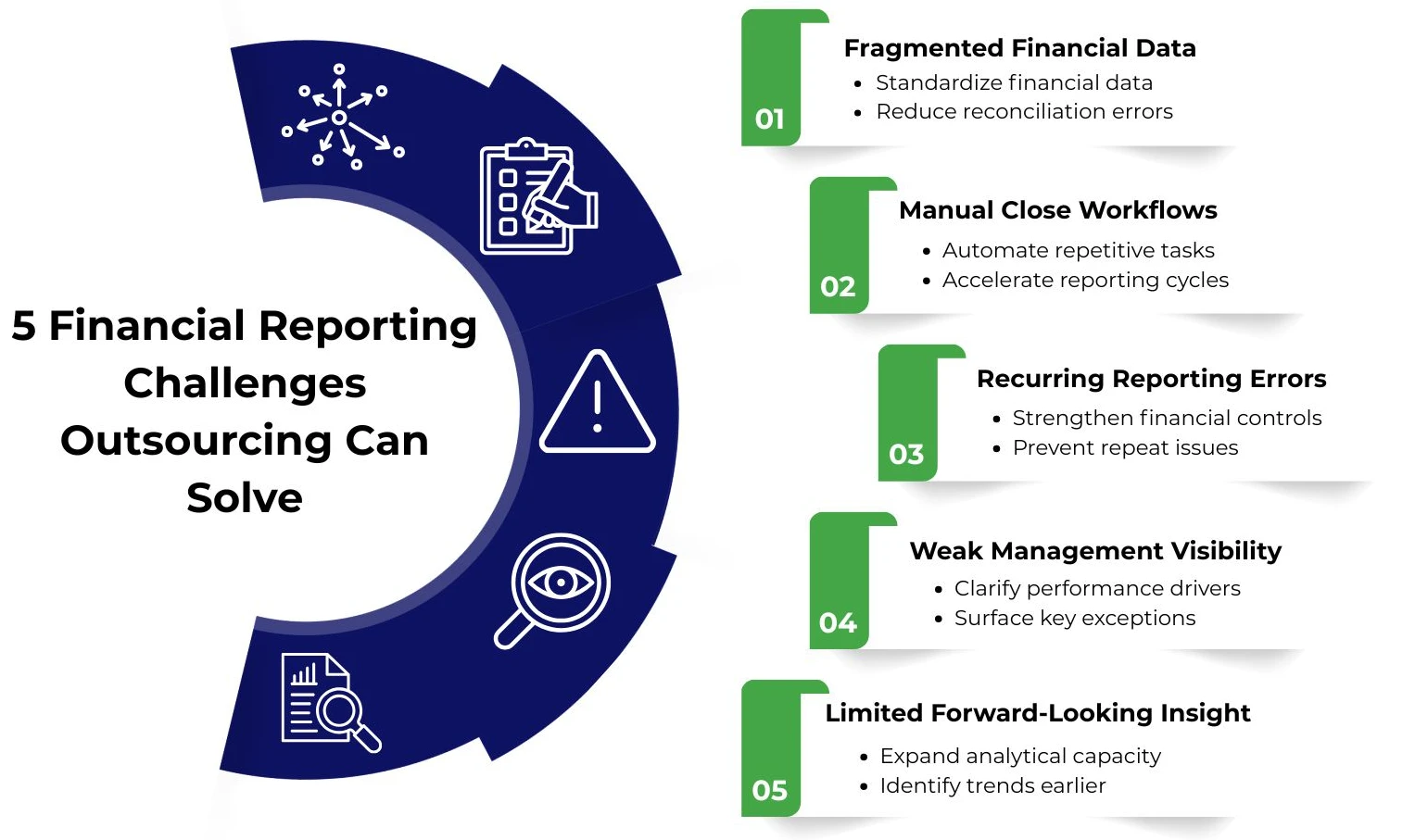
For mid-market businesses, financial reporting problems often appear when business complexity grows faster than the finance operating model supporting it. The right outsourcing model can address five structural constraints: fragmented data, manual close workflows, weak controls, limited management visibility, and insufficient analytical capacity.
The strategic question, then, is not whether an outside team can produce reports more cheaply. It is whether a tech-enabled, co-sourced finance model can make reporting more reliable, scalable, and decision-ready as the business grows.
Build a finance function that scales with the business
1. Fragmented Financial Data Turns Growth Into Reconciliation Work
As finance environments become more complex, reporting risk increasingly originates upstream. Different systems, entities, formats, and ownership rules can force teams to reconstruct financial truth during every reporting cycle.
The executive issue is not simply “dirty data.” It is the amount of finance capacity consumed compensating for an unreliable reporting foundation.
Premier NX approach: Financial reporting supported by data cleansing, ETL, structured data processing, and standardized reconciliation workflows.
Executive impact: More reliable reporting, fewer reconciliation exceptions, faster close cycles, and greater confidence in decision-critical financial data.
2. Manual Financial Close Workflows Create Structural Drag
Manual work is not automatically inefficient. The problem begins when critical reporting processes depend on repeated handoffs, spreadsheet manipulation, document extraction, or individual knowledge to complete every cycle.
Premier NX approach: Automation creates the most value when it removes recurring dependencies from the close, not when it simply accelerates isolated tasks.
Executive impact: Shorter reporting cycles, reduced manual processing, greater process consistency, and more finance capacity for analysis.
3. Recurring Reporting Errors Usually Signal a Control Problem
Don’t treat a recurring error as another item to correct during close. Repetition indicates the underlying process allows the same failure to re-enter the reporting cycle.
That changes the management question from “Who made the error?” to “Why could the process reproduce it?”
Premier NX approach: Financial Reporting & Compliance supported by reconciliations, auditing, dedicated quality assurance, and structured process review.
Executive impact: Fewer recurring exceptions, stronger reporting discipline, improved financial accuracy, and greater confidence in reported results.
4. Management Reporting Must Explain Performance, Not Recite It
A dashboard can be accurate and still be strategically weak.
Executives do not need more financial information simply because more information is available. They need reporting that isolates material movements, connects financial results with operating drivers, and makes exceptions visible early enough to act.
Premier NX approach: Financial reporting supported by business intelligence, structured reporting, and KPI dashboard support.
Executive impact: Clearer performance visibility, faster interpretation of financial results, and stronger alignment between reporting and management decisions.
5. Reporting Capacity Should Ultimately Create Foresight
A finance team can close accurately and on time yet remain strategically constrained if most available capacity is spent producing, reconciling, and validating information.
Once the reporting foundation is trusted, the next return comes from moving capacity toward analysis.
Premier NX approach: Financial Reporting & Analysis supported by business intelligence, advanced analytics, and AI-powered insights.
Executive impact: Greater analytical capacity, stronger decision support, earlier visibility into performance trends, and a more strategic finance function.
Build a Reporting Function That Can Keep Pace With the Business
For mid-market companies, the next constraint in financial reporting is rarely capacity alone. It is whether the operating model can sustain accuracy, control, visibility, and analytical depth as complexity increases.
Premier NX approaches this as a tech-enabled finance operations challenge combining financial reporting expertise with structured processes, data management, business intelligence, automation, and continuous improvement.
The objective is to create a reporting environment that gives leadership greater confidence in the numbers and greater clarity on what they signal.