


Mid-market companies today face a myriad of challenges: widening talent gaps, rising operational complexity, and the urgent need to digitally transform. Limited resources often constrain growth, making it harder to scale teams or adopt new technologies in-house.
In this landscape, many leaders are asking: What are the advantages and disadvantages of outsourcing? Can it help bridge skill shortages, improve efficiency, and support transformation—without compromising control or quality?
This article explores the pros and cons of outsourcing through the lens of mid-sized businesses—highlighting both the benefits and risks in a competitive landscape. Whether you’re exploring offshore outsourcing, comparing outsourcing vs co-sourcing, or simply weighing the limitations, our goal is to help you make an informed, strategic decision.
Pain Points Driving the Shift to Outsourcing
- Limited access to specialized talent: Roles in data science, AI, finance, and IT are increasingly hard to fill. For many mid-sized firms, building internal teams with these capabilities is costly and time-consuming. This gap highlights one of the clear benefits of outsourcing: immediate access to niche expertise at scale.
- Cross-functional hiring is expensive: Recruiting, onboarding, and retaining talent across multiple disciplines strains both budgets and bandwidth. In this context, it’s important to evaluate the pros and cons, especially when scaling rapidly without internal redundancy.
- Recruitment and training cycles slow execution: Long hiring timelines can delay strategic initiatives. Co-sourcing accelerates delivery without the internal overhead, one of the often-overlooked advantages of outsourcing in fast-moving markets.
- Digital transformation bottlenecks: Legacy systems, tool fragmentation, and lack of cloud readiness stall innovation. This is where the advantages and disadvantages of offshore outsourcing become relevant—offshore teams can provide around-the-clock progress, but require strong alignment to avoid disconnects.
- Pressure to cut costs without sacrificing quality: Maintaining service levels while optimizing costs is a persistent challenge. Understanding the limitations of outsourcing, such as potential control gaps, is essential to making it work. Strategic partners that align with your values help reduce these risks.
What are the Key Advantages of Outsourcing
Access to Skilled Talent at Scale
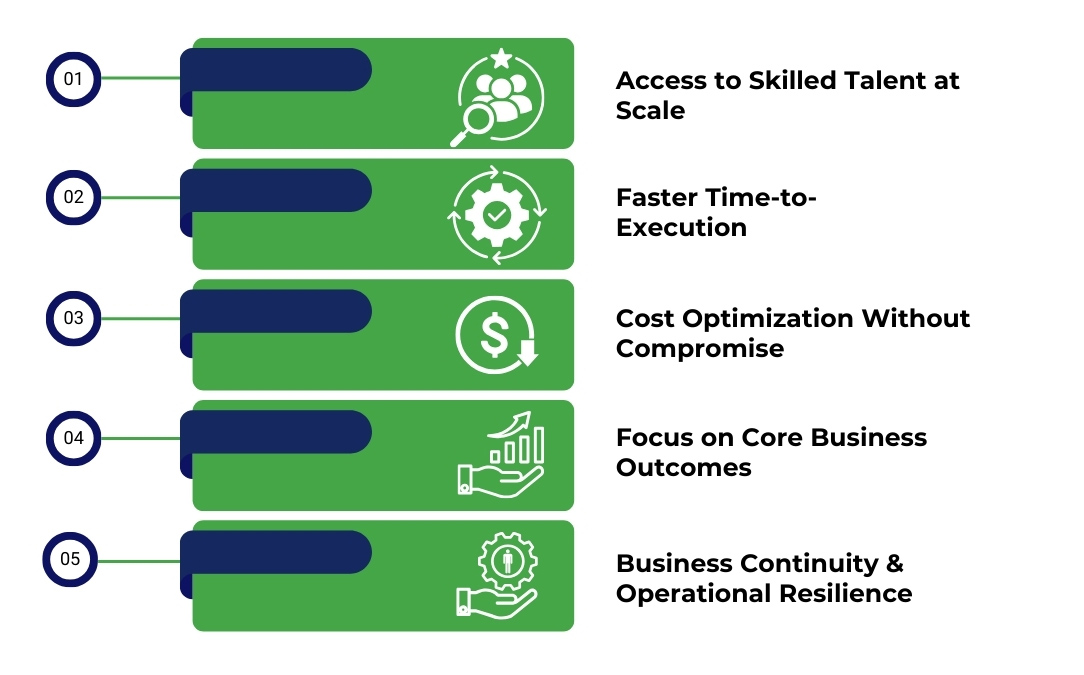
Outsourcing enables mid-sized firms to bypass hiring hurdles and tap into specialized skills across disciplines like analytics, customer experience, and finance operations. This closes capability gaps without expanding headcount. For companies asking who benefits the most from outsourcing, the answer often lies with those needing expertise without the burden of building it internally.
Faster Time-to-Execution
Through co-sourcing, onboarding cycles are accelerated and execution timelines shrink. Whether deploying a new CX platform or scaling reporting functions, outsourcing provides the agility that in-house models struggle to match. Among the pros and cons of outsourcing, speed is a distinct strategic advantage.
Cost Optimization Without Compromise
Right-shoring not only reduces labor costs but also enables access to global talent in cost-effective regions. This makes the financial model of outsourcing more predictable and scalable. When comparing outsourcing vs insourcing, mid-market leaders often find greater ROI through outsourced partnerships—without sacrificing quality.
Focus on Core Business Outcomes
By offloading transactional tasks and operational complexity, internal teams can shift their energy toward growth, innovation, and customer value. This is a critical often under-leveraged aspect in the outsourcing conversation. Strategic alignment allows organizations to do more with less.
Business Continuity & Operational Resilience
With remote-ready infrastructure, distributed teams, and built-in redundancy, outsourcing helps maintain service continuity, even amid disruption. For many, it reduces the risk of outsourcing by ensuring consistent delivery across locations. Especially in offshore setups, understanding the advantages and disadvantages helps leaders make risk-informed decisions that support long-term stability.
The Flip Side: What are the Disadvantages of Outsourcing
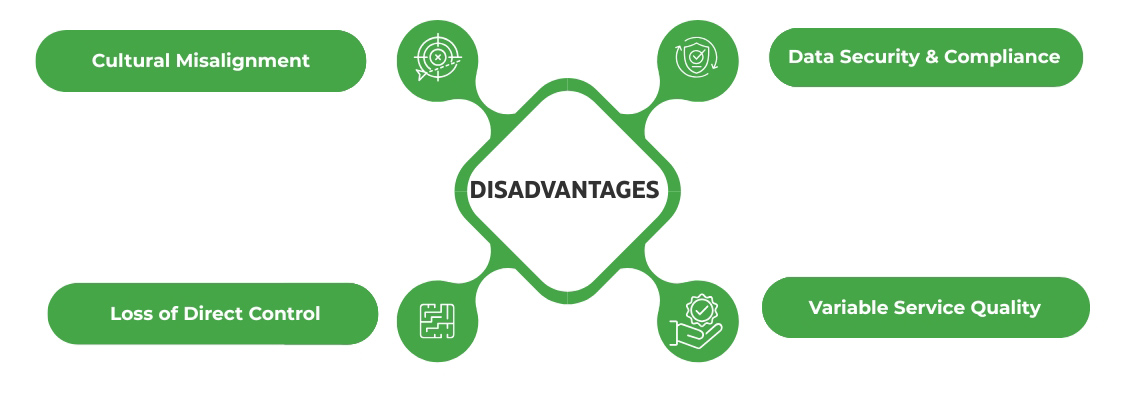
Cultural Misalignment or Lack of Immersion
Outsourcing relationships can falter when external teams operate in silos, disconnected from the client’s brand, values, or service expectations. This is one of the key drawbacks of outsourcing, especially in offshore models. Mid-market companies benefit more from co-sourcing partners who embed themselves into operations, not just transactional vendors.
Loss of Direct Control
A common concern in the outsourcing debate is the perceived loss of oversight. Without shared dashboards, aligned KPIs, or structured governance, service levels can drift. Leaders must ensure that accountability is baked into the engagement from the outset.
Data Security & Compliance Risks
Among the more critical risks of outsourcing factors is data protection. As operations extend beyond internal walls, exposure to regulatory, privacy, or cybersecurity lapses increases. This is especially true when exploring offshore outsourcing without rigorous due diligence. Compliance must be a non-negotiable.
Variable Service Quality Across Providers
Not all outsourcing partners operate with the same rigor. Without strong onboarding, training, and QA frameworks, inconsistency can undermine the benefits. This is one of the limitations that’s often realized too late—after customer satisfaction or process integrity is impacted.
Premier NX – The Strategic Outsourcing Partner
While outsourcing offers clear operational and financial advantages, the real value lies in choosing the right partner.
Mid-market businesses need more than low-cost execution; they need alignment, agility, and accountability.
At Premier NX, we deliver all three through a co-sourcing model built for strategic impact, not transactional delivery.
Here’s what sets Premier NX apart:
- Built for First-Time Outsourcers – Since 2003, we’ve helped businesses new to outsourcing navigate the unknown with clarity, confidence, and white-glove service tailored to their needs.
- Global Reach with Local Accountability – With five strategically placed service centers and U.S.-based account management, we provide scale and flexibility while maintaining close operational oversight.
- Premier Sync: Our Onboarding Framework: At Premier NX, we approach our client relationships with a partnership mentality, incorporating co-sourcing characteristics that allow us to tackle the entire recruiting and onboarding process while working together on business goals.
- Five Service Pillar Framework – We deliver integrated solutions across Customer Experience (CX), Digital Transformation (DX), Finance & Accounting, Analytics & Insights, and Sales Enablement.
- End-to-End Ownership of Operations – From recruitment to delivery, training to QA, analytics to reporting; we manage the complete lifecycle of your outsourced functions, so you can focus on growth while we handle the complexity.
Ready to Experience the Real Benefits of Outsourcing?
For businesses, the question isn’t just what the advantages and disadvantages of outsourcing are, but how to turn it into a long-term competitive advantage.
When evaluated strategically, outsourcing delivers more than cost efficiency; it bridges talent gaps, accelerates digital transformation, and safeguards continuity.
At Premier NX, we go beyond the traditional vendor model. Through co-sourcing, global expertise, and our five service pillars, we help you navigate the pros and cons of outsourcing while ensuring outcomes align with your strategic objectives.