

Key Takeaways
- 1Odoo integration is more than connecting tools.
- 2Governance protects data, reporting, and ownership.
- 3Scalable integration means connecting the right things.
Odoo integration means connecting systems, workflows, and data so the business operates consistently across departments. For mid-market businesses, the value is not simply connecting tools. It is protecting operational clarity as the business scales.
As businesses grow, integration becomes more complex. Accounting connects with banking. CRM connects with email. Inventory connects with shipping, reporting, or service workflows.
At first, these links feel manageable. Over time, they can become a web of dependencies that is difficult to control.
Why Do Odoo Integrations Become Hard to Manage?
Odoo integrations become difficult when they are treated as separate technical projects rather than as part of a wider operating model.
The issue is not always the connector or API. More often, the problem is inconsistency:
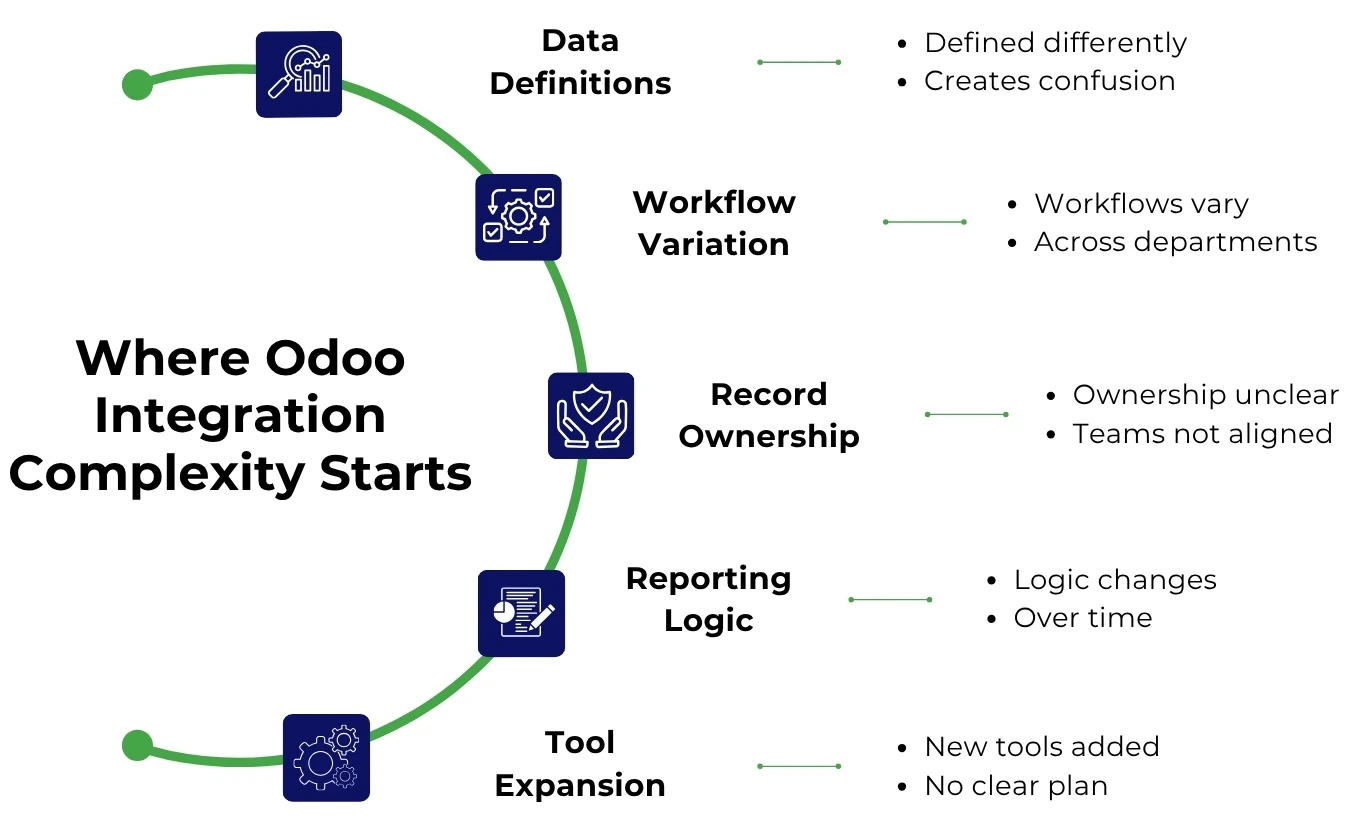
- Teams define data differently
- Workflows vary across departments
- Ownership of records is unclear
- Reporting logic changes over time
- New tools are added without a clear plan
Even connected systems can create confusion if teams are not aligned on how information should move.
What Does Odoo Integration as a Platform Capability Mean?
Odoo is often described as an ERP. That is accurate, but for growing businesses, it should also be viewed as an operating platform.
Everest Group’s research on enterprise platforms reinforces this shift: modern platforms are increasingly treated as the digital core that connects people, processes, and data across functions.
That is the right mental model for Odoo. It can become the place where transactions occur, workflows run, and core data definitions are settled.
When Odoo is treated this way, integration is no longer just about connecting tools. It becomes a way to keep finance, sales, service, inventory, and operations working from a consistent structure.
How Should Mid-Market Businesses Govern Odoo Integrations?
Integration governance does not need to be complicated. It does need to be clear.
For Odoo, governance means defining:
How to Govern Odoo Integrations
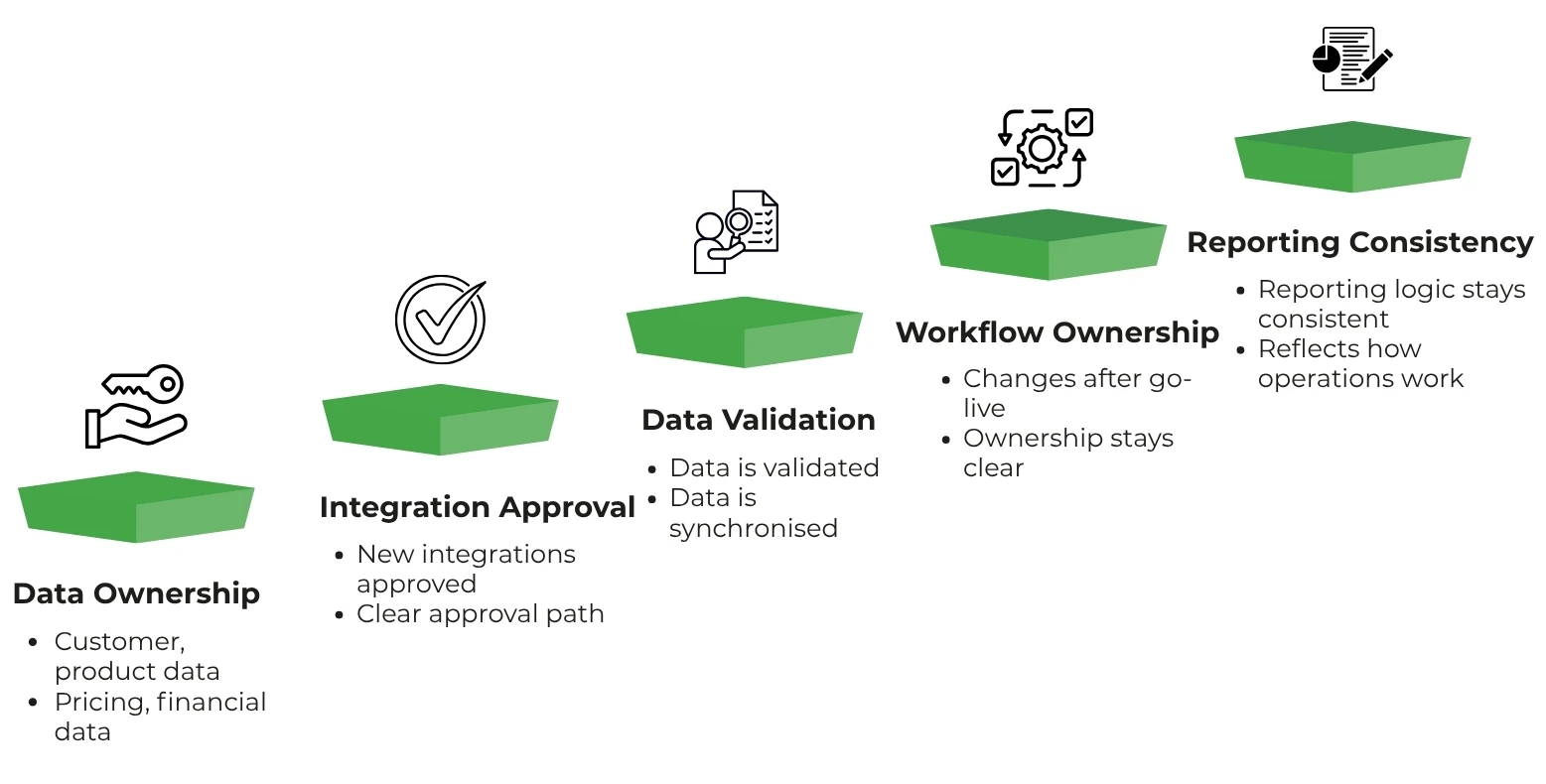
- Which system owns customer, product, pricing, and financial data
- How new integrations are approved
- How data is validated and synchronised
- Who owns workflow changes after go-live
- How reporting logic stays consistent
Deloitte’s ERP strategy guidance points to the same principle: transformation depends on understanding the points of process integration and building a reporting strategy that reflects how the organisation operates.
Without this structure, integrations become reactive. Tools are added for short-term needs, workarounds multiply, and the business slowly loses control over data, reporting, and ownership.
What Is the Odoo Integration Trap?
The integration trap happens when businesses keep adding tools without building a scalable integration model.
Over time, the business ends up with multiple versions of the truth, more reconciliation work, and rising support effort.
That is not only a technology issue. It is an operating issue.
How Does Odoo Support Operational Consistency?
In this Odoo series, I have focused on a practical question for mid-market businesses: how to make Odoo work beyond implementation.
Integration builds on that same idea. Module sequencing, finance clarity, delivery visibility, and post-go-live value all depend on connected workflows and trusted data.
Once the core Odoo environment is stable, integrations can extend the capability without fragmenting operations. This matters for mid-market businesses, where complexity grows quickly, but internal capacity is often limited.
The goal is not to integrate everything. The goal is to integrate the right things in the right way.
Building Odoo Integration Capability
Odoo integration is not just about connecting systems. It is about protecting operational clarity as the business scales.
For mid-market organisations, that means treating integration as an ongoing capability with ownership, standards, governance, and a clear roadmap.
Looking to make Odoo work more consistently across your business? Premier NX helps mid-market businesses implement, integrate, manage, and improve Odoo, so workflows, data, and teams stay connected as operations grow.
About the Author

Sheraz Chaudhry is Head of Sales, Europe at Premier NX, a leading provider of technology-enabled outsourcing solutions. With a background that includes founding membership at The Resource Group and leadership roles at Nielsen, he brings deep expertise in revenue strategy, partnerships, and data-driven innovation to the leaders he works with today.