

Key Takeaways
- 1Finance transformation begins with redesigning operations, not selecting technology.
- 2ERP, automation, and AI scale existing processes—including their weaknesses.
- 3Clear ownership, simplified workflows, trusted data, and defined exceptions create transformation readiness.
- 4Human-in-the-loop execution combines technology’s speed with business judgment and accountability
Finance transformation fails when organizations implement ERP, automation, or AI before fixing process ownership, governance, data quality, and exception management. Technology does not correct a weak finance operating model; it standardizes and scales it. The right sequence is to redesign finance operations first, then use technology to improve control, speed, visibility, and decision support.
Mid-market organizations often reach for new systems when close cycles slow, reports conflict, approvals stall, and teams rely heavily on spreadsheets. Yet these are rarely software problems alone. They are signs that the operating foundation of finance is not ready to scale.
What is Finance Transformation?
Finance transformation is the redesign of finance processes, roles, controls, data, and technology so the function can operate efficiently and provide timely insight for business decisions. It is not simply an ERP implementation or an automation project.
A transformed finance function should:
- Complete transactional work consistently
- Produce accurate, decision-ready information
- Clarify who owns each process and outcome
- Identify risk and performance changes early
- Scale without adding avoidable complexity
This distinction matters because software can enforce a workflow, but it cannot determine whether that workflow is necessary, well controlled, or owned by the right person.
Why Technology Reveals Weak Finance Operations
Technology exposes operational problems by removing the manual effort that once concealed them. When work is standardized, recurring exceptions, data gaps, and unclear decisions become visible.
Common signals include:
- Close delays caused by broken handoffs
- Duplicate reconciliations and manual adjustments
- Conflicting reports caused by unclear data ownership
- Approval bottlenecks with no accountable decision-maker
- Spreadsheet workarounds that sit outside formal controls
Technology is therefore a multiplier, not a repair strategy. It increases the speed and reach of whatever operating practices already exist.
Where Should Finance Transformation Begin?
Finance transformation should begin with four operational foundations:
- Process ownership and governance
- Simplified workflows and controls
- Trusted data and decision intelligence
- Exception design and human judgment
Addressing these foundations before selecting or scaling technology reduces the risk of embedding weak operations into new systems.
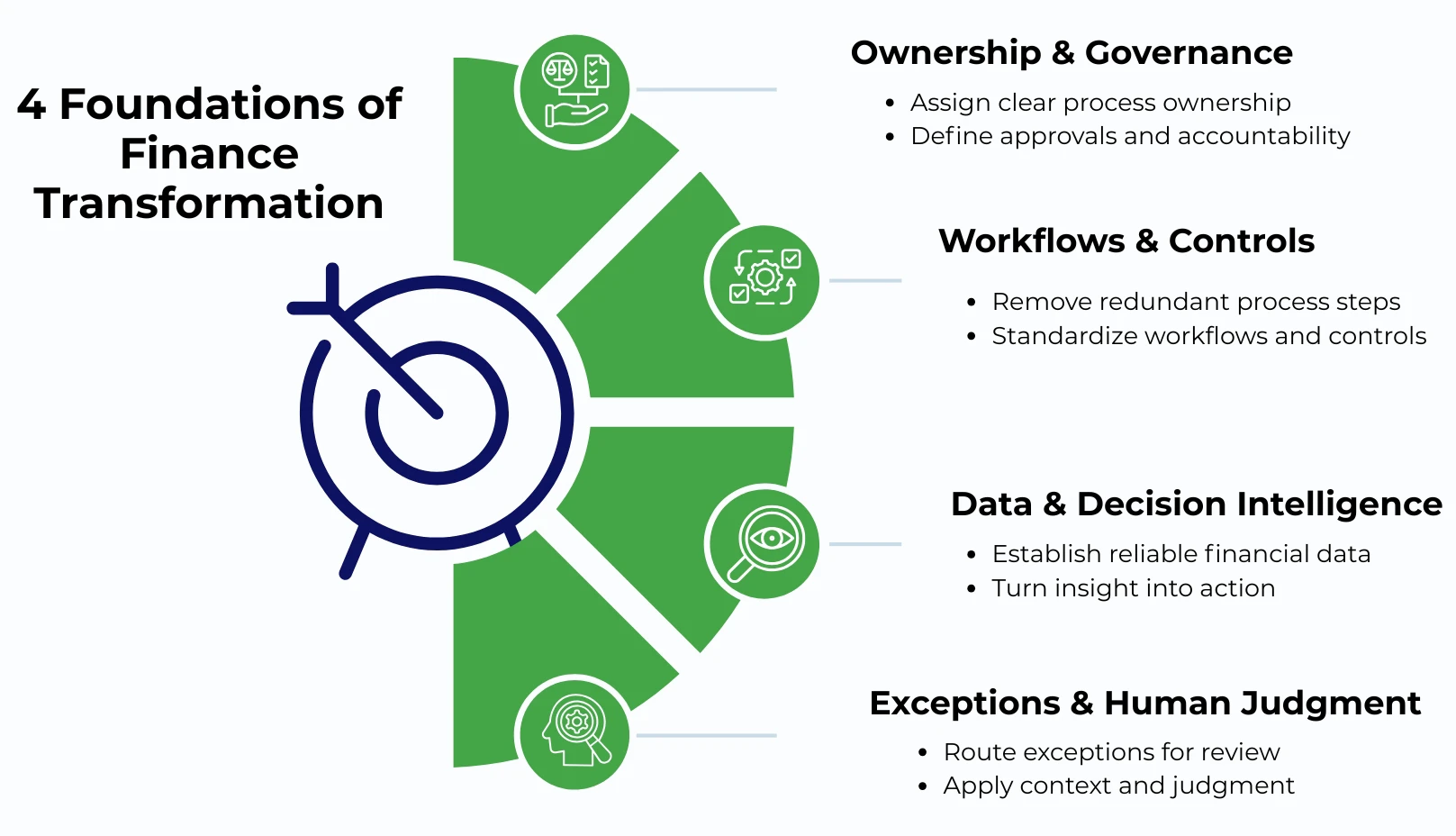
Transformation starts with the foundation.
1. Process Ownership and Governance
Every finance process needs an accountable owner for the outcome, not just people assigned to individual tasks. Ownership should cover approvals, controls, performance measures, exception decisions, and continuous improvement.
Without clear governance, systems route work faster but cannot resolve who decides, who intervenes, or who is responsible when performance slips.
2. Simplified Workflows and Controls
Before automating a process, determine which steps create value, which controls manage a real risk, and which activities can be eliminated. A poor process does not become effective because it runs faster.
Map handoffs, remove duplicate work, standardize inputs, and define how exceptions will move through the process. This reduces implementation complexity and prevents inefficient workflows from being embedded in technology.
3. Trusted Data and Decision Intelligence
Finance teams do not need more financial data; they need reliable information organized around decisions. Data definitions, source ownership, validation rules, and reporting logic must be consistent before analytics, or AI can be trusted.
Decision intelligence means converting financial data into insight that helps leaders see:
- What is driving performance
- Where cash, margin, or risk is changing
- Which assumptions require attention
- Where resources should be redirected
This is how finance shifts from recording past performance to guiding future action.
4. Exception Design and Human Judgment
Automated finance processes still encounter incomplete data, unusual transactions, policy conflicts, and business tradeoffs. Exception design determines which issues technology can resolve, which require review, and who has authority to act.
Human-in-the-loop finance operations apply experienced judgment where context, materiality, risk, or policy interpretation matters. The goal is not to preserve manual work. It is to automate repeatable activity while protecting decisions that require accountability.
How ERP, Automation, and AI Scale Existing Conditions
Each technology has value, but only when applied to the right operating foundation:
- ERP platforms standardize data and workflows but may institutionalize unnecessary approvals or weak process design.
- Automation executes defined rules consistently but also processes poor inputs and flawed rules faster.
- AI can accelerate analysis, identify patterns, and support decisions but depends on reliable data, defined controls, and human oversight.
- Business intelligence tools make performance visible but cannot correct inconsistent definitions or unresolved ownership.
The implementation question is therefore not only, “Which technology should we use?” It is also, “What operating conditions will this technology scale?”
Why Human-in-the-Loop Finance Operations Matter
Premier NX combines finance process expertise, technology enablement, analytics, and human-in-the-loop execution to strengthen the operation behind the system. This approach helps organizations improve data reliability, formalize exception management, support business intelligence, and maintain control as transaction volumes and decision demands grow.
Technology handles repeatable work with speed and consistency. Finance professionals interpret exceptions, apply business context, monitor outcomes, and improve the process over time. Together, they create a scalable finance function without becoming detached from judgment or accountability.
Finance Transformation Starts with the Operating Model
Successful finance transformation begins with clear ownership, simplified workflows, trusted data, defined governance, and deliberate exception handling. Once those conditions are in place, ERP, automation, AI, and analytics can become true force multipliers.
Premier NX helps mid-market organizations strengthen finance operations before, during, and after technology change.