



Key Takeaways
- 1Finance outsourcing strengthens decision-making by improving financial visibility, reporting accuracy, and cash flow management.
- 2Standardized finance processes reduce manual work, improve efficiency, and create capacity for business growth.
- 3Stronger financial controls enhance compliance, reduce operational risk, and improve audit readiness.
- 4The most successful outsourcing partnerships keep strategy in-house while outsourcing operational execution, creating a more scalable and resilient finance function.
Finance and accounting have evolved beyond transactional functions to become critical drivers of business performance. As organizations grow, finance teams often spend more time processing transactions than delivering strategic insight. When reporting slows, compliance becomes more complex, or cash flow becomes unpredictable, finance can become a bottleneck instead of a business enabler.
By outsourcing operational finance while retaining strategic oversight internally, organizations gain stronger financial governance, faster decision-making, and a more scalable finance function.
What Finance and Accounting Outsourcing Actually Improves
Finance and accounting outsourcing delegates operational finance activities to specialized teams while internal leaders retain ownership of strategy, governance, and executive decision-making. The goal is not to replace your finance function; it is to strengthen it by improving five core capabilities:
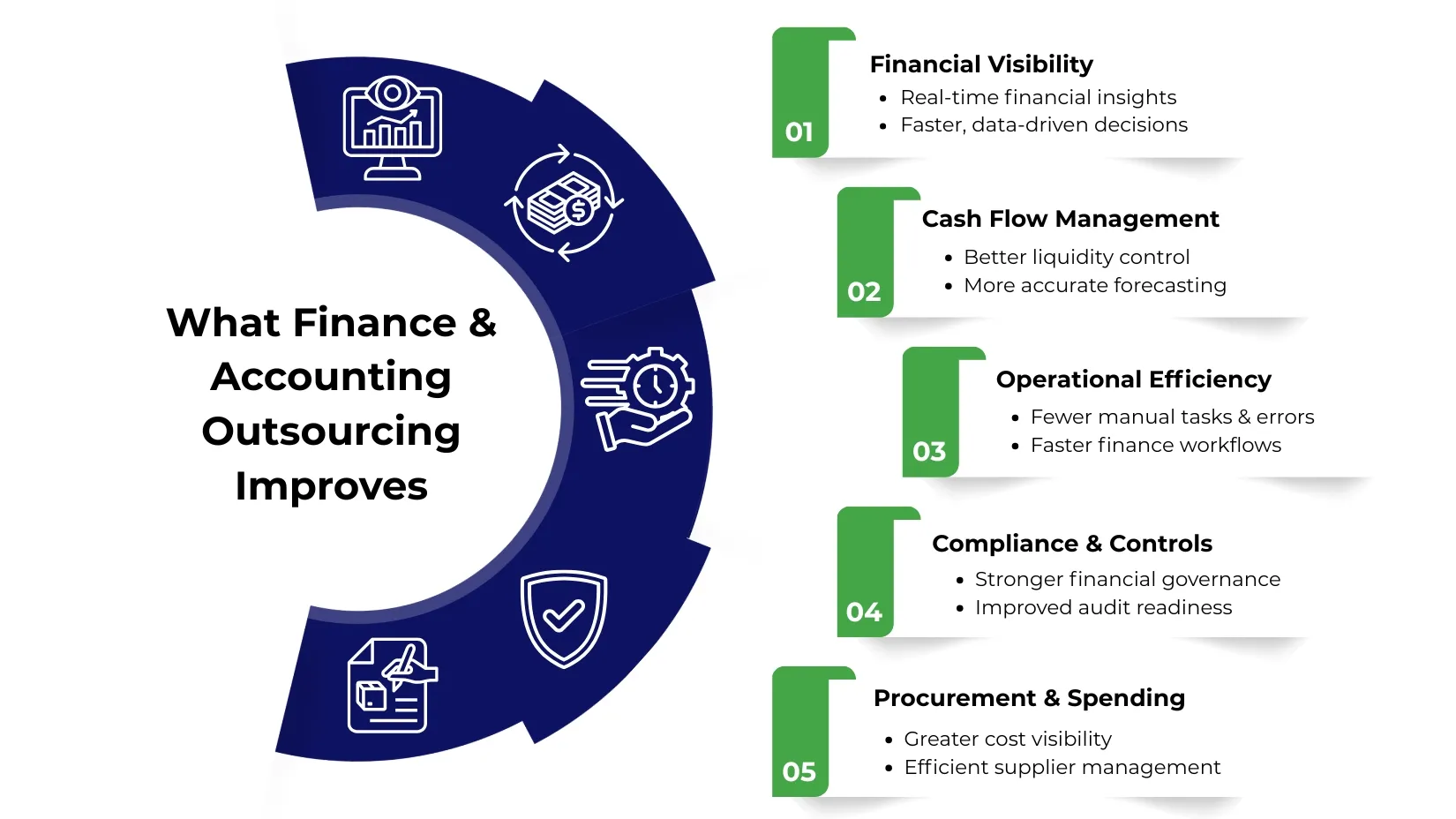
Build a finance function that's more efficient, compliant, and ready for growth.
1. Financial Visibility: How Finance and Accounting Outsourcing Improves Business Decision-Making
Financial visibility is the ability to access accurate, timely financial information across the business. When reporting, reconciliations, and month-end close processes are standardized, leaders can make decisions with greater confidence.
Business outcomes:
- Faster and more informed decision-making
- Stronger financial oversight and reporting confidence
- Greater accuracy in planning and performance management
2. Cash Flow Management: How Outsourcing Strengthens Financial Stability
Effective cash flow supports day-to-day operations and long-term growth. Outsourced finance teams strengthen cash forecasting, payment management, treasury activities, and liquidity reporting, giving organizations greater control over working capital.
Business outcomes:
- Improved cash flow visibility and liquidity
- Better forecasting and financial planning
- Stronger financial stability and operational resilience
3. Manual Finance Processes: How Outsourcing Improves Operational Efficiency
Manual finance work slows growth and increases the likelihood of errors. Standardizing accounts payable, bookkeeping, reconciliations, and transaction processing reduces administrative effort while improving consistency.
Business outcomes:
- Faster finance operations with fewer manual errors
- Greater process consistency and operational efficiency
- Increased capacity to support business growth
4. Financial Compliance: How Outsourcing Strengthens Controls and Reduces Risk
As regulatory requirements increase, consistent financial controls become essential. Outsourcing helps standardize documentation, audit preparation, and compliance reporting while strengthening governance across finance operations.
Business outcomes:
- Reduced compliance and operational risk
- Stronger financial governance and accountability
- Greater audit readiness and regulatory confidence
5. Procurement & Spending: How Outsourcing Improves Cost Control
Procurement is more than purchasing; it is controlling organizational spending. Structured procurement workflows, vendor management, approval processes, and expenditure tracking improve financial discipline without slowing operations.
Business outcomes:
- Improved spending visibility and cost control
- More efficient procurement operations
- Better supplier management and purchasing decisions
What Finance and Accounting Functions Should Businesses Keep In-House?
Businesses should retain ownership of finance activities that require executive judgment, strategic direction, and direct accountability. Finance outsourcing works best when operational execution is outsourced while strategic leadership remains internal. Executive teams should continue to own:
- Financial strategy and planning
- Budgeting and capital allocation
- Risk appetite and governance
- Board and stakeholder reporting
Turn Finance Operations into a Strategic Advantage
High-performing finance organizations do more than process transactions. They provide financial visibility, governance, and operational discipline that enable better business decisions and sustainable growth.
Premier NX helps organizations strengthen finance operations through tailored support across accounting, bookkeeping, treasury and cash management, financial reporting and compliance, and procurement and expenditure management.
About the Author

As CEO, Ali Din oversees the overall strategy and direction for Premier NX. With senior leadership roles at global HR and recruiting platforms, Indeed and ADP. Ali has over 25 years of experience in the IT and advanced technology sector. Ali’s time is focused on transformation in the business, both for professional development and for clients, to enhance business outcomes.