


Key Takeaways
- 1Monthly financial reporting should show not only what happened, but how reliably the finance function produced the result.
- 2Forecast accuracy, first-pass accuracy, and financial exceptions help CFOs identify weaknesses in assumptions, controls, and recurring processes.
- 3Process automation should be assessed by how effectively it reduces manual effort, rework, and processing delays.
- 4Financial data delivers greater value when it is reliable, decision-ready, and available early enough to support management action.
Monthly financial reporting should give CFOs more than a summary of actual performance against plan. It should also show whether the finance operating model behind those results is reliable: whether forecasts remain dependable, controls work before correction, exceptions are contained, automation reduces manual dependency, and financial data is usable in time to support decisions.
A reporting process can produce accurate results while still relying on inefficient workflows, repeated corrections, fragmented data, or delayed analysis. For finance leaders, the more important question is not simply whether the numbers are accurate, but how reliably and efficiently the finance function produced them.
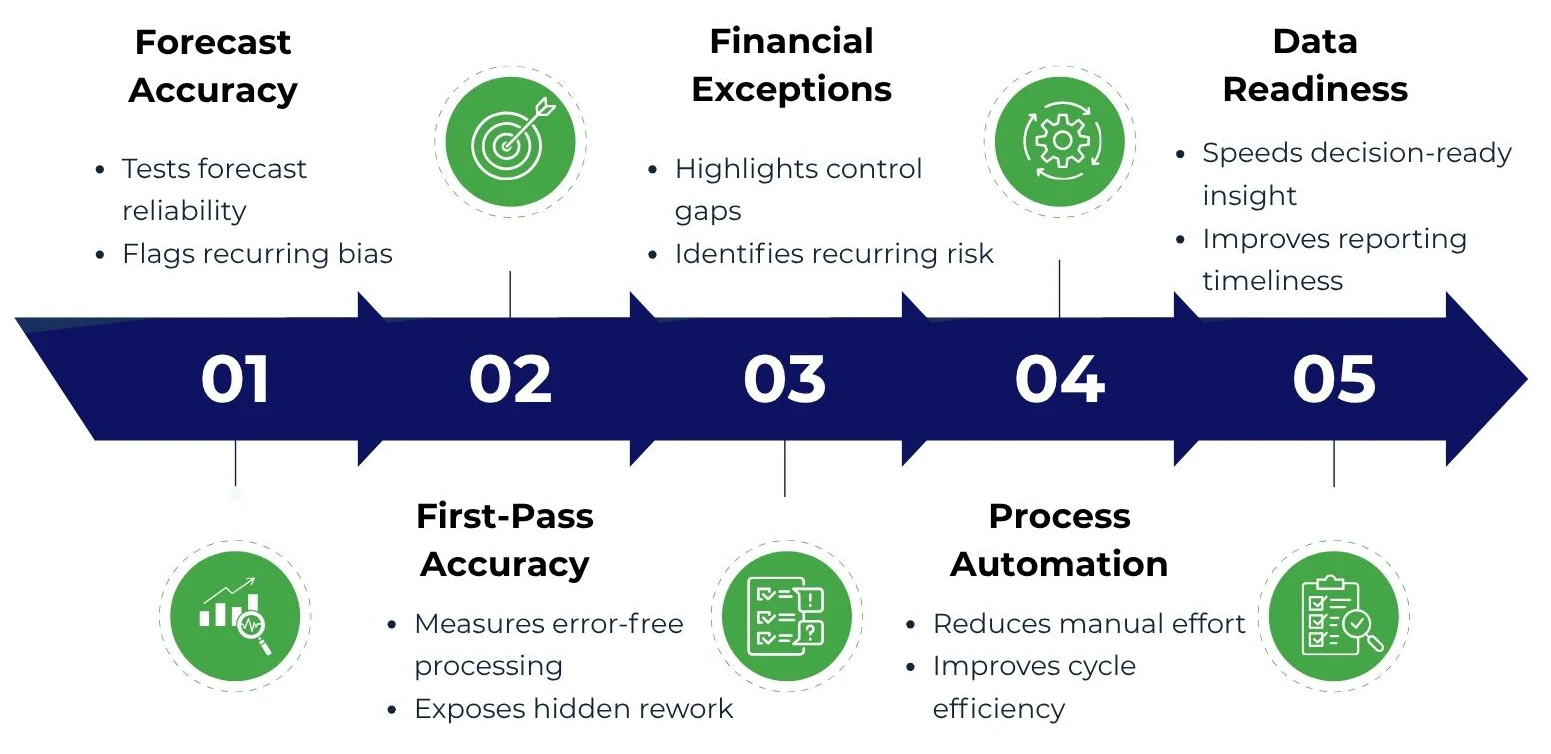
Five KPIs that reveal what’s happening behind the numbers
1. Forecast Accuracy & Predictive Reliability — Build a More Dependable FP&A View of What’s Next
Forecast accuracy should help CFOs determine whether FP&A assumptions and operating drivers continue to reflect changing business conditions. An isolated variance may be insignificant. Persistent misses in the same direction can point to a more structural issue.
What it signals: The reliability of forward-looking financial assumptions and the strength of the FP&A process.
Executive value: Greater predictive reliability gives leadership more confidence in planning, resource allocation, and scenario-based decisions before financial shifts become larger operating issues.
2. First-Pass Financial Accuracy — Strengthen Control at the Source
First-pass financial accuracy measures how consistently recurring finance activities are completed correctly before rework, adjustment, or escalation is required. Unlike final reporting accuracy, it shows what happened before corrective effort improved the result.
What it signals: The effectiveness of financial controls, process discipline, and technology-enabled validation across recurring finance activity.
Executive value: Stronger first-pass accuracy reduces rework, improves reporting reliability, and gives finance teams more capacity to focus on analysis and higher-value decision support.
3. Financial Exceptions — Identify Where Financial Controls Need Attention
A financial exception is a transaction or workflow that falls outside an expected rule, tolerance, or process path and requires investigation. As automation increases, exception management becomes more important because remaining manual work often carries greater ambiguity or risk.
What it signals: Where financial workflows require manual intervention, investigation, or stronger controls.
Executive value: Clearer exception visibility helps finance teams focus attention on higher-risk activity, strengthen reporting confidence, and prevent recurring issues from becoming larger financial or operational problems.
4. Finance Process Automation — Reduce Manual Effort Across the Finance Function
Finance process automation should show how much recurring activity moves from source to completion without unnecessary manual intervention. Digitized is not the same as automated: moving a spreadsheet into a workflow platform may simply relocate the manual work.
What it signals: The extent to which technology and integrated workflows are reducing manual dependencies across recurring finance processes.
Executive value: Greater automation can improve consistency, shorten processing cycles, and redirect finance capacity from transaction handling toward analysis, controls, and higher-value decision support.
5. Financial Data Readiness — Move Faster from Financial Data to Management Insight
Management reporting is only as useful as the financial data feeding it. When validation, reconciliation, exception handling, and data consolidation remain fragmented, leadership may receive accurate information too late to influence the decisions it was meant to support.
What it signals: How efficiently financial data moves from underlying activity to reliable, decision-ready reporting.
Executive value: Stronger data readiness improves reporting timeliness and gives leadership earlier access to the financial insight needed to assess performance, investigate emerging issues, and make more informed decisions.
Financial Reporting Should Strengthen the Finance Operating Model
The strongest monthly reporting environments do more than consolidate financial results. They create a tighter connection between FP&A, financial controls, process automation, and management visibility, giving leadership greater confidence in both the numbers and the processes behind them.
Premier NX supports this shift by combining financial reporting expertise with tech-enabled workflows, automation, analytics, and operational finance support. The objective is to build a finance function where accurate data, stronger controls, and timely insight work together.
Ready to strengthen your financial reporting and analysis function?