
In 2026, the outsourcing landscape is fundamentally different.
- Generative AI is embedded into operational workflows.
- Trade policy and geopolitical shifts have reshaped global delivery risk.
- The “lowest bidder” model no longer withstands executive scrutiny.
Investment is accelerating, but performance is not guaranteed.
What worked in 2018 no longer holds in 2026.
The decision is no longer between in-house and outsourced. It is between strategic partnership and strategic irrelevance.
For mid-market firms between $100M and $1B in revenue, navigating enterprise-level complexity without enterprise-level buffers, selecting the right outsourcing partner is now an architectural decision.
What follows is a framework to evaluate outsourcing partners against 2026-ready criteria: AI maturity, geopolitical resilience, and true consultative integration.
Why 2026 Demands a New Evaluation Lens
Outsourcing criteria that worked five years ago are structurally insufficient today.
Three shifts are redefining how leaders must evaluate partners.
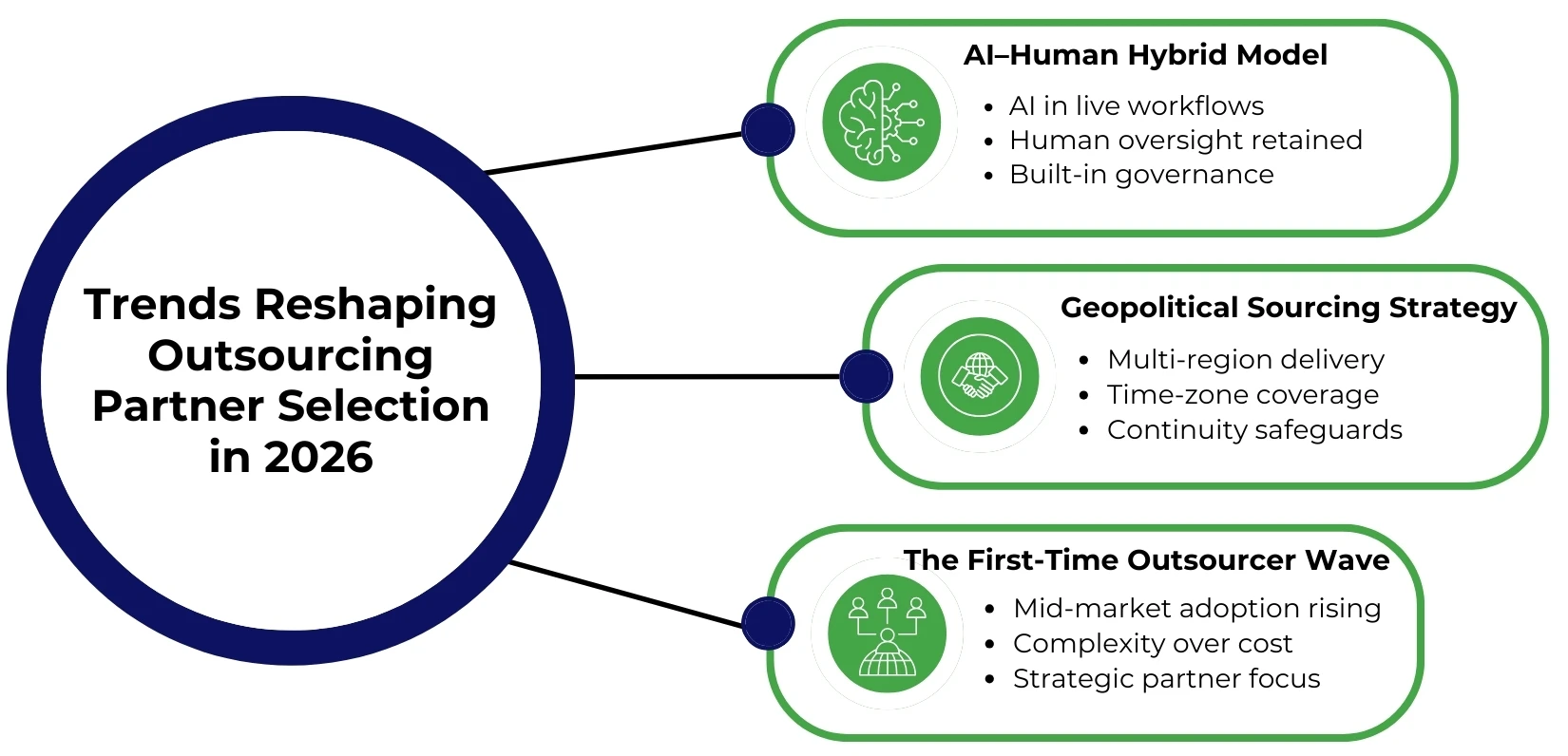
Trend 1: The AI–Human Hybrid Model
In 2026, basic task automation is table stakes.
The differentiator is a human-in-the-loop framework in which AI handles volume, pattern recognition, and speed, while humans retain judgment, escalation authority, and contextual decision-making.
When evaluating a partner, leaders must examine:
- Is AI embedded into core workflows, not layered on as a feature?
- Where is human judgment intentionally preserved?
- Is oversight designed into the architecture?
Trend 2: Geopolitical Sourcing Strategy
Post-2024 trade recalibrations and nearshoring momentum have reshaped assumptions about global delivery. Concentration risk is no longer theoretical; it is operational.
A 2026-ready partner should demonstrate:
- Diversified delivery centers across regions
- Structural flexibility across time zones
- Continuity planning beyond standard SLAs
Trend 3: The First-Time Outsourcer Wave
The next expansion wave is not enterprise-led.
It is driven by mid-market firms entering their first strategic outsourcing partnerships.
These organizations are not outsourcing to reduce headcount. They are outsourcing to manage structural complexity, including AI integration, compliance pressure, and cross-functional interdependence, without enterprise-level redundancy.
For this segment, partner selection is not tactical. It is architectural.
The 2026 Evaluation Framework: Five Pillars
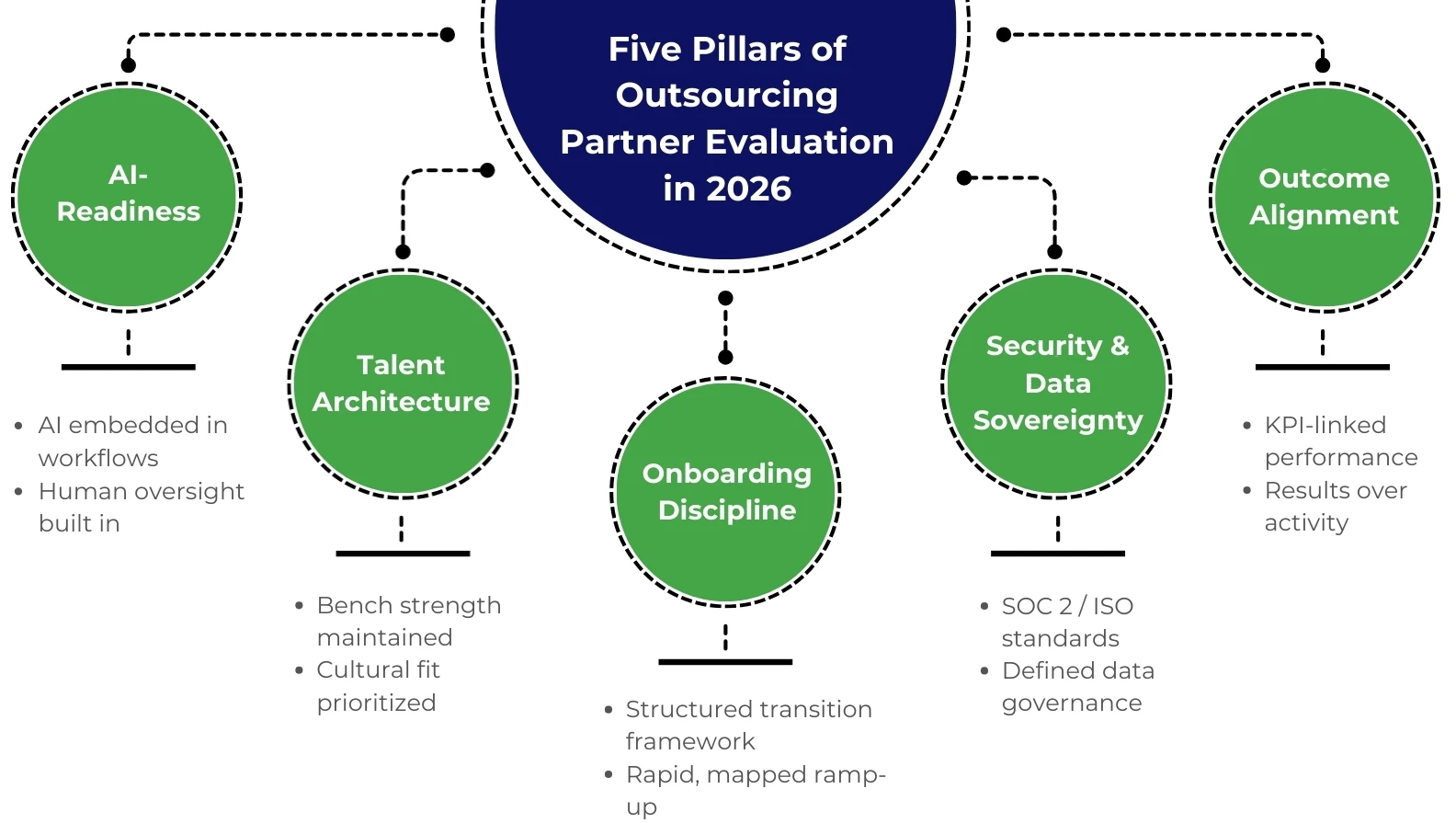
Pillar 1: AI-Readiness, Not Just AI Hype
In 2026, every IT outsourcing provider claims to have AI capabilities.
That is not the test.
The real question is sharper:
Do they have the ability to prototype, refine, and operationalize AI for your business, or are they repeating a vendor script?
Look beyond the pitch deck.
Ask for proof:
- Live use cases in agent-assist or intelligent routing
- Document AI applied to real workflows, not demos
- Predictive analytics influencing operational decisions
- Clear human-in-the-loop governance at decision points
If a partner cannot clearly articulate how AI fits into their delivery architecture and how it evolves, they are already behind.
Pillar 2: Talent Philosophy, Depth Over Deployment
In 2026, talent is the constraint.
Ask one question:
Do they hire to fill roles or invest in continuity?
Look for:
- Bench strength maintained before demand spikes
- Hiring discipline beyond contract dependency
- Cultural immersion into your operating model, not just skills matching
A partner’s talent philosophy determines whether execution compounds or resets with every transition.
Pillar 3: Onboarding as a Leading Indicator
Long-term performance is predictable, and it begins with onboarding.
Ask:
Is there a defined transition architecture, or is it just a kickoff call?
Look for a clear progression:
Discovery → Process mapping → Role alignment → Technology integration.
If onboarding lacks structure, long-term delivery will lack consistency.
The first 30 days tell you everything.
Pillar 4: Data Sovereignty & Security Maturity
In 2026, security posture is part of partner selection, not legal review.
Evaluate directly:
- SOC 2 and/or ISO 27001 certification
- Clearly defined data access controls
- Documented data residency and incident response protocols
Security maturity is not a badge. It is an operational discipline.
Pillar 5: Outcome-Based Partnership Models
Pricing reveals partnership depth.
- Hourly billing optimizes for activity.
- Outcome alignment optimizes for results.
In 2026, strategic work increasingly moves toward fixed-fee or performance-linked models where incentives reflect impact rather than time spent.
Evaluate:
- Are they willing to tie performance to your KPIs?
- Do they measure success through CSAT, cycle time, error reduction, or revenue impact?
- Is accountability shared or reported?
The ROI of Getting It Right in 2026
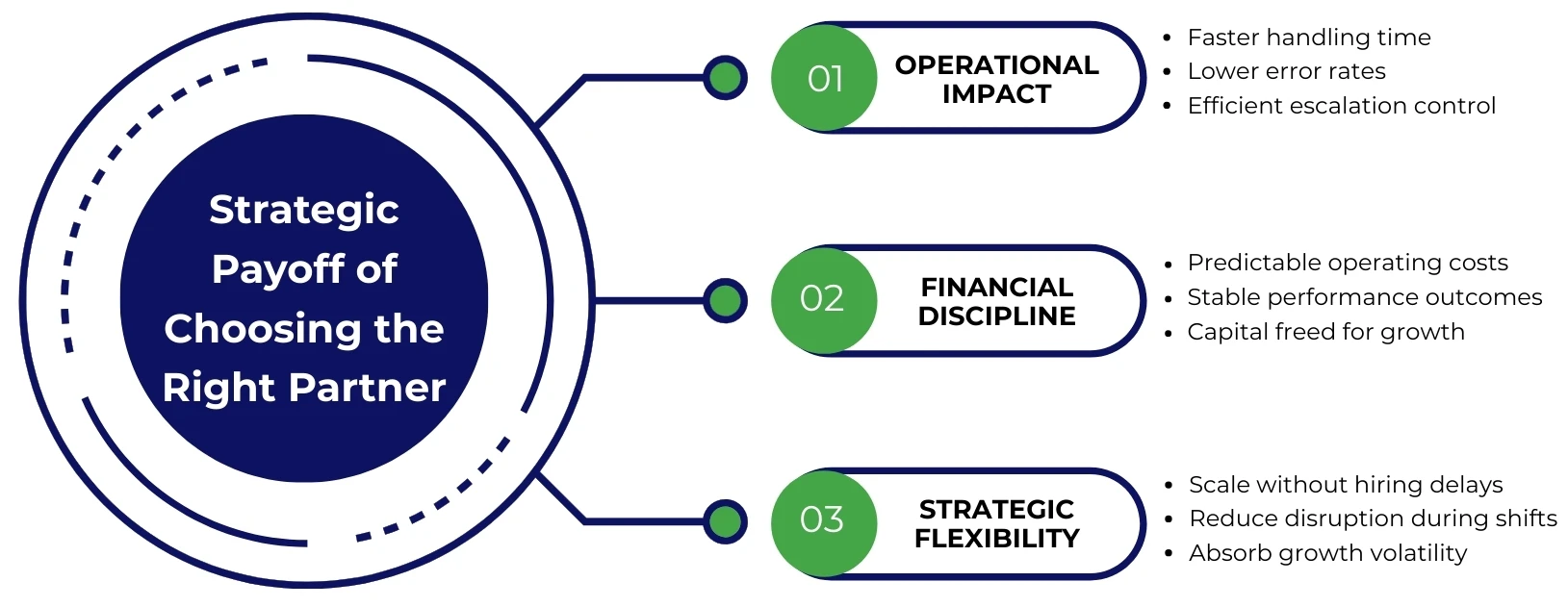
Operational Impact
When AI-enabled workflows are properly integrated, McKinsey estimates productivity gains of 20–30% in service operations.2
- Handling time compresses
- Error rates decline.
- Escalations become deliberate rather than reactive.
Financial Discipline
Strategic outsourcing in 2026 is less about the lowest cost and more about cost predictability.
Deloitte’s outsourcing research shows that organizations are increasingly pursuing structured, outcome-driven models that stabilize spend while improving performance.3
Predictable operating costs free capital for core initiatives: product innovation, market expansion, and digital investment.
Strategic Flexibility
The most underappreciated ROI is optionality.
The right partner allows you to:
- Scale up without the lag of hiring cycles
- Scale down without organizational disruption
- Absorb growth volatility without operational shock
Designing for What’s Next – The Partner You Choose Defines the System You Build
In 2026, strategic business partner outsourcing is no longer about filling seats.
It is about reinforcing the operating system behind your growth.
The right partner does not simply execute tasks. They strengthen how work scales, how risk is governed, and how insights flow across functions.
The real question is not whether to outsource.
It is this:
Are you choosing a vendor optimized for today or an outsourcing partner engineered for your next stage of scale?