

The Real Barrier to Outsourcing: Mitigating Transition Risk
The primary obstacle for mid-market CFOs considering finance and accounting outsourcing is rarely a question of capability—it’s the perceived risk of the transition itself. For a finance leader in a company of $50M–$1B revenue, the concern isn’t whether value exists, but whether the onboarding process will:
- Disrupt existing controls and compliance.
- Compromises the accuracy of financial reporting.
- Expose operational gaps in an already lean team.
In a function built on precision, onboarding is a strategic inflection point. Its execution determines whether outsourcing becomes a liability or a reliable, scalable extension of your finance function.
What follows is a blueprint for structured onboarding, designed to minimize exposure, accelerate alignment, and build a foundation for long-term stability.
Discovery & Design – Laying the Cornerstones (Approx. Weeks 1–2)
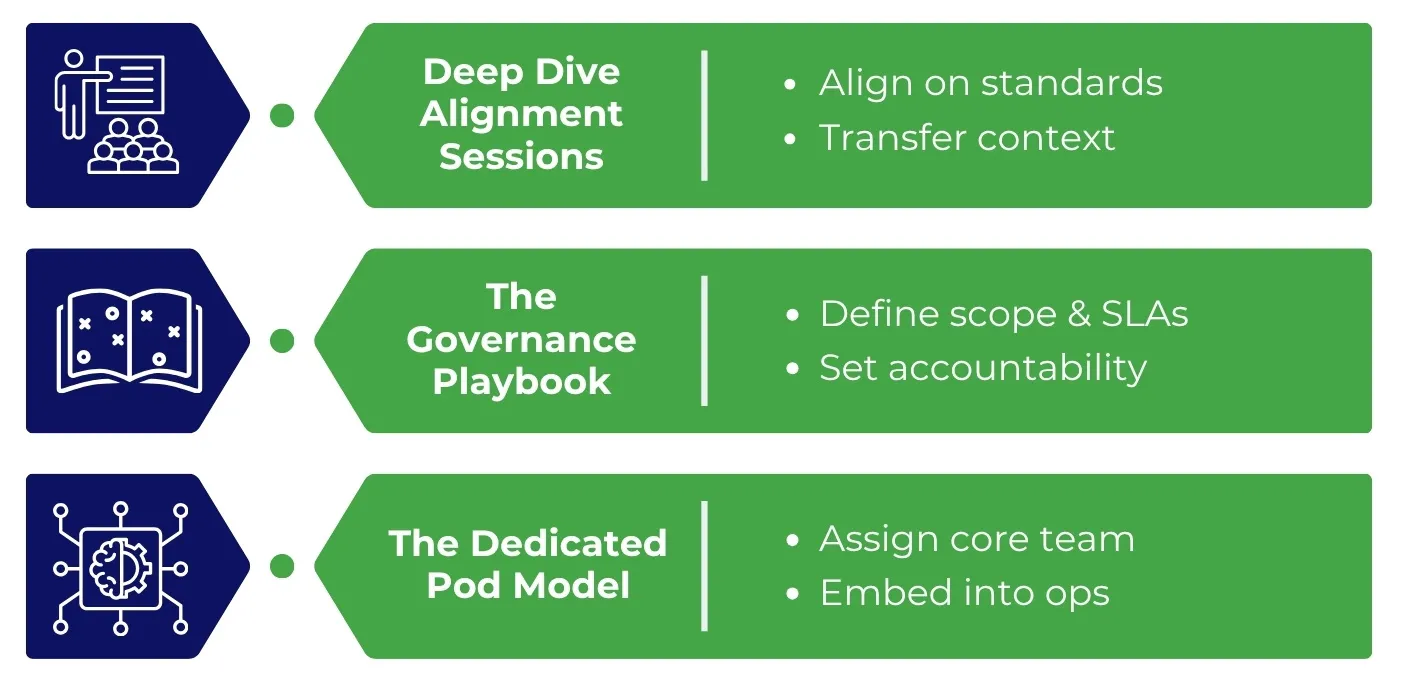
Deep Dive Alignment Sessions
The process begins by aligning on the principles that govern your finance function: execution standards, reporting structures, approval flows, and risk controls. These sessions ensure we transition not just a list of tasks, but the broader context that sustains performance, compliance, and the integrity of your decision-making data.
The Governance Playbook
A formal operating guide is co-developed to define scope, service levels, governance checkpoints, escalation protocols, and communication cadence. This Playbook acts as the engagement’s constitution, establishing clear discipline and accountability for both parties.
The Dedicated Pod Model
A dedicated finance team is assembled based on domain expertise, systems proficiency, and long-term continuity potential. This includes a core pod (e.g., 2–3 accountants + a team lead), trained pre-launch and positioned to function as an embedded extension of the client’s finance organization.
Phase 2: Knowledge Transfer & Parallel Run – Validating Fluency (Approx. Weeks 3–6)
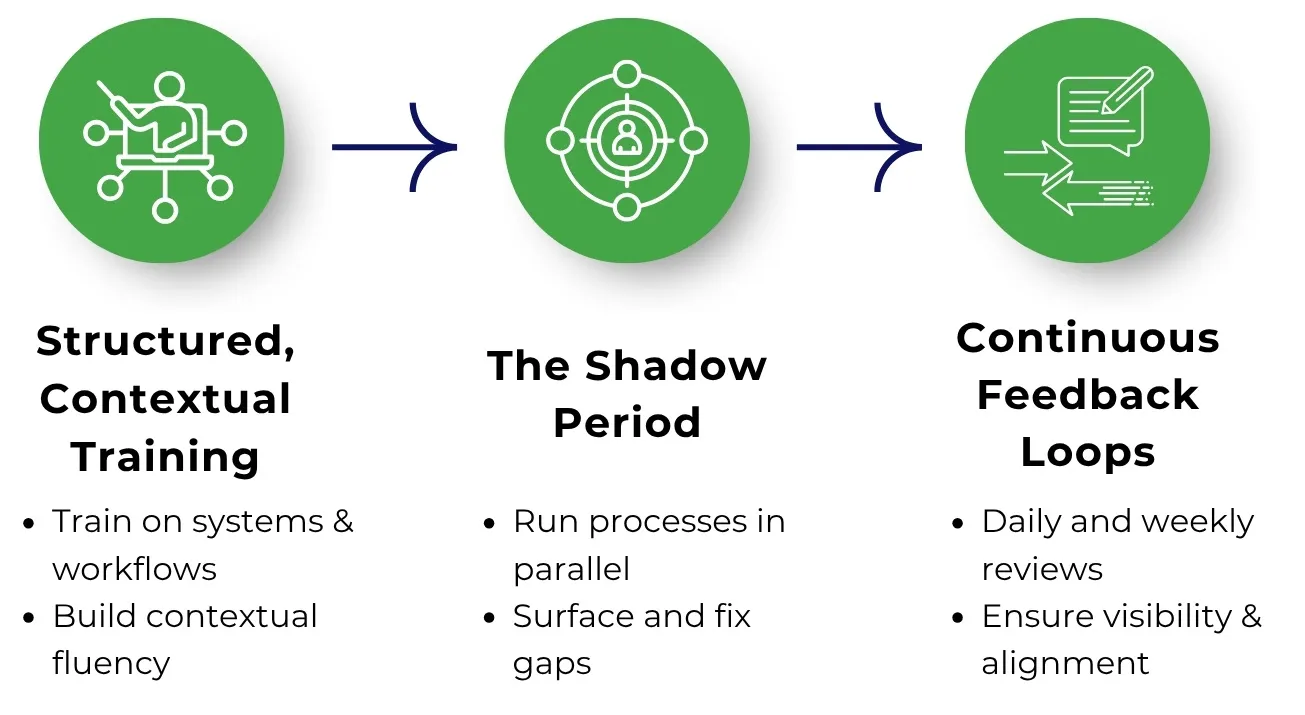
Structured, Contextual Training
Knowledge transfer is facilitated by the client’s finance team, with the delivery team trained on internal systems, workflows, reporting cadence, and control standards. The objective is to build contextual understanding—ensuring continuity beyond task execution.
The “Shadow” Period: A Controlled Simulation
The delivery team operates in parallel with internal operations, executing processes without impacting live outputs. This phase builds fluency, validates system access, and confirms process alignment, while providing a safe environment to surface and resolve potential gaps before the formal handoff.
Continuous Feedback Loops
Progress is monitored through structured daily stand-ups and executive-level steering reviews. These checkpoints provide early visibility into risks, reinforce alignment, and ensure onboarding remains on track across leadership and operational levels.
Phase 3: Go-Live & Stabilization – Ensuring Operational Control (Approx. Weeks 7–8)
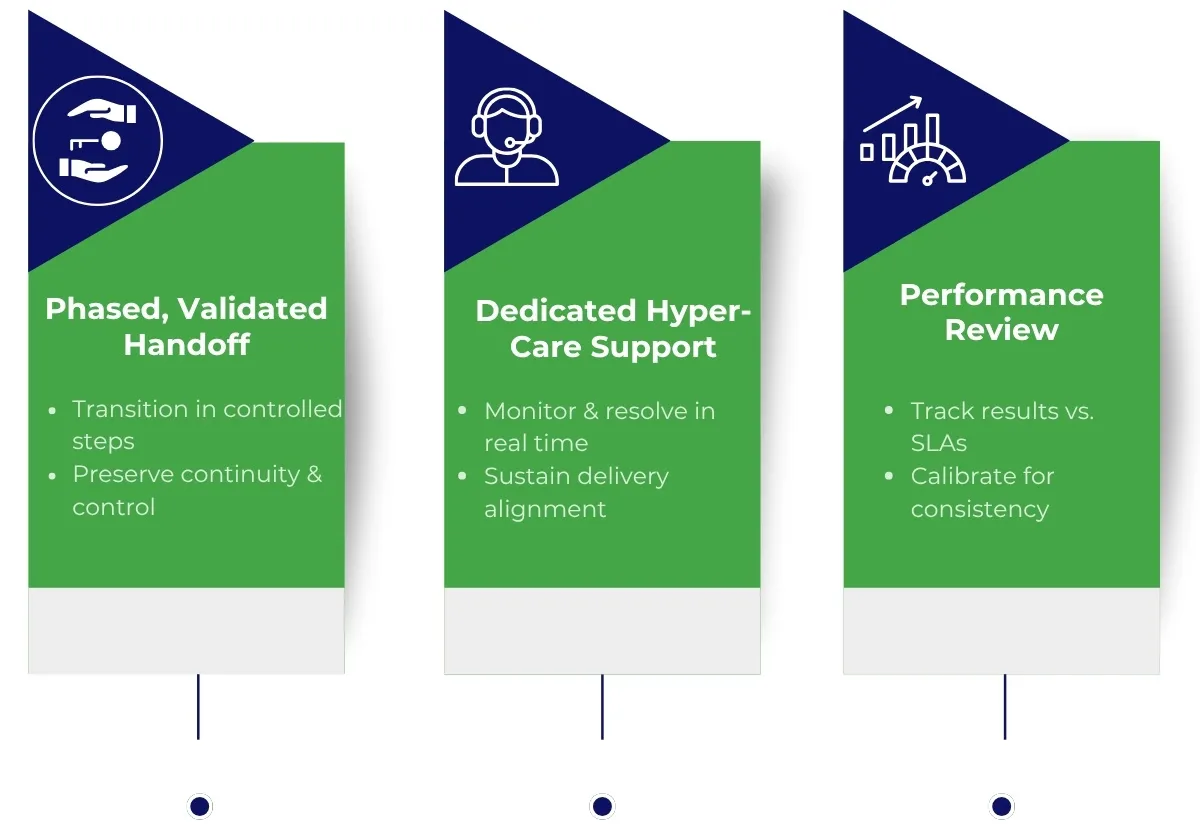
Phased, Validated Handoff
Ownership of core finance processes transitions in a controlled sequence, with each phase validated before proceeding. This measured approach preserves continuity, minimizes single-point exposure, and systematically builds confidence in the new operational model.
Dedicated Hyper-Care Support
Immediately following the handoff, the delivery team operates in a heightened support mode—monitoring output quality, addressing exceptions in real time, and ensuring sustained alignment with financial oversight requirements.
Performance Review Against Baseline
Execution is assessed against predefined SLAs, governance expectations, and reporting cadence outlined in the Playbook. Early results are reviewed with key stakeholders to validate performance and fine-tune for long-term consistency.
The Premier NX Difference: The Premier Sync Framework
The three-phase blueprint is the operational expression of Premier Sync, our structured onboarding framework. Refined over 20 years, it is designed to build the foundation for a strategic, long-term partnership, not just to transfer work.
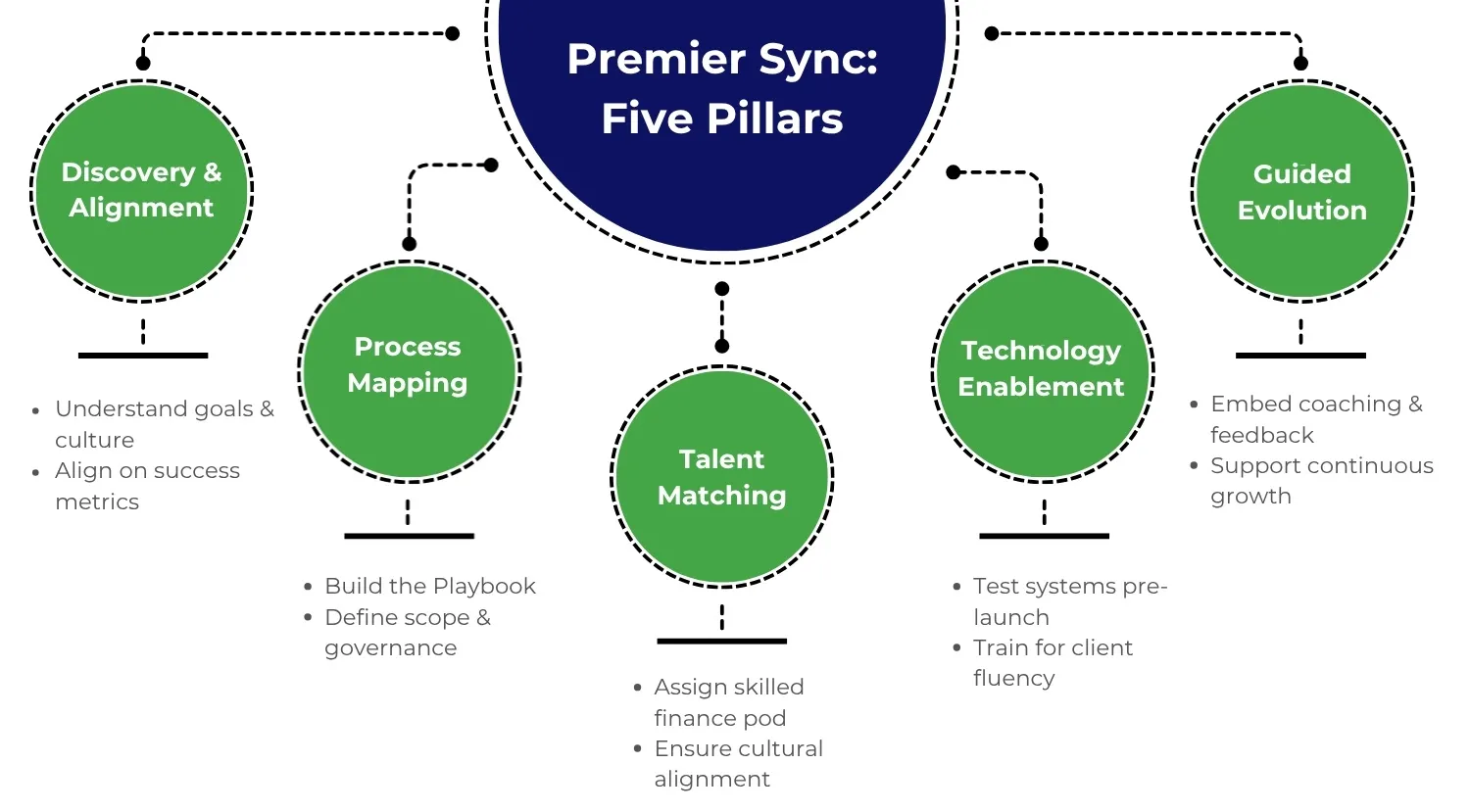
Premier Sync: The Five Pillars of a Seamless Transition
- Discovery & Alignment: We begin by understanding not just your processes, but your business objectives and culture. This deep alignment ensures our team operates as a true extension of your own, focused on your definition of success from day one.
- Process Mapping & Documentation: We translate your unique workflows into the formal Playbook. This document becomes the single source of truth for scope, governance, and protocols, eliminating ambiguity.
- Talent Matching via Premier Match: A process is only as strong as the people behind it. Premier Match is our disciplined approach to sourcing, screening, and selecting your dedicated pod for domain expertise, systems proficiency, and—critically—organizational fit.
- Technology Enablement & Training: Before go-live, we ensure all systems are integrated and tested. Your team then undergoes client-specific training and a “nesting” period to build fluency.
- Guided Evolution: Onboarding is the beginning. We embed coaching and continuous improvement feedback loops from the start, ensuring the partnership adapts and grows in value.
Your Success, Measured from Day One
In finance and accounting, trust is built on precision and reliability. For a mid-market finance leader, a misstep during transition isn’t an inconvenience; it’s a direct threat to operational control.
The Premier Sync framework is designed to eliminate that risk. It provides the clarity, control, and disciplined execution that turns the uncertainty of change into the confidence of a well-managed process.
If your finance function is ready to scale without compromising trust, accuracy, or continuity, the structured approach of Premier Sync is not just an advantage—it is essential.
Premier NX partners with mid-market leaders to make that transition seamless. Let’s have a confidential conversation to explore how our model can help your finance and accounting operation evolve, without disruption.
About the Author

As CEO, Ali Din oversees the overall strategy and direction for Premier NX. With senior leadership roles at global HR and recruiting platforms, Indeed and ADP. Ali has over 25 years of experience in the IT and advanced technology sector. Ali’s time is focused on transformation in the business, both for professional development and for clients, to enhance business outcomes.