


Imagine a scenario in which the Sales team celebrates a record-breaking quarter, while the CFO is managing a cash flow crisis. The generous payment terms that secured those deals were never stress tested. Simultaneously, Customer Service faces a surge of complaints, while Operations, awaiting a budget approval, delays the fulfillment that would have prevented them.
No single team failed in its duty. The system itself is the point of failure.
This is the structural cost of the functional silo, a model where critical decisions are made in isolation, and the total cost of disconnection remains invisible until it manifests as a crisis. For decades, this division of labor was a blueprint for control. Today, it is a blueprint for fragility.
By 2026, the most resilient mid-market companies will have rendered these internal walls obsolete. They will compete not with individual department strengths, but with the superior velocity and insight of a fully integrated operating model.
The Silo Tax: What Fragmentation Really Costs Your Business
To understand the imperative for change, we must first diagnose the true cost. We call this the Silo Tax, the measurable drag on revenue, margin, and strategic agility levied by fragmented data, goals, and workflows.
The Data Disconnect: Finance analyzes last month’s numbers. CX captures live customer sentiment. Operations monitors real-time capacity, yet faces three versions of the truth, leaving no single, actionable picture for leadership.
Customer Journey Friction: A simple fulfillment delay in Ops becomes a billing complaint for Finance and escalates into a customer churn risk for CX. Each team treats its symptoms, but no one can diagnose or cure the root cause during the handoffs between them.
Innovation Lag: In a fast-moving market, insights lose their value in transit. By the time customer feedback reaches a product team or financial constraints are factored into a new service design, the competitive window has closed.
The 2026 Model: The Rise of the Outcome-Oriented Pod
High-performing organizations are shifting from functional silos to cross-functional pods organized around outcomes rather than org charts.
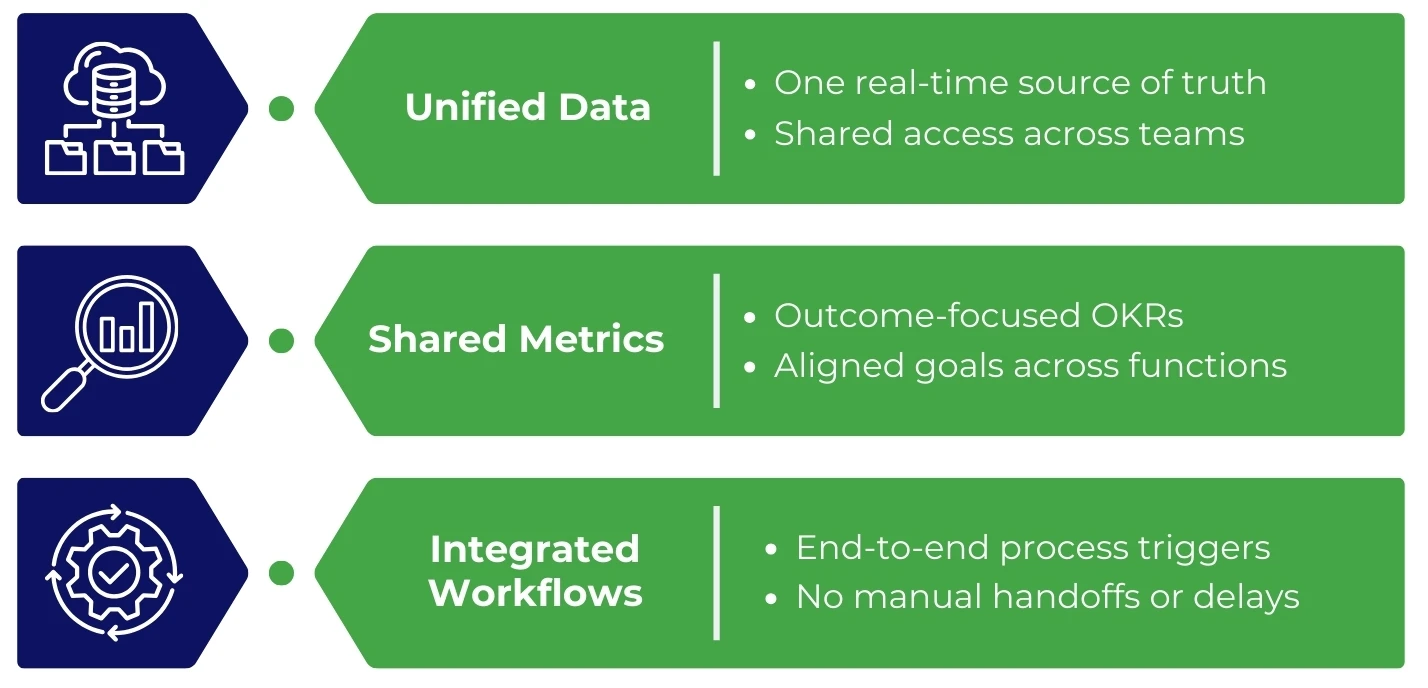
Unified Data
Pods operate from a single source of truth. Finance, Ops, and CX can access and update shared data in real-time, enabling faster, aligned decisions.
Shared Metrics
Outcome-driven Objectives and Key Results (OKRs) replace Key Performance Indicators (KPIs). Instead of siloed targets, teams rally around goals like “first-order fulfillment at 99%”, which require input from all sides.
Integrated Workflows
Processes are connected end-to-end. A customer order automatically triggers inventory checks, credit validation, and CX notifications without manual handoffs or delays.
This model doesn’t add complexity. It removes friction by embedding intelligence where execution happens.
The Three Connections That Define the Future
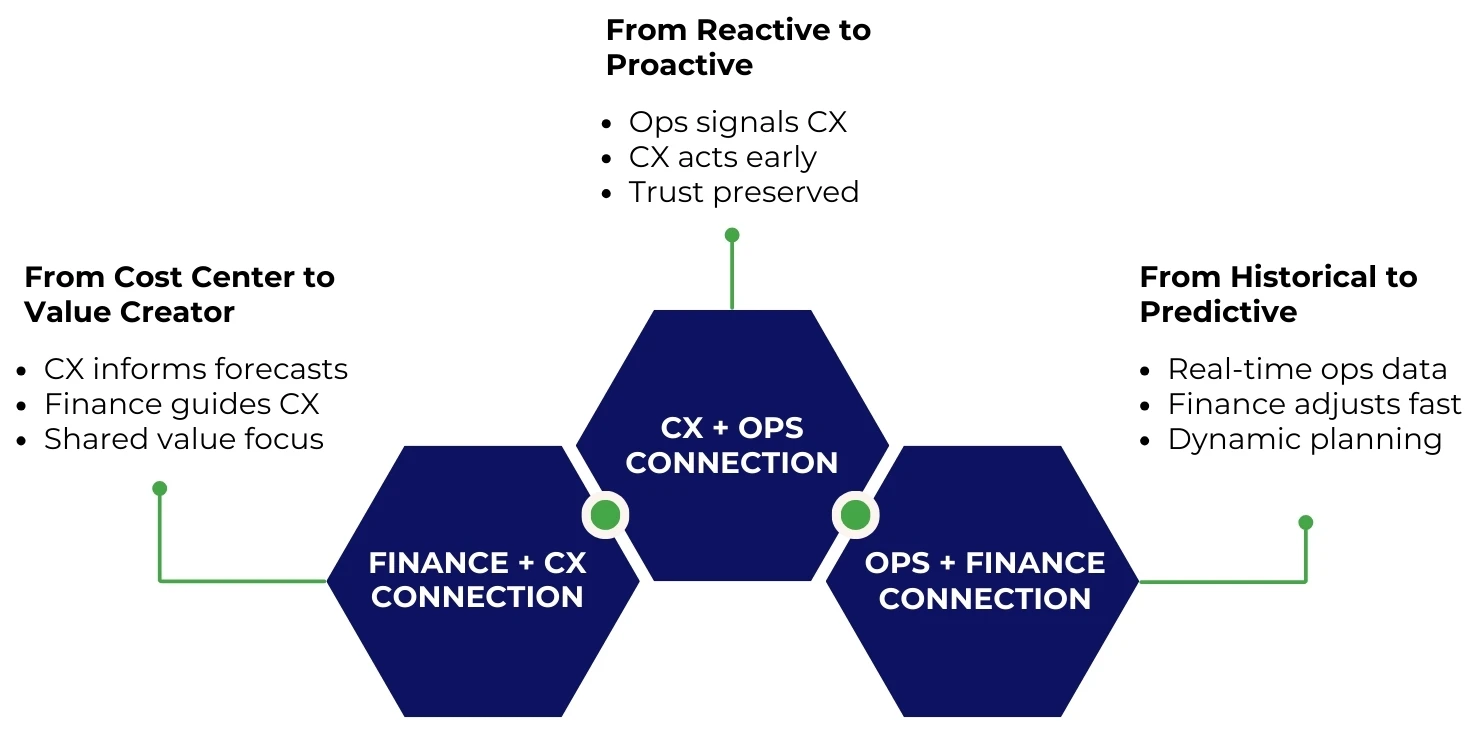
1. The Finance + CX Connection: From Cost Center to Value Creator
Customer Lifetime Value (CLV) data from CX enables Finance to model more accurate forecasts and inform investment priorities. In return, Finance provides profitability insights that help CX focus on high-value segments and service strategies that drive retention.
Result: Organizations shift from treating CX as a cost center to treating it as a growth lever, where both functions make more aligned decisions.
2. The CX + Ops Connection: From Reactive Support to Proactive Assurance
Operational signals like delays, inventory gaps, or fulfillment issues can feed directly into CX workflows. Instead of waiting for complaints, CX teams engage proactively to manage expectations and preserve trust.
Result: What would have been service failures become managed experiences, reducing escalation and strengthening customer relationships.
3. The Ops + Finance Connection: From Historical Reporting to Predictive Planning
Operational data—production capacity, lead times, and supply fluctuations can inform real-time financial modeling. Finance no longer works from last month’s numbers; it works from today’s realities.
Result: Scenario planning becomes dynamic, enabling leaders to adjust pricing, cash flow strategies, and resource allocation quickly and with confidence.
The Premier NX Advantage: A Partner for the Connected Enterprise
Building this interconnected model is the central challenge for the mid-market leaders. It requires a shift in strategy, supported by partners who provide the right capabilities, not just the promise of them.
Premier NX is structured to help mid-market companies navigate this complexity. Our core service pillars, Finance & Accounting, Customer Experience, and Revenue Operations & Analytics, are designed to function not in isolation, but as interdependent parts of a larger system.
Our approach focuses on creating the conditions for connection:
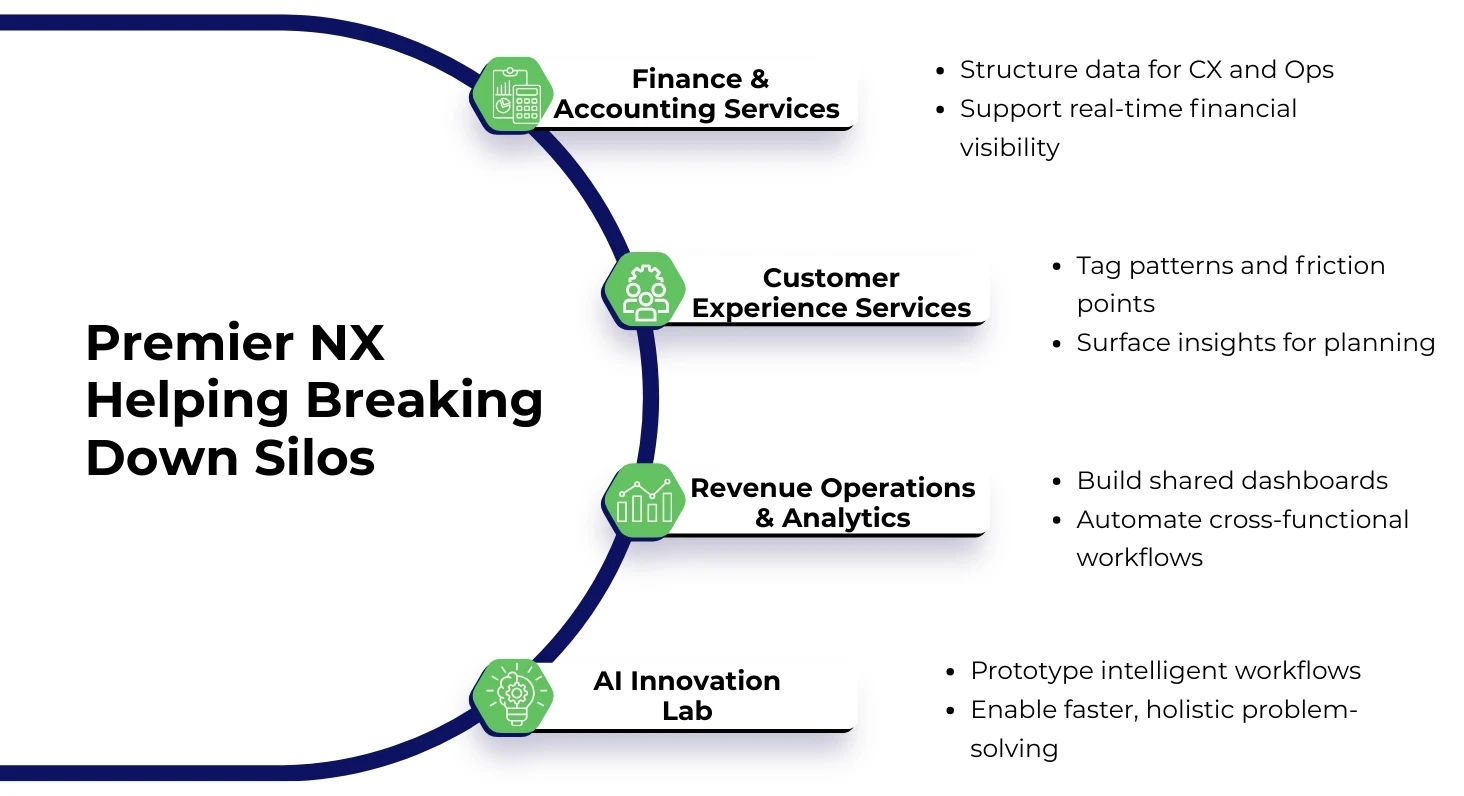
- Within our Finance & Accounting practice, we prioritize data integrity and structure, ensuring financial information is a reliable foundation for cross-functional decisions.
- Our Customer Experience teams are oriented around capturing and analyzing customer intelligence, providing the critical feedback loop that informs both operations and strategy.
- The role of our Revenue Operations & Analytics pillars is to build the visibility and automated workflows that make this shared data accessible and actionable for leadership.
Supported by our AI Innovation Lab, we explore tools and workflows to streamline these connections further. We operate on the principle that breaking down silos is a practical challenge of process, data, and alignment, and we provide the expertise to help address it.
Case Study: Improving Financial Accuracy Through Connected Processes
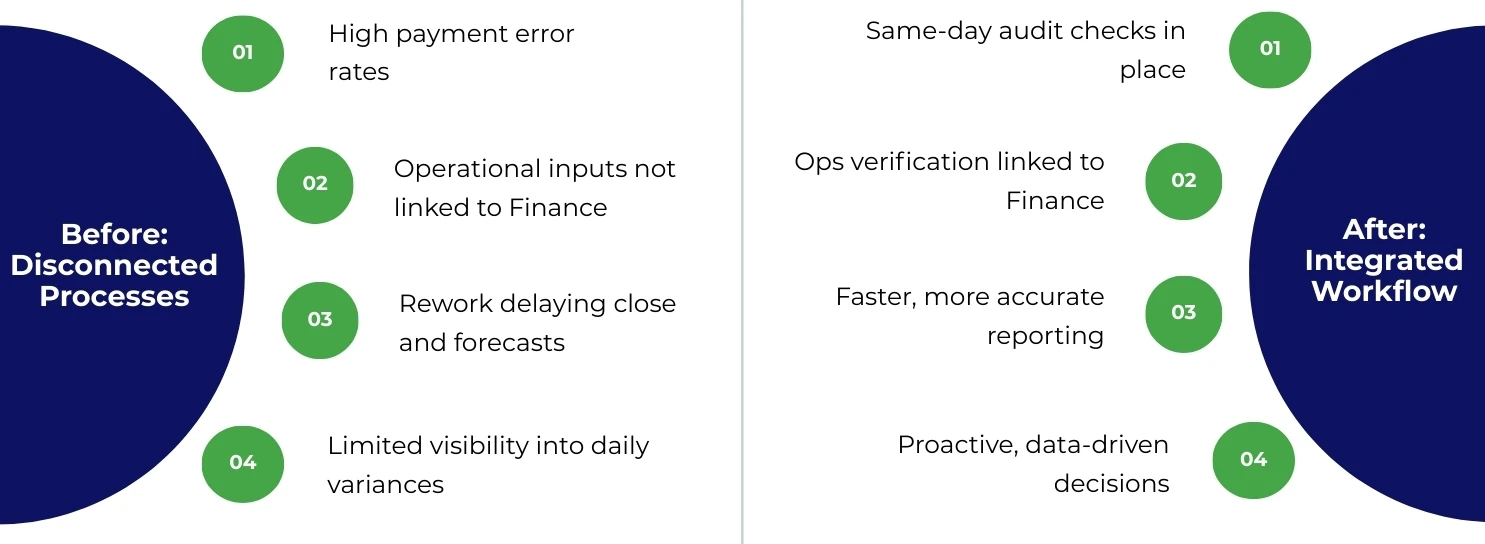
The Challenge
A financial services client faced chronic payment errors and slow financial reporting. Disconnected systems between their operations and finance teams created a cycle of rework and delayed insights, limiting proactive decision-making.
The Approach
We implemented a unified workflow that connected operational verification directly to financial processes. This included same-day audit checks and providing the finance team with earlier, direct access to operational data.
The Result
The client achieved a significant reduction in payment errors and faster, more accurate reporting. This transformed their approach from reactive correction to proactive financial management.
A Question for Reflection: Is Your Organization Built for 2010 or 2026?
The shift to a connected model is foundational, not incremental. For mid-market companies, it represents the single greatest opportunity to outperform larger competitors this decade.
Ask yourself this: If a major customer issue arose today, how many business days would pass before that insight actively shaped your financial forecasts and operational plans?
Your answer reveals whether your operating model is built for the past or engineered for the future.
The answers reveal more than system maturity; they expose whether your operating model is built to adapt, align, and scale in the years ahead.
Architecting Your Future, Today
Success requires more than tools or process improvements. It demands a partner who understands that Finance, Customer Experience, and Operations aren’t separate domains, but components of a single ecosystem.
If your organization is still navigating in silos, now is the time to rethink the model, not reactively, but intentionally.
Ready to design your 2026 operating model?
About the Author

As CEO, Ali Din oversees the overall strategy and direction for Premier NX. With senior leadership roles at global HR and recruiting platforms, Indeed and ADP. Ali has over 25 years of experience in the IT and advanced technology sector. Ali’s time is focused on transformation in the business, both for professional development and for clients, to enhance business outcomes.