

Key Takeaways
- 1ERP migration can remove legacy constraints that have shaped finance ownership, workflows, and operating capacity over time.
- 2A more efficient process does not automatically create a more efficient finance operating model unless ownership and execution are also reconsidered.
- 3Future-state finance capacity should be based on the work that remains after automation, standardization, and process redesign.
- 4Operating-model decisions made before go-live can prevent legacy roles, duplicated effort, and outdated structures from being carried into the new environment.
ERP migrations force finance organizations to make explicit decisions about workflows, approvals, controls, data and automation. They should also force a less obvious decision: whether the finance organization built around the legacy environment still belongs in the future state.
Over time, system limitations rarely remain contained within technology. They become embedded in finance through manual reconciliations, fragmented ownership, entity-specific routines, additional approvals, reporting workarounds and roles devoted to recurring exceptions.
When a new ERP removes some of those constraints, the organization built around them does not disappear automatically.
A company can therefore complete a technically successful migration and still operate finance with a structure, capacity model and division of work shaped by the platform it just replaced.
The objective is not to redesign finance simply because the ERP is changing. It is to require the existing model to prove that it still fits the work that remains.
Legacy Constraints in the Finance Structure
Legacy environments can make organizational complexity look like business complexity.
An entity may have its own reconciliation routine because its systems could not support a common process. A business unit may maintain separate reporting activity because data had to be extracted and manipulated locally. Additional approval steps may exist because the previous workflow could not route exceptions effectively.
Over time, those accommodations become roles, teams and accepted ways of working.
ERP migration creates an opportunity to distinguish between two very different sources of complexity.
Some variation reflects genuine business requirements: statutory obligations, tax structures, risk profiles, materiality, operating models or service expectations.
Process Redesign and Operating Model Change Are Different Decisions
ERP migration can standardize workflows, automate approvals, and reduce manual effort. But those gains do not automatically change how finance is staffed or delivered.
If ownership remains fragmented across entities, similar work is still performed by separate teams, and senior finance talent continues to absorb transactional activity, the transformation stops at the system layer.
The operating-model opportunity is to convert process improvements into structural gains:
- consolidate repeatable work where the new ERP creates common processes;
- retain internal capacity for judgment, control, and decision support;
- align delivery capacity with the future-state workload, rather than the legacy organization.
A modern ERP can make finance more efficient. The operating model determines whether that efficiency actually changes the cost, capacity, and scalability of the function.
What Should Change in the Post-ERP Finance Function
A successful migration should leave finance with a different operating footprint not simply the same work performed in a newer system.
Design finance for what's next.
Standardize Work That No Longer Needs to Vary
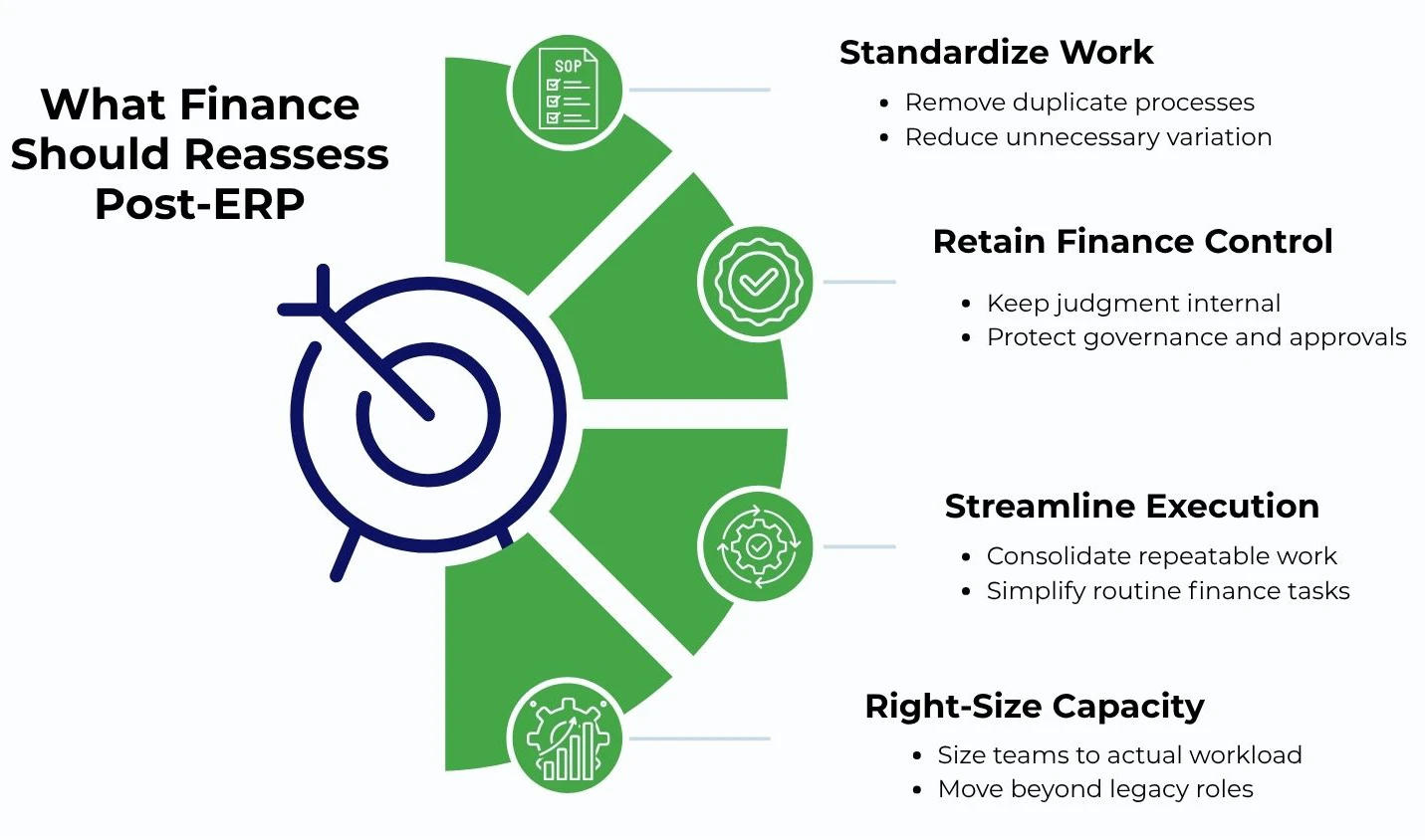
A common ERP environment can reduce the need for separate versions of the same finance activity across entities or business units. AP workflows, reconciliations, close activities, and recurring reporting should be reviewed for duplicate effort, inconsistent handling, and fragmented ownership.
Where the underlying business requirement is common, the process should not remain different by default.
Separate Finance Judgment From Transaction Execution
The post-ERP structure should place finance capacity where it creates the most value.
Keep internal finance focused on:
- financial judgment and policy;
- governance and control;
- exception approval;
- forecasting and decision support.
Reassess how repeatable execution is delivered:
- transaction processing;
- routine reconciliations;
- data validation;
- recurring reporting support;
- standardized close activities.
This distinction opens the door to centralized or externally supported execution without giving up internal control of the finance function.
Rebuild Capacity Around the Work That Remains
Post-migration capacity should reflect the workload created by the future-state process: transaction volumes, remaining manual touchpoints, exception levels, entity complexity, close requirements, and service expectations.
The shift is important: capacity is sized across connected finance processes, not inherited from the existing organization chart.
Make the Operating Model Decision Before Go-Live
ERP go-live should not become the point at which the existing finance structure is simply confirmed.
Before roles and capacity are carried into the new environment, leadership should establish:
- which processes can now operate consistently across entities or business units;
- which activities still require internal finance judgment and control;
- where recurring execution can be consolidated;
- how much capacity is required once automation, standardization, and exception volumes are understood.
These decisions are harder to revisit after the organization has staffed around the new platform.
The Premier NX Perspective: Build Execution Around the Future State
The objective is not to outsource finance ownership or use external capacity to preserve an inefficient structure. It is to build disciplined execution around the operating model finance leadership chooses.
Premier NX can support recurring finance execution across areas such as transaction processing, reconciliations, close support, reporting, and other standardized workflows within the client’s systems, controls, and governance requirements.
Client finance leadership retains financial policy, approvals, accounting interpretation, material judgment, and final accountability.
This allows external capacity to be evaluated across connected finance processes, rather than as a series of individual role replacements.
ERP Go-Live Is Not the Finish Line
A successful migration does not automatically mean the finance operating model is fit for the new environment.
If legacy ownership, duplicated activity, and staffing assumptions remain unchanged, the business may have modernized the platform without fully capturing the operating value of the migration.
The real opportunity is to align finance structure and capacity with the work the new ERP now enables.