


Outsourcing inventory management helps businesses improve stock accuracy, fulfillment speed, cost control, and supply chain scalability.
Inventory management becomes more complex as growth accelerates. More orders, expanding SKU counts, multiple sales channels, and tighter delivery expectations can quickly expose gaps in warehouse operations and stock control.
When inventory is not managed accurately, the impact extends beyond the warehouse. Stockouts reduce revenue, overstocking ties up cash flow, delayed fulfillment affects customer experience, and inaccurate counts weaken planning decisions across the supply chain.
Outsourcing inventory management allows businesses to shift execution-heavy tasks like tracking, storage coordination, replenishment support, fulfillment, returns, and reporting.
This guide explains what outsourcing inventory management means, how it works, where it creates value, what risks to evaluate, how costs are structured, and how to choose the right partner for long-term supply chain efficiency.
What is Outsourcing Inventory Management?
Outsourcing inventory management means using an external partner to manage stock control, fulfillment support, reporting, and related inventory tasks.
What It Usually Includes
- Receiving inventory: The provider accepts incoming stock, verifies quantities, and records goods into the warehouse management system.
- Warehouse storage: Inventory is stored by SKU, category, demand profile, or handling requirement for faster retrieval.
- Inventory tracking: Stock movement is monitored from receipt through fulfillment, including returns and adjustments.
- Stock level monitoring: Teams track available inventory, low-stock alerts, and reorder signals.
- Pick, pack, and ship services: Orders are selected, packed, labeled, and coordinated for delivery.
- Returns processing: Returned items are inspected, categorized, restocked, repaired, or removed from sellable inventory.
- Inventory reporting: Reports provide visibility into stock levels, discrepancies, aging inventory, and fulfillment activity.
- Replenishment support: Providers help monitor reorder points and support timely stock movement before shortages occur.
What Businesses Usually Keep In-House
- Supplier relationships: Businesses typically retain direct control over vendor negotiations, contracts, and supplier performance.
- Product strategy: Product selection, assortment planning, and lifecycle decisions remain strategic internal responsibilities.
- Purchase approvals: Final buying decisions are usually made by finance, procurement, or executive leadership.
- Sales and promotional planning: Internal teams manage campaigns, pricing, demand stimulation, and channel strategy.
- Financial decisions: Budgeting, margin planning, cash allocation, and working capital decisions remain under business control.
- Inventory investment decisions: Leadership decides how much capital to place into stock based on demand, risk, and growth plans.
How does Outsourced Inventory Management Work?
Outsourced inventory management works by transferring stock, integrating systems, and letting a provider manage daily inventory workflows.
Inventory Transfer and Setup
The process starts by moving stock to the provider’s warehouse or fulfillment center. Each SKU is verified, labeled, counted, and mapped to a storage location.
System Integration
The provider’s warehouse management system connects with the business’s sales channels, ERP, order management system, or accounting platform.
Daily Inventory Operations
After setup, the provider manages receiving, storage, SKU tracking, picking, packing, shipping coordination, returns handling, and inventory reporting.
What are the Benefits of Outsourcing Inventory Management?
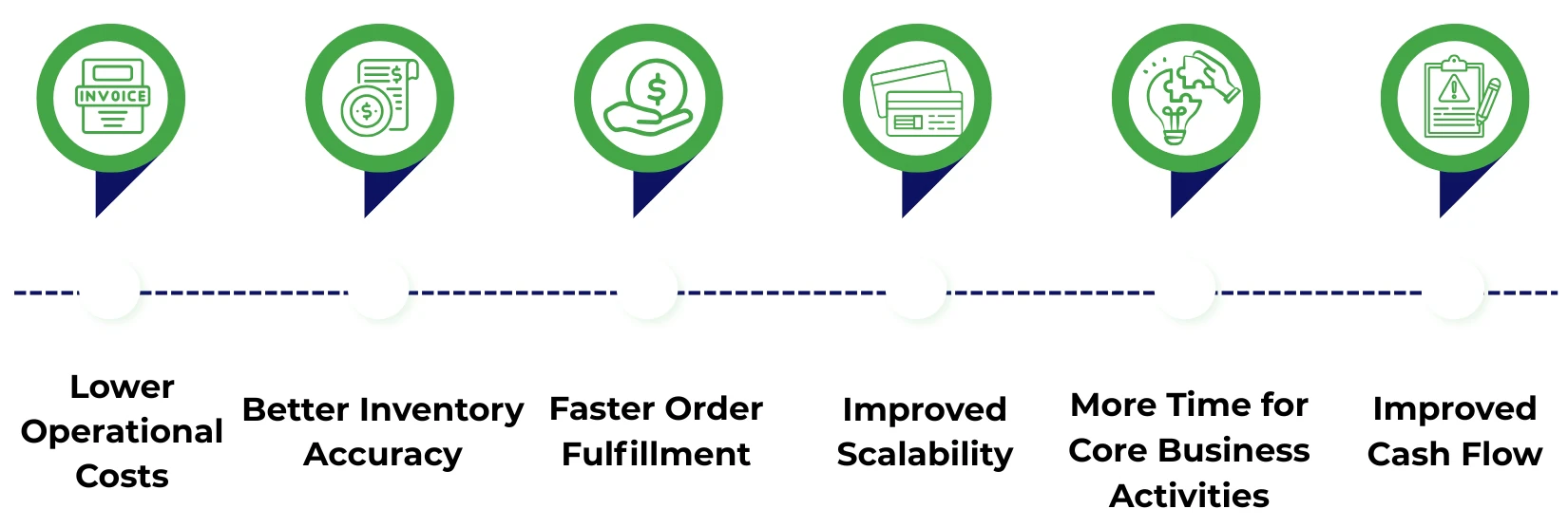
Outsourcing inventory management improves cost control, stock accuracy, fulfillment speed, scalability, and working capital efficiency.
Lower Operational Costs
Outsourcing reduces the fixed costs associated with warehouse leases, equipment, software, staffing, training, and supervision. It allows businesses to shift parts of their inventory operations to a variable-cost model.
Better Inventory Accuracy
Specialized providers use structured warehouse processes, barcode scanning, cycle counts, and inventory management systems to improve stock control. This reduces overselling, misplaced inventory, manual entry errors, and reporting gaps.
Faster Order Fulfillment
Outsourced inventory partners can improve order fulfillment speed through dedicated pick, pack, and ship workflows. Providers with regional or multi-location fulfillment networks can also reduce transit times and support faster delivery expectations.
Improved Scalability
Better inventory visibility supports stronger demand planning, higher inventory turnover, and reduced overstock. When businesses avoid excess stock and reduce carrying costs, they free up working capital that can be redirected toward growth, marketing, or product investment.
More Time for Core Business Activities
Inventory execution consumes management attention that could be used for revenue-generating work. By outsourcing daily warehouse operations, internal teams can focus on sales, product development, customer experience, supplier strategy, and market expansion.
Improved Cash Flow
Better inventory visibility supports stronger demand planning, inventory turnover, and overstock reduction. When businesses avoid excess stock and reduce carrying costs, they free up working capital that can be redirected toward growth, marketing, or product investment.
What are the Main Types of Inventory Management Outsourcing?
The main types include 3PL, fulfillment centers, VMI, drop shipping, outsourced administration, and hybrid fulfillment models.
Third-Party Logistics Providers
- Manage warehousing, inventory tracking, fulfillment, shipping, and returns.
- Best suited for ecommerce, retail, wholesale, and distribution businesses that need broader logistics support.
Fulfillment Centers
- Handle storage, pick-and-pack, shipping coordination, and returns processing.
- Useful for brands with high ecommerce order volume and standard fulfillment requirements.
Vendor Managed Inventory
- The supplier monitors stock levels and manages replenishment based on agreed inventory thresholds.
- Works best when demand is predictable, and supplier management is already mature.
Drop Shipping
- The supplier stores inventory and ships orders directly to customers.
- Reduces inventory ownership, but limits control over delivery speed, packaging, stock visibility, and product quality.
Outsourced Inventory Administration
- External teams manage inventory data, purchase order tracking, inventory reconciliation, reporting, and system updates.
- Useful when a business keeps physical inventory in-house but needs back-office outsourcing support.
Hybrid Inventory Outsourcing
- The business keeps selected inventory internally and outsources specific SKUs, regions, channels, or seasonal demand.
- Best for companies that want operational flexibility without giving up full inventory control.
When should a Business Outsource Inventory Management?
A business should outsource inventory management when growth, errors, costs, space limits, or fulfillment delays exceed internal capacity.
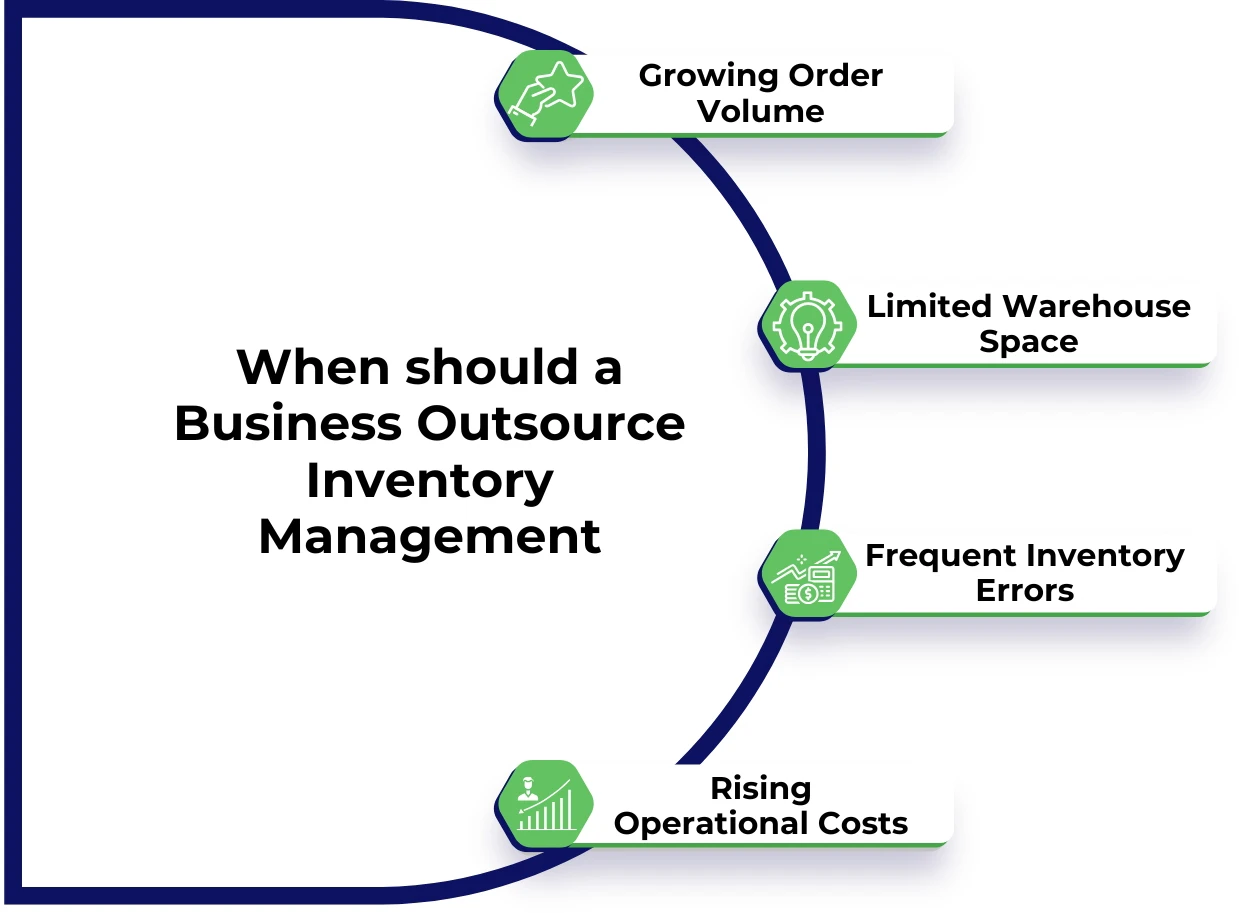
Growing Order Volume
- If order volume is rising faster than your team
- A key warning sign is when the fulfillment workload starts pulling managers away
Limited Warehouse Space
- If warehouse capacity is full, poorly organized, or limiting product expansion
- This is especially useful when seasonal demand creates short-term space pressure.
Frequent Inventory Errors
- If stock counts are unreliable, inventory control is already weakening.
- Overselling, stockouts, misplaced SKUs, delayed replenishment, and fulfillment mistakes
Rising Operational Costs
- If warehouse rent, labor, packaging, shipping, software, and supervision costs keep increasing
- Outsourcing can help convert some fixed operating costs into scalable service costs.
Expansion Into New Markets
- If customers are spread across new regions, a single internal warehouse may slow deliveries and increase shipping costs.
- Regional fulfillment through an outsourced partner can improve speed, reduce transit distance, and support business scalability.
What Inventory Tasks Can Be Outsourced?
Businesses can outsource warehouse storage, inventory control, fulfillment, returns, reconciliation, and inventory reporting tasks.
- Warehouse and storage tasks: Receiving, putaway, storage, stock organization, and space optimization can be handled by an external provider.
- Inventory control tasks: Stock counting, cycle counts, SKU tracking, reorder monitoring, and lot, batch, or serial number tracking can be outsourced.
- Fulfillment tasks: Picking, packing, order processing, shipping coordination, and packaging management can be managed by the provider.
- Returns and reporting tasks: Returns processing, reverse logistics, damaged goods handling, inventory reconciliation, reports, and performance analytics can be outsourced.
Outsourcing Inventory Management vs In-House Inventory Management
In-house inventory management offers more control, while outsourcing improves scalability, flexibility, and operational efficiency.
| Factor | In-House Inventory Management | Outsourced Inventory Management |
|---|---|---|
| Control | Businesses maintain direct operational control over warehouse staff, processes, and inventory decisions. | Daily inventory execution is managed by an external logistics or fulfillment provider. |
| Cost Structure | Requires investment in warehouse space, labor, inventory software, equipment, and supervision. | Converts part of the operation from fixed costs into variable service-based costs. |
| Scalability | Expansion depends on available space, staffing, and internal operational capacity. | Easier to scale during seasonal demand spikes, market expansion, or order growth. |
| Technology and Expertise | Internal teams must manage warehouse systems, process optimization, and fulfillment workflows independently. | Businesses gain access to established logistics systems, warehouse expertise, and fulfillment infrastructure. |
| Operational Flexibility | Process changes can be implemented directly but may require additional hiring or infrastructure. | Providers can often adapt capacity faster across multiple fulfillment environments. |
| Speed and Coverage | Delivery speed depends on warehouse location and internal fulfillment capabilities. | Regional fulfillment networks can improve order fulfillment speed and geographic coverage. |
What are the Risks of Outsourcing Inventory Management?
The main risks include reduced control, hidden fees, integration issues, fulfillment errors, and vendor dependency.
Reduced Direct Control
Outsourcing shifts daily operational control to the logistics provider. Without clear communication, reporting, and escalation rules, businesses may lose inventory visibility and respond too slowly to stock issues.
Hidden Fees
Service costs can extend beyond basic storage and fulfillment. Receiving, pick-and-pack, returns, software access, labeling, kitting, and special handling fees should be reviewed before signing any agreement.
System Integration Issues
Weak data integration can create inaccurate inventory records, delayed stock updates, overselling, or stockouts. Inventory systems, order platforms, and reporting tools should be tested before the provider goes live.
Fulfillment and Service Errors
Mispicks, late shipments, damaged goods, and slow returns can directly affect customer experience. A strong Service Level Agreement should define fulfillment accuracy, response times, reporting standards, and corrective action.
Vendor Dependency
Once inventory, workflows, systems, and customer delivery processes are connected to one provider, switching can become difficult. Businesses should review contract terms, data ownership, exit timelines, and inventory transfer procedures early.
What Cost Factors Affect Outsourced Inventory Management?
Outsourced inventory costs depend on storage, receiving, fulfillment, returns, software, account support, and special handling needs.
- Storage and receiving costs: These include monthly storage fees, pallet/bin charges, cubic-foot usage, receiving, put away, and inbound inventory handling.
- Fulfillment costs: These include pick-and-pack fees, packaging materials, shipping rates, labeling, kitting, and the total cost per order.
- Returns and special handling costs: These include returns processing, damaged goods handling, long-term storage fees, inspection work, and product-specific handling requirements.
- Software and account costs: These include integration fees, monthly platform access, inventory system usage, account management, and minimum monthly charges.
How do You Choose the Right Inventory Management Partner?
Choose a partner based on industry fit, technology, warehouse coverage, inventory accuracy, pricing clarity, and support quality.
Industry Experience
Select a provider that understands your product type, order profile, handling needs, and fulfillment complexity. Ask for examples from similar businesses before committing.
Technology and Integrations
Review the provider’s WMS, dashboards, reporting tools, and integration capabilities. Confirm compatibility with your e-commerce platform, ERP, POS, accounting system, and order workflows.
Warehouse Network
Assess warehouse locations, storage capacity, and regional fulfillment coverage. The right network should reduce transit time, support customer demand, and improve delivery reliability.
Inventory Accuracy and SLAs
Ask about inventory accuracy rate, cycle-counting frequency, fulfillment accuracy, response times, and issue-resolution standards. These should be documented in the SLA.
Pricing Transparency
Request a complete pricing breakdown before signing. Review minimum fees, storage charges, pick-and-pack costs, returns management fees, software costs, and special handling charges.
Customer Support
Evaluate communication channels, escalation paths, account management quality, and support response time. A pilot program can help test execution before a full transition.
What are the Best Practices for Outsourcing Inventory Management?
Best practices include clean inventory data, clear KPIs, documented SOPs, system integration, forecast sharing, and regular reviews.
- Clean up inventory data first: Standardize SKUs, barcodes, product names, dimensions, weights, reorder points, and handling rules before transition.
- Define clear KPIs: Track inventory accuracy, order accuracy, stockout rate, fulfillment speed, returns turnaround, and inventory discrepancy rate.
- Document workflows: Create SOPs for receiving, fulfillment, damaged goods, returns, replenishment, reporting, and escalation management.
- Integrate systems before launch: Connect sales channels, ERP, inventory software, WMS, and reporting dashboards before moving inventory.
- Communicate forecasts and promotions: Share demand forecasts, sales forecasts, seasonal peaks, product launches, campaigns, and supplier delays in advance.
- Review performance regularly: Monitor performance reporting, hold review meetings, compare results against KPIs, and strengthen inventory governance over time.
Is Outsourcing Inventory Management Right for Your Business?
Outsourcing inventory management is ideal for growing businesses that need scalability, faster fulfillment, and stronger operational efficiency.
Good Fit for Outsourcing
Businesses are more likely to benefit from outsourcing when they face growing order volume, multiple sales channels, limited warehouse capacity, frequent stock errors, seasonal demand spikes, or expansion into new markets.
Better Fit for In-House Management
In-house inventory management may be more practical for businesses with very low order volume, highly customized products, strict quality control requirements, limited product ranges, or a need for direct operational oversight.
Decision Factors
The decision should balance cost, operational control, scalability, technology requirements, customer experience expectations, inventory complexity, and long-term business growth plans. A strong cost-benefit analysis should evaluate both operational efficiency and strategic flexibility.
Frequently Asked Questions (FAQs)
Conclusion
Outsourcing inventory management improves inventory optimization, fulfillment performance, scalability, and supply chain efficiency.
Outsourcing inventory management can strengthen inventory control, improve operational performance, and support faster fulfillment without forcing businesses to build more internal warehouse capacity.
The right logistics partner should improve efficiency while preserving inventory visibility, reporting accuracy, and service accountability.
Before outsourcing, businesses should evaluate cost structure, operational risks, technology compatibility, SLA terms, fulfillment strategy, and long-term business scalability.
About the Author

As CEO, Ali Din oversees the overall strategy and direction for Premier NX. With senior leadership roles at global HR and recruiting platforms, Indeed and ADP. Ali has over 25 years of experience in the IT and advanced technology sector. Ali’s time is focused on transformation in the business, both for professional development and for clients, to enhance business outcomes.