

E-commerce support outsourcing helps online brands scale service, manage ticket volume, and protect CX across every channel.
E-commerce growth breaks weak support systems fast.
As order volume rises, tickets multiply across delivery delays, returns, refunds, sizing, damaged items, subscriptions, discount codes, payment issues, and marketplace orders. These requests do not stay in one channel. They arrive via email, chat, social, SMS, phone, and platform inboxes simultaneously.
That pressure directly affects revenue. Slow replies can block purchases, trigger cancellations, increase refunds, damage reviews, and weaken repeat buying.
This is why e-commerce customer support outsourcing is no longer just a cost-saving move. For online brands, it is a way to scale service capacity without slowing growth.
Modern outsourcing now includes trained omnichannel agents, AI-assisted workflows, multilingual coverage, returns support, marketplace support, helpdesk management, reporting, and CX optimization.
What is E-commerce Customer Support Outsourcing?
E-commerce customer support outsourcing involves an external team managing online store support across channels, tools, and time zones.
Simple Definition
E-commerce customer support outsourcing means hiring a trained external team to handle customer conversations for an online store.
That team may support the full customer journey or only selected workflows, such as:
- Order-status questions
- Returns and refunds
- Live chat
- Email tickets
- Marketplace messages
- Phone or voice support
- Social media inquiries
- Multilingual or 24/7 coverage
- AI chatbot and automation support
The brand still owns the customer experience. The outsourcing partner provides the people, process discipline, coverage, and operating capacity to deliver it consistently.
E-commerce Customer Support vs. General Customer Support
E-commerce support is not generic customer service with a shopping cart attached.
It sits inside a fast-moving environment where every answer may depend on order data, carrier status, payment rules, return windows, inventory availability, or marketplace policy.
A strong e-commerce support team needs working knowledge of:
- Order management systems
- Shipping and fulfillment workflows
- Returns and exchanges
- Discount codes and promotions
- Payment failures
- Subscription billing
- Marketplace rules
- Product sizing, compatibility, or usage
- Customer lifetime value and retention
The difference is execution. General support answers the customer. E-commerce support solves the issue while protecting the sale, the margin, and the relationship.
Customer Support Outsourcing vs. Customer Service Outsourcing
Customer service outsourcing usually covers the broader customer experience, including pre-sale questions, post-sale assistance, account support, and general customer care.
Customer support outsourcing is more resolution-focused. It handles issues that require action, troubleshooting, product knowledge, policy judgment, or system access.
In e-commerce, the terms often overlap.
A sizing question can become a conversion opportunity. A refund request can become a retention moment. A delayed shipment can become either a lost customer or a recovered relationship.
That is why e-commerce brands should not treat outsourcing as simple ticket handling. They should treat it as an extension of revenue, operations, and customer experience.
Why do E-commerce Brands Outsource Customer Support?
E-commerce brands outsource support to handle growth, improve response times, extend coverage, and reduce internal operating strain.
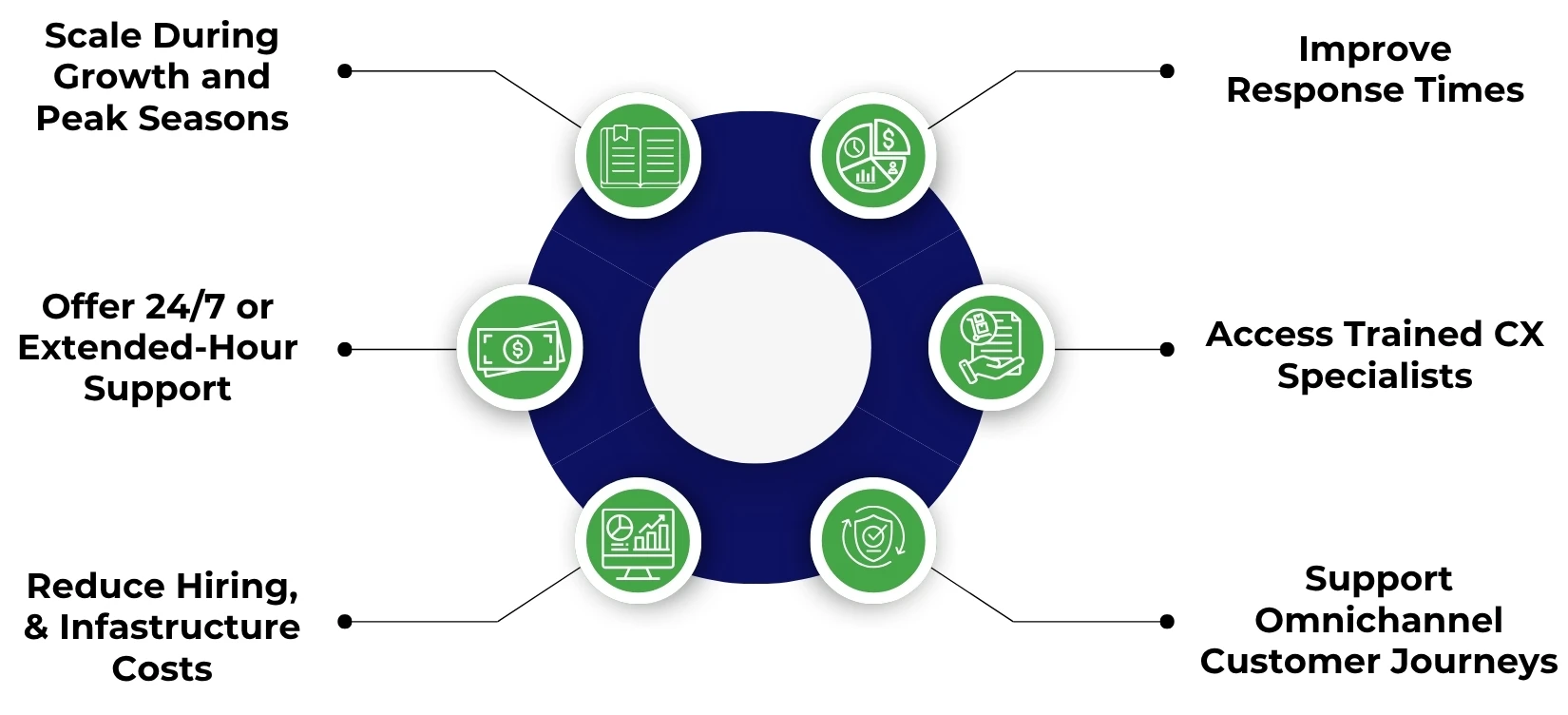
1. To Scale During Growth and Peak Seasons
E-commerce demand can change faster than hiring plans. A normal support queue can double during:
- Black Friday and Cyber Monday
- Holiday shopping
- Product launches
- Influencer campaigns
- Flash sales
- Marketplace promotions
- Viral social media moments
The problem is not only volume. It is timing. Tickets arrive when customers are already anxious, comparing options, tracking orders, or deciding whether to buy again.
2. To Offer 24/7 or Extended-Hour Support
Customers do not shop on the company’s schedule.
They browse after work, order on weekends, message from different time zones, and expect help before they abandon the cart. For global ecommerce brands, “business hours” can mean missed revenue.
Extended-hour support helps brands respond when buying intent is still active.
It can support:
- Late-night product questions
- Weekend order issues
- International customers
- Urgent delivery concerns
- Payment or checkout problems
- Pre-sale chats that may convert into orders
3. To Reduce Hiring, Training, and Infrastructure Costs
In-house support is expensive before the first ticket is answered.
Brands need salaries, benefits, recruiting, onboarding, team leads, training, QA, helpdesk tools, phone systems, workforce management, and coverage for nights, weekends, and holidays.
Outsourcing can reduce parts of that burden, depending on the partner, location, coverage model, and quality standards. But the stronger advantage is cost flexibility.
Instead of building a fixed team for unpredictable demand, brands can match support capacity to order volume, channel mix, seasonality, and growth stage.
4. To Improve Response Times
In e-commerce, slow support is not just a service issue. It is a revenue leak.
A delayed answer can mean:
- An abandoned cart
- A canceled order
- A refund request
- A negative review
- A lost repeat purchase
- A customer switching to a competitor
Fast response matters most when the customer is close to a decision. A product question before checkout, a delivery concern before an event, or a return issue after a poor experience can all influence revenue.
5. To Access Trained CX Specialists
E-commerce support requires platform fluency, not just polite communication.
Experienced outsourcing teams may already understand:
- Shopify, BigCommerce, WooCommerce, and Magento
- Amazon, Walmart Marketplace, Etsy, and eBay
- Gorgias, Zendesk, Freshdesk, Intercom, Kustomer, and Help Scout
- Returns platforms
- Subscription tools
- CRM and loyalty systems
6. To Support Omnichannel Customer Journeys
Modern ecommerce journeys are not linear.
A customer may discover a product on Instagram, visit the site on mobile, ask a question through chat, buy from a marketplace, then follow up by email.
If each channel works in isolation, the customer has to repeat the story. That creates friction.
Omnichannel outsourcing helps connect the conversation across touchpoints, so agents can see context, respond faster, and keep the experience consistent.
For growing brands, this is where support goes beyond ticket handling. It becomes journey management across sales, service, retention, and reputation.
What E-commerce Support Tasks can You Outsource?
E-commerce brands can outsource pre-sale, post-purchase, returns, chat, email, social, phone, product, multilingual, and AI-assisted support.
Pre-Sale Support
Pre-sale support helps customers buy with confidence. Outsourced agents can answer questions about:
- Product features
- Sizing and fit
- Stock availability
- Discount codes
- Shipping options
- Payment issues
- Product comparisons
This is where support directly supports conversion. A fast answer before checkout can remove hesitation, reduce cart abandonment, and help customers choose the right product the first time.
Post-Purchase Support
After the sale, customers want clarity. Common outsourced post-purchase tasks include:
- Order confirmations
- Tracking updates
- Delivery delays
- Address changes
- Order cancellations
- Damaged items
- Missing items
Post-purchase support protects trust after payment. It keeps customers informed while fulfillment, shipping, and delivery are still in motion.
Returns and Exchanges
Returns are not just a cost center. They are a loyalty test. Outsourced teams can manage:
- Return eligibility
- Refund timelines
- Exchange requests
- Store credit
- Return label generation
- Warranty claims
The goal is to make the process clear, controlled, and consistent. A poor return experience can lead to a lost next purchase. A smooth one can protect the relationship.
Live Chat Support
Live chat is valuable because it connects with customers while they are still on the site.
For pre-sale questions, it can support conversion. For post-purchase issues, it can reduce friction before the customer opens a longer email thread or escalates publicly.
Best-fit live chat use cases include product questions, order tracking, shipping options, discount issues, and basic returns guidance.
Email Ticket Management
Email remains one of the highest-volume support channels for e-commerce brands.
Outsourced teams can help organize, categorize, prioritize, and resolve tickets across common themes such as shipping, returns, refunds, order changes, product issues, and complaints.
Good email management is not just about clearing the inbox. It is about routing the right issue to the right workflow before the backlog becomes unmanageable.
Social Media and Marketplace Support
Customers often contact brands where they first discovered or purchased the product. That may include:
- Instagram DMs
- Facebook messages
- TikTok comments or messages
- Amazon buyer messages
- Walmart Marketplace inquiries
- Review responses where appropriate
This work requires speed and judgment. Social and marketplace support can affect public perception, seller performance, response ratings, and customer trust.
Phone Support
Voice support is still important when the issue is urgent, complex, or emotionally charged.
It is especially useful for:
- High-value purchases
- Delivery problems
- Technical products
- Billing concerns
- Complaints
- Escalations
Phone support gives customers direct reassurance when a written response may not be enough.
Technical or Product Support
Some e-commerce products require deeper guidance after purchase.
This applies to brands selling electronics, appliances, software-enabled products, subscriptions, connected devices, complex equipment, or products with setup requirements.
Outsourced product support can help customers troubleshoot, use the product correctly, reduce avoidable returns, and escalate true defects to internal teams.
Multilingual Support
International growth creates demand for support in more than one language.
Multilingual outsourcing helps brands serve customers across regions without building separate local teams for every market.
It is especially useful for cross-border ecommerce, global marketplaces, travel retail, beauty, fashion, consumer electronics, and subscription brands with international buyers.
AI Chatbot and Helpdesk Management
AI can improve speed, but it should not replace judgment.
AI-assisted support can help with:
- FAQs
- Order tracking
- Ticket routing
- Conversation summaries
- Suggested replies
- Knowledge base recommendations
- Agent assistance
Human agents should still handle complex, emotional, high-value, or policy-sensitive interactions.
The strongest model is hybrid: AI handles speed and structure; trained agents handle nuance, exceptions, and customer trust.
What are the Benefits of E-commerce Customer Support Outsourcing?
E-commerce support outsourcing can reduce internal workload, improve coverage, scale faster, and strengthen CX when managed well.
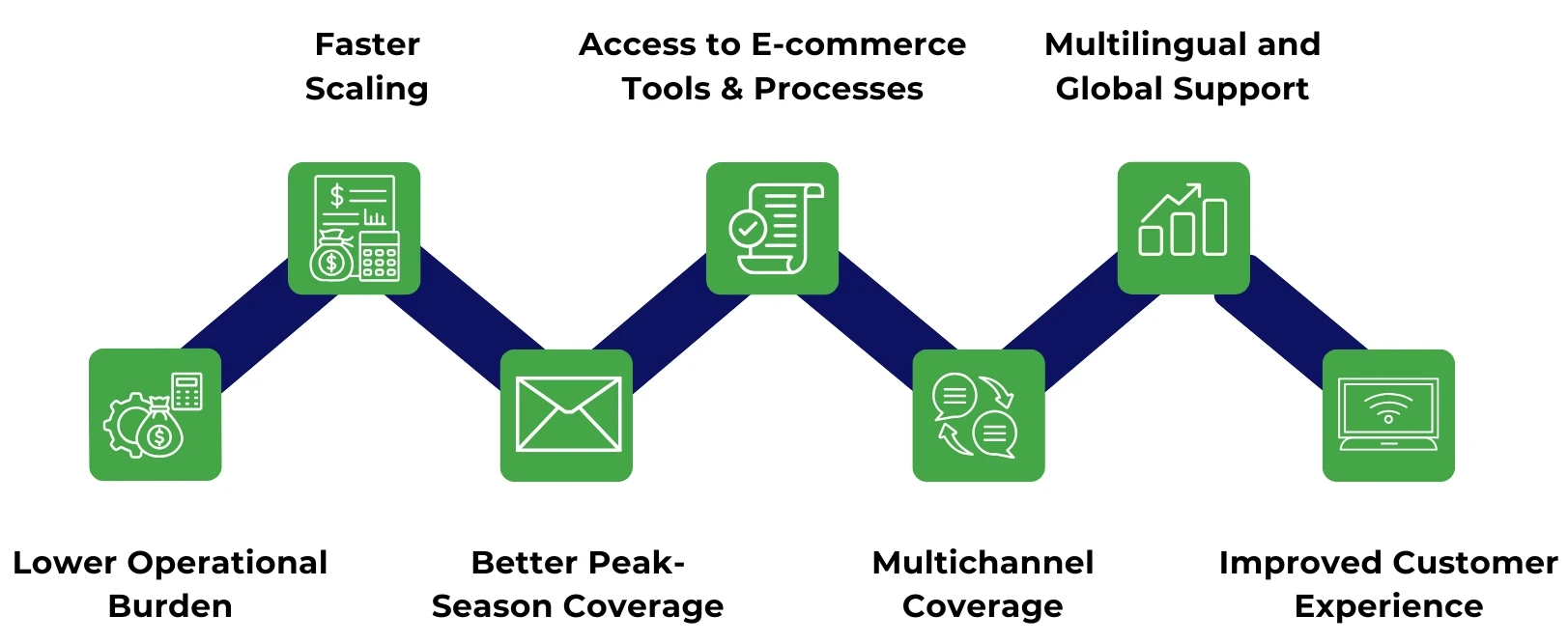
Lower Operational Burden
Outsourcing removes routine support pressure from internal teams, allowing them to focus on higher-value work: product, marketing, merchandising, fulfillment, growth strategy, and retention. Instead of spending the day clearing tickets, the core team can use customer insights to improve the business.
Faster Scaling
Hiring, training, and managing an internal support team takes time. Outsourced teams can often add trained agents faster, especially when the brand already has documented workflows, clear policies, and a mature helpdesk setup.
Better Peak-Season Coverage
Peak season creates a short-term support problem with long-term consequences. If response times collapse during Black Friday, holidays, or major launches, the damage can show up in refunds, reviews, and repeat purchase rates. Outsourcing helps brands prepare for surges without having to carry excess staff year-round.
Access to E-commerce Tools and Processes
Many e-commerce outsourcing providers already work within help desks, macros, workflows, QA scorecards, reporting dashboards, returns tools, and order platforms. That experience shortens the learning curve and brings process discipline to support operations that may have grown informally.
Multichannel Coverage
Customers do not think in channels. They expect the brand to respond wherever the conversation starts. Outsourced teams can help manage email, chat, phone, SMS, social media, and marketplace messages without forcing the internal team to monitor every queue manually.
Multilingual and Global Support
International sales create international service expectations. Multilingual support helps brands serve customers across regions, reduce language friction, and support global buyers without building separate in-house teams for every market.
Improved Customer Experience When Done Well
Outsourcing is not automatically better. It works when agents are trained, connected to the right systems, measured against quality standards, and managed as part of the brand experience.
What are the Risks and Challenges of Outsourcing E-commerce Support?
Outsourcing risks include brand voice gaps, weak training, data exposure, poor escalations, hidden costs, and overused automation.
Loss of Brand Voice
Customers should feel they are speaking with the brand, not a generic support desk.
To avoid this, give agents:
- A brand voice guide
- Approved macros
- Product training
The goal is not scripted replies. It is a consistent, brand-aligned judgment.
Inconsistent Product Knowledge
Poor product knowledge leads to wrong answers, extra returns, and unnecessary escalations.
This matters most for categories like apparel, beauty, skincare, supplements, electronics, furniture, subscriptions, and high-ticket products.
Agents need more than FAQs. They need product context, policy training, and live updates when products, promotions, or fulfillment rules change.
Data Privacy and Security Concerns
Outsourced agents may access customer names, addresses, order histories, payment-related details, and internal systems.
Vendor requirements should include:
- Role-based access
- NDAs
- Data processing agreements
- Secure systems
- Access logs
Security should be built into the support model before launch.
Poor Escalation Processes
Some issues should never stay with frontline agents.
Clear escalation paths are needed for:
- Angry customers
- Refund exceptions
- Chargebacks
- VIP customers
- Fraud concerns
Without escalation rules, agents either delay resolution or make decisions beyond their authority.
Hidden Costs
The quoted rate may not include everything.
Brands should check for setup fees, training fees, weekend coverage, phone support, multilingual support, QA reporting, management fees, software seats, and overage charges.
Cost clarity matters because e-commerce demand can spike quickly.
Over-Reliance on Scripts or AI
Scripts and AI help speed things up, but they fail when judgment is required.
Automation works best for FAQs, routing, summaries, and simple order updates. Human agents should handle emotional complaints, exceptions, high-value customers, and complex product issues.
The safest model is hybrid: AI for efficiency, humans for nuance.
When should an E-commerce Business Outsource Customer Support?
E-commerce brands should outsource when ticket volume, coverage needs, or service quality demands exceed internal capacity.
Signs You Are Ready to Outsource
Outsourcing makes sense when support starts slowing down the business.
Common signs include:
- Your team is missing response-time targets.
- Tickets are increasing faster than revenue.
- Founders or managers still handle routine tickets.
- Customers complain about slow replies.
- Nights, weekends, or holidays are uncovered.
- A launch, campaign, or peak season is coming.
- You need multilingual support.
- You are expanding into new markets.
- Your in-house team is burned out.
- Reporting and QA are inconsistent.
The clearest signal is when support becomes reactive. If the team spends all day catching up, it has no time to improve the customer experience.
When You Should Not Outsource Yet
Outsourcing will not fix a support operation without structure.
It may be too early if your policies are undocumented, your product changes daily, your answers still require founder-level judgment, or your team has no helpdesk and order-management process.
It is also risky if you cannot define success metrics or are not ready to train the partner.
A support vendor can improve execution. It cannot repair broken fulfillment, unclear policies, poor product quality, or a weak customer promise.
Hybrid Model: What to Keep In-House vs. Outsource
Most e-commerce brands do not need to outsource everything at once.
A staged model is safer.
Outsource repeatable work first:
- Tier 1 FAQs
- Order tracking
- Returns initiation
- Basic product questions
- Chat coverage
- Weekend coverage
Keep sensitive work in-house:
- VIP customers
- Product defects
- Brand-sensitive complaints
- Fraud concerns
- Complex technical issues
- Policy exceptions
- Retention or win-back conversations
This gives the outsourced team clear ownership while keeping strategic, high-risk, and brand-sensitive decisions close to the business.
What are the Main E-commerce Customer Support Outsourcing Models?
Common outsourcing models include dedicated agents, shared agents, managed teams, staff augmentation, and AI-assisted support.
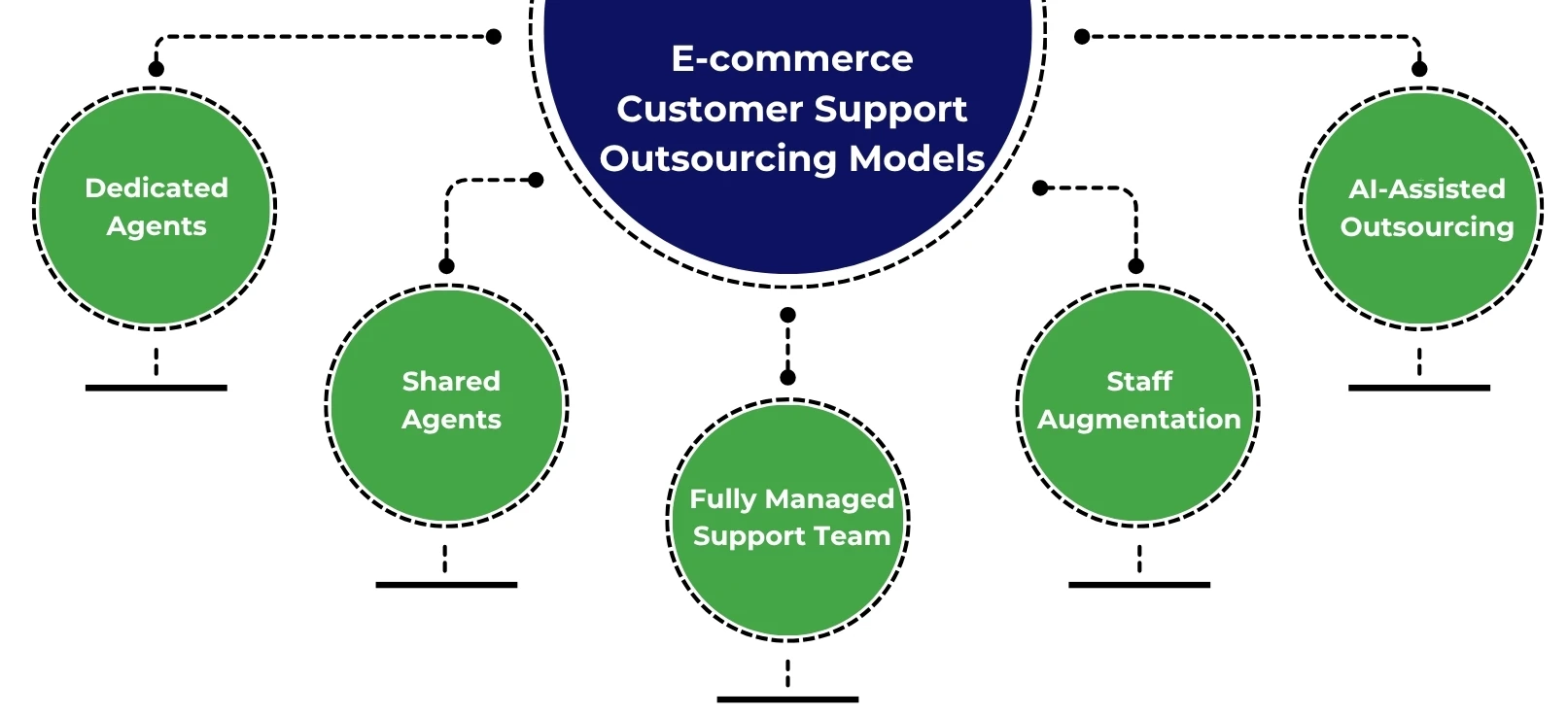
Dedicated Agents
Dedicated agents work only for your brand. This model is best for ecommerce businesses with higher ticket volume, complex products, strong brand voice requirements, or active scaling plans.
The advantage is depth. Dedicated agents learn your products, policies, tone, customers, and edge cases over time. Quality is usually more consistent.
Shared Agents
Shared agents support multiple brands. This model works well for smaller ecommerce stores, low ticket volume, inconsistent demand, or early-stage outsourcing.
The advantage is flexibility and lower cost.
Fully Managed Support Team
A fully managed model gives the vendor responsibility for agents, team leads, QA, scheduling, reporting, and process improvement.
This is best for brands that want a hands-off or semi-managed support function.
It works when the brand needs operational ownership, not just extra agents.
Staff Augmentation
Staff augmentation means the provider supplies agents, but your internal team manages the process.
This is best for brands with an existing CX lead, support manager, or operations owner.
The brand keeps control of workflows, coaching, priorities, and performance. The provider supports capacity.
AI-Assisted Outsourcing
AI-assisted outsourcing combines human agents with tools for suggested replies, ticket routing, sentiment detection, conversation summaries, order lookup, and self-service automation.
This is becoming the modern standard.
AI improves speed and structure. Human agents still handle judgment, empathy, exceptions, and customer trust.
How much does E-commerce Customer Support Outsourcing Cost?
Costs vary by pricing model, agent location, support channels, coverage hours, ticket complexity, and service management.
Common Pricing Models
E-commerce support outsourcing is usually priced by the hour, by ticket, by agent, by dedicated team, on a pay-as-you-go basis, with a hybrid structure, or for seasonal surge coverage.
Hourly or pay-as-you-go works for variable volume. Dedicated pricing fits steady demand. Surge pricing helps during launches, holidays, and peak campaigns.
Factors That Affect Cost
The main cost drivers are agent location, email/chat/phone/social mix, coverage hours, ticket complexity, languages, tools, training, QA, reporting, management layer, and seasonal volume.
More complexity means more cost. Simple order tracking is easier to outsource than technical support, refund exceptions, or high-value customer complaints.
In-House vs. Outsourced Cost Comparison
| Cost Area | In-House Team | Outsourced Team |
|---|---|---|
| Recruiting | Brand handles | Vendor handles |
| Training | Brand handles | Shared responsibility |
| Management | Internal CX lead | Vendor or hybrid |
| Tools | Brand pays | Brand or vendor pays |
| Scaling | Slower | Faster |
| Peak coverage | Temporary hiring | Easier to flex |
| Brand control | Higher | Needs process and QA |
How to Estimate ROI
Use this formula:
ROI = cost savings + retained revenue + conversion impact + reduced management burden – outsourcing cost
Track cost per ticket, first response time, resolution time, CSAT, repeat purchase rate, refund rate, escalation rate, agent utilization, and revenue from pre-sale chat.
How do You Choose the Right E-commerce Customer Support Outsourcing Partner?
Choose a partner with ecommerce experience, channel coverage, tool fluency, QA discipline, security controls, and brand fit.
1. Look for E-commerce-Specific Experience
Do not evaluate the partner as a generic call center. E-commerce support has its own systems, urgency, and revenue impact.
Look for experience with platforms such as Shopify, Shopify Plus, BigCommerce, WooCommerce, Magento/Adobe Commerce, Amazon, Walmart Marketplace, Etsy, and eBay.
The right partner should understand orders, returns, promotions, marketplaces, fulfillment delays, and customer retention.
2. Check Channel Capabilities
Your partner should support the channels your customers actually use.
That may include email, live chat, phone, SMS, social DMs, marketplace messages, WhatsApp, reviews, and community channels.
Channel coverage is not enough. The partner should also preserve context when customers move from one channel to another.
3. Evaluate Tool Experience
Tool fluency affects speed. Look for experience with e-commerce and CX platforms such as Gorgias, Zendesk, Freshdesk, Intercom, Kustomer, Help Scout, Shopify, Loop Returns, Recharge, Klaviyo, Yotpo, Okendo, ShipStation, AfterShip, and Narvar.
A partner that already knows your stack can onboard faster and make fewer operational mistakes.
4. Review Training and Onboarding Process
Ask how the provider learns your products, policies, customer personas, and brand tone.
A strong onboarding process should include SOPs, macros, knowledge base updates, product training, ticket simulations, and a plan for training new agents as the team scales.
Also, ask how they handle product launches, policy changes, and promotion updates.
5. Ask About QA and Performance Management
Quality should be managed, not assumed.
Look for ticket audits, call reviews, CSAT tracking, coaching, reports, calibration sessions, and escalation reviews.
The partner should show how they improve performance after launch, not only how they staff the account.
6. Confirm Security and Compliance
E-commerce support involves access to customer data and internal systems.
Ask about data access controls, password management, two-factor authentication, NDAs, compliance policies, secure remote-work practices, and incident response.
A serious partner will treat security as part of the operating model.
7. Check Cultural and Brand Fit
The partner should understand your tone, customer expectations, and brand personality.
This matters most when support touches lifestyle, luxury, wellness, fashion, beauty, subscriptions, or high-value products. The wrong tone can make even a correct answer feel off-brand.
8. Ask for E-commerce References or Case Studies
References should come from brands with similar product categories, ticket volume, average order value, markets, or support channels.
A relevant case study tells you more than a generic promise. Look for proof of scale, quality, response-time improvement, retention impact, or successful peak-season support.
What are the Questions to Ask Before Hiring an E-commerce Support Outsourcing Company?
- Have you worked with e-commerce brands in our category?
- Which e-commerce platforms and helpdesks do your agents know?
- Do you offer dedicated or shared agents?
- What hours and time zones can you cover?
- Can you support peak seasons?
- How do you train agents on our products and policies?
- How do you maintain brand voice?
- What KPIs do you report on?
- How do you handle refunds, exchanges, and exceptions?
What is your escalation process?
- What security controls do you use?
- What are your pricing models?
- Are there setup, training, or software fees?
- Can we start with a pilot?
- How often will we meet to review performance?
How do You Outsource E-commerce Customer Support Step by Step?
Start by auditing support, choosing repeatable tasks, documenting workflows, training agents, running a pilot, then scaling.
Step 1: Audit Your Current Support Operation
Start with the numbers. Document monthly ticket volume, ticket categories, response times, resolution times, CSAT, refund and return volume, top complaints, channel split, and peak days or hours.
This shows what is actually driving support load before you hand work to a partner.
Step 2: Decide What to Outsource First
Start with repeatable tasks before moving into complex work.
Good first workflows include:
- Order status
- Returns
- FAQs
- Shipping questions
- Basic chat
These tasks are easier to train, measure, and improve during the first phase.
Step 3: Create SOPs and Macros
Your partner needs clear rules before they need more tickets.
Prepare SOPs for refund policy, return policy, shipping policy, warranty policy, discount code rules, escalation matrix, tone-of-voice guidelines, and product FAQs.
Macros should speed up replies, not replace judgment.
Step 4: Choose the Right Support Model
Select the model that fits your volume and control needs.
Dedicated agents work better for complexity and brand voice. Shared agents fit lower volume. Managed teams reduce internal workload. Staff augmentation keeps control in-house. Hybrid models combine flexibility with oversight.
Step 5: Integrate Tools and Permissions
Give agents enough access to resolve issues, but not more than they need.
Set up helpdesk access, ecommerce platform access, order-management permissions, returns tools, CRM, knowledge base, and an internal communication channel.
Use role-based permissions from day one.
Step 6: Train Agents
Training should cover the brand, customers, products, policies, tone, and common edge cases.
Use ticket simulations, voice examples, product walkthroughs, and real support scenarios. Agents should know not only what to say, but when to escalate.
Step 7: Run a Pilot
Start with a limited scope for 30 to 60 days.
Track first response time, resolution time, CSAT, escalation accuracy, QA score, customer complaints, and internal team feedback.
A pilot helps test quality before expanding volume.
Step 8: Review, Optimize, and Scale
Use reporting to improve the operation.
Look for product issues, fulfillment gaps, confusing policies, FAQ weaknesses, automation opportunities, and training gaps.
Then scale what works instead of expanding a process that has not been proven.
Which E-commerce Customer Support KPIs should You Track After Outsourcing?
Track speed, resolution, customer satisfaction, revenue impact, retention, QA, policy accuracy, and brand voice consistency.
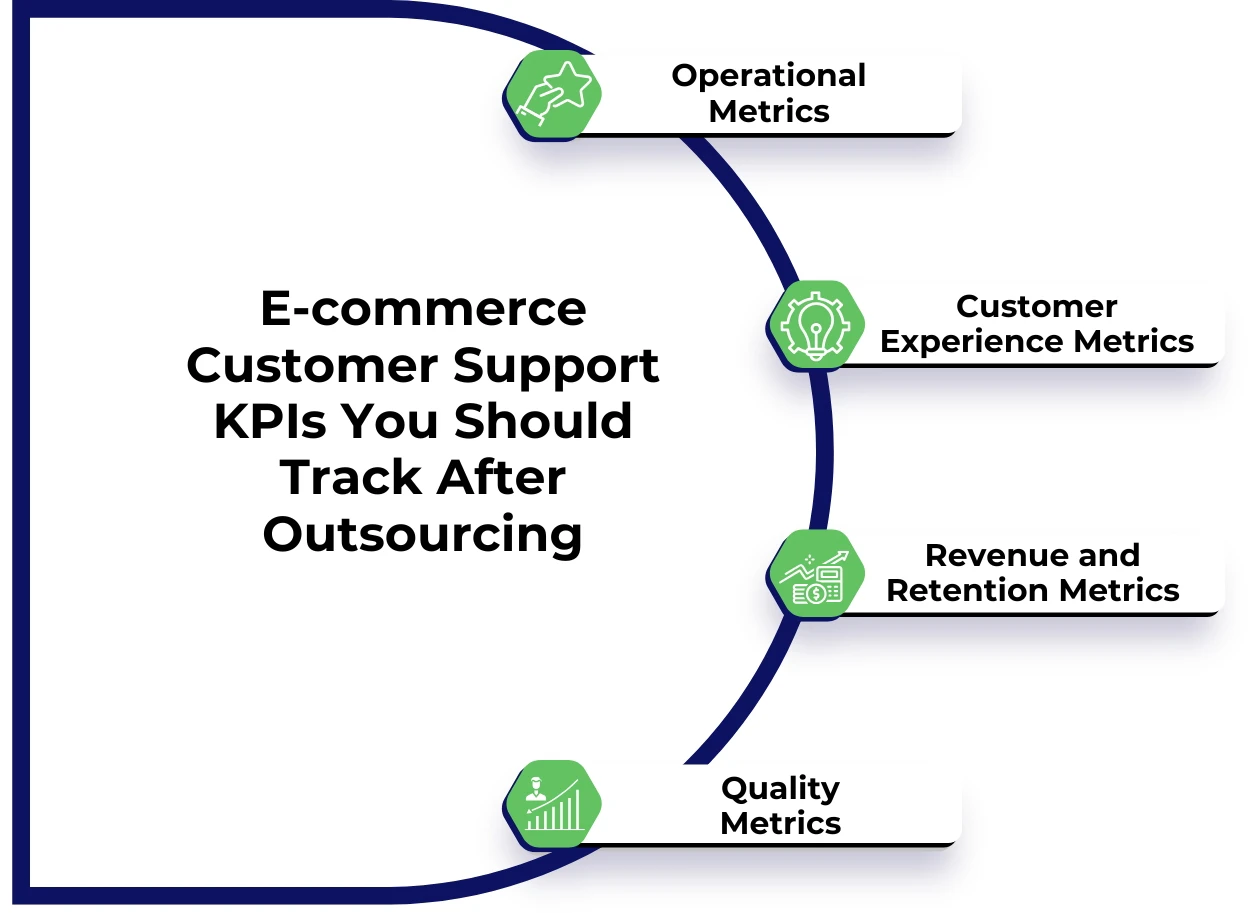
Operational Metrics
Operational KPIs show whether the outsourced team is keeping pace with demand.
Track first response time, average resolution time, ticket backlog, tickets per order, tickets per agent, reopen rate, escalation rate, and SLA compliance.
Customer Experience Metrics
CX metrics show how customers feel about the support experience.
Track CSAT, NPS, customer effort score, sentiment, review ratings, and complaint rate. Speed matters, but it is not enough. A fast wrong answer still damages trust.
Revenue and Retention Metrics
Support should be connected to commercial outcomes.
Track repeat purchase rate, customer lifetime value, live chat conversion rate, refund rate, return rate, revenue saved through retention offers, and subscription churn reduction.
These KPIs show whether support is only closing tickets or actually protecting revenue.
Quality Metrics
Quality metrics show whether agents are resolving issues correctly and in the right voice.
Track QA score, macro accuracy, policy compliance, brand voice consistency, and product knowledge accuracy.
What are the Best Practices for E-commerce Customer Support Outsourcing?
Best practices include clear documentation, focused scope, hybrid AI use, weekly reviews, agent context, and ticket-led improvement.
Build a Knowledge Base Before You Outsource
A support partner is only as strong as the information behind them.
Build a knowledge base that covers:
- Product details
- Shipping rules
- Return and refund policies
- Discount code guidelines
This reduces guesswork and keeps answers consistent across agents, shifts, and channels.
Start With a Clear Scope
Do not outsource everything on day one unless your support operation is already mature.
Start with repeatable workflows such as order tracking, returns, FAQs, shipping questions, or basic chat. Once quality is stable, expand into more complex areas.
Clear scope prevents confusion, over-escalation, and poor first impressions.
Use AI for Speed, But Keep Humans for Judgment
AI is useful for repetitive support work.
Use it for:
- FAQs
- Ticket routing
- Order tracking
- Conversation summaries
- Self-service flows
Keep human agents on issues that need emotion, judgment, exceptions, or revenue protection. The strongest model is AI-assisted, not AI-only.
Maintain Weekly Communication
Weekly reviews keep the partner aligned with current business priorities.
Review:
- Ticket trends
- QA issues
- Customer complaints
- Product changes
Support teams perform better when they know what is changing before customers start asking about it.
Give Agents Context, Not Just Scripts
Scripts create consistency. Context creates better decisions.
Agents should understand why customers buy, what the brand stands for, which issues affect loyalty, when to be flexible, and when to escalate.
That is what turns outsourced support from ticket handling into brand-aligned customer care.
Prepare for Peak Season Early
Peak season should be planned before the queue starts rising.
Finalize staffing, promo rules, shipping cutoff dates, return policy updates, escalation ownership, saved replies, temporary macros, and weekend coverage.
Late planning creates a backlog. Early planning protects revenue.
Continuously Improve Based on Ticket Data
Support tickets show where the customer journey is breaking.
Use ticket data to improve:
- Product pages
- Sizing guides
- Shipping pages
- Return policies
- FAQ pages
The best support teams do more than close tickets. They show the business what to fix next.
How is AI Changing E-commerce Support Outsourcing?
AI is making outsourced support faster through automation, routing, summaries, and agent assistance, while humans handle judgment.
AI Is Becoming a Standard Part of Support Operations
AI is now part of the e-commerce support workflow, not a future add-on.
It is commonly used for automated answers, ticket classification, sentiment analysis, suggested replies, translation, summarization, knowledge base recommendations, and workflow automation.
Why Human Agents Still Matter
AI can move fast, but it does not always read the moment.
Human agents remain critical for angry customers, refund exceptions, high-value buyers, complex product issues, sensitive complaints, brand reputation risks, and loyalty conversations.
These are not just tickets. They are judgment calls.
What to Ask Vendors About AI
- Before using AI in outsourced support, ask:
- Is AI customer-facing, or is it only used to assist agents?
- Can we approve AI-generated macros?
- How do you prevent incorrect answers?
- How is customer data protected?
- Can AI escalate to a human automatically?
- Who owns the conversation data?
- How do you measure AI accuracy?
The right model is not AI replacing support. It is AI making trained agents faster, better informed, and more consistent.
What Common Mistakes should E-commerce Brands Avoid When Outsourcing Support?
Avoid outsourcing without SOPs, choosing only on price, limiting access, skipping brand training, and ignoring quality data.
Outsourcing Without SOPs
- The mistake: Handing tickets to agents without documented policies, workflows, or escalation rules.
- Why it hurts: Agents guess, customers get inconsistent answers, and simple issues turn into escalations.
Choosing the Cheapest Vendor
- The mistake: Selecting a partner based only on the lowest rate.
- Why it hurts: Poor support can create refunds, bad reviews, chargebacks, churn, and more internal cleanup.
Giving Agents Too Little Access
- The mistake: Restricting agents so tightly that they cannot check orders, process basic requests, or verify customer details.
- Why it hurts: Every simple issue becomes a delay, transfer, or follow-up ticket.
Failing to Train on Brand Voice
- The mistake: Giving agents policies but not tone, personality, or customer context.
- Why it hurts: This weakens the experience, especially for lifestyle, beauty, fashion, luxury, wellness, and premium brands.
Not Tracking Quality
- The mistake: Measuring only speed or ticket volume.
- Why it hurts: Fast replies mean little if answers are inaccurate, off-brand, cold, or non-compliant.
Ignoring Customer Feedback
- The mistake: Treating outsourced support as a ticket-closing function only.
- Why it hurts: Support data can reveal product gaps, confusing policies, fulfillment issues, website friction, and retention risks.
What should be on Your E-commerce Customer Support Outsourcing Checklist?
Your checklist should cover support audit, policies, KPIs, vendor selection, onboarding, QA, security, and post-launch optimization.
Before You Outsource
Use this stage to make the operation ready, not perfect.
- Audit ticket volume.
- Identify top contact reasons.
- Document support policies.
- Create approved macros.
- Build or update the knowledge base.
- Define KPIs.
- Choose support channels.
- Decide coverage hours.
- Set escalation rules.
- Select the support model.
- Review security requirements.
- Prepare training materials.
The cleaner the setup, the faster the partner can perform.
During Vendor Selection
Use vendor selection to test fit, not just pricing.
- Review e-commerce experience.
- Ask for relevant references.
- Compare pricing models.
- Review the onboarding plan.
- Confirm the QA process.
- Test communication quality.
- Ask about peak-season staffing.
- Review contract terms.
- A strong partner should explain how they will manage quality, not only how many agents they can provide.
After Launch
Launch is the start of optimization.
- Monitor KPIs weekly.
- Audit tickets.
- Update SOPs.
- Review escalations.
- Collect customer feedback.
- Improve macros.
- Share product and promotion updates.
- Scale gradually.
The best results come when the brand and partner keep improving the system together.
Is E-commerce Customer Support Outsourcing Right for Your Business?
Outsourcing is right if support demand exceeds internal capacity and you have clear processes, KPIs, and partner oversight.
E-commerce support outsourcing is a good fit when growth is putting service pressure on your internal team that it cannot absorb.
It may be the right move if:
- You are growing quickly.
- Response times are slipping.
- Your team is overwhelmed.
- You need 24/7 or multilingual coverage.
- Support is adding operational complexity.
- Your policies and workflows are documented.
- You are ready to manage the partner strategically.
It may not be the right move yet if your support process is undocumented, ticket volume is very low, or every customer issue still requires founder-level judgment.
Outsourcing also will not solve the wrong problem. If complaints are caused by fulfillment delays, product defects, unclear policies, or poor inventory management, those issues need to be fixed at the source.
The best time to outsource is when the business has enough structure to train a partner and enough demand to benefit from added capacity.
Frequently Asked Questions (FAQs)
Conclusion
E-commerce customer support outsourcing can help online brands scale faster, extend coverage, reduce internal pressure, and deliver quicker customer experiences.
But the outcome depends on execution.
The right partner should understand e-commerce systems, customer urgency, brand voice, data security, QA, reporting, and peak-season pressure. The brand should establish clear policies, provide strong training, define KPIs, and maintain regular oversight.
Outsourcing works best when it is treated as a customer experience function, not just a ticket-clearing function.
If your team is spending more time reacting to support queues than improving the customer journey, outsourcing may be the next step. Start by auditing your current volume, identifying repeatable tasks, and choosing a partner that understands ecommerce operations, not just generic customer service.