

In 2026, the barrier to innovation isn’t budget or intent.
It’s bandwidth.
Your Managed Services Partner (MSP) might not be in the boardroom, but they directly impact how much your team can execute, how fast you can deliver, and how far your strategy can scale.
Mid-market leaders have their digital agendas set. The strategies are sound. The targets are clear. Yet the engineers expected to execute are buried not in strategic complexity but in operational noise.
Escalations. Patches. Platform upkeep.
This is not a resource problem. It is a design problem.
In our last brief, we challenged the legacy MSP model and reframed it as a growth engine.
Now we turn to execution: the operational architecture required to restore innovation capacity, liberate internal teams, and turn strategic intent into sustained momentum.
The Foundational Insight: The Maintenance Trap
Your top engineers weren’t hired to manage tickets.
But in too many mid-market firms, that’s exactly what they spend their time doing, trapped in a cycle of IT maintenance that your Managed Services Partner (MSP) should be handling.
Instead of building competitive advantage, they administer CRMs. They oversee contact center updates. They respond to the same escalations, week after week, month after month.
Essential work. Just not theirs.
The greatest drag on transformation in 2026 is not a lack of ideas. It is the silent erosion of engineering capacity by work that should have been externalized years ago.
Enlightened Architecture: Partner-Led Operations, Internal-Led Innovation
Escaping the maintenance trap isn’t just about reducing workload; it’s about redesigning ownership.
Mid-market leaders are now structuring partnerships so operational precision is externalized, freeing internal teams to focus on value creation.
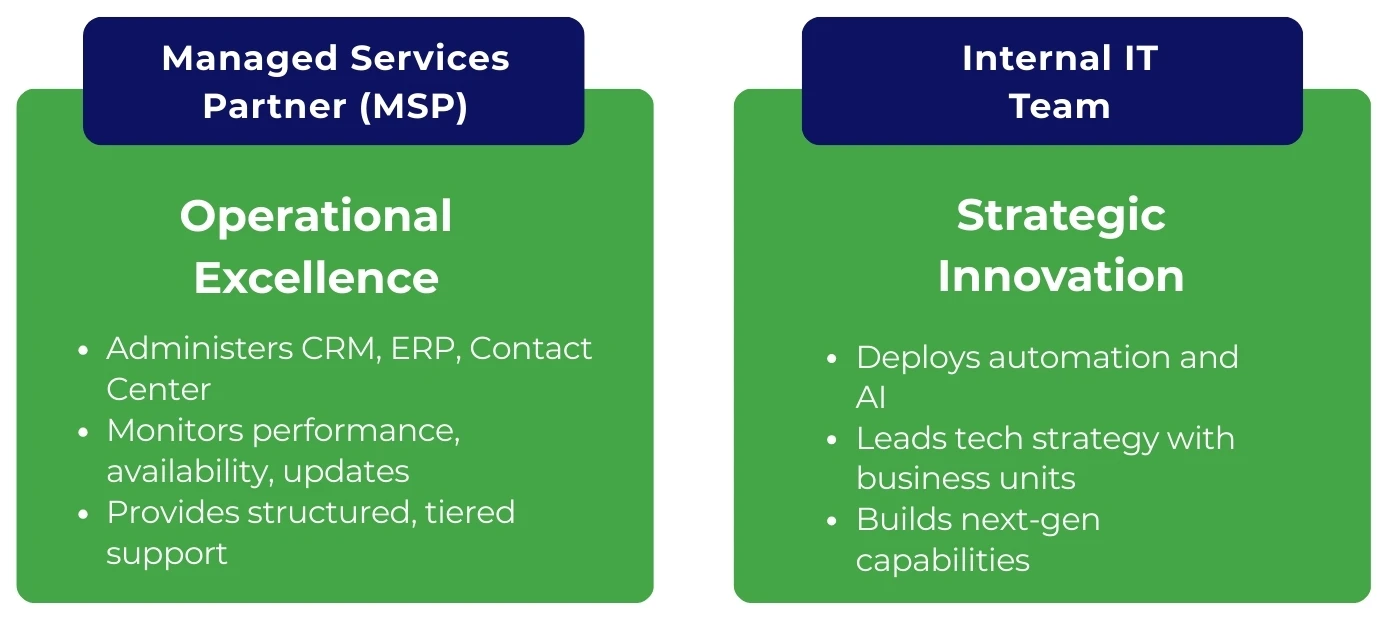
The Partner’s Mandate (Operational Excellence)
The managed services partner assumes ownership of the critical backbone:
- Platform administration: CRM, ERP, contact center
- Proactive monitoring: performance, availability, updates
- Tiered support: consistent, disciplined, audit-ready
This is not outsourcing. It is an operational specialization. The systems run without friction. The business moves without interruption.
Your Team’s Liberated Mandate (Strategic Innovation)
Freed from daily maintenance, internal teams reclaim their original mandate:
- Deploying automation and AI across workflows
- Collaborating with business units on technology strategy
- Building capabilities, not just keeping them running
Your top engineers become forward-deployed strategists. They stop fighting yesterday’s fires and start architecting tomorrow’s advantage.
Velocity is not effort. It is architecture.
The Disciplined Progression: The Three Phases of Transformation
Strategic transformation doesn’t happen in a sprint.
It’s built through deliberate, disciplined progression designed not to disrupt, but to de-risk.
Here’s how the most effective mid-market CIOs are reshaping their MSP relationships:
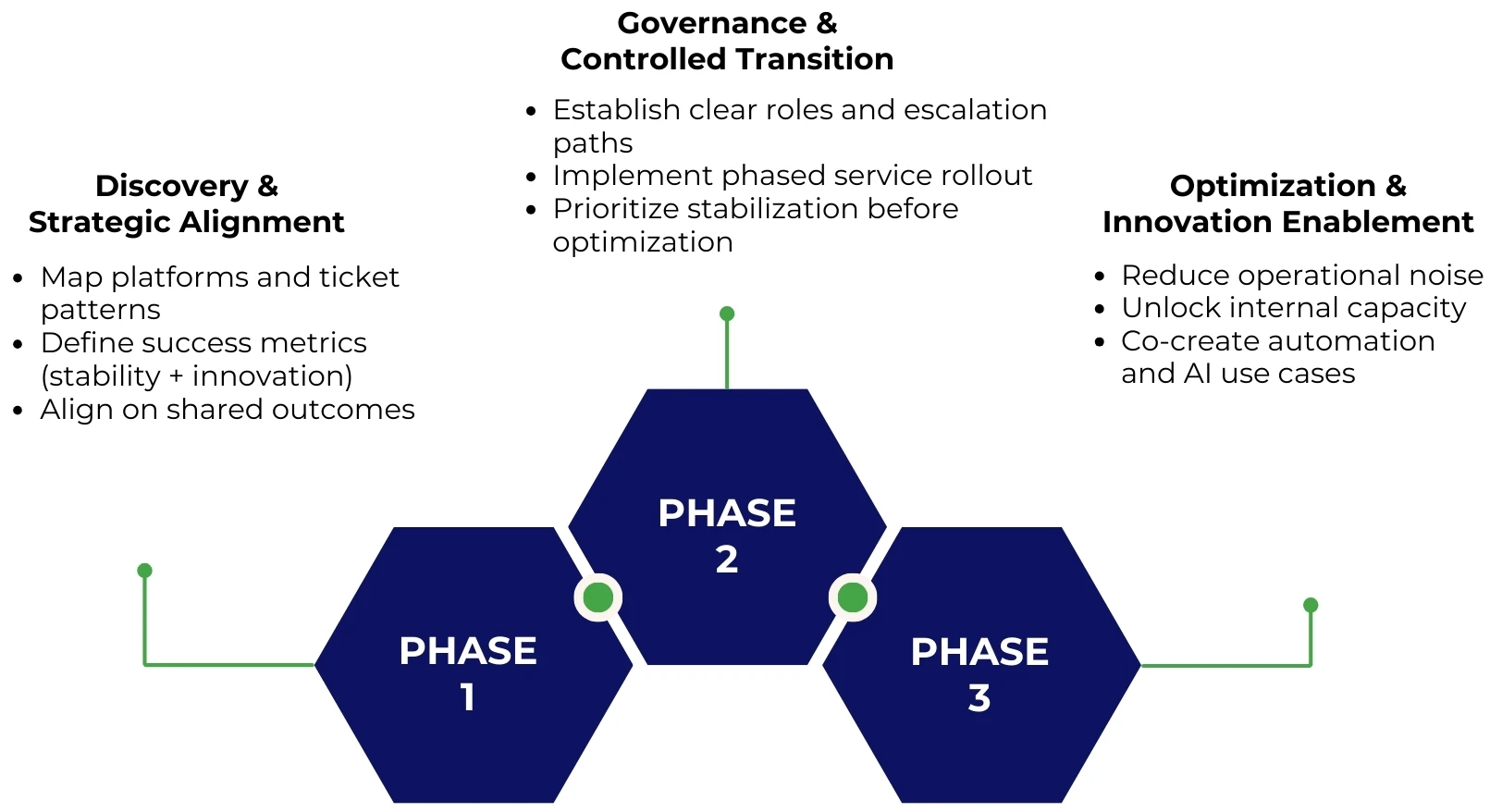
Phase 1: Discovery & Strategic Alignment
Every breakthrough starts with clarity.
This stage establishes a shared understanding of your systems, support patterns, and pain points, so success is defined not just by uptime, but by capacity reclaimed.
- Core platforms mapped. Ticket drivers diagnosed.
- Stability thresholds defined. Innovation benchmarks set.
- A mutual definition of what “good” looks like for both sides.
Phase 2: Governance & Controlled Transition
Trust is built through structure, not promises.
This phase introduces governance that preserves control even as operational ownership shifts. Delivery begins in a controlled rollout. Disruption is designed out. Early wins establish rhythm and confidence.
- Role clarity. Escalation protocols. Access controls.
- Phased transition. Stabilization first, optimization second.
Phase 3: Optimization & Innovation Enablement
With foundations secure, the model matures from delivery to velocity.
The partner drives continuous improvement. The internal team reclaims its innovation charter. Together, they reduce noise, unlock capacity, and co-develop strategic use cases for automation and AI.
This is not the end of the transformation. It is the beginning of momentum.
The Measure of True Success: Innovation Capacity Restored
Ticket closures aren’t a transformation metric.
The most forward-looking IT leaders in 2026 are measuring something else entirely:
How much internal time has been reallocated to strategic initiatives?
Because when your top engineers move from escalation queues to high-impact work:
- AI pilots launch faster
- Automations go deeper
- Strategic projects stop stalling
This is the ROI of a strategically designed MSP partnership.
From Maintenance Trap to Momentum Engine
Turning IT into a growth engine does not begin with new software. It begins by reclaiming control of your team’s focus.
That shift demands more than a service provider. It requires a partner with the operational acumen to structure the transition, scale with discipline, and remain aligned with your strategy—not for a quarter, but for the long arc of your growth.
This is what we built Premier NX to do.
Let’s explore what Phase 1: Strategic Discovery could unlock for your business.