

Key Takeaways
- 1Finance operating models can drift out of sync as the business changes.
- 2The right model may combine internal ownership, shared services, automation, and external delivery.
- 3Process problems should be traced across connected workflows before adding capacity.
- 4The goal is to align governance, execution, and scale with how the business operates today.
Finance operating models often become misaligned by accumulation, not by design. An acquisition adds entities. An ERP migration changes workflows. Growth increases transaction volume. A new team, automation, shared service, or external provider is added to relieve immediate pressure.
Each decision may be reasonable. Together, they can leave Finance with overlapping ownership, inconsistent process rules, fragmented handoffs, and execution that no longer reflects how the business operates.
For CFOs, the useful question is not “in-house or outsourced?” It is: which parts of Finance should be owned internally, which should be centralized, which activities should be automated, and where external execution can add value without weakening governance?
Finance Operating Model Complexity
In-house Finance, shared services, automation, and outsourcing are often discussed as if they were competing models. They are not equivalent choices.
In-house versus external delivery addresses who performs work. Shared services address how work is centralized and standardized. Automation changes how specific activities are executed. None of those choices, by itself, determines who owns policy, controls, approvals, risk, or financial accountability.
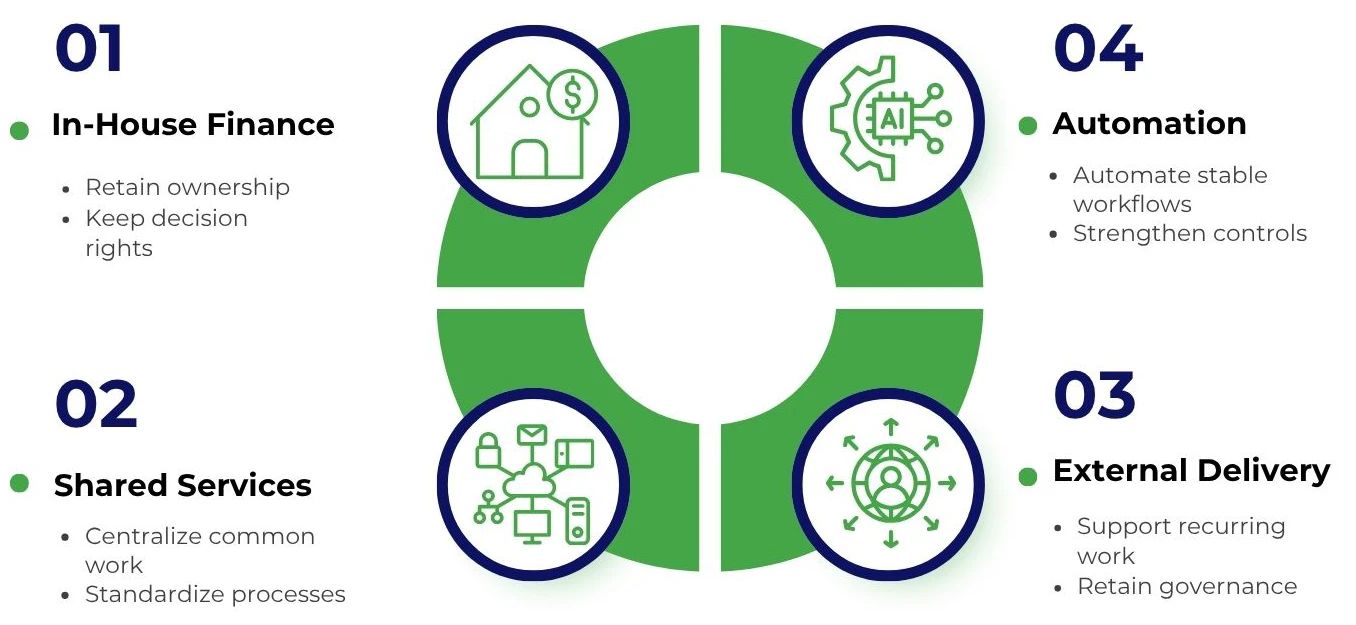
A finance function can therefore combine all four approaches: retain finance leadership, policy, and business partnering internally; centralize common transactional processes; automate stable workflow steps; and use an external team for selected recurring execution.
Drivers of Finance Operating Model Change
Finance operating models are often tested during periods of structural change. Common inflection points include:
- Acquisitions, roll-ups, and multi-entity growth: Can introduce process variation, duplicated work, and more complex reconciliations and reporting.
- ERP migrations: Often expose inconsistent workflows, unclear ownership, and legacy workarounds.
- Carve-outs: May require finance capabilities, controls, and processes to be rebuilt independently.
- Rapid growth: Can strain handoffs, close cycles, reporting, and operational capacity.
These events do not automatically favor in-house expansion, shared services, automation, or external delivery. They signal that Finance should reassess how it is organized and executed before adding more capacity.
Finance Delivery Choices in Context
The goal is not to select one approach for all of Finance, but to apply each where it fits the operating need.
Build flexibility into Finance delivery
In-House Finance – Where Internal Ownership Matters
Responsibilities involving material judgment, business context, policy, risk, and executive decision-making typically remain closely owned by Finance, including:
- finance leadership and business partnering,
- governance and decision rights,
- planning and performance oversight,
- risk and policy ownership.
But ownership and execution are different decisions. Finance can retain policy, approvals, controls, and accountability without performing every supporting activity internally.
Shared Services – When Centralization Creates Leverage
Shared services can create leverage where similar work is repeated across entities, business units, or locations and can be governed through common processes.
But centralization and standardization are not the same thing. If different entities follow inconsistent approval paths, reconciliation practices, data requirements, or process rules, moving that work into one shared-services environment simply brings the variation together.
Automation – Improve the Process, Not Just the Task
The useful question is not only what Finance can automate, but what is defined well enough to automate.
Technology can reduce repetitive effort, but it does not resolve unclear ownership, weak handoffs, inconsistent data, or poorly designed processes. Automating an inefficient process may speed up individual tasks while preserving the end-to-end problem.
Automation can also shift rather than eliminate control requirements, increasing the importance of data quality, workflow rules, exception handling, and monitoring.
When External Delivery Makes Operational Sense
External delivery is less compelling where the underlying process remains unstable, highly judgment-dependent, or poorly governed; moving unresolved friction externally may simply relocate the problem.
Finance leadership can retain governance and decision rights while selected execution is supported externally.
Process Handoffs and Hidden Friction
Finance processes are interconnected, and weaknesses in one area often surface somewhere else.
- Poor transaction quality increases reconciliation effort.
- Delayed reconciliations slow the close.
- Inconsistent invoice handling creates downstream exceptions.
- Fragmented data reduces reporting visibility.
The implication is important: you shouldn’t always solve a problem where it becomes visible. CFOs need to identify where friction is actually being created before changing ownership, technology, or delivery.
Aligning the Finance Operating Structure
A deliberate finance structure should make three things explicit:
- Keep decision rights with Finance. Policy, controls, approvals, and performance accountability can remain internal even when execution is centralized, automated, or supported externally.
- Design around connected processes. AP, reconciliations, close, and reporting should not be optimized independently if performance depends on the handoffs between them.
- Use each delivery approach for a distinct purpose. Internal teams provide context and judgment; shared services create consistency; automation removes repetitive effort; external delivery can provide sustained execution across selected processes.
For mid-market organizations where external delivery forms part of the operating structure, Premier NX supports selected Finance Operations through dedicated resources, quality assurance, reporting, and continuous improvement aligned to client requirements.
Finance Delivery That Fits the Business
No single delivery model defines the modern finance function. What matters is how well ownership, execution, technology, and control align with business needs.
If external delivery may play a role in your current finance structure, Premier NX can discuss which Finance Operations are best suited for external support.