


What is Customer Experience (CX)
Customer Experience (CX) refers to the perception a client forms through every interaction with a business. It is embedded across the customer journey, encompassing pre-sale engagement, the purchasing process, service delivery, ongoing support, and long-term relationship management. These moments, digital or human, proactive or reactive, collectively shape how a brand is experienced and evaluated.
Unlike customer service, which is typically reactive and limited to resolving issues, CX is strategic and continuous. It reflects a company’s ability to anticipate needs, simplify complexity, and deliver value consistently across all touchpoints.
A 2024 Forrester report shows a decline in overall CX quality—underscoring the need for strategic CX alignment.
The strength of a customer relationship often hinges on more than product performance or pricing. It’s influenced by how well the business understands evolving client expectations, responds to challenges, and integrates solutions that make the experience seamless and efficient.
To develop an effective customer experience strategy, organizations must consider not only what they deliver but how they deliver it. This includes aligning systems, teams, and processes to ensure consistency and responsiveness. Well-executed CX efforts enhance loyalty, increase retention, and generate measurable customer experience benefits over time.
Why CX Should Be at the Core of Your Business Strategy
Exceptional customer experience is no longer optional, it’s a competitive necessity. As markets become more saturated and buyers more informed, companies are under pressure to differentiate through value, not just price or product features. CX directly influences customer retention, drives revenue growth, and strengthens long-term loyalty.
A well-executed customer experience strategy doesn’t just deliver smoother transactions; it fosters trust, accelerates onboarding, and positions the business as a reliable partner throughout the lifecycle.
Consider this scenario: A mid-sized software company is evaluating two IT infrastructure providers. Both offer similar pricing, capabilities, and contract terms. However, while one sends generic brochures and quotes, the other delivers a customized onboarding simulation, assigns a dedicated solutions specialist, and integrates a digital walk-through using the client’s actual architecture. That level of tailored engagement simplifies decision-making and demonstrates commitment, clarity, and customer focus before the contract is even signed.
This distinction between standard service and strategic experience can determine who wins the account and who’s forgotten. It’s why leading organizations are rethinking their customer experience strategies to focus on long-term value, using data, automation, and omnichannel platforms to deliver consistent experiences at scale.
In digital-first markets, expectations evolve rapidly. Clients demand seamless, personalized, and value-driven interactions. Businesses that align their platforms, people, and processes accordingly are positioned to lead.
What is the Customer Journey in CX?
The customer journey is the complete sequence of client interactions with your business—from initial discovery to ongoing service and renewal. Mapping this journey allows businesses to understand where value is delivered, where friction occurs, and how to improve customer experience at each stage.
Key Stages of the Customer Journey
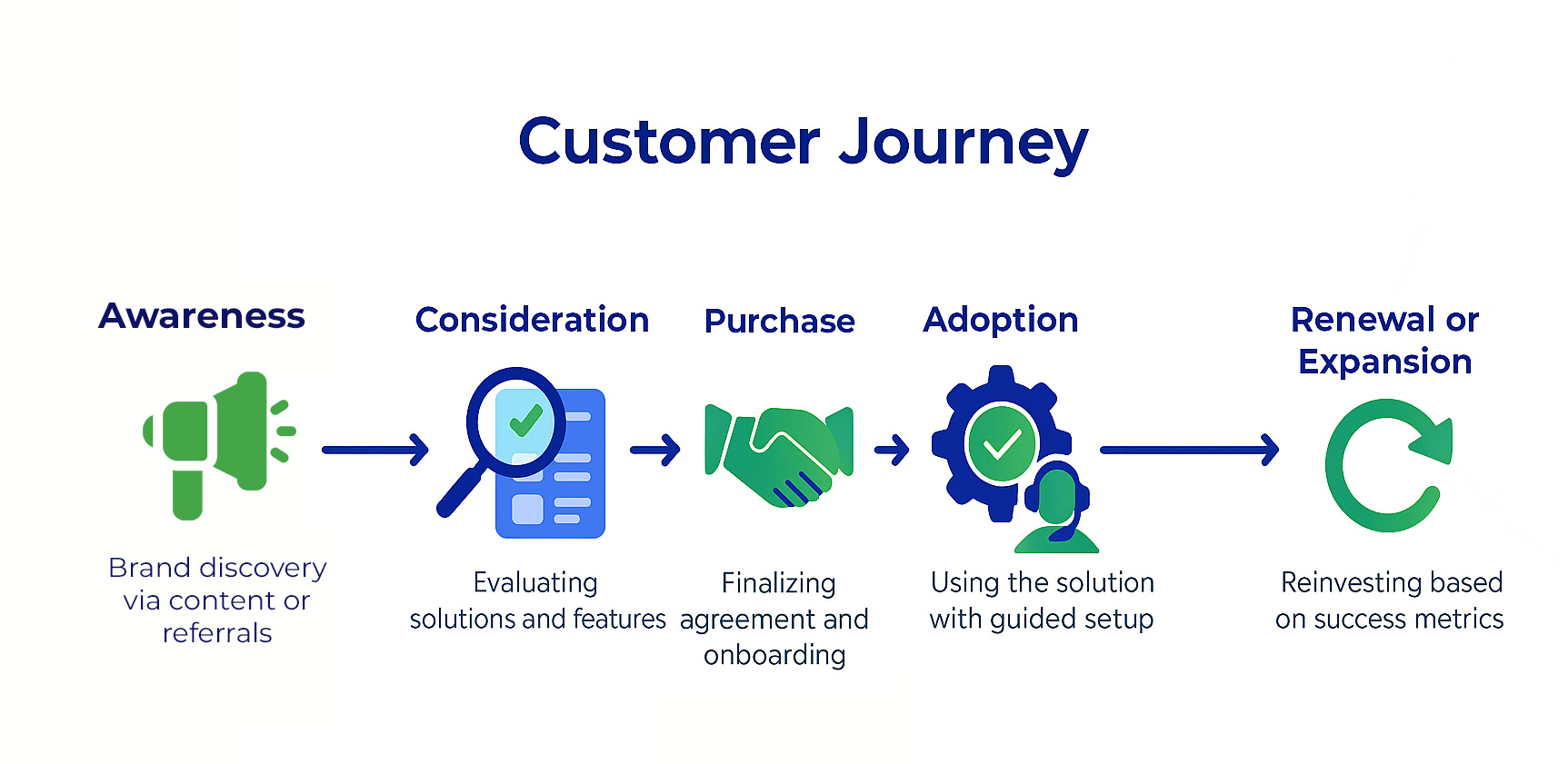
- Awareness: Initial brand exposure through marketing, referrals, or industry content
- Consideration: Engagement with sales materials, demos, proposals, and comparison tools
- Purchase: Transactional phase involving contracts, onboarding, and provisioning
- Adoption: Clients begin using the service or solution; onboarding and training play a critical role
- Support & Value Realization: Timely support isn’t just reactive—component disruptions like product recalls or quality issues must be resolved quickly with product recall guidance in hand.
- Renewal or Expansion: Re-engagement based on performance reviews, success metrics, and future needs
Why Journey Mapping Matters
- Reveals pain points, drop-off areas, and inconsistent experiences
- Supports internal alignment by connecting marketing, sales, delivery, and service
- Enables efficient customer experience management by providing a visual framework for accountability
- Forms the foundation for implementing customer experience best practices
Optimizing the Journey
- Use integrated software platforms to track interactions and surface insights
- Apply AI-driven tools to anticipate client needs and automate repetitive processes
- Conduct periodic reviews of the journey using client feedback and internal data
- Align cross-functional teams through consulting-led workshops and journey design sprints
Understanding and refining the customer journey is essential for delivering consistent value, improving satisfaction, and building long-term relationships. It becomes one of the most strategic levers for enhancing overall CX when executed well.
How Does a Modern CX Ecosystem Drive Business Success?
To deliver consistent, high-value customer experiences, businesses must go beyond traditional customer service models and build a fully integrated CX ecosystem. This includes internal teams, external partners, technology platforms, and service delivery models—all working in coordination.
In modern enterprises, CX orchestration has replaced CX ownership. Organizations are managing direct interactions and aligning third-party providers, digital platforms, and automation layers that influence the customer’s perception.
Key Components of a High-Performance CX Ecosystem
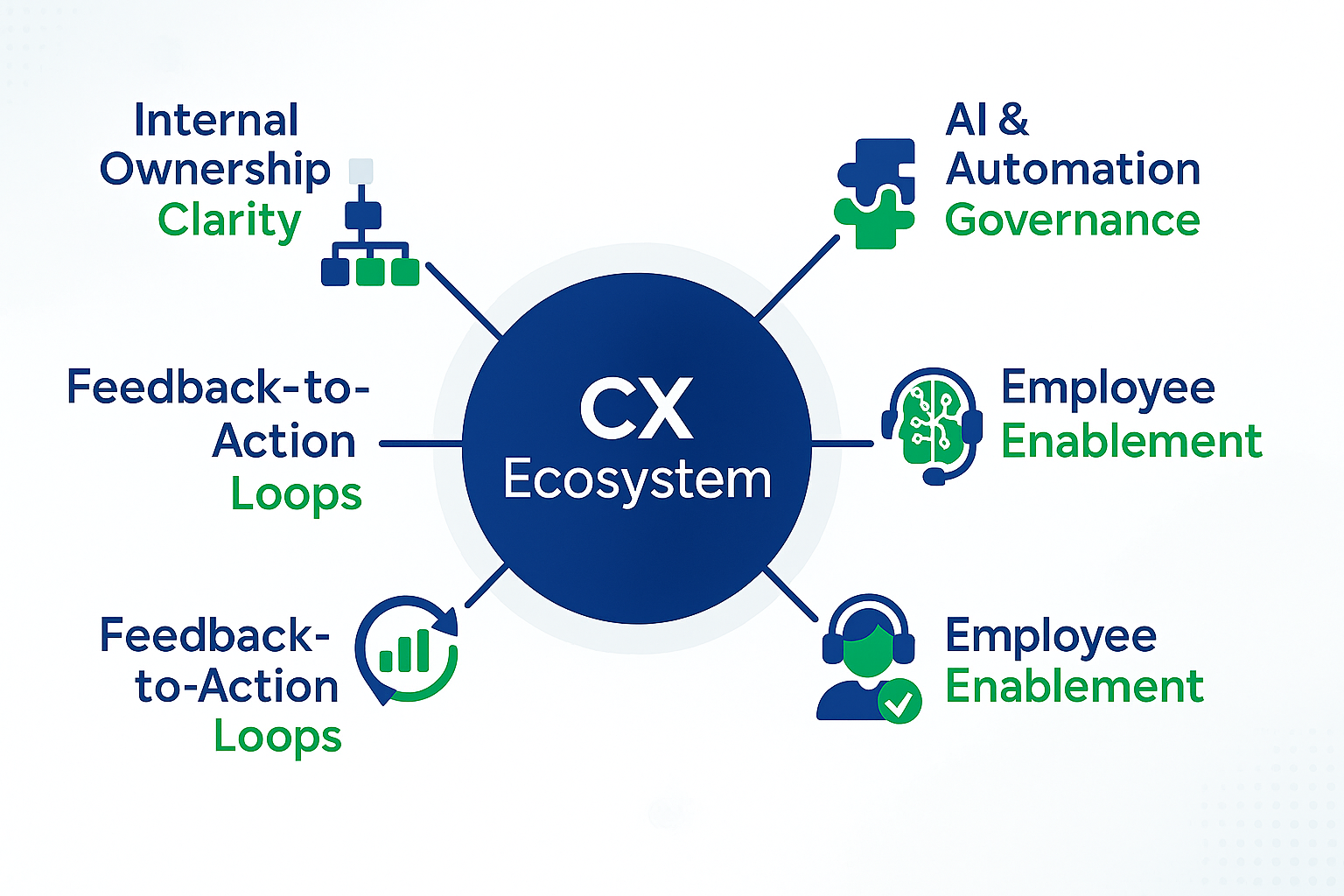
- Internal ownership clarity: Define who is responsible for each touchpoint—sales, onboarding, support, success, or product.
- Partner integration: Collaborate with outsourcing and consulting partners who influence parts of the customer journey.
- AI & automation governance: Ensure that technology platforms used for CX are aligned with experience goals, not just efficiency targets. When CX tools prioritize automation without human-in-the-loop design, it can lead to fragmented, impersonal experiences—undermining customer trust and satisfaction
- Employee enablement: Equip front-line teams with tools, training, and authority to resolve issues and personalize interactions.
- Feedback-to-action loops: Implement systems for continuous improvement based on internal metrics and client feedback.
As disruptions reshape priorities, businesses must build adaptable, insight-driven CX ecosystems that scale intelligently without compromising quality or brand promise.
Who Owns the Customer Experience?
In high-performing organizations, customer experience is not confined to a single department—it is an integrated responsibility shared across the enterprise. Companies with tightly aligned CX and operational teams see up to 30% higher customer lifetime value than those with siloed structures.2
While marketing, sales, and support teams are on the front lines, every function influences how clients perceive and interact with the brand. A fragmented approach leads to inconsistent experiences. Unified CX leadership, however, builds loyalty, improves retention, and drives revenue.
Functional Accountability Across the Enterprise
- CEO & Strategy Office: Set the vision, tie CX to growth metrics, and sponsor cross-functional alignment.
- Marketing: Shape expectations, deliver personalized engagement, and ensure the brand promise is consistently upheld.
- Sales: Act as advisors, not just sellers—by responding to needs with relevance and speed, they model what makes great customer experience.
- Customer Support & Service Agents: Humanize the brand and close the loop on satisfaction. Empowering these teams with insights and autonomy is essential.
- Product Teams: Use feedback loops to create intuitive, high-impact solutions that meet evolving demands.
- Technology & IT: Ensure scalability and speed across CX platforms, including integrations with AI, self-service tools, and analytics.
- Operations & Delivery: Balance efficiency with empathy—streamlining back-end processes to enhance front-end experience.
CX Leadership is an Enterprise Mandate
Today’s consumer experience trends demand more agility, personalization, and consistency than ever. Clients expect brands to not only understand their needs but anticipate them. And that responsibility can’t rest on a single function. It must be embedded into how companies hire, train, evaluate, and innovate.
By asking, “What does customer experience mean to you?” leaders across departments can begin to realign around a shared goal: delivering value that is felt, remembered, and measured. That’s what good customer experience looks like.
How to Deliver Great Customer Experience – Best Practices and Examples
What Makes a Great Customer Experience?
Companies prioritizing CX are 60% more profitable than competitors that don’t, driven largely by consistency and personalization.3
- Personalized, relevant, and timely interactions—tailoring communication and resources based on client context.
- Consistency across channels and stages, ensuring a seamless perception from awareness through renewal.
- Proactive support and issue resolution, detecting and addressing potential hurdles before clients report them.
- Seamless transitions between internal teams, avoiding delays and friction when clients move from sales to onboarding to support.
- Empowered agents with decision-making capability, giving frontline teams the authority and CX tools to resolve requests immediately.
CX Best Practices to Apply Across the Journey
Use this phase-based guide to enhance customer experience and operational excellence:
- Awareness: Craft unified brand messaging and targeted, value-based content—supported by digital platforms and analytics.
- Consideration: Enable sales teams with interactive tools, personalized demos, virtual consultations, and comparative insights.
- Purchase: Streamline contracting and provisioning processes with clear communications, intake automation, and onboarding readiness.
- Adoption: Deploy self-service portals, proactive training modules, and feedback-enabled workflows to accelerate value realization.
- Support: Maintain fast issue resolution via CX support teams empowered with knowledge bases and decision-making autonomy.
- Renewal: Conduct outcome-based reviews, development of expansion opportunities, and consultative renewal processes.
What Are the Top Customer Experience Trends in 2025?
As businesses aim to stay ahead, several consumer experience trends are reshaping how customer experience is delivered and perceived. Here’s what modern organizations are prioritizing:
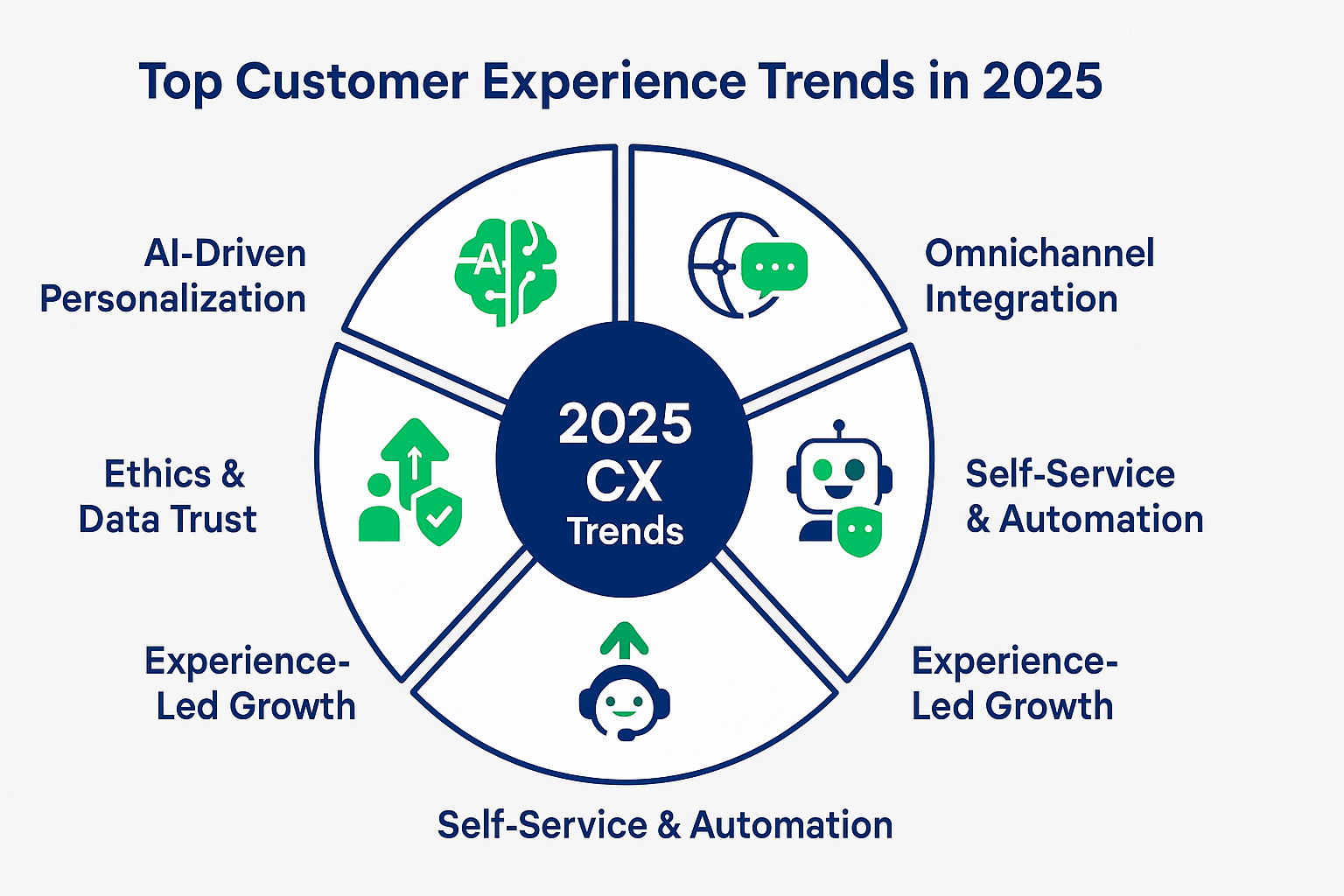
Companies across industries are embedding AI into CX platforms and tools. A 2024 survey shows that 84% of B2B sales marketers report that AI enhances interactions—boosting relevance and speed.4 Whether it’s account prioritization engines or intelligent recommendations, AI now drives tailored, proactive outreach—a hallmark of what makes a great customer experience.
Emotion AI enables businesses to understand customer sentiments in real time, allowing for adaptive, emotionally intelligent experiences.
Omnichannel Integration
Becomes Standard
Modern clients expect a unified experience across every channel. B2B buyers now interact with suppliers through ten or more channels, up from 5 in 2016.5 Companies delivering seamless omnichannel journeys maintain an 89% customer retention rate, compared to just 33% for those with weaker integration.6
Self-Service and Automation Take Center Stage
Self-service is now table stakes. 91% of B2B buyers favor self-service tools over speaking with sales or support.7 Efficient knowledge bases and AI-powered chatbots not only reduce friction but also elevate customer experience best practices in post-purchase stages.
Experience-Led Growth Mindset
CX is no longer a support function—it’s a strategic business lever. Firms that embed experience-led growth—aligning tools, people, and data across lifecycle stages—are gaining share by enhancing onboarding, retention, and advocacy.
Ethics & Trust in the Data-Driven CX Stack
With AI playing a bigger role, data privacy and ethical use are non-negotiable. Clients—and regulators—expect clarity about how their data is gathered, stored, and leveraged.
Why CX Outsourcing Is Essential for Modern Enterprises
Customer experience outsourcing isn’t merely a cost-saving measure—it’s a strategic lever for growth, innovation, and competitive differentiation. The global customer experience BPO market was valued at approximately US $103.6 billion in 2024 and is projected to reach US $309.3 billion by 2034, with an 11.6% CAGR.8 This surge reflects businesses’ increasing reliance on specialized partners to expand and optimize experience functions.
Here are five advanced benefits of CX outsourcing:
Outcome-Based Service Models
Modern outsourcing partners move beyond cost-saving to deliver against outcome-oriented commitments—such as improving NPS, accelerating onboarding time, or increasing renewal rates—rather than merely reducing tickets.
Co-Innovation with CX Specialists
Leading providers offer more than agents—they bring consulting expertise, reusable CX accelerators, journey design services, and cross-industry insights to help you evolve without reinventing the wheel.
Embedded AI & Automation
Outsourcers typically come with mature CX platforms incorporating AI-driven chatbots, predictive analytics, and self-service automation. This means faster deployment and fewer internal dependencies, accelerating maturity in improving customer experience through technology.
Global, Omnichannel, 24/7 Coverage
Enterprise-grade outsourcing enables support across languages, time zones, and channels—phone, social, email, and chat support—ensuring a consistent experience.
Secure, Compliant, and Scalable Infrastructure
CX partners bring enterprise-grade security protocols and compliance capabilities, which are critical for sectors like finance and healthcare. They also enable rapid scale-up or down during global expansions or market shifts.
Premier NX – The Right Strategic Partner for CX Outsourcing
For businesses navigating complex customer landscapes, having the right partner to co-design and execute scalable, personalized, and technology-enabled CX programs is essential. At Premier NX, we deliver tailored customer experience solutions grounded in strategy, backed by expertise, and built to evolve with your needs.
Premier’s Core CX Offerings
Customer Support & Service Operations
Omnichannel support solutions that integrate with your existing platforms, ensuring fast, consistent, and high-quality customer resolutions.
CX Strategy & Optimization
Experience design and strategic consulting to align touchpoints with growth goals—driven by data, CX best practices, and measurable KPIs.
Retention, Loyalty & Engagement Programs
Relationship-focused initiatives that use behavioral insights to improve loyalty, reduce churn, and elevate long-term customer value.
Digital & Social Engagement Management
Integrated digital CX strategies that ensure brand presence, responsiveness, and alignment across online and social channels.
How Premier Delivers
Human-in-the-Loop (HITL) Integration
- Combining automation with human insight for smarter, empathetic, and context-aware interactions.
Premier Sync Partnership Model
- A framework that aligns talent acquisition, onboarding, and operational execution with shared business goals—enabling true client-vendor collaboration.
Strategic Global Delivery Network
- Locations in the USA, Canada, China, Pakistan, and the Philippines provide geographic diversity, cost optimization, and operational resilience.
24/7 Multilingual Support Capability
- Around-the-clock service delivery with bilingual support ensures consistency, accessibility, and responsiveness for global customer bases.
Ready to Redefine Your Customer Experience?
Whether you’re building your first CX strategy or scaling an enterprise-wide transformation, the path to long-term customer loyalty starts with intentional, insight-driven experiences. At Premier NX, we combine operational expertise with digital innovation to help you deliver exceptional journeys—at every touchpoint.
Let’s build CX that delivers real business impact.
Connect with our specialists to explore solutions tailored to your goals.