


Key Takeaways
- 1Omnichannel CX fails when channels are managed separately from the customer journey.
- 2Support, digital engagement, and automation must connect to retention and trust.
- 3Reporting should reveal customer intelligence, not just operational activity.
- 4The right CX partner improves outcomes while preserving visibility and control.
Omnichannel CX outsourcing red flags are operating model weaknesses that prevent customer experience programs from delivering consistent, measurable outcomes across channels.
They typically appear when providers focus on managing interactions rather than improving customer journeys, retention, customer intelligence, and long-term CX performance.
For mid-market companies, these issues do more than weaken customer experience. They reduce visibility, limit scalability, increase customer effort, and make it harder for leadership teams to improve loyalty, retention, and business outcomes through CX.
What Is an Effective Omnichannel CX Strategy?
A strong omnichannel customer experience strategy connects every customer interaction into a unified journey. Customer context, engagement history, sentiment, and support activity should move seamlessly across voice, chat, email, social, and self-service channels.
If that foundation is missing, the following red flags often appear.
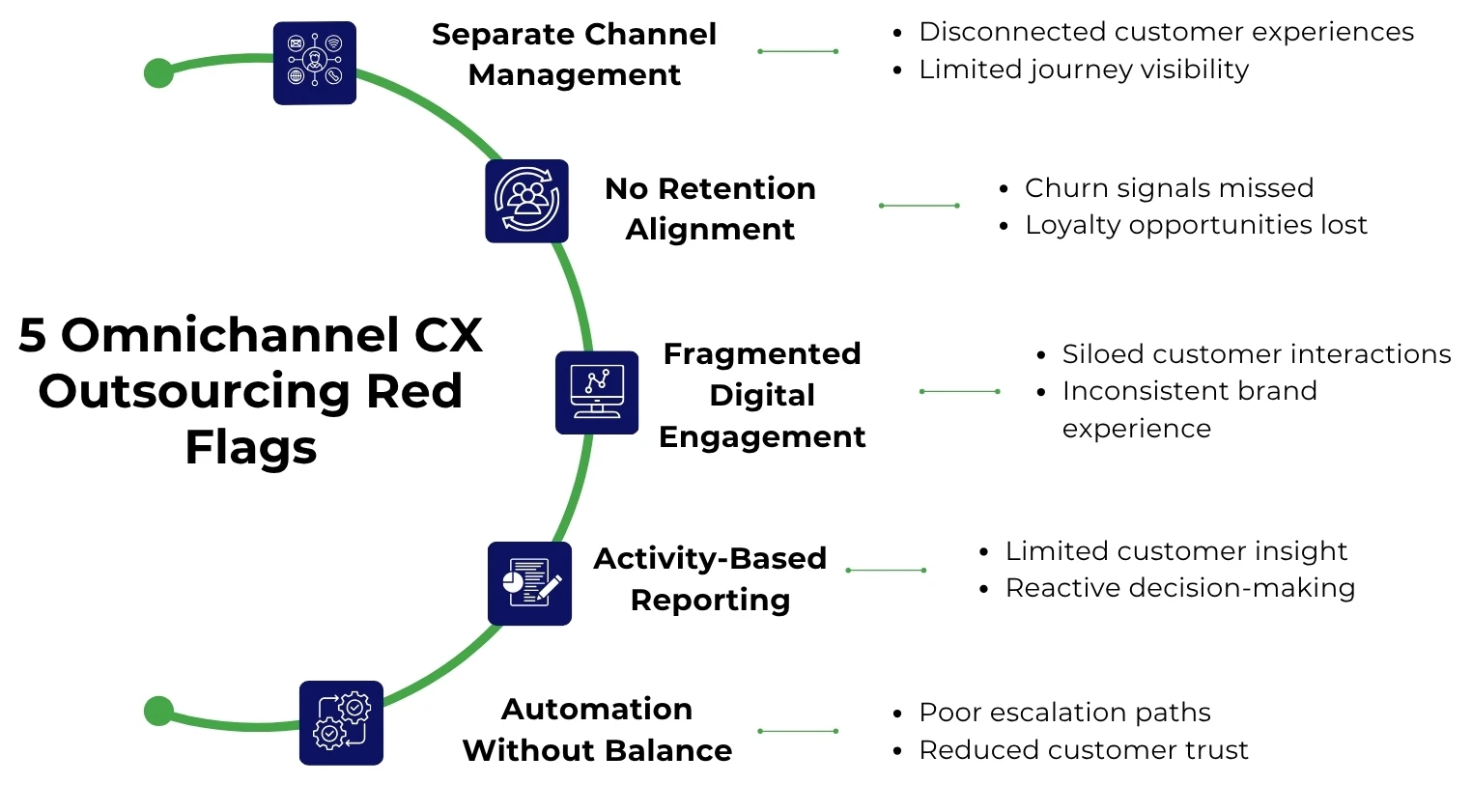
Five omnichannel CX outsourcing red flags that can limit customer experience performance.
1. Customer Journeys Are Managed as Separate Channels
Omnichannel CX breaks down when each channel is managed as an isolated service line instead of one connected customer journey.
Customers may move from chat to email, voice, social, or self-service during the same issue. If context does not move with them, the experience becomes repetitive, inconsistent, and harder to resolve.
Business impact: Higher customer effort, weaker journey visibility, slower resolution, and less consistent brand experience across channels.
2. Customer Support Is Not Connected to Retention Outcomes
Omnichannel CX loses strategic value when support interactions are treated only as service events instead of signals for retention, loyalty, and customer growth.
Repeat complaints, unresolved friction, cancellation intent, and negative sentiment often appear first inside support conversations. If those signals are not captured and acted on, brands miss opportunities to protect customer relationships.
Business impact: Preventable churn, missed loyalty opportunities, weaker customer lifetime value, and a support model that remains reactive instead of relationship-driven.
3. Digital and Social Engagement Operate Outside the Customer Experience Strategy
An omnichannel CX strategy becomes fragmented when digital and social engagement channels operate independently from customer support, retention, and customer experience initiatives.
Customer sentiment, service issues, and engagement signals increasingly surface through social platforms, reviews, messaging channels, and online communities.
Business impact: Incomplete customer visibility, inconsistent engagement experiences, weaker sentiment management, and missed opportunities to strengthen customer relationships.
4. Reporting Focuses on Activity Instead of Customer Intelligence
Omnichannel CX reporting becomes limited when performance is measured primarily through operational activity rather than customer behavior, experience trends, and business outcomes.
Metrics such as ticket volume, handle time, and response speed show what happened, but not why it happened.
Business impact: Reduced visibility into customer needs, slower decision-making, missed improvement opportunities, and a customer experience strategy that becomes increasingly reactive.
5. Automation is Not Balanced With Human Support
Omnichannel CX programs become vulnerable when automation is deployed primarily to reduce effort without preserving the human judgment required for complex customer interactions.
Automation can improve speed, consistency, and scalability, but customer journeys still contain moments that require context, empathy, and decision-making. Effective CX programs use automation to support agents, not replace customer understanding.
Business impact: Escalation friction, lower customer satisfaction, reduced trust, and customer experiences that feel efficient but impersonal.
What Should Brands Look for Instead?
The strongest omnichannel CX partners do more than manage customer interactions. They connect support, retention, engagement, insights, and optimization into a unified customer experience strategy.
| Capability | Why It Matters |
|---|---|
| Journey-Centric CX Operations | Creates consistent customer experiences across channels. |
| Retention and Loyalty Alignment | Turns customer interactions into relationship-building opportunities. |
| Unified Digital Engagement | Connects customer conversations across support, social, and digital channels. |
| Customer Intelligence and Insights | Improves visibility into customer behavior, friction points, and experience trends. |
| Human-in-the-Loop Automation | Balances efficiency with empathy, judgment, and customer trust. |
Premier NX helps organizations build omnichannel CX programs that connect customer support, retention, digital engagement, and customer intelligence into a more unified customer experience strategy.
Omnichannel CX Should Improve Outcomes, Not Just Coverage
The biggest omnichannel CX risk is believing channel availability equals customer experience maturity. The strongest programs connect customer journeys, retention strategies, engagement channels, and customer intelligence into one operating model.
Ready to identify hidden CX gaps before they affect loyalty and revenue? Schedule a complimentary CX Readiness Assessment with Premier NX.