


Key Takeaways
- 1Operational responsiveness helps CPG brands move from isolated reactions to coordinated enterprise action.
- 2Fragmented data, unclear ownership, and limited execution readiness can create costly delays.
- 3Connected intelligence, flexible capacity, and coordinated execution enable faster, more confident response.
- 4Building responsiveness before disruption can protect revenue, preserve margins, and strengthen consumer and retailer trust.
CPG brands have traditionally competed through product innovation, distribution strength, brand recognition, and scale. Today, many of those advantages are becoming easier for competitors to replicate.
What is harder to copy is the ability to recognize change early, understand its implications, and coordinate an effective response.
Operational responsiveness is the ability to identify a meaningful signal, evaluate its business impact, make a decision, and mobilize action before a manageable issue becomes a costly one.
For mid-market CPG brands, this capability can create an advantage that larger competitors cannot automatically buy: faster decisions, stronger coordination, and more adaptable operations.
Why Operational Responsiveness Matters for CPG Brands
Change can begin with a single signal.
A product complaint spikes after a promotion. A retailer reports an unexpected inventory issue. Social sentiment begins to shift. Customer inquiries suddenly increase. A supplier delay threatens product availability.
The signal may appear in one channel, but its impact rarely stays there.
A customer complaint may point to a product-quality concern. A stock issue may affect retailer relationships, customer support volumes, sales forecasts, and brand reputation. A sudden increase in order questions may reveal a wider fulfillment problem.
When information, decisions, and execution are disconnected, teams lose valuable time trying to understand what happened, who owns the response, and what should happen next.
That is the gap operational responsiveness is designed to close.
What is Operational Responsiveness in CPG?
Operational responsiveness is a CPG company’s ability to detect meaningful change, assess the potential business impact, align the appropriate teams, and execute a coordinated response.
The goal is to act before an issue damages:
- Revenue
- Profit margins
- Product availability
- Retailer relationships
- Regulatory compliance
- Consumer trust
- Brand reputation
Operational responsiveness is broader than response time.
Response time measures how quickly one task, ticket, or customer interaction is handled. Operational responsiveness measures how quickly the broader organization can understand and address an issue.
That may require coordination across customer experience, supply chain, quality, operations, sales, analytics, finance, and retail account teams.
A responsive organization can quickly answer four questions:
- What changed?
- Why does it matter?
- Who has the authority to act?
- How quickly can the response be executed?
Adding more agents, building another dashboard, or automating a single workflow may improve one function. However, those investments do not create enterprise-wide responsiveness unless they are connected.
The Hidden Cost of Operational Fragmentation
Most CPG companies do not suffer from a lack of data, expertise, or effort.
The real challenge is often fragmentation.
Consumer feedback may be stored separately from retailer data. Inventory information may not reach the teams handling customer inquiries. Quality teams may identify an issue before commercial teams understand its potential impact. External partners may be working with less context than internal teams.
Even when individual departments are operating efficiently, the organization can still respond slowly as a whole.
This delay usually appears in four areas.
1. Limited Signal Visibility
Important signals from consumers, retailers, suppliers, orders, inventory, product quality, and social media may not be connected or reviewed together.
As a result, teams may see individual incidents without recognizing the broader pattern.
2. Unclear Decision Ownership
Teams may understand the issue but remain uncertain about who owns the next step.
Approval processes, escalation paths, and decision authority may be unclear, especially when an issue crosses multiple functions.
3. Limited Execution Readiness
Even after a decision is made, the organization may not have enough trained capacity, workflow flexibility, specialist support, or documented procedures to respond quickly.
4. Missed Opportunities to Improve
Teams may resolve an immediate problem without capturing what caused it, how it was handled, and what should change.
Without that learning process, the same issue may create delays again in the future.
Closing these gaps turns responsiveness from a departmental improvement into an enterprise capability.
Three Capabilities That Make CPG Operations More Responsive
Operational responsiveness does not come from one team, platform, or technology.
It develops when intelligence, capacity, and execution work together, allowing the business to respond as one connected organization.
From Insight to Action: Three Essential Capabilities
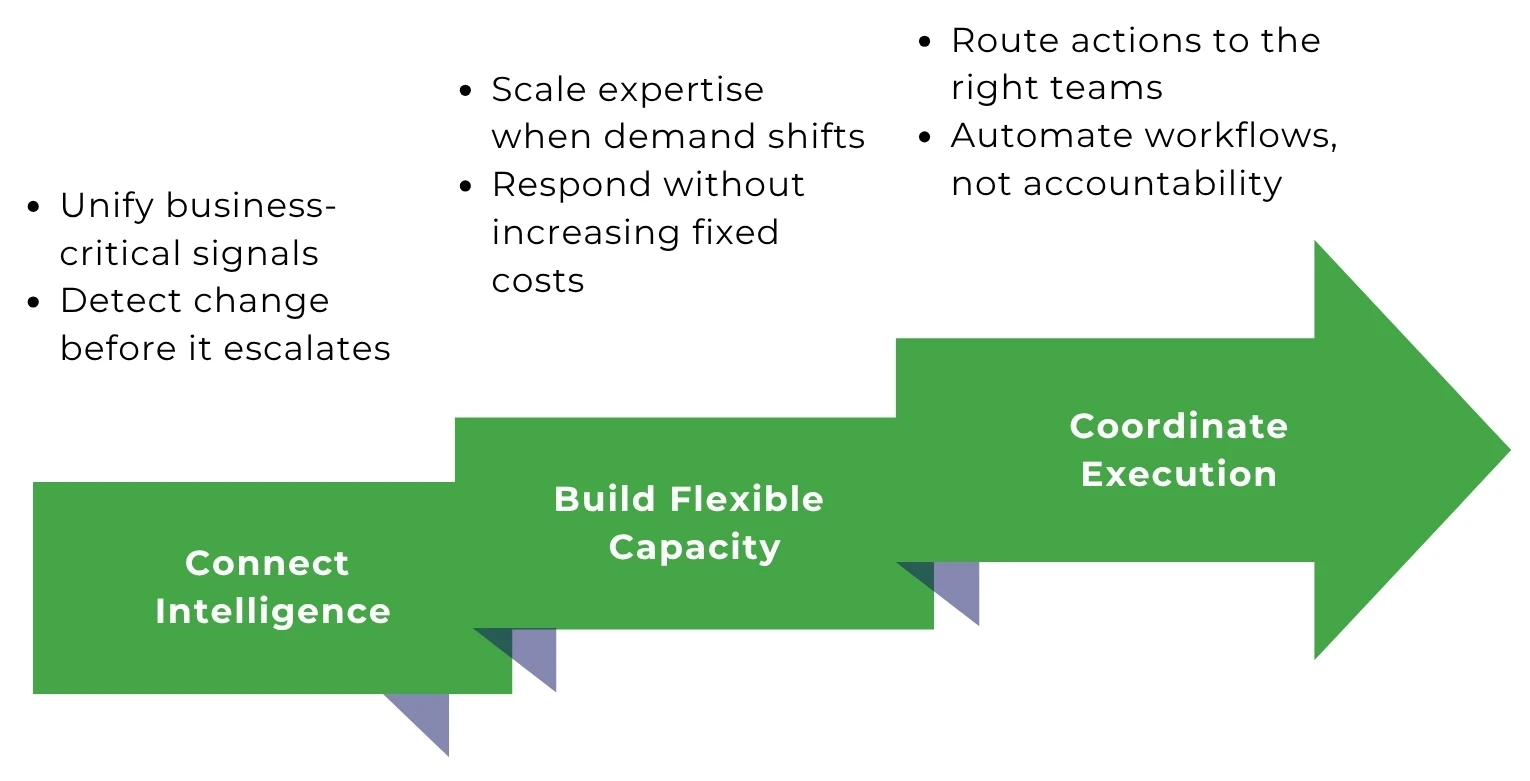
Turn signals into coordinated action
1. Connect Operational Intelligence
Connected operational intelligence brings together data from across the business to create a clearer view of what is changing and why it matters.
This may include information related to:
- Customer inquiries and complaints
- Retailer feedback
- Product quality
- Orders and fulfillment
- Inventory levels
- Supply chain activity
- Returns and refunds
- Social media sentiment
The objective is not simply to create more reports.
It is to identify meaningful changes early enough for decision-makers to act.
Effective operational intelligence should:
- Highlight important exceptions rather than create more reporting noise.
- Connect related signals across channels and business functions.
- Route issues to the appropriate teams with enough context to act.
- Record outcomes so future decisions can be made faster.
- Help teams distinguish isolated incidents from emerging operational risks.
When information is connected, a CPG company can move from asking, “What happened?” to deciding, “What should we do next?”
2. Build Flexible Operational Capacity
Recognizing an issue is only useful when the organization has the capacity to respond.
Flexible capacity gives CPG brands access to additional skills, coverage, and support when demand, complexity, or risk increases.
This may include:
- Cross-trained customer support teams
- Multilingual and multichannel coverage
- Extended or 24/7 support
- Seasonal workforce capacity
- Specialized operational expertise
- Back-office support
- Clearly documented escalation procedures
- Onshore, offshore, and right-shore delivery
For mid-market CPG companies, flexible capacity can provide greater adaptability without requiring fixed resources to increase at the same pace as operational complexity.
It can also help internal teams remain focused on high-value decisions while trained support teams manage repeatable execution.
3. Coordinate Execution and Decision-Making
The third capability is the ability to move information, ownership, and action across the business without unnecessary delay.
Coordinated execution ensures that the right people receive the right information at the right time.
Automation can support this process by improving:
- Issue routing
- Prioritization
- Alerts and notifications
- Case summaries
- Workflow handoffs
- Data collection
- Repeatable follow-up actions
However, automation should not replace accountability.
Human judgment remains essential when decisions involve:
- Product safety
- Regulatory requirements
- Retailer commitments
- Policy exceptions
- Financial risk
- Consumer trust
- Brand reputation
The principle is straightforward: automate the movement of information, not accountability for the outcome.
Technology can help teams act faster, but people must remain responsible for the decisions that affect the business and its customers.
The Business Impact of Operational Responsiveness
Operational responsiveness can improve far more than customer service metrics.
It strengthens the organization’s ability to turn information into coordinated action.
Protect Revenue
Faster coordination can help contain operational issues before they affect product availability, customer demand, or retailer performance.
Preserve Profit Margins
A faster response can reduce rework, emergency labor, unnecessary refunds, repeated escalations, and other avoidable costs.
Respond to Demand Without Proportional Cost
Flexible capacity allows brands to manage seasonal peaks, promotions, product launches, and unexpected disruptions without permanently increasing fixed costs.
Strengthen Retailer Relationships
Retailers need timely, accurate updates when issues affect orders, inventory, promotions, or customer demand.
Clear coordination can help maintain confidence and demonstrate operational reliability.
Maintain Consumer Trust
Consumers are more likely to remain confident in a brand when they receive consistent, informed, and timely responses.
Increase the Value of Technology Investments
Analytics, automation, artificial intelligence, and workforce tools create greater value when they support connected decisions and coordinated action.
Operational Responsiveness Is Built Before Disruption Happens
Disruption does not create operational responsiveness.
It reveals whether the organization was prepared to respond.
The strongest CPG companies build the processes, decision structures, operational capacity, and data connections they need before a major issue occurs.
They are able to:
- Recognize meaningful changes earlier.
- Understand the wider business impact.
- Assign ownership quickly.
- Mobilize the right people and resources.
- Execute a consistent response.
- Use each resolution to improve future performance.
That preparation allows the business to respond with greater speed, clarity, and confidence when conditions change.
Where Does Your Organization Lose Time Between Signal and Resolution?
At Premier NX, we help mid-market CPG brands connect customer experience, operational support, analytics, workflow enablement, flexible global talent, and human-in-the-loop automation.
Our goal is to help organizations close the gap between recognizing an issue and resolving it.
About the Author

Lisa Murray is a Consumer Goods Industry Advocate at Premier NX, helping North American CPG brands strengthen support for consumers, retailers, internal teams, and day-to-day operations. Focus centers on building scalable onshore, offshore, and right-shore service models that improve trust, efficiency, insight, and growth across the business.