

Key Takeaways
- 1Reporting has improved, but many teams still struggle to turn visibility into timely action.
- 2Reports drive better decisions when they explain what changed, why it matters, who owns it, and what should happen next.
- 3Decision Velocity helps leaders measure how quickly their organization moves from insight to execution.
- 4AI adds value when it accelerates the path from signal to response without replacing human judgment.
Decision-making slows when reporting explains what happened but fails to identify why it matters, who owns it, and what action comes next. Organizations that outperform their competitors are not necessarily better at collecting data; they are better at converting insights into action.
Most businesses already have dashboards, KPIs, and reports. Leaders can track sales, operations, customer experience, and financial performance from virtually anywhere.
Yet many teams face the same problem they did a decade ago: decisions still take too long. The real gap is not visibility. It is execution.
Reporting Has Improved. Decision-Making Hasn’t
The real test of reporting is not whether leaders can see the issue. It is whether the business knows what to do next. Many reporting systems fall short because they are built to present performance, not guide response.
A useful report should clarify three things: what changed, why it matters, and what decision is now required.
Without that discipline, reporting becomes a review cycle. With it, reporting becomes a trigger for decisions.
Why Reporting Often Fails to Drive Decisions
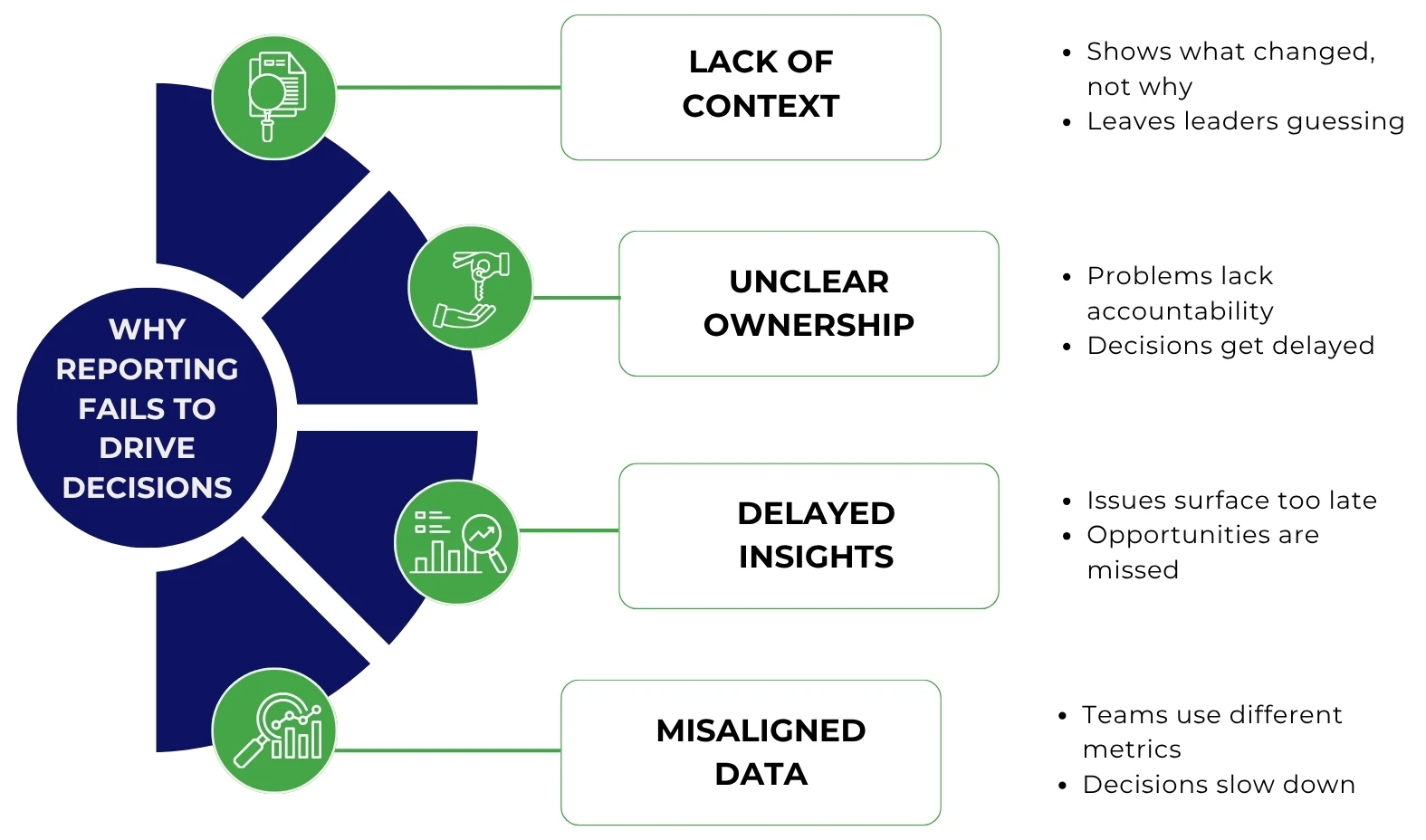
Reporting often fails to drive decisions because it focuses on measuring performance rather than guiding action, leaving organizations with visibility into what changed but limited clarity on why it happened, who owns it, and what should happen next.
Metrics Lack Business Context
A KPI without context is simply a number.
Leaders don’t need another dashboard showing what changed. They need to understand why it changed, what it means for the business, and whether action is required. Without context, reporting creates discussion instead of action.
Insights Are Not Connected to Ownership
Many dashboards identify problems. Far fewer identify accountability.
When ownership is unclear, issues move from report to meeting, from meeting to discussion, and from discussion to delay. Insight creates value only when accountability is attached to it.
Reporting Arrives Too Late
Historical reporting explains outcomes. Leading indicators help change them.
Whether tracking customer retention, sales pipeline health, or operational risk, the goal should be intervention, not postmortem analysis.
Teams Operate from Different Versions of the Truth
Sales, Finance, Operations, and Customer Experience often use different definitions and reporting structures.
When teams spend time reconciling numbers rather than solving problems, decision-making slows. Alignment happens faster when teams share the same metrics, definitions, and objectives.
The KPI Leaders Aren’t Measuring: Decision Velocity
What is Decision Velocity?
Decision Velocity is the speed at which an organization can detect change, understand its impact, align stakeholders, and execute a response.
It matters because business outcomes do not improve simply by identifying a problem. They improve when a response is executed.
Organizations with high Decision Velocity can:
- Address customer churn risks before customers leave
- Respond to demand shifts faster
- Correct operational bottlenecks earlier
- Reallocate resources more effectively
- Adapt to market changes with less disruption
How Fast Is Your Organization’s Decision Velocity?
Many companies discover they don’t have a reporting problem; they have a decision-making problem.
To assess how effectively your organization turns reporting into action. Evaluate reporting context, accountability, alignment, and execution speed to uncover hidden sources of decision friction.
How AI Changes the Conversation
AI creates value only when it shortens the path from signal to response.
It can flag what changed, connect the likely causes, show which areas need attention first, and reduce the manual work required to prepare a response.
That improves Decision Velocity without turning judgment over to technology.
For Premier NX, the practical role of AI is to combine automation, analytics, and human-in-the-loop expertise so mid-market teams can move from reporting to action with greater speed, context, and accountability.
Assess Whether Reporting Is Driving the Right Decisions
Reporting should do more than present performance. It should help leaders understand what requires attention, where action is needed, and how decisions can move forward with greater clarity.
For many mid-market companies, the gap is not visibility. It is the ability to connect reporting with ownership, context, and action.
Our complimentary Reporting-to-Decision Assessment evaluates how information moves through your organization, where reporting creates friction, and whether your dashboards, workflows, escalation paths, and operating rhythms are helping teams make timely business decisions.