


Key Takeaways
- 1Customer experience is the visible result of the operational decisions behind every interaction.
- 2Operational design aligns workforce, processes, technology, data, and governance around customer outcomes.
- 3AI creates more value when it strengthens execution while people retain oversight of complex decisions.
- 4Resolution quality, accuracy, retention, and cost to serve provide a clearer view of CX performance.
Customer experience is not created by CX strategy alone. It is the result of operational design: how effectively an organization aligns people, processes, technology, data, and governance to consistently deliver on its customer promise.
In practical terms, customer experience is the visible result of invisible operations.
A company may intend to provide fast, personalized, and seamless service. But those outcomes depend on whether the business has the right capacity, clear workflows, reliable data, connected systems, and accountable teams behind every interaction.
For mid-market organizations, this matters even more. Growth often increases customer demand faster than operational maturity can keep pace, creating service gaps that become more visible as the business scales.
What is Operational Design in Customer Experience?
Operational design is the intentional alignment of the capabilities required to consistently deliver customer outcomes.
It connects five core elements:
- Workforce: The people, capacity, and skills needed to meet demand.
- Processes: The workflows, decision rights, and escalation paths that guide execution.
- Technology: The systems and automation that improve speed, accuracy, and access.
- Data: The information required to personalize service and make informed decisions.
- Governance: The ownership, standards, and controls that maintain quality.
Together, these elements can deliver reliable experiences across channels, locations, and periods of changing demand. When these elements are fragmented, customers experience delays, inconsistent answers, repeated transfers, and unresolved issues.
Four Operational Design Decisions That Shape Customer Experience
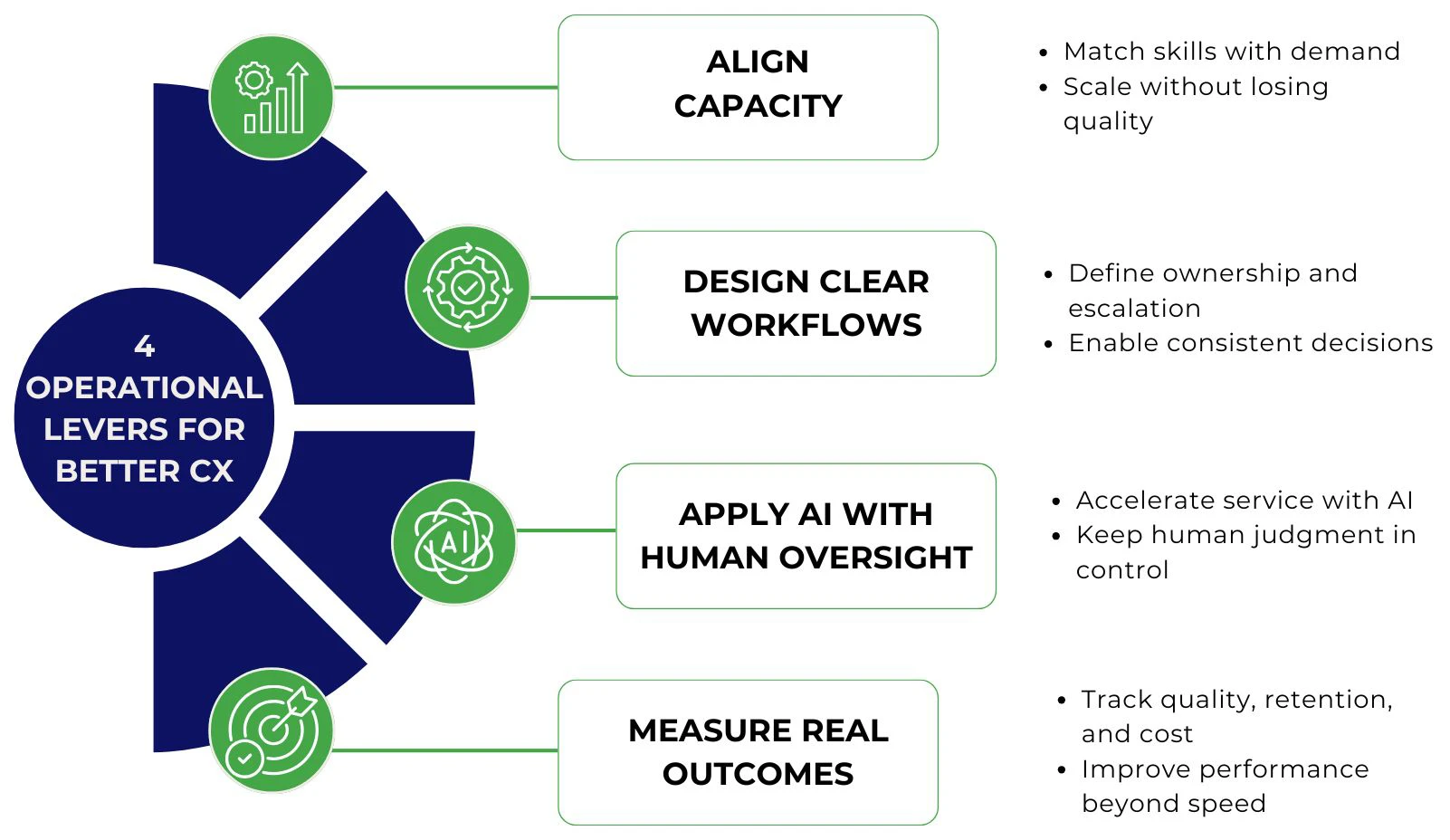
Better customer experiences begin with better operational design
1. Align Capacity with Customer Demand
Customer experience is only as reliable as an organization’s ability to place the right expertise where and when demand occurs.
Traditional workforce planning often focuses on one question: Do we have enough people?
Operational CX planning asks better questions:
- Are the right skills available in the highest-demand channels?
- Can capacity adjust to seasonal or unexpected volume changes?
- Are complex interactions routed to employees with the right expertise?
- Can the organization scale without increasing service inconsistency?
Effective capacity planning balances service quality, employee utilization, and cost to serve.
2. Build Workflows That Enable Consistent Decisions
Consistency does not begin when an employee answers a call, email, or chat. It begins with the workflow that guides the interaction.
Well-designed workflows establish:
- Clear process ownership
- Defined decision authority
- Structured escalation paths
- Accessible knowledge and documentation
- Embedded quality standards
- Feedback loops for continuous improvement
These controls reduce uncertainty while still allowing employees to apply judgment when a situation requires flexibility.
3. Apply Technology Where It Strengthens Execution
AI-powered knowledge management, agent assistance, automation, and self-service can improve the speed and accuracy of customer service.
However, technology does not automatically improve customer experience.
This is where a Human-in-the-Loop (HITL) approach becomes essential. AI should accelerate execution by surfacing information, recommending actions, and reducing repetitive work, while people retain accountability for decisions that require context, empathy, or business judgment.
4. Measure the Outcomes That Matter
Response time, handle time, and productivity are useful operational measures. But they do not provide a complete picture of customer experience performance.
A fast interaction is not necessarily a successful interaction.
Organizations should connect operational metrics to outcome-based indicators such as:
- Resolution quality: Was the issue fully and accurately resolved?
- Process accuracy: Was the correct process followed without preventable errors?
- Repeat contact rate: Did the customer need to return for the same issue?
- Escalation rate: How often did interactions require additional intervention?
- Customer retention: Did the experience strengthen the relationship?
- Cost to serve: Was the outcome achieved efficiently and sustainably?
The objective is not simply to measure activity, but to understand whether operational decisions are creating a customer experience that is both sustainable and commercially effective.
Operational Design is Becoming the Competitive Advantage
As AI, automation, and digital platforms become more accessible, technology alone will become less of a differentiator.
Competitive advantage will depend on how effectively organizations embed those tools into day-to-day operations and use them to improve execution.
The organizations that consistently deliver exceptional customer experiences will be those that intentionally align people, processes, technology, data, and governance around execution.
This is the philosophy behind Premier NX approach. Rather than treating CX as a standalone function, we help mid-market organizations strengthen the operational capabilities that enable consistent execution through:
- AI-infused Customer Experience, supported by a Human-in-the-Loop approach that combines automation with human judgment.
- Workforce Management and Quality Assurance that improve consistency across teams, channels, and locations.
- Analytics & Insights that provide operational visibility and support continuous improvement.
Customer experience is no longer defined solely by customer interactions. Increasingly, it is defined by the operational decisions that make those interactions consistently possible.
Designing Customer Experience for Sustainable Growth
Exceptional customer experience is engineered, not improvised.
The businesses that consistently differentiate themselves will be those that intentionally design the operational capabilities required to deliver their customer promise.
Looking to strengthen the operational foundation behind your customer experience?